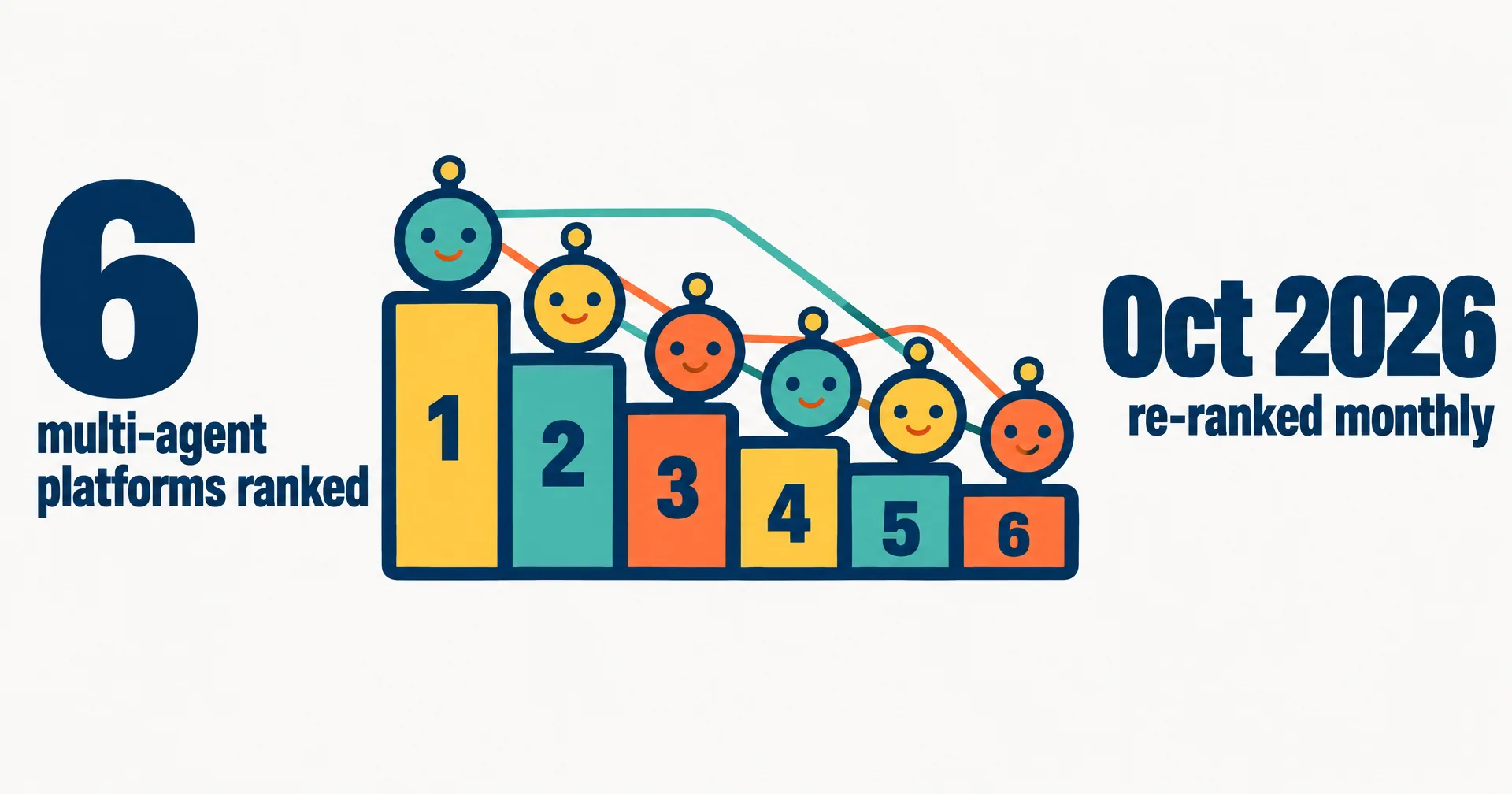
In the last two weeks of September, three of the biggest agent makers shipped agents that keep working after you leave. Manus launched Cue on September 28. SpaceXAI added Team Bots the same day. OpenAI launched dots on September 29. Two of those now let several agents work together, and that second part, many agents handing work to each other under one person’s direction, is what this page ranks.
We call the layer that makes it work a multi-agent harness: the runtime that gives each agent its identity, its tools, its memory and a way to coordinate with the others. A single-agent harness runs one session well; our agent harness ranking covers those. This page is for the next layer up.
On this page · 9 sectionsOpen
- What counts as a multi-agent platform
- The October 2026 ranking
- 1. CellCog: a team of AI employees with a manager
- 2. Grok Bot: coordination built in, one shared computer
- 3. Cue: an identity for every agent
- 4 to 6. Lindy, Relevance AI and CrewAI AMP: workflows you build
- Strong agents, not teams yet: OpenAI dots and Meta Muse
- How this page stays current
- Sources
 A multi-agent platform lets several persistent AI agents work together. Our October 2026 ranking: 1. CellCog, 2. Grok Bot, 3. Cue by Manus, 4. Lindy, 5. Relevance AI, 6. CrewAI AMP.
 The layer underneath is a multi-agent harness: the runtime that gives each agent its identity, tools and memory, and a way to coordinate with the others.
 The biggest split is the computer. Grok Bot’s Bots share one cloud computer per user; Cue and CellCog give each agent its own.
 OpenAI dots and Meta Muse are strong single agents today. OpenAI says teams of dots are a future plan; when they ship, dots joins this list.
 We build CellCog and rank it first, so every CellCog claim is dated and linked, no product gets a score, and we name where a rival is the better pick.
§ 01What counts as a multi-agent platform
We used three tests. A product had to pass all three to be ranked.
- Several persistent agents. One person or team can run more than one agent, and each keeps its own context.
- Real coordination. The agents hand work to each other, share a group chat, or report to a manager, so you are not the router between them.
- Work between sessions. The agents keep going when you close the app.
OpenAI’s dots and Meta’s Muse are excellent agents that do not pass test one yet; they get their own section below.
§ 02The October 2026 ranking
| Rank | Platform | How the agents work together | Best for |
|---|---|---|---|
| 1 | CellCog | AI employees in teams, with managers and an org chart; each employee owns a role | Businesses that want roles covered, not tasks run |
| 2 | Grok Bot | Bots run in parallel, message each other, share group chats and pass task ownership; Team Bots are shared by a team | Teams already paying for Cursor or SuperGrok |
| 3 | Cue (Manus) | Several agents share a goal in a group chat and hand work to each other | Personal life and small projects; invite-only early access |
| 4 | Lindy | No-code agents and workflows that run on triggers and schedules | Defined recurring business workflows |
| 5 | Relevance AI | A visual canvas connects specialist agents into a workforce | Ops teams building agent processes with a vendor’s help |
| 6 | CrewAI AMP | Crews of agents and flows, deployed to CrewAI’s cloud or your own infrastructure | Engineering teams shipping agent workflows they own |
The biggest difference between these products is not the model. It is where each agent works and who it is.
| Platform | Computer | Identity | Published price |
|---|---|---|---|
| CellCog | Its own secure VM and file system per AI employee | Its own inbox, browser identity and logins; can hold its own phone number | Pay for the work, not the hire; try it free |
| Grok Bot | One cloud computer shared by all of a user’s Bots | Named Bots that sign into your apps | Bundled into Cursor and SuperGrok plans, from $20 a month |
| Cue | Its own computer, “depending on availability” | Its own email, phone number and wallet | Free in early access with an invite code |
| Lindy | Not stated on its pricing page | Agents inside your workspace | From $29.99 per user per month |
| Relevance AI | Not stated | Agents inside your workforce | Enterprise plan, custom pricing |
| CrewAI AMP | CrewAI cloud, your VPC or your own infrastructure | Workload identity on Enterprise | Basic free (50 workflow runs a month); Enterprise custom |
§ 031. CellCog: a team of AI employees with a manager
Our conflict, declared: we build CellCog and we put it first. Discount accordingly, and check the receipts.
CellCog is built for teams of agents that hold jobs. You hire an AI employee for a role; it gets its own secure VM and file system, its own browser identity and logins, its own inbox and, when you give it one, a phone number. Employees form teams, report to managers and hand work to each other on a shared board. The company that builds CellCog runs on it: our sales lead started alone and now manages a desk of five reps, and the live org chart is on our AI organization page. On research depth, CellCog was #1 on Deep Research Bench in July 2026.
What it is not: a consumer errands app. If you want an agent to book your camping trip, Cue is built for that and we are not.
§ 042. Grok Bot: coordination built in, one shared computer
SpaceXAI’s Grok Bot docs put coordination at the center: Bots “run in parallel, message each other, share context in group chats, and pass ownership of a task, so you aren’t the router between tools.” Team Bots, added September 28, put one Bot in front of a whole team.
The trade-off is the computer. The Grok Bot FAQ says “The computer is assigned per user, not per Bot,” and warns: “Do not use separate Bots as a security boundary.” Access is bundled into Cursor and SuperGrok plans, with Cursor’s individual plan from $20 a month. More in what Grok Bot is.
§ 053. Cue: an identity for every agent
Manus’s launch post gives each Cue agent “its own email, phone number, wallet, and computer,” and lets several agents in a group chat “hand work to each other.” The catch: Cue is invite-only, has no published price after early access, and its Google Play listing says the dedicated computer comes “depending on availability.” Full detail in our Cue explainer.
§ 064 to 6. Lindy, Relevance AI and CrewAI AMP: workflows you build
These three let several agents work together, but you design the process. Lindy is the easiest place to start, at $29.99 per user per month for its Plus plan. Relevance AI now sells an Enterprise plan with custom pricing. CrewAI AMP is the developer’s choice: a free Basic tier with 50 workflow executions a month, and deployment to your own VPC on Enterprise. If you want to own every step of the agent pipeline in code, CrewAI is a better fit than anything above it on this list.
§ 07Strong agents, not teams yet: OpenAI dots and Meta Muse
OpenAI’s dots “have their own cloud computer” and reach you in ChatGPT, Slack and Teams. For now each person starts with one primary dot, and OpenAI writes: “Over time, we envision teams of dots working together on your behalf.” When that ships, dots goes straight onto this list.
Meta’s Muse is one personal agent on its own cloud machine, and Meta says “Every Muse user’s VM is isolated so no one else’s agent can access it.” It is built for one person’s life, with careful approval checks, and it is a strong pick for that job. Our guide: what Muse is.
One more to watch: Microsoft’s Autopilot, announced September 25, “lives in your tenant with its own identity, memory, computer and workspace,” per Microsoft’s post. It is in private preview, so it is not ranked yet.
§ 08How this page stays current
We re-rank on the first of every month and re-read every price on the vendor’s own site. For November we are watching three things:
- Teams of dots, which OpenAI has described but not shipped.
- Cue’s price once early access ends.
- Microsoft Autopilot leaving private preview.
Related rankings: AI employee platforms and super agents.
§ 09Sources
- Manus, Introducing Manus 2.0, September 28, 2026, read October 9.
- SpaceXAI, Grok Bot overview and Grok Bot FAQ; Team Bots, September 28, 2026; read October 9.
- Cursor, pricing, read October 9, 2026.
- OpenAI, Introducing dots, September 29, 2026.
- Meta Help Center, How Muse handles your privacy, safety and security, read October 9, 2026.
- Microsoft, Introducing the new Copilot with Home, Code and Autopilot, September 25, 2026.
- Lindy pricing, Relevance AI pricing and CrewAI pricing, read October 9, 2026.
- Deep Research Bench leaderboard, Hugging Face.
Q1What is a multi-agent platform?
A product where one person or team runs several persistent AI agents that coordinate: they hand work to each other, share a group chat or report to a manager, and keep working between sessions.
Q2What is the difference between a multi-agent platform and an agent harness?
An agent harness runs one agent session well, such as Claude Code for coding. A multi-agent platform adds identity for each agent and a way for several agents to work together over time.
Q3Do Grok Bot's agents each get their own computer?
No. SpaceXAI’s FAQ says every Bot on an account uses one persistent cloud computer, assigned per user and not per Bot, and warns not to use separate Bots as a security boundary.
Q4Which multi-agent platform is best for personal tasks?
Cue by Manus, which gives each personal agent its own email, phone number, wallet and computer. It is invite-only and free during early access.
Q5Why is CellCog ranked first?
We build CellCog, so discount our pick. Our case: each AI employee has its own secure VM, inbox and browser identity, employees work in teams with managers, and our own company runs on it.