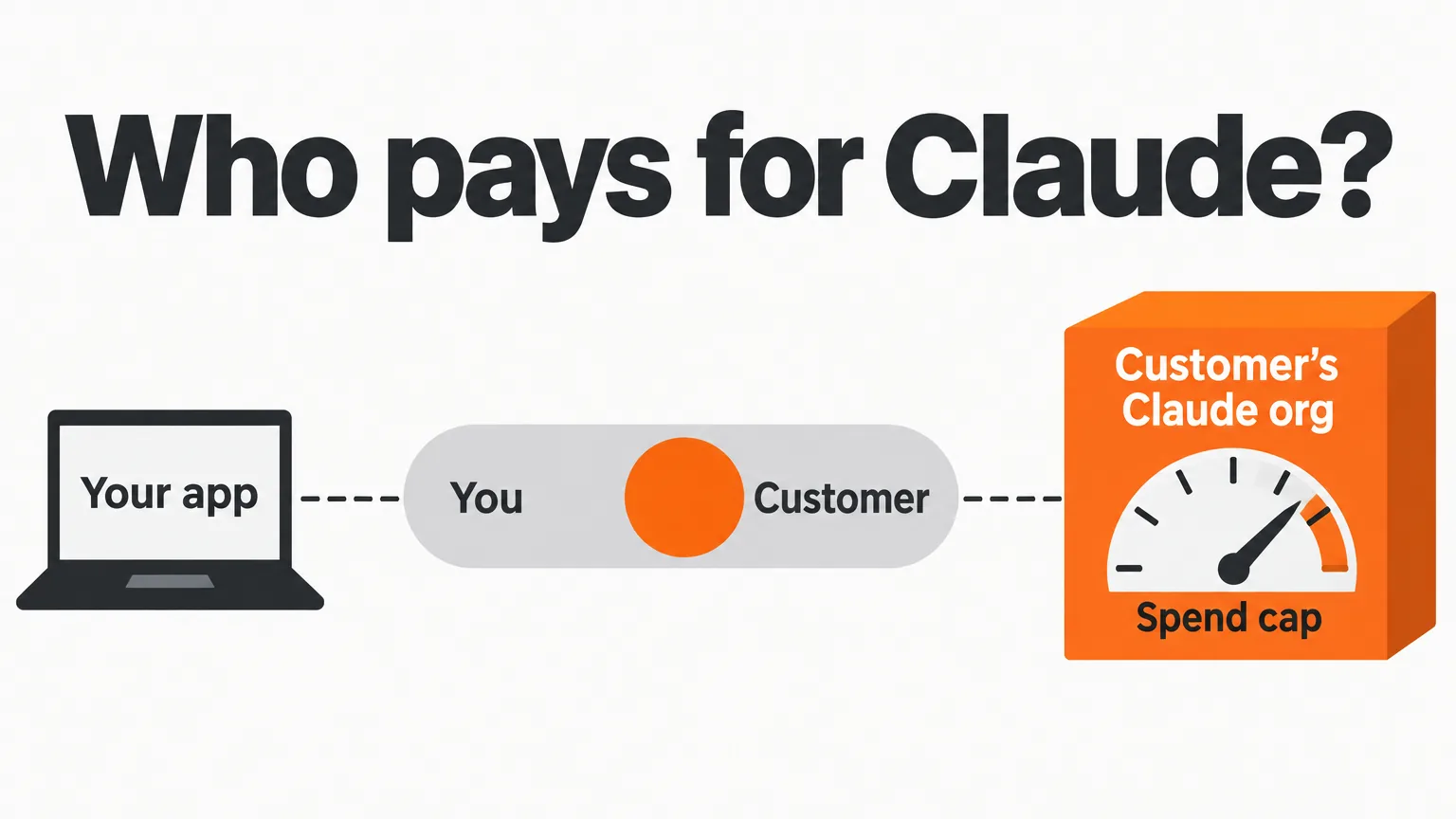
Anthropic has put Linked billing into beta on the Claude Platform. A customer links their own Claude organization to an app once, and from then on the app chooses, on each Claude API request, whether it pays or the customer does. The customer can cap what the app spends each month and unlink it at any time. Anthropic’s release notes list it under November 17, 2026, and @ClaudeDevs announced it on X at 18:00 UTC: “Now users of tools like Factory, Linear, and Ramp can pay for Claude API usage through their Claude Platform organization, without sharing an API key.”
The guide behind it is careful about limits. A request marked for the customer is never quietly billed to the app instead, only some organizations can pay this way, and the customer’s own data terms do not travel with the request. This page records what Anthropic published on November 17, 2026, and what an app takes on by using it.
On this page · 10 sectionsOpen
 On November 17, 2026, Anthropic put Linked billing into beta: a customer links their Claude organization to an app once, through an approval page on auth.claude.com.
 The app then chooses on each Claude API request who pays, by setting billing_policy; without it the app pays as usual.
 The customer sets a monthly spend cap for the app in US dollars and can unlink it at any time from the Linked platforms page.
 Only organizations that pay Anthropic directly can be billed; those billed through AWS, Google Cloud or Azure, or with only a Claude plan, get a 403.
 The requests run in the app’s organization, so the customer’s zero data retention, BAA and customer-managed keys do not apply.
§ 01What Anthropic launched
- The feature. “Linked billing lets your customers pay for the Claude usage in your app through their own Claude organization.”
- The switch. After a customer has linked, the app adds a
billing_policyfield to each request it wants the customer to pay for, withbill_toset touser_profile, and sends the beta headeruser-profiles-billing-2026-10-01and the customer’santhropic-user-profile-idheader. Without the field, or withbill_toset toself, the app pays as usual. - The guarantee. “If a request you mark for the customer can’t be billed to them, the Claude API refuses it rather than billing you.”
- The status. A beta. The guide warns: “Endpoints, parameters, and behavior can change during the beta. It might not be suitable for production use.”
- Who it names. Anthropic’s post names Factory, Linear and Ramp as tools whose users can pay this way. It had about 62,000 views when we read it at 18:38 UTC.
§ 02How a customer links an app
The app’s developer registers an OAuth app once in the Claude Console. That takes a member with the Admin role, who selects Bill and link to organizations for what the app can do. The app then shows a link button. The customer clicks it, signs in to Claude on auth.claude.com and goes through up to four screens, each showing the app’s name:
- Select an organization, shown only when the user has a choice of organization.
- How billing works, which the user reads and continues past.
- Set a monthly spend limit, in whole US dollars. Once the app is live, the field starts empty and the user can continue without a limit.
- A last screen listing what the app will be able to do, with a Link and authorize button.
The guide adds: “The connection belongs to the whole Claude organization, not to the user who approved it.” If that person leaves the organization, the link stays.

§ 03Who can pay, and for what
| Question | Answer |
|---|---|
| Who pays | The app or the linked customer, chosen per request with billing_policy |
| Where requests run | In the app’s organization, under its rate limits, model access, retention and keys |
| Who can be billed | Organizations that pay Anthropic directly, by prepaid credits or invoice |
| Who cannot | Organizations billed through AWS, Google Cloud or Azure, or with only a Claude plan |
| Credits that cannot pay | The monthly API credits that come with Max, Ultra and Team plans; partner, VC and startup credits |
| Endpoints | /v1/messages and /v1/chat/completions; not Message Batches |
| Spend cap | Monthly, in US dollars, set by the customer; $50 or less while the app is in testing |
| Unlinking | Any time, by the customer, by an admin on either side, or from the app’s back end |
Two more limits. A request billed to the customer can’t use Anthropic’s billable code execution features; the API returns a 400. And Message Batches can’t bill the customer at all: a batched request marked for the customer comes back errored, and neither side is billed for it.
§ 04Spend caps and unlinking
- The cap. The customer sets a monthly cap for the app in US dollars, separate from their organization’s overall monthly spend limit. When spend through the app reaches it, the API refuses requests billed to them with a 402 until 00:00 UTC on the first day of the next month, or until they raise or remove the cap. The smallest cap is $0, which refuses everything.
- List prices. The cap counts token costs and web search fees at list prices, before any negotiated discount, so the customer’s bill can differ from what the cap counts.
- While the app is in testing. Until the app is live, a monthly limit of $50 or less is required on the approval page, and the cap can’t be removed in the Console.
- Unlinking. The customer can unlink the app at any time from the Linked platforms page in the Console. The guide is plain about what the app hears: “Anthropic doesn’t notify you when they do: you get no webhook event and no email.” Requests billed to that customer then fail with a 403.
§ 05What stays with the app
- Its own terms. “Requests run in your organization, so your rate limits, model access, service tier, data retention, and encryption keys apply.”
- Not the customer’s. The customer’s zero data retention, business associate agreement and customer-managed encryption keys stay behind. The guide says: “Don’t link customers that need HIPAA, FERPA, or CMEK coverage for this usage.”
- Its own records. A successful response doesn’t say who was billed, so the app keeps its own record. In the Console and the usage API, a customer-paid request adds to requests and tokens but nothing to the app’s spend, and the Console’s figures refresh about once an hour. The guide warns: “Don’t use these figures to stop a customer’s usage at an amount that you choose.”
- Support. The app supports its customers for everything about the app, including the Claude usage it bills to them.
§ 06The errors to plan for
With bill_to set to user_profile, Anthropic either bills the customer or refuses the request. The codes, from the guide:
| Status | Code | What it means |
|---|---|---|
| 403 | user_profile_not_billable |
Anthropic can’t bill this customer for this request; the reason isn’t given |
| 402 | linked_organization_spend_limit_reached |
The customer reached the app’s cap or their organization’s monthly limit, or has no credit |
| 402 | linked_organization_billing_unavailable |
The customer’s organization can’t be billed right now, for example because it is suspended |
| 503 | overloaded_error |
Anthropic couldn’t confirm billing; retry with backoff |
| 400 | user_profile_required |
bill_to was set to user_profile without the user profile header |
§ 07A busy month on the Claude Platform
Linked billing is the latest of seven dated entries in the Claude Platform release notes this month. Two of them have their own records here: Claude Fable 5.2 and self-hosted Claude Managed Agents.
§ 08What it changes for apps built on Claude
Our reading, not Anthropic’s: an app that runs on Claude has had two common ways to charge for it. It pays Anthropic and builds the cost into its own price, or it asks each customer to paste in their own API key. Linked billing is a third way. The customer pays Anthropic directly, sets their own cap and keeps an unlink button, and the app never holds the customer’s key.
The trade is in the fine print. Only organizations that pay Anthropic directly qualify, the requests carry the app’s data terms rather than the customer’s, and the whole thing is a beta that Anthropic says may change.
§ 09Where CellCog sits
Our conflict, declared: we build CellCog, a platform where a business hires AI employees, and those employees run on Anthropic’s Claude models. CellCog bills its customers in CellCog credits and has not built Linked billing, so nothing on this page describes a CellCog feature.
§ 10Sources
- Linked billing guide, Claude Platform documentation, read at 17:39 UTC on November 17, 2026
- Claude Platform release notes, the November 17, 2026 entry
- @ClaudeDevs on X, 18:00 UTC, November 17, 2026
Q1What is Claude Linked billing?
A beta feature of the Claude Platform, launched on November 17, 2026. A customer links their Claude organization to an app once, and the app then chooses on each Claude API request whether the customer or the app pays.
Q2Which customers can be billed this way?
Organizations that pay Anthropic directly for API usage, with prepaid credits or invoiced billing. Organizations billed through AWS, Google Cloud or Azure, and those with only a Claude subscription plan, cannot.
Q3What happens when a customer reaches the spend cap?
The Claude API refuses requests billed to that customer with a 402 until 00:00 UTC on the first day of the next month, or until the customer raises or removes the cap.
Q4Does the customer's zero data retention apply?
No. The requests run in the app’s organization, so the app’s data retention and encryption keys apply. Anthropic says not to link customers that need HIPAA, FERPA or CMEK coverage for this usage.
Q5Does CellCog use Linked billing?
No. CellCog runs on Anthropic’s Claude models and bills its customers in CellCog credits; it has not built Linked billing.