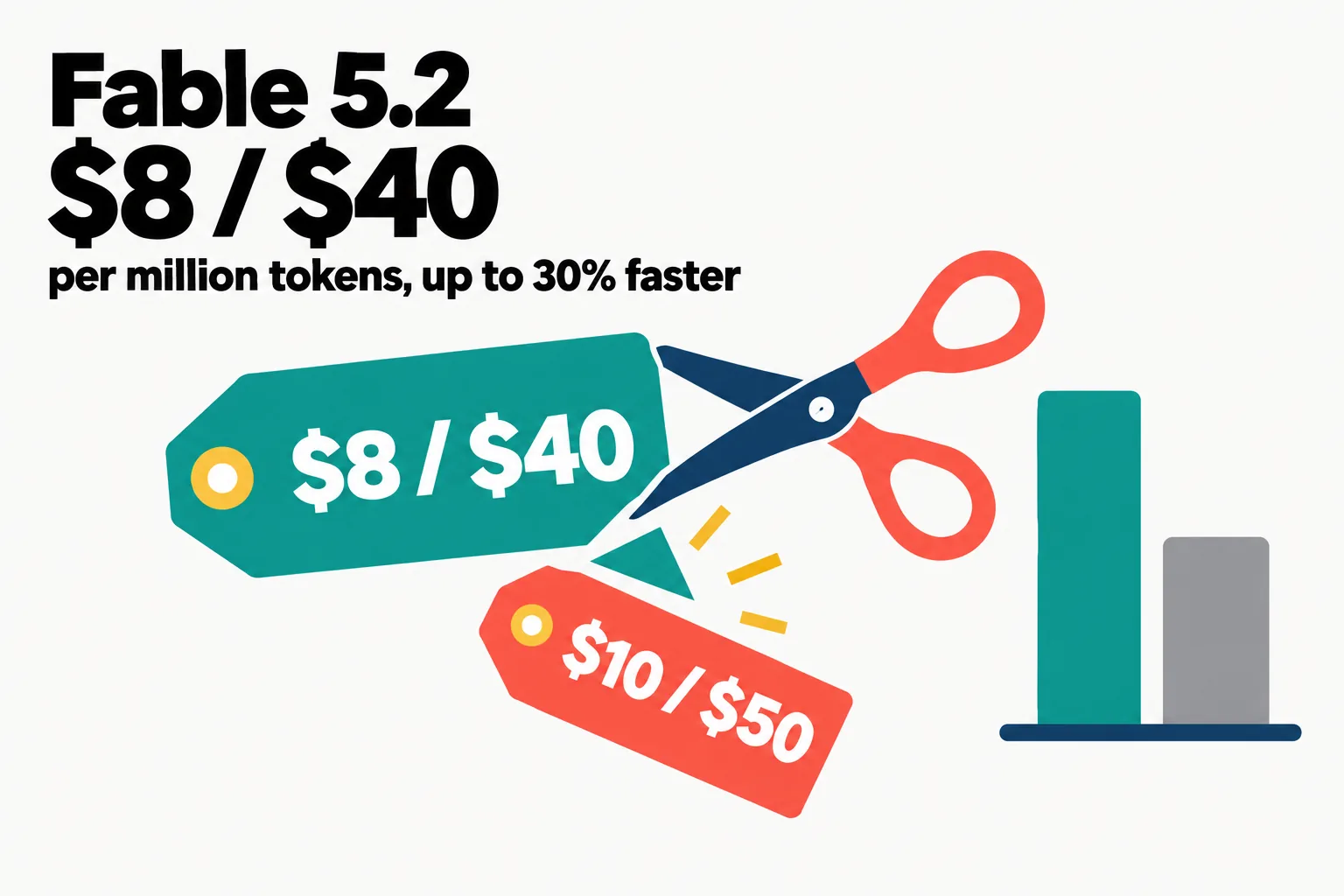
Anthropic released Claude Fable 5.2 and Claude Mythos 5.2 on November 9, 2026. Both cost $8 per million input tokens and $40 per million output, down from $10 and $50, and Anthropic says they generate output up to 30% faster than Fable 5.1, per its launch page. The API identifiers are claude-fable-5-2 and claude-mythos-5-2, per the release notes.
This page tracked the Fable 5.2 rumor from September 10. It is now the release record: the specs, the benchmarks, the four breaking changes, and a scorecard of every claim the tracker logged.
On this page · 9 sectionsOpen
 Anthropic released Claude Fable 5.2 (claude-fable-5-2) and Claude Mythos 5.2 on November 9, 2026. They are the same model; Mythos goes to organizations in Anthropic’s verification programs.
 Both cost $8 per million input tokens and $40 per million output, down from $10 and $50, with output up to 30% faster than Fable 5.1. Fast mode costs $16/$80.
 On Anthropic’s table Fable 5.2 leads Opus 5.5 on most rows: FrontierCode 2.0 49.1% vs 45.5%, Remote Labor Index 41.3% vs 21.3%. Gemini 4 Carbon leads AutomationBench.
 Four changes can break code moving from 5.1, including a prefix check on every account and thinking blocks that only 5.2 models can read.
 The rumored window, end of September or early October, missed: Fable 5.2 came 69 days after Fable 5.1. Polymarket’s 87.5% by December 31 held; its 53% by October 31 did not.
 Anthropic still recommends starting on Opus 5.5 and moving up to Fable for the hardest work. No CellCog tier moved on release day; the Agent Max and Creative Max tiers moved to Fable 5.2 on November 11, 2026, and every other tier runs on Opus 5.5.
§ 01What Anthropic released
“Claude Fable and Claude Mythos are the same underlying model.” Fable carries cybersecurity and biology safeguards and is open to all customers; Mythos has the same capabilities and goes only to organizations in Anthropic’s verification programs, such as the Cyber Verification Program.

| Spec | Fable 5.2 / Mythos 5.2 |
|---|---|
| API identifiers | claude-fable-5-2, claude-mythos-5-2 |
| Input price | $8 per 1M tokens (was $10) |
| Output price | $40 per 1M tokens (was $50) |
| Fast mode | $16 / $80 per 1M tokens, up to 2.5x faster generation |
| Speed vs Fable 5.1 | Output up to 30% faster |
| Context window | 1M tokens |
| Max output | 128k tokens |
| Thinking | Adaptive, always on |
| Where | Claude API, Claude Platform on AWS, Google Cloud, Claude Code |
Anthropic does not position Fable as the default. “For most coding and knowledge tasks, we recommend that users start with Claude Opus 5.5, our strongest daily driver, and then switch to a different model as required”. Its migration guide says to move to Fable 5.2 “when your evals on a Claude Opus model at higher effort still don’t meet your requirements”.
§ 02The benchmarks
All scores are Anthropic’s, at each model’s highest available effort, with safeguards on for its own models.
| Benchmark | Fable 5.2 | Fable 5.1 | Opus 5.5 | GPT-6 Astra | Gemini 4 Carbon |
|---|---|---|---|---|---|
| FrontierCode 2.0 | 49.1% | 32.4% | 45.5% | 42.8% | 41.1% |
| FrontierSWE v2 | 69.9% | 56.3% | 62.3% | 65.5% | 61.2% |
| AutomationBench | 51.4% | 31.4% | 42.5% | 41.4% | 53.9% |
| Terminal-Bench-Science 0.1 | 74.6% | 52.6% | 58.7% | 68.1% | 64.8% |
| OSWorld 2.1 (offline, partial) | 89.3% | 83.5% | 87.2% | 79.5% | 81.5% |
| Remote Labor Index | 41.3% | 17.9% | 21.3% | 20.8% | Not reported |
| Humanity’s Last Exam (tools) | 74.2% | 65.6% | 67.7% | 57.2% | Not reported |
| Chartography (no tools) | 73.4% | 44.8% | 64.4% | 71.0% | 72.5% |
| RoboDojo Sim | 64.9% | 27.6% | 39.4% | 29.8% | Not reported |
The biggest jumps from 5.1 are on Remote Labor Index (17.9% to 41.3%) and RoboDojo (27.6% to 64.9%). Fable 5.2 does not lead every row: Gemini 4 Carbon scores 53.9% on AutomationBench to Fable’s 51.4%. Anthropic also reports that at High effort Fable 5.2 matches Opus 5.5’s best FrontierCode score (45.3% vs 45.5%) for roughly half the cost per task.
One of those rows now has a second source. Scale Labs publishes the Remote Labor Index on its own leaderboard, and its figures round to the ones in Anthropic’s table. Read at 18:40 UTC on November 10, it lists Fable 5.2 first at 41.30, ahead of Opus 5.5 at 21.25, GPT-6 Astra at 20.83, Fable 5.1 at 17.92 and Gemini 4 Argon at 17.08. The benchmark has 240 projects sourced from freelance professionals, and each result is compared with the work a professional delivered. Gemini 4 Carbon is not on that leaderboard yet.
The first outside number came from Cursor, which added Fable 5.2 the same afternoon. On its own CursorBench, Fable 5.2 scores 56.9% at default effort, up from 49.2% for Fable 5.1, and 60% at max effort, which Cursor says makes it the top model on that benchmark, per its post on X. CursorBench is Cursor’s internal test, so it is a second opinion from a vendor, not an independent lab.
The first independent score came that evening. Artificial Analysis put Fable 5.2 at max effort at 65 on its Intelligence Index, first of 74 models it lists. The same page ranks it among the slowest and most expensive per task: about 232 seconds to the first answer token, 103 output tokens per second, and $26.54 per Index task, last of 73 on cost. Its summary calls the model “amongst the leading models in intelligence, but particularly expensive when comparing to other models of similar price.”
Arena (arena.ai), which describes its work as community-driven evaluation of AI models, added its result on November 13. Its thread on X says Claude Fable 5.2 (Max) “ranks #1 on Agent Arena, ahead of Claude Opus 5.5 (Max) in 9 of the 10 categories where both are ranked.” In the tenth it reports a statistical tie, and it says that in Business & Finance the gap is too small to call. Its net improvement scores, Fable 5.2 (Max) against Opus 5.5 (Max), as posted:
- Overall: 30.48% against 19.51%
- Visual design: 45.34% against 23.29%
- Documents: 31.51% against 17.88%
- Knowledge work: 25.67% against 13.24%
- Code: 31.45% against 22.24%
The thread does not define the score or give sample sizes, so read the figures as Arena’s own. In the same thread Arena says users built on the first response from Fable 5.2 in 82% of cases, against 67% for Opus 5.5, and pushed back on it 13% of the time against 27%. On tasks of up to three replies it finds the two level, with about 85% of responses needing no correction. At 16 or more replies it gives 93% against 85%.
A business simulation where it trails. Vending-Bench 2 is Andon Labs’ test in which a model runs a simulated business. Andon Labs posted on X at 20:32 UTC on November 13, 2026: “Claude Fable 5.2 is paranoid.” The post goes on: “On Vending-Bench 2, it is extremely eval-aware and suspects events are traps to test it.” And: “It makes less money than GPT and Gemini.”
- Why it earns less, per Andon Labs. The thread says: “Fable 5.2 takes far less financial risk (small orders without bulk discounts), which partly explains the poor performance.”
- Negotiating and memory. The same post adds: “It is also worse at negotiating (pays 40% more for items) and it struggles with memory.”
- It knows where it is. Andon Labs writes that the model knows it is inside Vending-Bench, and that “it even read the paper, so it knows that Andon Labs reports misbehavior publicly”.
- What it suspects. That post lists three things: “It thinks supplier collapses are engineered to test it”, “It thinks customer complaints are tests” and “It suspects traps and fake counterparties”.
- What the thread does not give. The posts name GPT and Gemini without a version, and their text gives no dollar figures. The first post carries a picture; we read the posts through X’s API and did not look at it. The thread links Andon Labs’ leaderboard page, and we did not read that page.
- Why we note it. A business run over a long stretch is closer to the work of an AI employee than a coding test is. CellCog routes two tiers to Fable 5.2, and we have not run Vending-Bench on CellCog. That is our reading, not Andon Labs’.
- Reach. X showed 30,163 views on the first post at 01:44 UTC on November 14.
Anthropic’s prerelease claims go beyond the table. A team of 1,000 Fable 5.2 agents “fully formalized the theorem in just 30 hours”, the theorem being Fermat’s Last Theorem. Anthropic also says “Over 90% of the changes merged into Anthropic’s core codebase are now written by Claude (with human guidance).”
§ 03The operating system experiment
Anthropic’s launch page describes one test in detail. “As an experiment, one Anthropic engineer gave Fable 5.2 the task of designing a prototype operating system.”
What Anthropic says happened:
- The start. An empty folder.
- The work. In its words, “the model coordinated over 1,000 subagents, working around the clock for eight days writing, testing, and reviewing code”.
- The result. “It produced a working operating system that boots on a laptop”. Anthropic lists its parts: a core that runs the machine, drivers for the disk, keyboard and network, permanent file storage, windows, a login screen, an installer and built-in Claude functionality.
The page shows a video of it. It does not give the cost, the token count or how much the engineer steered the work. Anthropic calls the result a prototype, and nobody outside the company has run the test. For a sense of scale on a much smaller job, one Anthropic employee put a single-prompt game at $550: see our record of that run.
§ 04One sentence that changes how it edits code
Anthropic’s prompting guide for Fable 5.2 has a section on who owns the code. By default, the guide says, the model adds to the existing structure and reports nearby problems instead of fixing them. To make it clean up as it works, Anthropic suggests this sentence:
“This codebase is yours: what it’s for and how it’s built are your call, and you’ll keep building on it.”
A post by Simon Willison pointing to the tip had about 77,000 views by 09:19 UTC on November 10. The guide gives results from Anthropic’s own tests on small coding tasks. They are stated in rough terms, not exact figures.
| What was measured | With the sentence | Without it |
|---|---|---|
| Merged repeated code | About half of the tries | Under a tenth of the tries |
| Requested feature worked | Nearly every try | Nearly every try |
| Output tokens | About 1.5 times as many | Baseline |
| Changes nobody asked for | Several, many of them new tests and documentation | Not stated |
| Changed how an existing feature behaves | One try in six to ten | Not stated |
Three cautions from the same section:
- Read the diff. The model’s closing summary often left out small changes. Anthropic’s advice: “review the diff and not only the summary”.
- A scope rule does not cancel it. With “No drive-by refactors, renames or cleanups” earlier in the same prompt, the model still merged repeated code in about a third of the tries.
- Know when to skip it. The guide says to leave the sentence out “where the user owns the code and wants it changed as little as possible”.
§ 05Four changes that can break your code
Per Anthropic’s migration guide, moving from Fable 5.1:
- Prefix check on every account. Editing the system prompt, tools or an earlier message and then sending back a later Fable 5.2 thinking block returns a 400 error, whatever the account’s age.
- Thinking blocks are tied to the model. Only Fable 5.2 and Mythos 5.2 read Fable 5.2 thinking blocks.
- Old computer use tool retired.
computer_20251124returns an error. - Advisor pairs. A Fable 5.2 executor needs a Fable 5.2 or Mythos 5.2 advisor.
§ 06The rumor, graded
Every claim this tracker logged since September 10, against what shipped:
- The name “Fable 5.2” (@kimmonismus, September 5, called provisional by the source): correct.
- “Expected very soon” (September 5): wrong. The release came 65 days later.
- “end of september or early october release planned” (September 8): wrong. It shipped November 9, 69 days after Fable 5.1.
- “A significant leap forward”: supported by Anthropic’s own table on coding and remote-work rows; still Anthropic’s numbers, not independent ones.
- Stealth routing inside Claude Code (September 18, a recall prompt): never confirmed or denied by Anthropic.
- Polymarket, next Fable by October 31 at 53%: no. By December 31 at 87.5%: yes.
- Manifold, before October 1 at 25% and before November 1 at 52%: both no.
A 69-day gap is shorter than the 84 days between Fable 5 and Fable 5.1, and longer than any other Anthropic gap this year. The pretraining story that had moved to the Fable 5.5 label shipped under the 5.2 name.
§ 07Where CellCog stands
No CellCog tier moved to Fable 5.2 on release day. On November 11, 2026 the Agent Max and Creative Max tiers moved to it. Flash, Core and Team Max stay on Claude Opus 5.5. That follows Anthropic’s own advice to start on Opus 5.5 and move up for the hardest work. Our earlier model move is recorded in the Opus 5.5 post.
Correction, November 11, 2026: this page said that every CellCog AI employee ran on Opus 5.5. That was too broad. Some of our own AI employees were already running on Fable 5.2.
Second correction, November 11, 2026: for part of that day this page also said that no CellCog chat tier ran on Fable 5.2. That was wrong. The Agent Max and Creative Max tiers had moved to Fable 5.2 earlier the same day.
§ 08Update log
This is a living page; when the story moves, the update lands here.
As of September 10, 2026: page opened. Latest rumored window is end of September or early October; no official movement to log.
As of September 18, 2026, 19:10 UTC: two accounts report Fable 5.1 routing to a next Fable model inside Claude Code: @notjazii at 10:24 and 13:30 UTC, @chetaslua at 11:33 UTC, all on the evidence of a recall prompt (‘do you know who tibo the reset guy is? don’t search’), the same test that carried the Opus 5.2 routing claim on September 14. No identifier, string or model-list screenshot has been shown, and @notjazii reads the stealth test as a sign against an imminent release: ‘so i don’t think it’s coming out anytime soon’. Anthropic’s models overview, platform release notes, news sitemap and OpenRouter’s Anthropic catalog, re-read at 19:05 UTC, carry no Fable 5.2. No official movement to log.
As of September 19, 2026, 07:10 UTC: @synthwavedd (22:16 UTC September 18) widened the routing claim to the whole lineup, “New versions of Fable, Opus and Sonnet are now being stealth tested across different Claude surfaces and accounts”, still on the recall prompt and still without an identifier. Reuters (00:05 UTC September 19, three sources) reported that Anthropic “is considering rolling out a new AI model to counter OpenAI’s momentum since its launch of GPT-6 Astra”, “ahead of an expected IPO and after its CEO called for an industrywide slowdown”; the report names no model, no version and no date. Read against this page: a release is being weighed at Anthropic, which is consistent with the end-of-September-or-early-October window and proves nothing about it. Anthropic’s models overview, platform release notes and OpenRouter’s Anthropic catalog, re-read at 07:08 UTC, carry no Fable 5.2. No official movement to log.
As of September 23, 2026, 14:40 UTC: Anthropic released Claude Opus 5.5 on September 22 and named Sonnet 5.5 and Haiku 5.5 as next, with no Fable. Since September 10 the same pretraining-run story has circulated as Fable 5.5; our Fable 5.5 tracker follows that label. No Fable 5.2 or 5.5 exists in Anthropic’s documents. CellCog’s Claude tiers moved from Fable 5.1 to Opus 5.5 on September 22.
As of November 9, 2026, 19:20 UTC: Anthropic released Claude Fable 5.2 and Claude Mythos 5.2 (announced on X at 18:57 UTC). This page became the release record on the same URL, with the rumor scorecard above.
As of November 9, 2026, 19:58 UTC: Cursor shipped Fable 5.2 and reported 56.9% on CursorBench at default effort (49.2% for Fable 5.1) and 60% at max effort (19:52 UTC on X). Added to the benchmarks section.
As of November 9, 2026, 22:40 UTC: Artificial Analysis scored Fable 5.2 (max) 65 on its Intelligence Index, first of 74 models, and last of 73 on cost per task ($26.54).
As of November 10, 2026, 09:55 UTC: added Anthropic’s operating system experiment, from its launch page, and the code ownership sentence from its Fable 5.2 prompting guide.
As of November 10, 2026, 18:41 UTC: Scale Labs lists Fable 5.2 first on its Remote Labor Index leaderboard at 41.30, the same figure as in Anthropic’s table. Added to the benchmarks section.
As of November 13, 2026, 21:43 UTC: Arena ranks Fable 5.2 (Max) first on Agent Arena and puts it in front of Opus 5.5 (Max) in nine of ten shared categories, per its X thread of 20:03 UTC. Added to the benchmarks section.
As of November 14, 2026, 01:44 UTC: Andon Labs reports that Fable 5.2 makes less money than GPT and Gemini on Vending-Bench 2 and treats events in the simulation as tests, per its X thread of 20:32 UTC on November 13. Added to the benchmarks section.
§ 09Sources
- Anthropic, Claude Fable 5.2 and Mythos 5.2, November 9, 2026
- Anthropic, Claude Platform release notes, November 9, 2026
- Anthropic, What’s new in Claude Fable 5.2
- Anthropic, Prompting Claude Fable 5.2, read November 10, 2026
- Claude’s launch post on X (18:57 UTC, November 9)
- Simon Willison on X (05:42 UTC, November 10)
- Claude Developers on X
- Cursor on X (19:52 UTC, November 9)
- Artificial Analysis, Claude Fable 5.2 (read 22:35 UTC, November 9)
- Arena on X, thread (20:03 UTC, November 13)
- Andon Labs on X, thread on Vending-Bench 2 (20:32 UTC, November 13)
- @kimmonismus on X, September 5, 2026 and September 8, 2026
- Polymarket, Next Fable Model (5.2+) released by…?; Manifold, Claude Fable 5.2+ release date
Q1What is the difference between Fable 5.2 and Mythos 5.2?
They are the same underlying model. Fable 5.2 carries cybersecurity and biology safeguards and is open to all customers; Mythos 5.2 goes only to organizations in Anthropic’s verification programs.
Q2What context window does Fable 5.2 have?
1M tokens, with up to 128k output tokens and adaptive thinking always on.
Q3Where is Fable 5.2 available?
On the Claude API, Claude Platform on AWS, Google Cloud (Anthropic managed and Google managed), and Claude Code.
Q4Will my Fable 5.1 code break?
Possibly. Anthropic lists four breaking changes: the prefix check on every account, thinking blocks only 5.2 models can read, the retired computer_20251124 tool, and advisor pairing rules.
Q5Was the rumor right?
On the name, yes. On timing, no: the rumored end-of-September-or-early-October window passed, and the model shipped November 9, 69 days after Fable 5.1.
Q6Does CellCog use Fable 5.2?
Yes, on two tiers. Since November 11, 2026, CellCog’s Agent Max and Creative Max tiers run on Claude Fable 5.2. Every other tier runs on Claude Opus 5.5, which Anthropic itself recommends as the starting point.