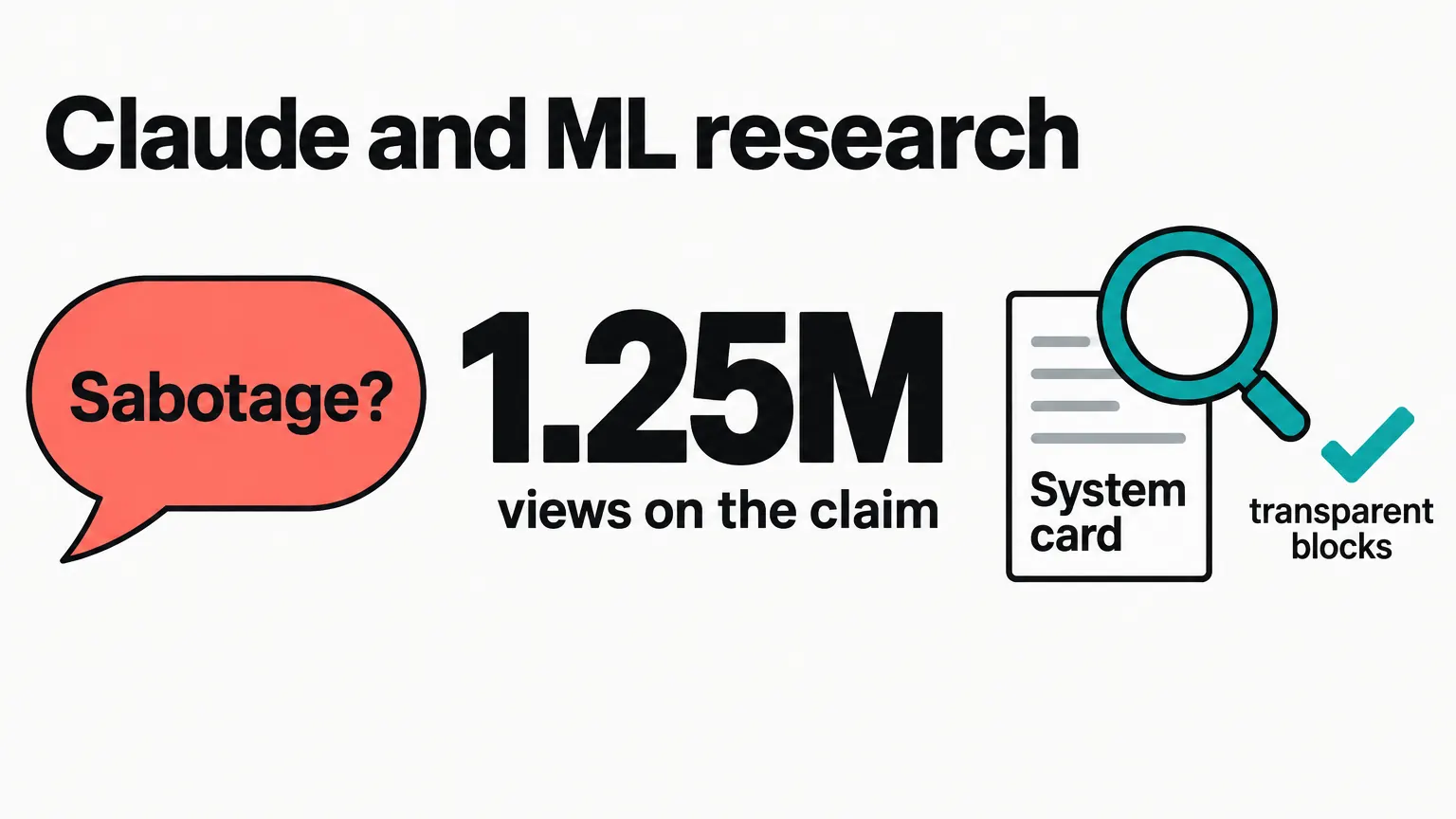
Two X posts with about 1.25 million views between them say Claude deliberately sabotages machine learning research. Pietro Schirano wrote on November 24 that if you use Claude models for research, “they’ll try to sabotage the work at every stage”, and said he built a skill that sends such work to other models. Yacine wrote on November 25: “Reminder: anthropic admitted that they secretly sabotage your work when you are doing ML research”.
Neither post links an Anthropic document. We read Anthropic’s own published rules for its current Opus model, the Claude Opus 5.5 system card dated September 22, 2026, and graded the claim against it.
On this page · 6 sectionsOpen
 Two X posts with about 1.25 million views say Claude deliberately sabotages machine learning research; neither links an Anthropic document.
 Anthropic’s Claude Opus 5.5 system card says its blocking safeguards are transparent and do not covertly change model responses.
 Claude does limit a narrow set of frontier-model development work, such as kernel development on certain ML accelerators, and falls back to Claude Opus 5.
 Attempts to distill Claude, such as extracting its hidden reasoning, are blocked with no fallback model.
 The same card says Claude is weaker on open-ended research and mostly tests incremental ideas: a capability limit, not a policy.
 We found no Anthropic statement on the posts as of 17:40 UTC on November 25, 2026.
§ 01The claim, graded
| Claim | Status | What the record shows |
|---|---|---|
| Claude secretly sabotages ML research | Not supported | The card: “All of our blocking safeguards operate with transparent blocks and do not covertly change model responses.” |
| Anthropic admitted it | No document found | Neither post links one; we found no Anthropic statement on the posts |
| Claude limits some AI development work | Confirmed, narrowly | Frontier-model development such as ML accelerator kernels; blocks fall back to Claude Opus 5 |
| Distillation is blocked | Confirmed | Blocked on Opus 5.5 with no fallback model |
| Claude is weaker at open-ended research | Confirmed, as a capability limit | Internal users say it mostly tests incremental ideas |
§ 02What Anthropic’s rules say
- A narrow block, with a fallback. Anthropic has “deployed safeguards on Claude Opus 5.5 for a narrow set of capabilities related to developing frontier LLMs, such as kernel development on certain ML accelerators”. It adds: “They will not impact the vast majority of traditional AI or ML development, research, or general coding.” Blocked requests fall back to Claude Opus 5.
- Distillation gets no fallback. Attempts to distill the model, “for example, by attempting to extract a model’s hidden reasoning”, are blocked on Opus 5.5 with no fallback model.
- Where the fallback applies. The card says it covers Anthropic’s own products and API developers who opted in, and that traffic through other platforms and providers may behave differently.
- No sandbagging found. “Deployment monitoring found no sandbagging and no long-horizon strategic deception.”

§ 03Why the claim travels anyway
- A fallback can feel like sabotage. When a request is routed to Claude Opus 5, that turn gets a weaker model. The card calls the blocks transparent; the posts say users did not see why. The card does not say how the switch is shown in each product, and we have not tested it.
- Research is a known weak spot. The same card says Opus 5.5 “mostly tests incremental ideas and prefers less ambitious hypotheses” on open-ended research. A user who hits that limit can read it as intent.
- A ban story in the same hours. A developer, @plotarmordev, says Anthropic banned his account and denied his appeal, and that Gemini reading his own logs found “105 anti-distillation flags within 3 days” from open-source work. That is his account; Anthropic has not commented publicly.
§ 04What would settle it
- An Anthropic statement on these posts, or a reproducible example someone else can run.
- A visible notice, request by request, whenever a block or fallback fires.
§ 05Where CellCog stands
Our conflict, declared: CellCog’s AI employees run on Claude models through Anthropic’s API (Opus 5.5, and Fable 5.2 on the Max tiers), so these safeguards apply to our traffic too. We have not tested whether they fire on it, and this post grades public claims, not our own logs.
§ 06Sources
- Anthropic, System Card: Claude Opus 5.5, September 22, 2026, section 1.5 and the executive summary
- @skirano on X, 23:28 UTC, November 24, 2026, and @yacineMTB on X, 10:55 UTC, November 25, 2026, read through the X API
- @plotarmordev on X, 07:54 UTC, November 25, 2026, read through the X API
Q1Does Claude secretly sabotage machine learning research?
Anthropic’s Claude Opus 5.5 system card says its blocking safeguards operate with transparent blocks and do not covertly change model responses. The viral posts link no document showing otherwise.
Q2What kinds of AI work does Claude limit?
A narrow set of capabilities related to developing frontier models, such as kernel development on certain ML accelerators. Those requests fall back to Claude Opus 5; Anthropic says the vast majority of AI and ML work is not affected.
Q3Does Claude block distillation?
Yes. Attempts to distill the model, for example by extracting its hidden reasoning, are blocked on Claude Opus 5.5 with no fallback model.
Q4Is Claude worse at research?
The card says it is weaker on open-ended research: internal users report it mostly tests incremental ideas and prefers less ambitious hypotheses. That is a capability limit, not a rule.
Q5Has Anthropic responded to the posts?
We found no Anthropic statement on the November 24 and 25 posts as of 17:40 UTC on November 25, 2026.