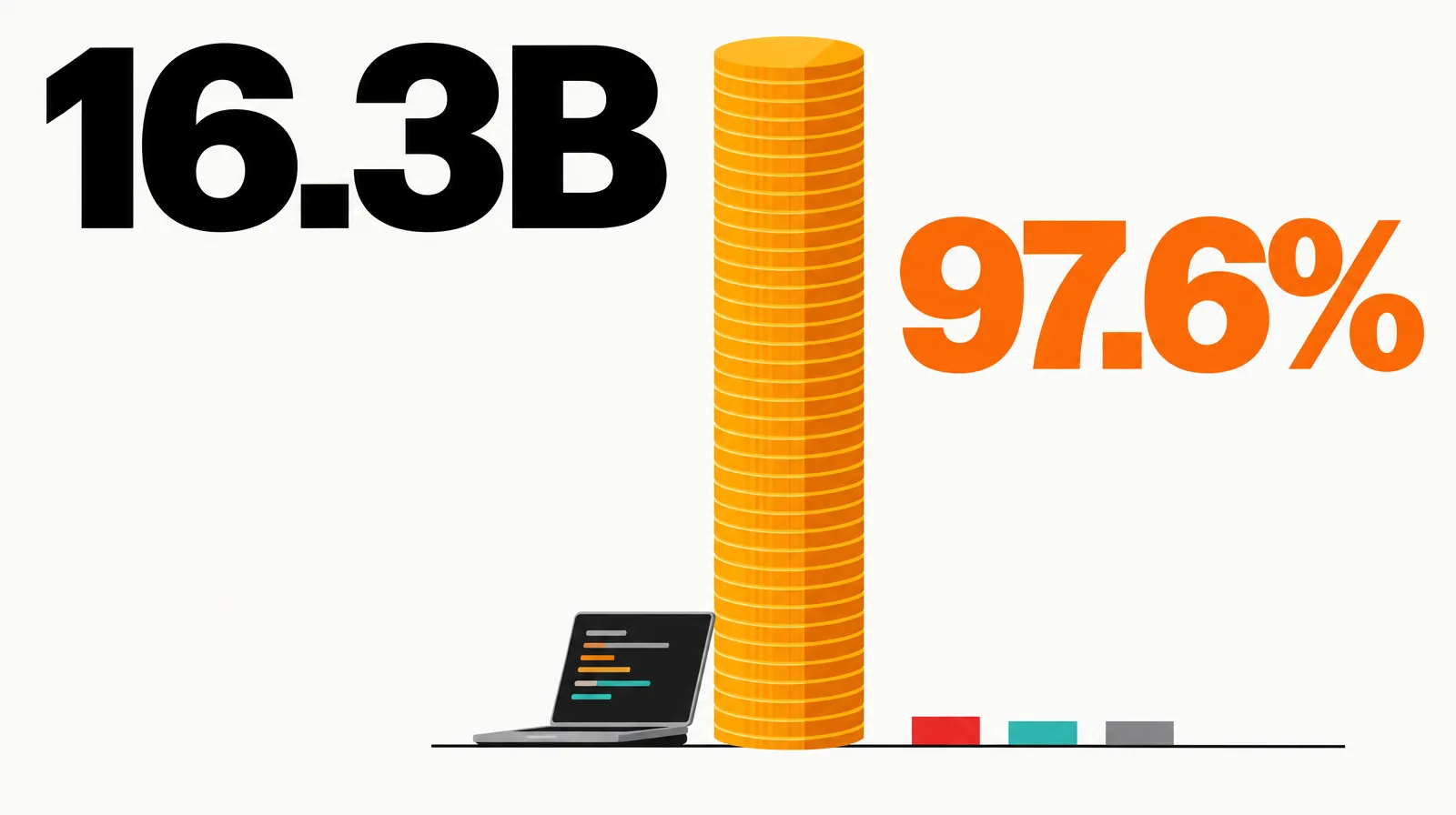
A developer says his Claude Pro plan let him use about $100,000 of tokens for $200 a year. On November 20, 2026, Vlad Mihalcea posted on X: “My Pro plan costs $200 per year, yet I used 16B tokens, which, at the per-use rate, would cost around $100,000.” The post passed 400,000 views by the afternoon.
His own screenshot tells a different story about the price. Almost all of his tokens were cache reads, the cheapest kind Anthropic sells. Priced at Anthropic’s own list rates for Claude Opus 5.5, the model his screenshot names as his favorite, the same tokens cost about $6,500 to $7,400.
On this page · 6 sectionsOpen
 Developer Vlad Mihalcea posted on November 20, 2026 that he used 16 billion Claude tokens on a Pro plan that costs him $200 a year, and that the same use would cost around $100,000 at per-use rates.
 His own screenshot splits the 16.3 billion tokens: 15.9 billion are cache reads, 97.6% of the total. Fresh input was only 487,400 tokens.
 Anthropic’s price list charges cache reads on Claude Opus 5.5 at $0.20 per million tokens, a twentieth of the $4 for fresh input.
 Priced at those list rates, his tokens come to about $6,500 to $7,400, not $100,000. It is still far more than $200, which is the real story about flat plans.
 List price is not Anthropic’s cost. Nothing public says what serving these tokens actually cost Anthropic, and Anthropic has not commented on the post in anything we read.
§ 01What the screenshot shows
| Item | Value |
|---|---|
| Total tokens | 16.3 billion |
| Cache reads | 15.9 billion |
| Cache writes | 301.8 million |
| Output | 88.6 million |
| Fresh input | 487.4 thousand |
| Favorite model | Opus 5.5 |
| Sessions | 63 |
| Active days | 125 of 296 |
The four parts add up to the total: 16.29 billion against the 16.3 billion shown. Cache reads are 97.6% of everything.
§ 02What those tokens cost at list price
Anthropic’s price list for Claude Opus 5.5 reads $4 per million input tokens, $5 per million for five-minute cache writes, $8 for one-hour cache writes, $0.20 per million cache reads and $20 per million output tokens. We priced each line of his screenshot at those rates.
| Token type | Tokens | List price per million | Cost |
|---|---|---|---|
| Cache reads | 15.9 billion | $0.20 | $3,180 |
| Output | 88.6 million | $20 | $1,772 |
| Cache writes | 301.8 million | $5 or $8 | $1,509 to $2,414 |
| Fresh input | 487.4 thousand | $4 | $1.95 |
| Total | 16.3 billion | $6,463 to $7,368 |
If every one of his 16.3 billion tokens were billed as fresh input at $4 per million, the total would be about $65,000. The $100,000 figure in the post is his own estimate; he did not show how he reached it.

§ 03Why the gap is so large
A coding agent sends the same long context again and again: the code, the history, the instructions. Anthropic reuses its earlier work on that context and bills it as a cache read. Its price list sets cache reads on Opus 5.5 at 0.05 times the input price.
Gergely Orosz made the same point about three hours after the original post: “reading from the KV cache is very cheap”. His post drew more than 120,000 views.
So a long agent session piles up billions of tokens that are each cheap to bill. The screenshot shows one session that lasted 127 days.
§ 04What this does and does not show
- It does show a big gap. About $6,500 to $7,400 of list-price use on a $200-a-year plan is a large subsidy at list price, even without the $100,000 headline.
- It does not show Anthropic’s cost. List price is what an API customer pays. What it costs Anthropic to serve these tokens is not public.
- It is one user. A heavy power user says nothing about the average Pro subscriber.
- We did not check his account. The numbers come from his screenshot, read as posted.
§ 05If you pay for AI work
Token bills are dominated by how often the same context is re-read, not by how much new text goes in. Anyone pricing AI work, flat plan or metered, should split usage into these four lines before comparing numbers.
§ 06Sources
- Vlad Mihalcea on X, 12:21 UTC, November 20, 2026, with his usage screenshot
- Gergely Orosz on X, 15:09 UTC, November 20, 2026
- Anthropic, Claude pricing, read 20:32 UTC, November 20, 2026
Q1What is a cache read?
When a coding agent sends the same long context again (the files, the history, the instructions), the model provider can reuse work it already did. Anthropic bills that reuse as a cache read, at a small fraction of the price of new input.
Q2Where do the token numbers come from?
From the usage screenshot in his post: input 487.4 thousand, output 88.6 million, cache reads 15.9 billion, cache writes 301.8 million, 16.3 billion in total, with Opus 5.5 as his most used model.
Q3Why a range and not one number?
Anthropic charges $5 per million for cache writes kept five minutes and $8 for one hour. The screenshot does not say which, so we priced both.
Q4Does this prove Claude subscriptions lose money?
No. List price is what an API customer pays, not what serving the tokens costs Anthropic. Nothing public gives that cost, and one user’s screenshot says nothing about the average subscriber.
Q5Does CellCog use Claude?
Yes. CellCog’s Agent, Creative and Team lanes at Core run on Claude Opus 5.5, and its own bills depend on the same cache pricing.