Anthropic published research on October 16, 2026 showing Claude designing quantum circuits that beat the best published versions, in some tasks by more than an order of magnitude. “Working largely on its own, Claude found designs that improve on the best published circuits, in some cases by an order of magnitude or more,” Anthropic writes. The work comes with a paper on arXiv, Discovering state-of-the-art quantum circuits with large language models, by Andi Gu, Alek Kemeny, Susanne Yelin and Mikhail Lukin of Anthropic, Harvard and QuEra.
The model doing the designing was Claude Mythos 5, running inside an open-source evolutionary search called OpenEvolve, the paper says. The headline claim from the abstract: “In seven of the eight tasks, the discovered circuits significantly reduce both Toffoli and qubit counts relative to the state of the art.”
On this page · 7 sectionsOpen
 Anthropic published research on October 16, 2026: Claude Mythos 5 designed quantum circuits that beat the best published versions.
 Claude worked in a closed loop: it wrote each circuit as Python, an evaluator checked and scored it, and there was no human input between rounds.
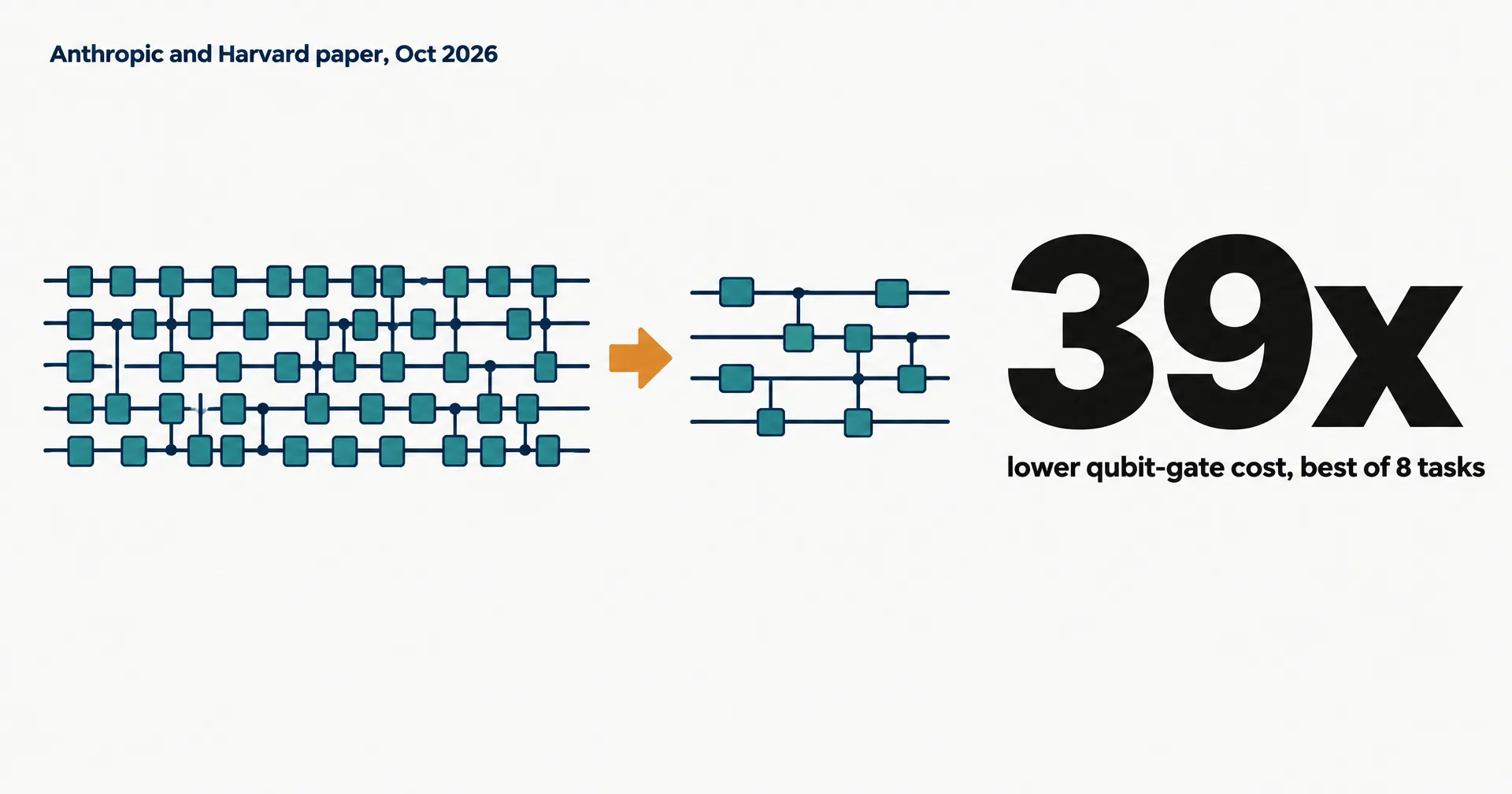
 On seven of eight tasks the circuits cut both Toffoli gates and qubits; the biggest cut in qubit-gate cost was 39x, on a fixed-point Gaussian.
 One 53-hour run produced a new reversible design for modular inversion, the costliest step of elliptic-curve point addition.
 Against the smallest previous point-addition circuit, Claude’s design uses about 12% more qubits and about 17 times fewer Toffoli gates.
 Anthropic says Claude was conservative at first and needed prompts to explore new approaches; these are circuit designs, not a quantum computer.
§ 01How the setup worked
Quantum circuits can be written as ordinary code, and the class of circuits in this study can be checked for correctness by a normal computer. That made a closed loop possible: Claude proposes a circuit as a Python program, an evaluator checks that it computes the right answer, scores it on qubits times gates, and sends the score back. There was no human input between rounds.

The score matters because both resources are scarce. Qubits are few and fragile, and the Toffoli gate is one of the most expensive operations a quantum computer runs, so counting Toffoli gates is the field’s standard proxy for runtime. A circuit that needs fewer of both brings a useful computation closer to hardware that exists.
§ 02The results, task by task
| Task | Baseline Toffolis | Baseline qubits | Claude Toffolis | Claude qubits | Cost reduction |
|---|---|---|---|---|---|
| Fixed-point Gaussian | 24,000 | 362 | 1,583 | 139 | 39x |
| HHL rotation angle | 16,000 | 300 | 1,348 | 115 | 32x |
| Reed-Solomon DQI decoder | 5,100,000 | 1,938 | 440,000 | 1,837 | 12x |
| Coulomb potential | 6,355 | 252 | 1,140 | 142 | 9.9x |
| Lattice-gauge simulation | 1,300,000 | 1,927 | 170,000 | 1,859 | 7.7x |
| Fe2S2 Select step | 55,000 | 139 | 15,000 | 126 | 4.1x |
The cost reduction is the paper’s own measure: the baseline’s Toffolis times qubits, divided by Claude’s. Two more tasks sit outside the table. A Hermitian-code decoder improved too, but the paper gives no single comparable ratio. The eighth task, prime-field modular inversion, had no comparable published circuit at all.

§ 03The 53-hour run: modular inversion
The hardest test was point addition on an elliptic curve, the core step in quantum attacks on the discrete logarithm problem, and its most expensive part, modular inversion. Ordinary computers do this with a method called divsteps. It had never become a practical quantum circuit, because a quantum circuit must be reversible and divsteps throws away a record of its choices that a reversible version would have to keep.
“After working for 53 hours with minimal human input (limited to the initial brief and occasional prompts to think more broadly), Claude arrived at a completely new approach to the problem,” Anthropic writes. Claude found that the record did not need storing: it could be decoded from the numbers themselves after each step. It proved the identities that make the decoding exact and formalized the claim in Lean.

The paper’s point-addition table compares Claude’s two designs with the best published ones:
- Schrottenloher (2026), binary gcd: 1.9 million Toffolis, 1,446 qubits.
- Claude, divsteps with decoding: 4.0 million Toffolis, 935 qubits.
- Luo et al. (2026), packed Euclidean walk: 70 million Toffolis, 838 qubits.
- Claude, specialized Euclidean walk: 21 million Toffolis, 843 qubits.
Against the smallest previous design, Luo et al., Claude’s divsteps circuit uses about 12% more qubits and about 17 times fewer Toffoli gates. Anthropic draws the contrast with how this field has moved before: a 150,000-fold drop in one chemistry estimate “took many research groups eight years”, while this design was “the result of a single 53-hour run”.
§ 04What it did not do on its own
Anthropic is candid about the limits. “In our early experiments, Claude was conservative by nature.” It double- and triple-checked results already well supported, and showed “a tendency to prefer existing, well-known approaches to more novel ones.” The team required it to develop several qualitatively different approaches in parallel and occasionally prompted it to search more broadly.
The decoder result also shows a deliberate trade. Rather than reserve memory for the worst case, Claude simulated 403 million decodings and sized the circuit for the common case. “About one run in 10,000 needs more than that and fails, which is well within the error rate the task allows.”
These are circuit designs, not a quantum computer. The resource counts are estimates for future fault-tolerant machines, and circuit design is one layer among many, from error-correcting codes to hardware control. Our record of Google’s magic-state result covers the hardware side of that stack.
§ 05Why it matters beyond quantum
The recipe is the transferable part: a problem written as code, an automatic checker for correctness, a single number to improve, and a model that iterates for days against that number. Anthropic names other quantum components that share those traits. Plenty of ordinary engineering does too, from query plans to compilers to cost models.
Our conflict, declared: we build CellCog, and every CellCog tier runs on Claude Opus 5.5, not the Mythos 5 model used here. AI employees on CellCog work in the same closed-loop way on business problems: they propose, check against data, and revise, with the checks visible to you.
§ 06What we are watching
- Whether Anthropic or the authors release the circuits or the evaluator code.
- Independent checks of the resource counts by other quantum groups.
- Whether the same loop is applied to error-correcting codes and decoders, as the paper suggests.
§ 07Sources
- Anthropic, Designing more efficient quantum circuits with Claude, October 16, 2026, 17:29 UTC.
- Andi Gu, Alek H. Kemeny, Susanne F. Yelin, Mikhail D. Lukin, Discovering state-of-the-art quantum circuits with large language models, arXiv, October 15, 2026; full text with Table 1.
Q1Who wrote the paper?
Andi Gu, Alek H. Kemeny, Susanne F. Yelin and Mikhail D. Lukin, from Anthropic’s STEM Fellows Program, Harvard and QuEra Computing; it is arXiv 2610.22367.
Q2What is a Toffoli gate?
One of the most expensive operations a quantum computer runs; counting Toffoli gates is the field’s standard way to estimate runtime.
Q3How long did the hardest run take?
The elliptic-curve point addition design came from a single 53-hour run with minimal human input.
Q4Were the results checked?
An automated evaluator checked every circuit for correctness, and Claude formalized the key divsteps claim in Lean.
Q5Does CellCog use Mythos 5?
No. Every CellCog tier runs on Claude Opus 5.5.