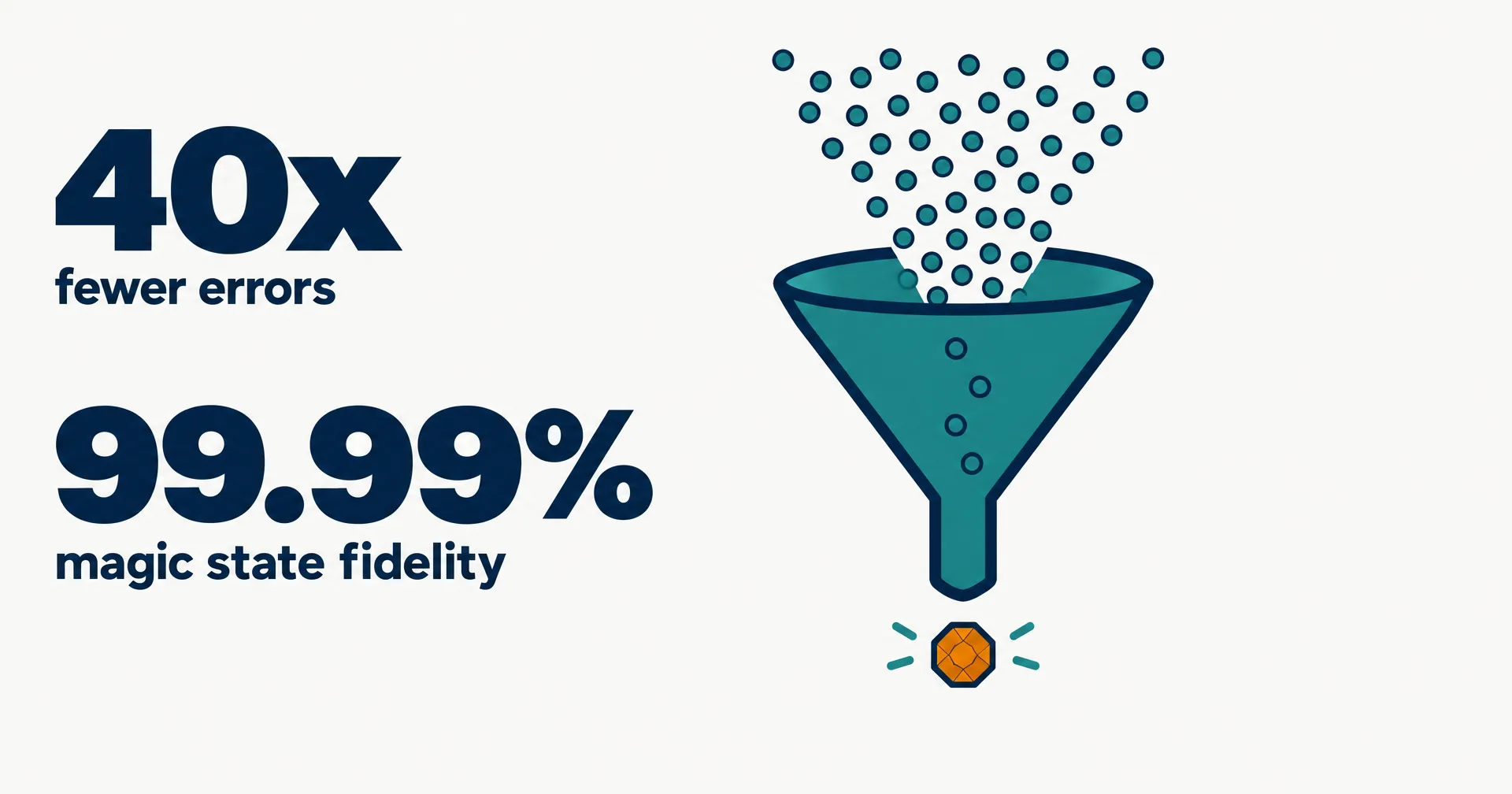
Google said on October 15, 2026 that its Willow quantum processor ran magic state cultivation, cutting errors about 40 times and producing magic states with a logical fidelity of 99.99%. The announcement, posted at 18:00 UTC by Emma Rosenfeld and Craig Gidney of Google Quantum AI, describes the method as “reducing errors about 40x compared to without it.”
At 19:31 UTC, Polymarket posted: “BREAKING: Google announces a major breakthrough in quantum computing, achieving 99.99% accuracy in a key quantum operation.” A minute later it added “11% chance quantum breaks Bitcoin by the end of next year.” The 99.99% is real, but it measures something narrower than accuracy in a key operation. Here is what it measures, how many attempts were kept, and why it does not set a Bitcoin date.
On this page · 7 sectionsOpen
 On October 15, 2026, Google showed magic state cultivation working on its existing Willow quantum processor.
 Cultivation cut errors about 40 times compared with states made without it, and produced T-states at 99.99% logical fidelity.
 The method is a filter: the reported result keeps 8% of attempts and discards the rest, by design.
 It does not set a date for breaking RSA or Bitcoin; Google’s own post-quantum migration target is 2029.
 Google says the work is published in Science; the preprint has been on arXiv since December 15, 2025.
§ 01What Google showed
- The chip: Willow, Google’s existing processor. This is a new result on it, not a new chip.
- The result: magic state cultivation works on real hardware. In the preprint’s words, “Cultivation reduces the error by a factor of 40” relative to states made without it.
- The number: T-states, one kind of magic state, at “a record logical fidelity of 99.99%”. The preprint gives the figure as 0.9999(1).
- The handoff: states were moved from a distance-3 color code into a distance-5 surface code, two kinds of quantum error correction, and survived the transfer.
- The paper: Google says it is published in Science. The preprint, arXiv:2512.13908, has been public since December 15, 2025, and Google Research lists it as Magic state cultivation on a superconducting quantum processor.
§ 02Why magic states matter
Error-corrected quantum computers can run most operations cheaply, but a universal machine also needs one harder class of operation. Those are built from magic states, which are used up once spent. Making clean ones is expensive: Google’s post cites estimates that up to 95% of a quantum computer’s capacity could go to producing them.
Cultivation works like a filter. A noisy state goes into a small patch of the chip, a sequence of checks looks for errors, and any flawed attempt is thrown away. What survives is a much purer state that can then be grafted into a larger code. Craig Gidney, Noah Shutty and Cody Jones proposed the method in 2024; this is the first time Google has shown it on hardware.
§ 03What 99.99% does and does not mean
| Claim | What the sources say |
|---|---|
| Polymarket: 99.99% accuracy in a key operation | 99.99% logical fidelity of a prepared T-state, a single magic state, measured with a new benchmarking method |
| 40x fewer errors | Error relative to states made without cultivation, per Google’s post and the preprint |
| Every attempt succeeds | No: the reported result keeps 8% of attempts |
| A new chip | No: Willow |
| Ready for practical computing | Not yet: Google says cultivation still has to be shown at larger scale |
Throwing most attempts away is how the filter is meant to work, and the preprint says so plainly: the fidelity comes “retaining 8% of attempts.” Each attempt uses a small patch of the chip, so the cost is in repeats rather than in qubits. How that rate holds up at larger scale is the open question.
| Outcome | Share of attempts |
|---|---|
| Kept | 8% |
| Discarded | 92% |
Google is direct about what is left: “Of course, we still need to demonstrate magic state cultivation at a larger scale to make it realistic for practical quantum computing, and plenty of technical challenges remain.”
§ 04Does it change the Bitcoin clock?
The announcement gives no date for breaking any encryption, and it does not revise Google’s earlier estimates. It shows one component of a fault-tolerant machine working; it is not a machine running an attack. Google Research has published separate resource estimates for RSA-2048 and for the elliptic-curve problem behind cryptocurrency keys, and Google has set 2029 as its own post-quantum migration target.
Polymarket’s 11% is a market price set by traders, not a figure from Google. A cheaper way to make magic states matters because it lowers the size of the machine an attack would need, but today’s result does not say by how much.
§ 05What it means if you run a business
For most companies the practical date is not a chip result but the migration calendar: Google is planning around 2029 for its own systems. The useful habit is reading the paper behind a headline number before acting on it, which is exactly the gap between a headline that says 99.99% accuracy and a paper that says 99.99% fidelity with 8% of attempts kept.
§ 06What we are watching
- The Science paper’s final text and any differences from the December preprint.
- Cultivation at larger code distances, and how the kept share changes.
- Any update to Google’s resource estimates for RSA-2048 or elliptic-curve keys.
§ 07Sources
- Google, Bringing the magic: Google breaks open a bottleneck in quantum computing, October 15, 2026.
- arXiv, Magic state cultivation on a superconducting quantum processor, December 15, 2025, and the Google Research publication record.
- Google, post-quantum cryptography migration timeline; Google Research, RSA-2048 estimate and cryptocurrency vulnerability disclosure.
- Polymarket, X post, October 15, 2026.
Q1What is magic state cultivation?
A method that injects a noisy magic state into a small patch of a quantum chip, checks it for errors, discards flawed attempts and keeps a much purer state for error-corrected computing.
Q2What does 99.99% fidelity mean here?
The logical fidelity of a prepared T-state, one kind of magic state. The arXiv preprint reports it as 0.9999(1), with 8% of attempts kept.
Q3Is this a new quantum chip?
No. The result ran on Willow, Google’s existing processor.
Q4Does this change when quantum computers could break Bitcoin?
The announcement gives no date and does not revise Google’s resource estimates. A market price on Polymarket is not a Google forecast.
Q5Does CellCog use quantum computing?
No. CellCog’s AI employees run on Claude Opus 5.5. This post reads Google’s announcement and the preprint as published.