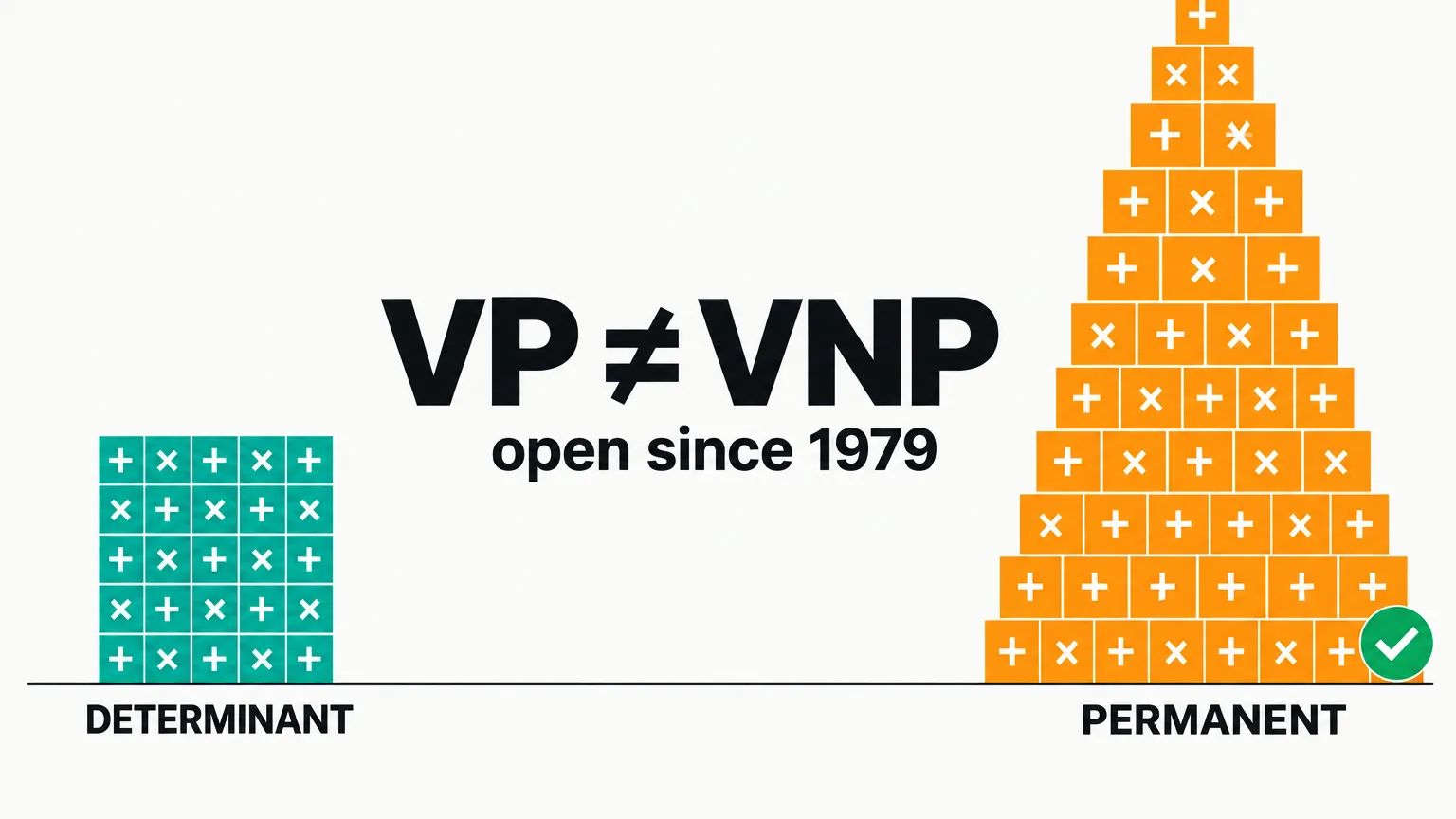
Anthropic has published a paper, credited to Claude, that proves VP ≠ VNP over every field: Leslie Valiant’s 1979 conjecture that the permanent cannot be computed by small arithmetic circuits. The 70-page paper and its Lean 4 proof landed in Anthropic’s formal-math repository at 20:04 UTC on November 23, 2026. Its README is direct about where it came from: “The result was discovered by an internal research Claude model.” It is just as direct about the gap: “Both were written by AI models, and no human mathematician has checked the proof.”
This is Anthropic’s research, not CellCog’s; we have no part in it and have not checked the proof. This page sets out what the paper and the repository say, what is checked by machine and what is not, and why the result is not P ≠ NP.
On this page · 7 sectionsOpen
- Anthropic posted a 70-page paper credited to Claude, VP ≠ VNP over every field, with a Lean 4 formalization, to its formal-math repository on November 23, 2026.
- The paper says computing the permanent of an m by m matrix needs a superpolynomial number of gates, settling Valiant’s 1979 conjecture in the algebraic model.
- By the paper’s own account the best previous bound for general circuits was the Baur and Strassen bound from 1983, close to linear.
- It does not settle P vs NP: the bound is about arithmetic circuits and does not carry over to Boolean circuits.
- No human mathematician has checked the proof; Lean checks it, but no machine checks that the stated theorems mean what the paper claims.
- It is the fourth Claude result in the same repository, after the 3SUM and APSP algorithm, the refutation of ETH and a zeta result.
§ 01What the paper claims
VP is the class of polynomials that arithmetic circuits of polynomial size can compute, with addition and multiplication gates. VNP adds sums over exponentially many cases. The permanent of a matrix looks almost like the determinant, the same products of entries with every sign set to plus, yet the determinant has small circuits and nobody has found any for the permanent. Valiant conjectured in 1979 that none exist.
The paper says every circuit for the permanent of an m by m matrix needs more than m^(c (log m)^(1/3)) gates for some constant c and all large m. That holds over the real numbers, over every field of characteristic other than two, and, for the Hamiltonian cycle polynomial, over every field. Because that number outgrows every polynomial in m, VP is a proper subset of VNP. The same bound holds for circuits that only approximate the polynomial.
| Question | What the paper says |
|---|---|
| Main bound | Over every field, circuits for the permanent (characteristic not two) or the Hamiltonian cycle polynomial need more than m^(c (log m)^(1/3)) gates |
| Previous best for general circuits | The bound of Strassen and of Baur and Strassen (1973, 1983), close to linear in the number of variables; nothing above m² log m for the permanent |
| Approximating circuits | Same bound, so VNP is not in the closure of VP |
| Mulmuley and Sohoni’s conjecture | Follows over the complex numbers: the permanent is not approximated by small determinants (the one statement not formalized in Lean) |
| P vs NP | Not settled; the bound does not apply to Boolean circuits |
| Human review | None yet |
The jump is the story. Lower bounds for unrestricted circuits had been stuck near linear for over forty years; strong bounds existed only for restricted models such as constant-depth circuits. The paper also says its argument does not follow the geometric complexity theory programme of Mulmuley and Sohoni, using neither representation theory nor orbit closures.

§ 02Why it is not P ≠ NP
An arithmetic circuit has to compute the polynomial for every input in the field and its extensions, not only for 0 and 1. A Boolean circuit only has to be right on bits. So a lower bound for arithmetic circuits does not transfer to Boolean ones. The README puts it in one line: “This does not settle P vs NP.” The paper notes the known implication runs the other way: proving VP = VNP over a suitable field would have implied a Boolean collapse, but VP ≠ VNP implies nothing about P vs NP.
§ 03What the machine checks, and what it does not
The proof is formalized in Lean 4 (324 Lean files in the folder, about 3.4 million bytes of source). The repository’s check re-runs every proof through a second, independently written kernel, nanoda, and the axiom check should name nothing beyond “propext, Classical.choice and Quot.sound.” The README adds the limit any reader should keep: “Lean checks the proofs, but no machine checks that this file says what is claimed.” That file, Statement.lean, imports only Mathlib, so a mathematician can read the theorem statements without reading the proof. Until people do, the claim rests on the formalization being a faithful statement of Valiant’s conjecture.
§ 04Fourth result in one repository
The vp-vnp folder joins three earlier Claude results in the same repository: the 3SUM and APSP algorithm, the refutation of the Exponential Time Hypothesis and a zeta result. It also arrives days after a mathematician at Anthropic posted a Lean proof of the Riemann Hypothesis made with Claude. The paper itself cites an OpenAI manuscript from September 2026 with a cubic lower bound on the determinantal complexity of the permanent, which this result goes past.
As of 02:00 UTC on November 24 we found no post about it from Anthropic’s main X accounts; the paper spread through other accounts.
| Post | Time (UTC) | Views |
|---|---|---|
| Polymarket | 23:17 | 340,051 |
| imjustnewatai | 22:18 | 200,421 |
| Liam06972452 | 22:16 | 118,574 |
§ 05What we did not check
- The proof itself. We read the README and the paper’s introduction and structure; we did not check any argument.
- The Lean build. We did not run
lake buildor the second-kernel check; the repository says its CI runs it. - How the model found it. The paper names no model version, compute or time spent.
§ 06Where CellCog sits
Our conflict, declared: CellCog builds AI employees, including an AI research assistant that reads papers and writes up findings. That is far from proving theorems. CellCog has no part in this result.
§ 07Sources
- VP ≠ VNP over every field, Claude (Anthropic), November 23, 2026
- anthropics/formal-math, vp-vnp folder: README, Statement.lean, Lean proof
- Polymarket on X, imjustnewatai on X, Liam06972452 on X, November 23, 2026
Q1What is VP vs VNP?
VP is the class of polynomials that small arithmetic circuits (addition and multiplication gates) can compute. VNP adds sums over many cases. Leslie Valiant conjectured in 1979 that the permanent, which sits in VNP, needs much larger circuits than the determinant.
Q2What does the Claude paper prove?
That circuits computing the permanent over every field of characteristic other than two, or the Hamiltonian cycle polynomial over every field, need more than m^(c (log m)^(1/3)) gates for large m. That bound grows faster than any polynomial, so VP is not VNP.
Q3Does this solve P vs NP?
No. Arithmetic circuits must work over the whole field, not only on 0 and 1, so the bound does not apply to Boolean circuits, and no known result turns VP ≠ VNP into P ≠ NP.
Q4Has the proof been verified?
It is formalized in Lean 4, and the repository re-checks it with a second, independently written kernel. Anthropic says no human mathematician has checked it, and Lean cannot check that the statement file says what is claimed.
Q5Is this a CellCog result?
No. The paper and proof are Anthropic’s and Claude’s. CellCog has no part in it.