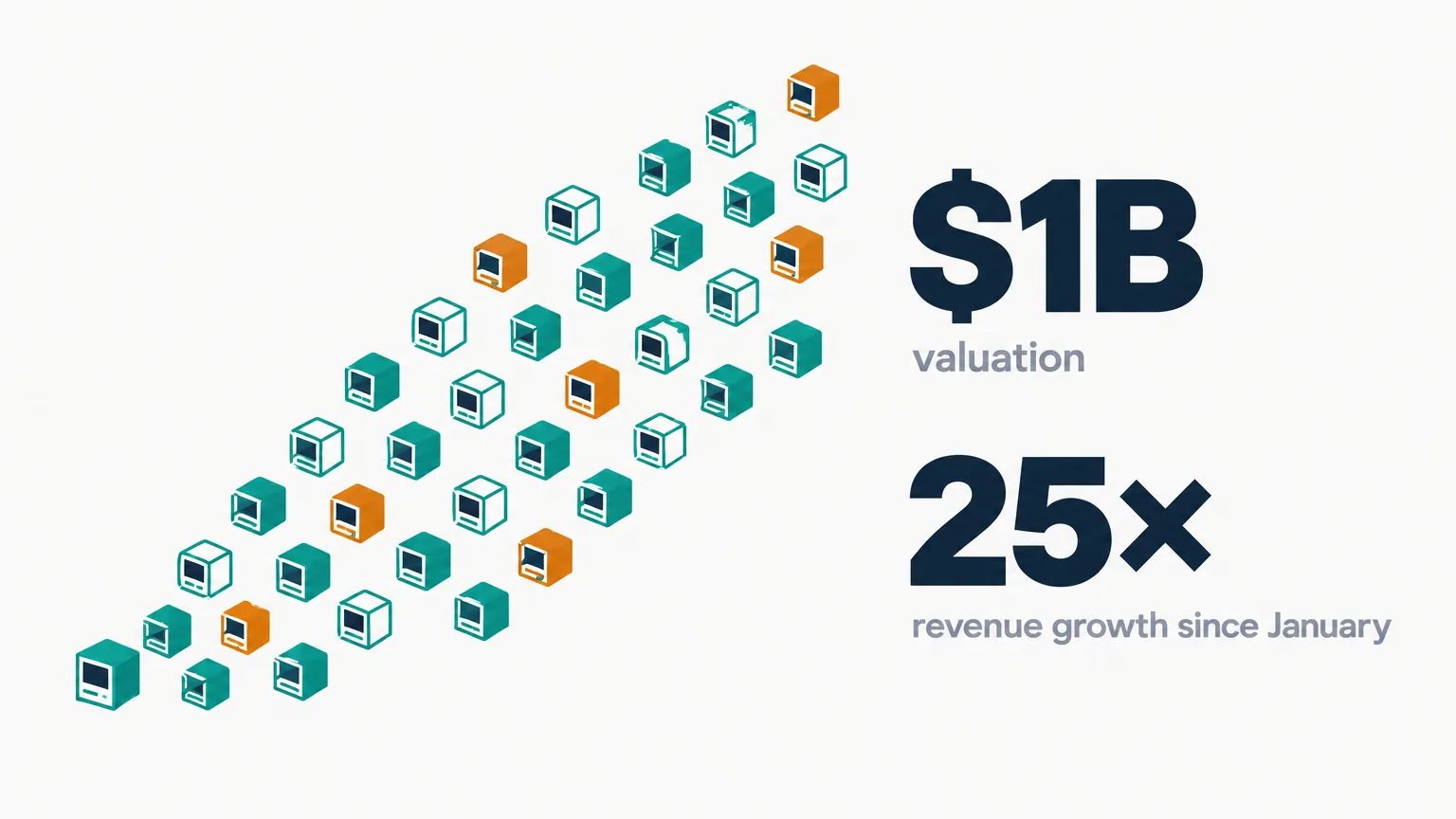
Daytona raised a $60M Series B at a $1B valuation on October 20, 2026, led by FirstMark Growth, to build what it calls the agent cloud: a computer, a browser and storage for every AI agent. The round brings its total funding to $91M. CEO Ivan Burazin’s announcement opens on the thesis the company has held from the start, that “agents are digital humans” and need a computer like anyone doing real work.
Daytona posted the news on X at 15:04 UTC. This page reads the announcement and the pricing page, checks the growth figures against each other, and prices a sandbox from the list.
On this page · 7 sectionsOpen
 Daytona raised a $60M Series B at a $1B valuation on October 20, 2026, led by FirstMark Growth, bringing its total funding to $91M.
 It sells the execution layer for agents: computers that start in milliseconds, pause with their state, fork into copies and disappear when the job is done.
 Daytona says revenue grew about 25x since January, roughly 43% to 50% a month, and that last spring’s customers now spend nearly three times as much.
 Its stated 135% average monthly net revenue retention would compound to 6.05x over six months, about twice the 3x it describes, so read 3x as the safer figure.
 Billing is per second: a 2 vCPU, 4 GiB sandbox costs 16.56 cents an hour at list price, or under 3 cents for a 10-minute run.
§ 01The round
- $60M Series B at a $1B valuation, led by FirstMark Growth; total raised $91M.
- Angels: Patrick Collison (Stripe), Tobi Lutke (Shopify), Aravind Srinivas (Perplexity), Eric Yuan (Zoom), Olivier Pomel (Datadog), Adam D’Angelo (Quora) and Brendan Foody (Mercor).
- Strategic investors: Qualcomm Ventures, Samsung Next and Okta Ventures.
- Returning: E2VC in its fourth round, Upfront Ventures in its third, FirstMark Capital and Pace Capital in their second. Evergreen Fund, Alumni Ventures and Torch Capital are new.
§ 02What an agent’s computer is
Daytona’s argument is that a cloud instance and an agent’s computer are different machines. “An instance takes minutes to boot and runs until you shut it down.” An agent’s computer has to “start in milliseconds, pause with its state intact, fork into parallel copies, and disappear when the job is done.” Agents, the post says, spin up “thousands of short, stateful jobs nobody planned in advance”.

The company draws the line explicitly: not inference, not observability, not the dashboards people use to manage agents, but the execution layer underneath. Burazin repeated it that afternoon on The Information’s TITV: Daytona is “the execution layer where agents do the work.” The post also names tools no human computer needs: agents “fork into a thousand copies or rewind to an earlier state.”
Qualcomm’s Quinn Li gives the strategic investor’s reading: “AI agents need secure environments to run code, call tools, browse the web and learn through reinforcement learning.”
§ 03The growth claims, checked against each other
Daytona publishes no revenue figure, only ratios. It says revenue has grown about 25x since January, that average month-over-month net revenue retention is about 135%, and that the customers it had six months ago now spend “nearly three times as much with us today.”
- 25x since January. Over eight monthly steps (January to September) that is about 50% revenue growth every month; over nine, about 43%.
- 135% a month vs nearly 3x. Held for six months, 135% monthly retention compounds to 6.05x. Daytona’s own description of the same six months is nearly 3x, which works out to about 20% a month. Both can be true only if the 135% is a simple average lifted by a few very large months, so 3x is the figure to plan around.
- The Snowflake comparison. Daytona sets its number beside Snowflake’s net revenue retention of about 160% per year at IPO. Even on the conservative 3x in six months, its existing customers are expanding several times faster than that, from a much smaller base.

§ 04Who uses it
The announcement sorts customers into three groups:
- Model builders: Meta and Cohere.
- Training data and environments: Handshake, Snorkel, Surge AI, Turing, AfterQuery and Trajectory.
- Products people use: Writer, Clay, n8n, Postman, Mintlify and bolt.new.
Two migrations get numbers. Writer ran its own sandbox platform until it passed 20,000 sandboxes a day, then provisioned 300,000 sandboxes on Daytona in a single month. AfterQuery replaced its in-house GKE cluster with Daytona in a day. One caution on the Writer figure: 20,000 a day is about 600,000 a month, so the 300,000 month most likely covers a partial month or part of Writer’s workload. Daytona does not say which.
§ 05What it costs
All billing is calculated per second, new accounts get $200 in free compute, and startups can apply for up to $50k in credits.
| Resource | Price | Note |
|---|---|---|
| vCPU | $0.0504 per hour | Billed per second |
| Memory | $0.0162 per GiB-hour | Billed per second |
| Storage | $0.000108 per GiB-hour | First 5 GiB free |
| Windows | $0.0858 per vCPU-hour | Replaces the Linux vCPU rate |
| Nvidia RTX 4090 | $0.57 / $0.99 per hour | Preemptible / on demand |
| Nvidia H100 | $2.27 / $3.95 per hour | Preemptible / on demand |
| Nvidia B300 | $4.08 / $6.25 per hour | Preemptible / on demand |
Daytona lists component prices, not sandbox sizes, so here is what common Linux shapes cost at list, with storage inside the free 5 GiB.
| Sandbox size | Cents per hour | Cents per 10-minute run |
|---|---|---|
| 1 vCPU, 1 GiB | 6.66 | 1.11 |
| 2 vCPU, 4 GiB | 16.56 | 2.76 |
| 4 vCPU, 8 GiB | 33.12 | 5.52 |
| 8 vCPU, 16 GiB | 66.24 | 11.04 |
For scale: if each of Writer’s 300,000 sandboxes ran for 10 minutes on 2 vCPU and 4 GiB, the month would cost about $8,280 at list price, before the volume discounts Daytona offers. Daytona does not publish run lengths, so treat that as an order of magnitude, not a bill.
§ 06Why it matters for teams of AI employees
Daytona’s thesis and CellCog’s overlap: an agent doing real work needs its own computer, not a borrowed tab. Every CellCog AI employee runs on its own secure VM and file system, with its own browser identity and logins, and carries what it learns from one task into the next. The difference is the layer. Daytona sells the computer to teams building their own agents; CellCog hands you the employee that already has one.
§ 07What to watch
- Absolute numbers. Daytona publishes growth ratios but no revenue or total sandbox count; a figure for either would make the 25x readable.
- GPU sandboxes. The price list runs from an RTX 4090 at $0.57 an hour to a B300 at $6.25 on demand, aimed at the reinforcement-learning work its model-builder and training-data customers run.
- What the strategics do. Qualcomm, Samsung and Okta all invested; none has said yet what it will build on Daytona.
Q1How much did Daytona raise?
$60M in a Series B at a $1B valuation, announced October 20, 2026 and led by FirstMark Growth. Total funding is now $91M.
Q2Who invested in Daytona's Series B?
FirstMark Growth led. Angels include Patrick Collison, Tobi Lutke, Aravind Srinivas, Eric Yuan, Olivier Pomel, Adam D’Angelo and Brendan Foody; Qualcomm Ventures, Samsung Next and Okta Ventures joined as strategic investors.
Q3How much does Daytona cost?
$0.0504 per vCPU-hour, $0.0162 per GiB-hour of memory and $0.000108 per GiB-hour of storage after 5 free GiB, billed per second. GPUs run from $0.57 an hour (RTX 4090, preemptible) to $6.25 (B300, on demand).
Q4Who uses Daytona?
Model builders such as Meta and Cohere, training-data firms such as Snorkel, Surge AI and Turing, and product companies such as Writer, Clay, n8n, Postman, Mintlify and bolt.new.
Q5How is Daytona different from CellCog?
Daytona sells computers to teams that build their own agents. CellCog gives you finished AI employees, each already running on its own secure VM, file system and browser.