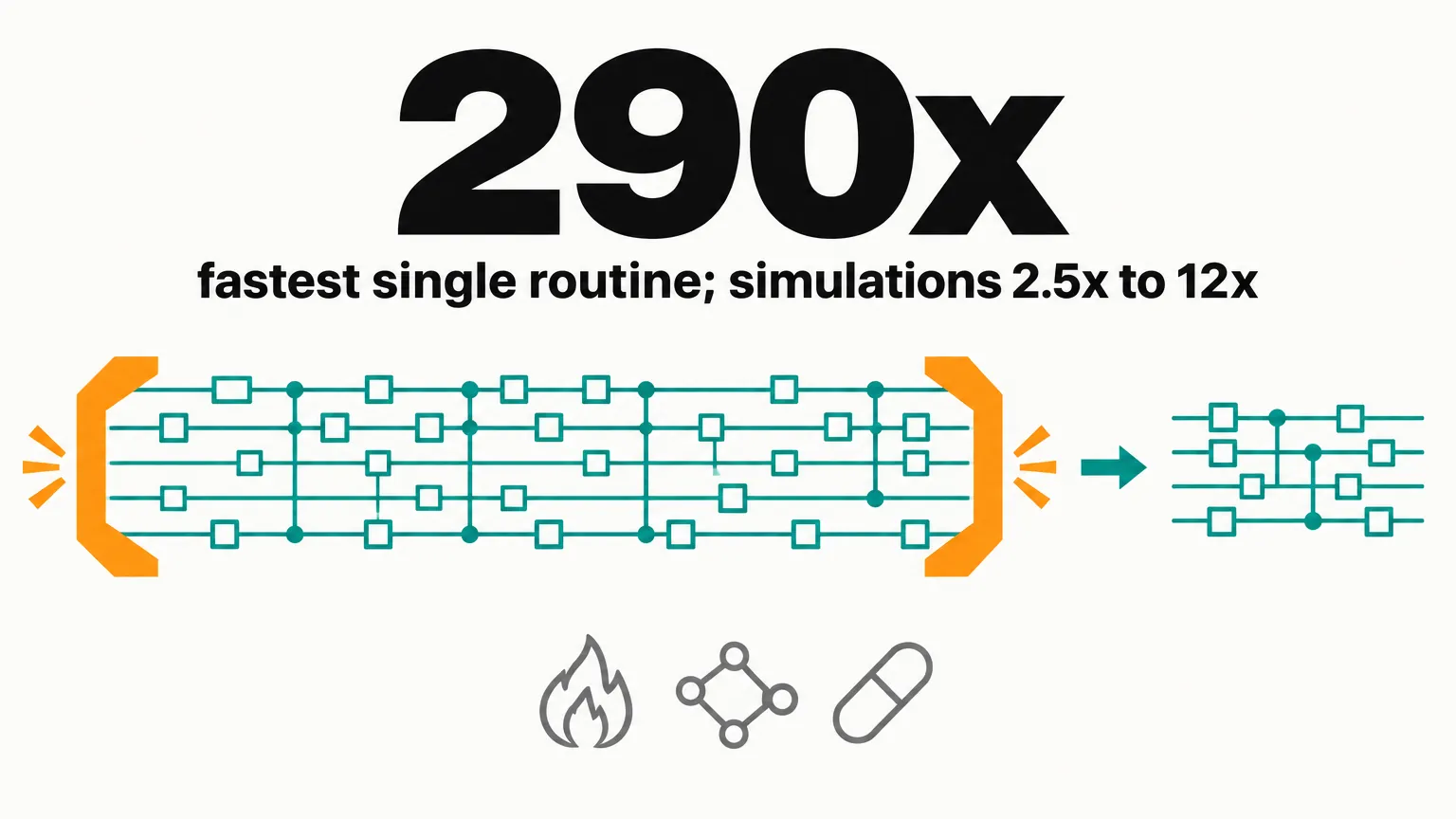
Google DeepMind says teams of Gemini 4 agents found quantum circuits that make five known problems cheaper to run, from fusion physics to drug metabolism, and proved every one correct in Lean. The announcement went up on November 23, 2026, with the paper on arXiv and the Lean library on GitHub. Its own post on X summed it up as circuits that “cut future simulation costs by up to 10 times.” The number that spread was larger: 290x, which applies to one arithmetic routine, not to the science problems.
This is Google DeepMind’s and Google Quantum AI’s research, not CellCog’s; we have no part in it and have not checked the proofs. This page sets out what was improved, by how much, how it was checked and what it does not yet mean.
On this page · 7 sectionsOpen
- Google DeepMind said on November 23, 2026 that teams of Gemini 4 agents found cheaper quantum circuits for fusion, photochemistry and drug-metabolism simulations.
- The cuts it reports: 11.8x for a fusion problem, 8x for a light-sensitive molecule, 2.5x for the enzyme Cytochrome P450, 2.57x for a Grover search and 290x for the arcsin routine.
- Every result was proved in Lean, because circuits this large cannot be tested on classical computers or today’s quantum chips.
- Separate agent teams worked each problem and met every four hours at a virtual conference to trade and debate ideas.
- DeepMind says the improved simulations would still need more resources than the first error-corrected quantum computers are likely to have.
- The Lean library is open source under Apache 2.0, with the problem specifications and verified solutions.
§ 01What the agents improved
| Problem | Why it matters | Cost cut |
|---|---|---|
| Inertial confinement fusion property | Fusion that compresses hydrogen fuel with lasers | 11.8x (12x in the paper’s abstract) |
| A common light-sensitive molecule | Photochemical reactions | 8x |
| Cytochrome P450 | Enzyme that breaks down most medicines | 2.5x |
| Grover’s search, one implementation | A foundational quantum search | 2.57x |
| Arcsin routine | Loads numbers into quantum states inside many algorithms | 290x |
The arcsin result is off the chart because at 290x it would flatten the rest. It is a routine many algorithms call, so a cheaper arcsin makes other circuits cheaper too, but on its own it is not a science result. For two problems the blog also gives memory, counted in error-corrected qubits:
| Problem | Before | After |
|---|---|---|
| Fusion property | 5,650 qubits | 4,338 qubits |
| Cytochrome P450 | 481 qubits | 333 qubits |
§ 02How the agents worked
Each problem went to separate, independent teams of Gemini 4 agents. An idea counted only once Lean had checked it, and checked ideas went into a shared notebook. The blog describes the rhythm: “Every four hours, agents from each team met at a virtual conference to trade, debate and compare ideas.” The paper’s abstract adds that teams shared results “through wikis.” The researchers chose the problems and supervised; the agents searched.
The reason for Lean is practical. Circuits for useful quantum algorithms are too large to simulate on a classical computer and too large for today’s quantum chips, so nobody can run them to see whether they work. A proof is the only test available, and Lean also checks the cost claimed for each circuit.
§ 03What it does not mean yet
DeepMind is plain about the gap: “Running these algorithms in scientific simulations would still demand more computational resources than the first error-corrected quantum computers are likely to provide.” The circuits are cheaper on paper, for machines that do not exist yet. The result is about the method: agent teams searching under proof can compress years of manual circuit design, in DeepMind’s words, so researchers can “focus on choosing problems and interpreting results.”
It also sits next to similar work. Anthropic and Harvard researchers reported Claude redesigning quantum circuits earlier this month, and DeepMind’s own AlphaProof Code used agents writing Lean proofs for real software. The pattern across all three is agents proposing and a proof checker deciding.
§ 04How far it spread
DeepMind’s post at 17:00 UTC on November 23 drew 230,374 views by 02:20 UTC on November 24. A Polymarket repost leading with 290x drew 964,204, and unusual_whales 181,873, about 1,376,000 together.
§ 05What we did not check
- The proofs. We read the blog and the abstract; we did not build the Lean library or check any circuit.
- The baselines. Each cut is against prior circuits the paper chose; we did not compare them with other published designs.
- Compute and cost. Neither the blog nor the abstract says how long the agents ran or what it cost.
§ 06Where CellCog sits
Our conflict, declared: CellCog builds AI employees, including an AI research assistant that reads new papers and checks claims against the source. That is reading research, not doing it. CellCog has no part in this result.
§ 07Sources
- Finding faster quantum algorithms with agents and formal verification, Google DeepMind, November 23, 2026
- Discovering formally verified quantum programs with AI, arXiv 2611.09822
- google-deepmind/formal-quantum-computation, Apache 2.0
- Google DeepMind on X, PolymarketMoney on X, unusual_whales on X, November 23, 2026
Q1What did Google DeepMind and Google Quantum AI find?
Cheaper quantum circuits for five problems: an inertial confinement fusion quantity (11.8x), a light-sensitive molecule (8x), the drug-metabolism enzyme Cytochrome P450 (2.5x), a Grover search implementation (2.57x) and the arcsin arithmetic routine (290x).
Q2How were the circuits checked?
In Lean, a formal theorem prover. The circuits are too large to simulate on classical computers or run on current quantum processors, so each improvement was proved correct and its cost proved as well.
Q3How did the agents work together?
Separate Gemini 4 agent teams took each problem. Verified ideas went into a shared notebook, and every four hours agents from each team met at a virtual conference to compare ideas.
Q4Where is the paper?
On arXiv as 2611.09822, Discovering formally verified quantum programs with AI. The Lean library is on GitHub as google-deepmind/formal-quantum-computation under Apache 2.0.
Q5Is this a CellCog result?
No. It is Google DeepMind’s and Google Quantum AI’s research. CellCog has no part in it.