DeepSeek has opened the tools behind its chat app to developers. Web search, file input, link reading, safety checks and voice are now available through its API, for its V4.1-Flash model. The company announced it in a four-post thread on X on November 13, 2026.
This page is read from that thread, from the price image in it, and from the public repository of DeepSeek’s demo app on GitHub. We did not use DeepSeek’s website or its documentation as sources, and we have not called any of these APIs.
On this page · 7 sectionsOpen
 DeepSeek opened the tools behind its chat app to developers on November 13, 2026: web search, file input, link reading, safety checks and voice, all through its API.
 The built-in tools work with V4.1-Flash across three API formats. DeepSeek says tool calls and context assembly are handled on its servers.
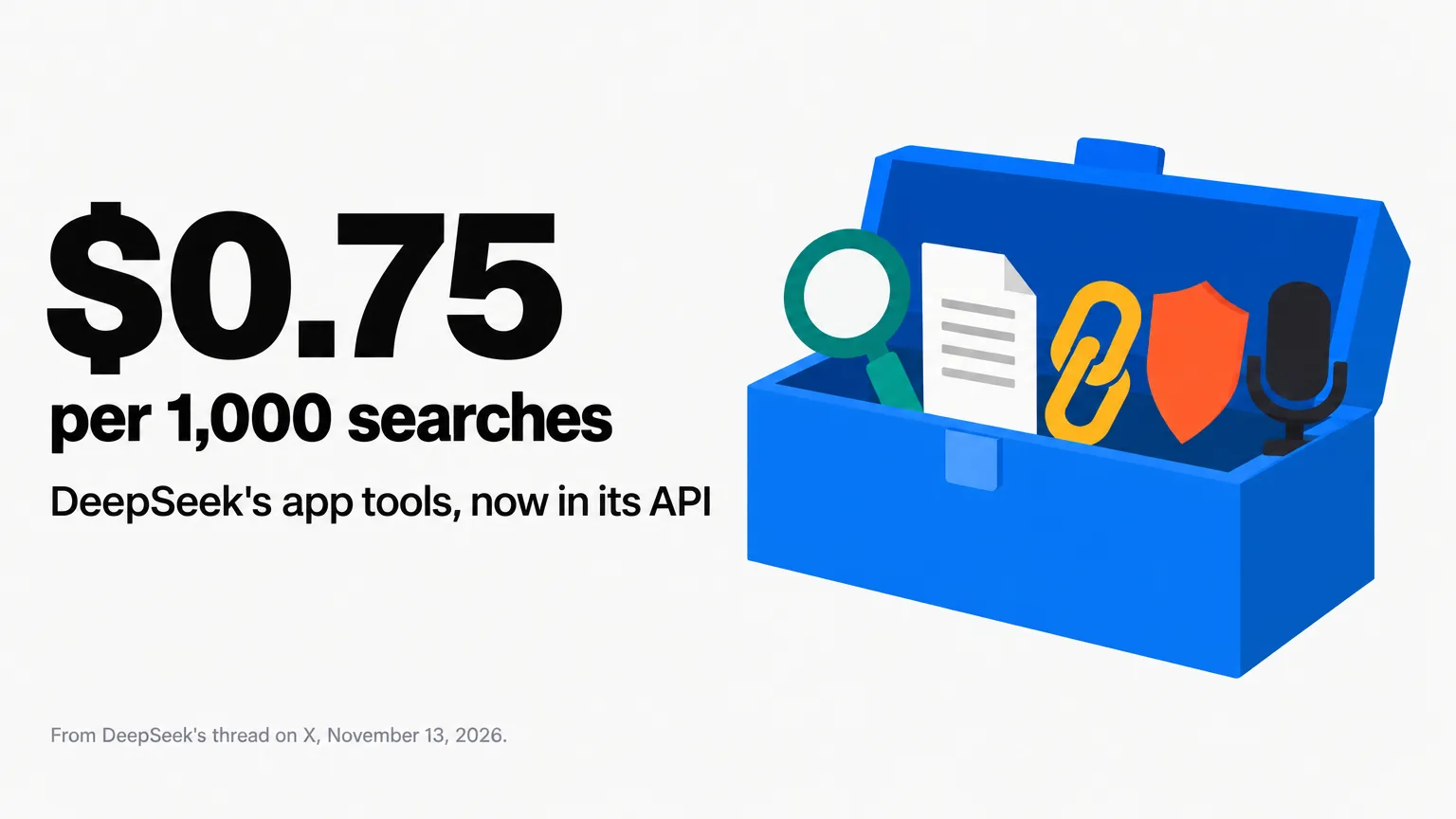
 Tools cost extra on top of tokens. Search and fetch are $0.75 per 1,000 requests and OCR is $0.225 per 1,000 pages, per the image in the thread.
 Speech recognition and text to speech are marked 50% off for a limited time. The image gives no end date.
 An open-source demo app is on GitHub under the MIT license. We have not called these APIs or run the demo.
§ 01What DeepSeek announced
- The post. DeepSeek’s first post is headed “The full DeepSeek App experience, now via API”. It had about 211,000 views when we read it at 15:52 UTC.
- In one line. It says: “The capabilities behind the DeepSeek App are now available through the DeepSeek API.”
- Two ways to use them. As built-in features that a developer switches on with a few parameters, or as standalone APIs. The thread names five standalone APIs: Search, Fetch, OCR, ASR and TTS.
- Which model. The second post says: “V4.1-Flash (deepseek-flash) now supports these capabilities across Messages, Responses, and Chat Completions, with tool calls and context assembly handled server-side”
- A demo. DeepSeek also published an open-source chat app. The first post says it supports importing DeepSeek conversation history.
- The pitch. The fourth post says of the app: “Its capabilities are now yours to call and combine freely.”
§ 02The five built-in tools
| Tool | What the thread says it does |
|---|---|
| Web Search | Search the web or images with citations in non-thinking mode |
| Deep Thinking Search | Search and read pages throughout multi-step reasoning |
| File Input | Parse PDFs, Office files, images, and more into conversation context |
| URL Reading | Automatically fetch links in user messages to inform answers |
| Safety Checks | Screen inputs and outputs, returning refusal indicators when risks are detected |
- How to switch them on. The thread names two parameters: deepseek_web_search for search and deepseek_read_url for URL reading. It names none for the other three.
- Where the work happens. DeepSeek says tool calls and context assembly are handled on its servers.
- A rule for public apps. “Public-facing apps must enable safety checks.”
- What stays with the developer. “Developers remain responsible for content moderation, applicable model registration, and AI-generated content labeling.”

§ 03What it costs
The third post says: “Extended capabilities incur tool usage fees in addition to standard token charges.” The prices are in an image attached to that post, and we read them from the image.
| Tool | Price | Note in the image |
|---|---|---|
| Search | $0.75 per 1,000 requests | No discount shown |
| Fetch | $0.75 per 1,000 requests | No discount shown |
| OCR | $0.225 per 1,000 pages | No discount shown |
| ASR | $0.058 per hour | 50% off, limited time; $0.116 struck through |
| TTS | $0.225 per 10,000 characters | 50% off, limited time; $0.45 struck through |
- Per unit, by our arithmetic. One search or one fetch comes to $0.00075. One page of OCR comes to $0.000225.
- On top of tokens. The fees are added to the model’s token charges. The thread gives no token prices.
- Two discounts with no end date. The image marks the ASR and TTS prices as 50% off for a limited time. It gives no end date.
- Different units. The five prices use four units: requests, pages, hours and characters. They cannot be ranked against each other.
§ 04The demo app
We read the repository at 15:45 UTC on November 13, 2026.
- What it is. The README says: “A static chat demo powered by the DeepSeek API.”
- No server of your own. “No application backend is required: the browser connects directly to the configured API service.”
- How it calls the model. The README says chat uses deepseek-flash by default through Anthropic-compatible Messages and Files APIs, and that speech features use the ASR and TTS endpoints.
- Where the key lives. “Your API key and settings are stored in the browser’s localStorage.”
- The repository. Created on November 12, 2026, under the MIT license, written mainly in TypeScript. It listed two releases, v0.1.0 and v0.1.1, both dated November 13. It had 292 stars and 59 forks when we read it.
§ 05What we did not check
- We have not called any of these APIs, and we have not opened or run the demo app.
- We did not read DeepSeek’s documentation or any page of its website. Anything said only there is not on this page.
- The prices come from one image in the thread. We did not check them against a price page.
- We did not test the safety checks, the search results or the voice quality.
- We did not check which countries or accounts can use the tools.
- We did not read the demo’s source code.
§ 06Where CellCog sits
CellCog is our product, an AI employee platform. CellCog AI employees run on Anthropic’s Claude models. We do not use DeepSeek’s models or these APIs, so we make no claim about how well they work. OpenAI makes the image model behind this page’s pictures.
§ 07Sources
- DeepSeek: post 1 of 4 on X, November 13, 2026, 14:24 UTC.
- DeepSeek: post 2 of 4, the built-in tools.
- DeepSeek: post 3 of 4, the price image.
- DeepSeek: post 4 of 4.
- DeepSeek: the chat-demo repository on GitHub, README and release list read at 15:45 UTC on November 13, 2026.
Q1Can I use DeepSeek's web search through its API?
DeepSeek says so. Its thread names a parameter, deepseek_web_search, that turns search on for V4.1-Flash, and a standalone Search API.
Q2How much does DeepSeek's search API cost?
$0.75 per 1,000 requests, per the price image in its thread. That is on top of the model’s token charges.
Q3Does DeepSeek's API have speech to text and text to speech?
The thread lists ASR and TTS as standalone APIs. The price image shows $0.058 per hour for ASR and $0.225 per 10,000 characters for TTS, both marked 50% off for a limited time.
Q4Do public apps need DeepSeek's safety checks?
The thread says public-facing apps must enable safety checks, and that developers remain responsible for content moderation and for labeling AI-generated content.
Q5Is DeepSeek's chat demo open source?
Yes. The repository is public on GitHub under the MIT license, and its README says the app needs no application backend.