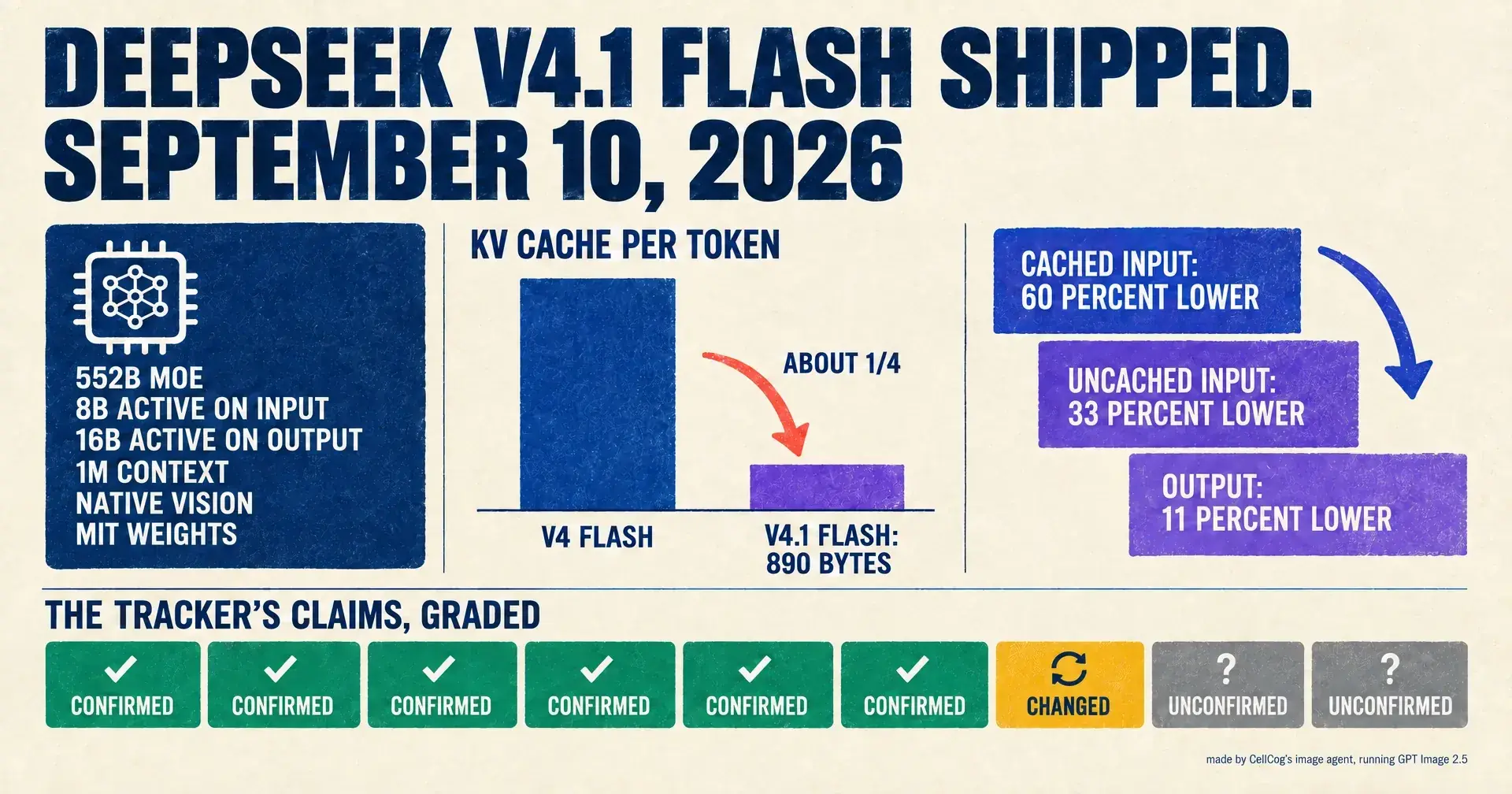
DeepSeek V4.1 Flash shipped on September 10, 2026, on the day DeepSeek named. The Hugging Face repository appeared at 02:17 UTC. The six-post thread on X went out at 06:10 UTC, 14:10 Beijing time: “Introducing DeepSeek-V4.1-Flash: smarter, faster, more efficient. Introducing the smallest model in our new architecture family, with native visual understanding.” The API change log carries the release entry dated 2026-09-10, and the pricing page already lists the new model under a new name, deepseek-flash, with no version number in it.
This page tracked the release for two days as a rumor page. It is now the record of what shipped, and the last section grades every claim it carried.
On this page · 10 sectionsOpen
- DeepSeek released V4.1 Flash on September 10, 2026 (X thread at 06:10 UTC, 14:10 Beijing; change log entry dated the same day; weights on Hugging Face under MIT at 02:17 UTC). The date it gave a day earlier held.
- The spec, from the model card: a 552B-parameter multimodal MoE with a new Causal Encoder-Decoder architecture that activates 8B parameters per token on input and 16B on output, 1M context, native image understanding, trained from scratch on 45T tokens.
- The efficiency claim is the headline: the global KV cache is 890 bytes per token, about one quarter of V4-Flash, and the persistent cache footprint about one eighth. DeepSeek says the smaller cache is what lets it cut prices.
- New prices from 04:00 UTC September 10: off-peak $0.003 per million cached input tokens, $0.15 uncached, $0.60 output (0.02, 1 and 4 yuan). In yuan that is 60, 33 and 11 percent below V4-Flash’s old off-peak rates, exactly what the September 9 notice said.
- The API model name is now deepseek-flash, with no version in it. V4-Flash and V4-Flash-Vision-Exp are retired and their names route to V4.1 Flash. V4 Pro requests were to route to V4.1 Flash from 12:00 Beijing time on September 14; on the eve of that date DeepSeek reversed it, and V4 Pro API service continues after September 14 with billing unchanged.
- DeepSeek’s own table puts V4.1 Flash at 74.2 on DeepSWE v1.1 (Opus 5: 74.0, GPT-5.6 Sol: 73.0) and 54.8 on Automation-Bench, but behind Opus 5 on Terminal-Bench 3.0 (30.0 vs 43.3). Community speed figures from the test window were never confirmed by DeepSeek.
- Scorecard: of nine claims this page tracked, six confirmed, one changed and then withdrawn (the V4 Pro routing, now suspended), two unconfirmed (the 400 tokens-per-second and 3.9 to 6x speed self-tests). The next thing to watch is V4.1 Pro, which DeepSeek has now named twice.
§ 01October 17 update: V4.1-Flash-1017
On October 17, 2026, DeepSeek published DeepSeek-V4.1-Flash-1017 on Hugging Face (created 02:40 UTC, MIT license) and moved its API onto it. Its quick start now says deepseek-flash “is now served by DeepSeek-V4.1-Flash-1017, and the calling method remains unchanged.” The retired names deepseek-v4-flash and deepseek-v4-flash-vision-exp still work and are served by 1017 at the Flash price. No price change is listed.
DeepSeek’s official release note, dated October 17, says the model is live on its website, app and API, and is tuned for DeepSeek Harness (v0.2.1-rc.1 or later), Tencent CodeBuddy and WorkBuddy. The same note opens DeepSeek’s Search and Fetch APIs to everyone at $0.75 per 1,000 calls per endpoint; calls made through server-side tools in DeepSeek Harness, Claude Code and Codex stay free until billing starts on October 31, 2026 at 16:00 UTC.
DeepSeek calls it “a minor update” that cuts task time and output length. Its own table shows gains on every row it reports against the September release:
| Benchmark | V4.1 Flash | 1017 | Change |
|---|---|---|---|
| Terminal-Bench 4.0 | 31.2 | 42.3 | +11.1 |
| ProgramBench | 20.3 | 29.1 | +8.8 |
| Apex Bench v1.1 | 64.6 | 72.1 | +7.5 |
| HLE without tools | 36.8 | 42.6 | +5.8 |
| Automation-Bench v1.0.6 | 54.8 | 60.5 | +5.7 |
| Agents’ Last Exam | 31.8 | 35.4 | +3.6 |
| Chartography (tools) | 78.9 | 83.0 | +4.1 |
| BabyVision (tools) | 89.6 | 92.5 | +2.9 |
| DeepSWE v1.1 | 74.2 | 77.0 | +2.8 |
| NL2Repo-Bench | 65.4 | 68.2 | +2.8 |
| ZeroBench-main (tools) | 49.0 | 51.0 | +2.0 |
The biggest jump is agentic coding: Terminal-Bench 4.0 rises from 31.2 to 42.3 in the Claude Code harness, past GPT-5.6 Sol’s 39.9 in the same table but still behind Opus 5 at 51.8. These are DeepSeek’s numbers; the first independent runs, below, arrived a day later.
The first independent runs (October 18)
Two outside teams published 1017 results on October 18. Browser Use ran its Browser Use Benchmark v2.1, 180 shared long-horizon browser tasks, and called 1017 “the new pareto frontier”:
| Model and setting | Score | Cost per task |
|---|---|---|
| GPT-6.1 Sol, medium | 79.6 | $1.30 |
| GPT-6 Astra, medium | 77.9 | not labeled |
| DeepSeek V4.1-Flash-1017, max thinking | 75.0 | $0.22 |
| Claude Opus 5.5, high | 75.0 | $2.35 |
| DeepSeek V4.1-Flash-1017, low thinking | 74.0 | $0.12 |
| DeepSeek V4.1 Flash (previous) | 70.9 | not labeled |
At equal score, 1017 on max thinking costs about 10.7x less per task than Opus 5.5 on high. Browser Use’s headline “19x cheaper” pairs Opus 5.5 with the low setting, which costs $0.12 and scores a point lower. GPT-6.1 Sol still leads by 4.6 points. The previous Flash scored 70.9, so on this benchmark the update added about four points.
The second run is narrower. Enactra tested 3D building reconstruction from real photos on its BuildingBench and reports 1017 at 81.9 overall, up from 72.9 for the previous Flash, against 81.4 for Fable 5.1 and 82.1 for Sonnet 5.5, at an estimated median $3.01 per task. Both are single runs by the benchmark owners, on their own tasks; neither touches Terminal-Bench, DeepSWE or Automation-Bench, where DeepSeek’s gains are largest.
§ 02What shipped
| Item | What DeepSeek published |
|---|---|
| Total parameters | 552B, mixture of experts (1 shared expert, 384 routed, 6 active per token) |
| Active parameters | 8B per token on input (prefill), 16B on output (decode) |
| Architecture | Causal Encoder-Decoder: 40 layers, a 20-layer causal encoder then a 20-layer decoder; the decoder’s global KV cache is projected from the encoder’s final hidden states |
| Context | 1M tokens; maximum output 384K |
| Multimodal | Native: a vision encoder (DeepSeek-ViT) trained from scratch with the language model; images and text from the start of pre-training |
| Global KV cache | 890 bytes per token, about 1/4 of V4-Flash; persistent footprint about 1/8 (FP4 main KV, Compressed Sparse Attention 2, SWA Bounded Replay) |
| Pre-training | 45T multimodal tokens; sparse attention trained at 64K, context extended to 1M |
| Reasoning | Thinking and non-thinking modes; a controllable reasoning effort integer from 1 to 100 |
| API name | deepseek-flash; the legacy names deepseek-v4-flash and deepseek-v4-flash-vision-exp route to it |
| Weights | Open, MIT license, on Hugging Face; a technical report PDF ships in the repository |
Two things in that table change how DeepSeek’s lineup reads. The API name lost its version: DeepSeek now has deepseek-flash and deepseek-v4-pro, and the thread says V4 Pro is being phased out. And “the smallest model in our new architecture family” is the second time in two days DeepSeek has pointed at a larger sibling; the September 9 notice named a V4.1 Pro and the pricing page repeats it.
§ 03DeepSeek’s own numbers
The change log lists the release scores. Two rows are DeepSeek’s, no rival numbers attached; the five-model comparison is from the chart in the first post of the launch thread.
| Benchmark | Score |
|---|---|
| GPQA Diamond | 90.9 |
| HLE | 36.8 (39.1 on the pure-text subset) |
| Codeforces rating | 3471 |
| MathArena Apex | 65.6 |
| Terminal-Bench 2.1 | 90.6 |
| Terminal-Bench 3.0 | 30.0 |
| Terminal-Bench 4.0 | 31.2 |
| DeepSWE v1.1 | 74.2 |
| CyberGym | 88.1 |
| Automation-Bench | 54.8 |
| HLE with tools | 63.9 |
| BabyVision with tools | 89.6 |
| Benchmark | DeepSeek V4.1 Flash | Kimi K3 | GLM-5.3 | Opus 5 | GPT-5.6 Sol |
|---|---|---|---|---|---|
| Terminal-Bench 3.0 | 30.0 | 17.7 | 28.3 | 43.3 | 34.4 |
| DeepSWE v1.1 | 74.2 | 67.5 | 66.9 | 74.0 | 73.0 |
| Automation-Bench | 54.8 | 46.7 | 48.8 | 50.3 | 45.8 |
Read the chart the way DeepSeek drew it. On DeepSWE and Automation-Bench a model with 8B active parameters on input edges Opus 5 and Sol; on Terminal-Bench 3.0 it is 13 points behind Opus 5. The thread’s own wording is careful: the new methods “deliver benchmark results ahead of” the previous generation, and “tests by multiple parties put V4.1-Flash ahead of V4-Pro on performance, cost, speed & total runtime.” DeepSeek is claiming a Flash that beats its own Pro, and a Flash that competes with frontier models on agent work, not a frontier model.
§ 04The prices
The September 9 notice gave yuan; the English pricing page now gives dollars. Both are below, with the old V4-Flash off-peak yuan rates this page carried yesterday for comparison. Off-peak is every hour outside Beijing time Monday to Friday 9:00 to 12:00 and 14:00 to 18:00; peak is double. The new rates took effect at 04:00 UTC on September 10, which is 12:00 Beijing time, as announced.
| Line | Off-peak USD | Peak USD | Off-peak yuan | Old V4-Flash off-peak yuan | Change |
|---|---|---|---|---|---|
| Input, cache hit | $0.003 | $0.006 | 0.02 | 0.05 | 60 percent lower |
| Input, cache miss | $0.15 | $0.30 | 1 | 1.5 | 33 percent lower |
| Output | $0.60 | $1.20 | 4 | 4.5 | 11 percent lower |
The thread connects the two halves of this page in one line: “Cache-hit charges often account for a large share of agent costs. Compressing the cache cuts those costs significantly.” The KV cache is a quarter the size, and the cached-input price is 60 percent lower. For V4 Pro users the routing was the bigger number (DeepSeek has since suspended it; see the next section): V4 Pro is $0.022 cached, $0.66 uncached and $1.98 output off-peak; once its requests are served by V4.1 Flash, uncached input falls 77 percent and output 70 percent, while DeepSeek says the answers get better.
§ 05What changed from the notice
The September 9 notice, as relayed, said V4 Pro traffic would route to V4.1 Flash once V4.1 Flash was live. The release moved that date: “Starting at 04:00 UTC on Sept 14, 2026, all deepseek-v4-pro requests will route to V4.1-Flash at V4.1-Flash rates. This will continue until V4.1-Pro launches.” The pricing page’s footnote says the same, with the reason: “we plan to retire V4 Pro in an orderly manner.” Four days of overlap is the difference between the notice and the release.
Then the routing itself moved. By 01:10 UTC on September 14, seven hours before it was due to start, DeepSeek’s change log and pricing page carried a new sentence: “In response to user demand, we have decided to continue providing API services for DeepSeek V4 Pro after September 14, 2026, with the billing method remaining unchanged.” and “We will provide further notice should there be any changes.” The release news page still says “We’re phasing out V4-Pro” and still carries the September 14 routing line; two DeepSeek documents now disagree, and the newer one wins. On the pricing page, deepseek-v4-pro reads as a model with no end date again. Nothing changes for V4.1 Flash. What changed is the tell: DeepSeek’s Pro tier has customers who asked to keep paying Pro prices for a model DeepSeek says its Flash beats, and DeepSeek listened.
The other change is the name. Nobody predicted deepseek-flash. Every prior DeepSeek release put the version in the model id (V4-Flash-0731, V4-Pro-0813). A versionless Flash name means the next Flash release will swap in underneath the same id, the way deepseek-v4-flash just did.
§ 06The rumor scorecard
Every claim this page tracked, graded against what DeepSeek published.
| Claim | Source of the claim | Outcome |
|---|---|---|
| Release around September 10, Beijing time | DeepSeek open-platform notice, Sep 9, relayed by press | Confirmed: shipped 14:10 Beijing time |
| New model structure | Community-group notice, Sep 8, relayed | Confirmed: Causal Encoder-Decoder, a new architecture family |
| Native multimodal support | Community-group notice, Sep 8, relayed | Confirmed: vision encoder trained with the language model; Vision-Exp retired |
| Beats V4 Pro on performance, cost, speed and total time | Open-platform notice, Sep 9 | Confirmed as DeepSeek’s claim, now with a published benchmark list; the launch chart compares against rivals, not V4 Pro |
| New Flash prices from Sep 10, 12:00 Beijing time: 0.02, 1, 4 yuan | Open-platform notice, Sep 9 | Confirmed to the yuan and the hour |
| Test id expires September 10 | The id itself | Confirmed: retired; the legacy names route to the release |
| V4 Pro traffic routes to V4.1 Flash once it is live | Open-platform notice, Sep 9 | Changed, then withdrawn: routing was set for September 14, 12:00 Beijing time; on the eve of it DeepSeek said V4 Pro service continues after September 14, billing unchanged |
| About 400 tokens per second | Community self-tests via Machine Heart | Unconfirmed: no throughput figure in the release |
| 3.9 to 6 times faster than V4-Flash-Vision-Exp | One X user’s self-tests via Machine Heart | Unconfirmed: DeepSeek published KV cache ratios, not speed |
Six confirmed, one changed and then withdrawn, two unconfirmed. The two that did not land were the two this page marked as self-tests on a two-day checkpoint. The notice-by-press claims all held, which is worth remembering the next time a DeepSeek date arrives through a community group rather than a news page: the channel was informal, the content was exact.
§ 07DeepSeek’s cadence, closed
| Model | Announced by DeepSeek | Days since previous |
|---|---|---|
| DeepSeek-V3 | December 26, 2024 | n/a |
| DeepSeek-R1 | January 20, 2025 | 25 |
| DeepSeek-V3-0324 | March 25, 2025 | 64 |
| DeepSeek-R1-0528 | May 28, 2025 | 64 |
| DeepSeek-V3.1 | August 21, 2025 | 85 |
| DeepSeek-V3.1-Terminus | September 22, 2025 | 32 |
| DeepSeek-V3.2-Exp | September 29, 2025 | 7 |
| DeepSeek-V3.2 | December 1, 2025 | 63 |
| DeepSeek-V4 Preview | April 24, 2026 | 144 |
| DeepSeek-V4-Flash-0731 | July 31, 2026 | 98 |
| DeepSeek-V4-Pro-0813 | August 13, 2026 | 13 |
| DeepSeek-V4-Flash-Vision-Exp | August 21, 2026 | 8 |
| DeepSeek-V4.1-Flash | September 10, 2026 | 20 |
Twenty days after Vision-Exp, DeepSeek shipped a new architecture with a new naming scheme. That is the fastest structural update in the table, and the first DeepSeek release previewed through an expiring test id. The preview worked: two days of public testing, one notice with the date and the prices, and a release on the date.
§ 08What we are watching for next
- V4.1 Pro. Named twice now, no date. The routing sentence said V4 Pro’s traffic would go to V4.1 Flash “until V4.1-Pro launches”; with that routing suspended, V4 Pro stays on the price list and V4.1 Pro is still the next thing on DeepSeek’s calendar, with no date and no forced migration pushing customers toward it.
- V4.1 Flash beyond DeepSeek’s own API. Two days in, it is served well beyond it: OpenRouter lists 12 endpoints for
deepseek/deepseek-v4.1-flash(see the September 12 log entry). DeepSeek’s news page names WorkBuddy (including CodeBuddy) and OpenCode as the first official partners with full support; the first vLLM or SGLang release that names the new architecture is the next thing to watch on this line. - Third-party runs. Browser Use and Enactra published the first independent 1017 results on October 18 (see the October 17 update). Independent Terminal-Bench, DeepSWE and Automation-Bench numbers, and any throughput measurement, are still open.
- The Harness. DeepSeek Harness 0.1.3 pre-release builds ran all week; a release build for the new model would match how V4-Pro landed.
- Inference support. The thread says DeepSeek will “work closely with the open-source community on V4.1-Flash inference support,” which for a new architecture means the first vLLM or SGLang release that runs it.
§ 09Update log
This was a living tracker; the story it tracked has landed.
As of September 8, 2026: page opened. Test id deepseek-v4.1-flash-expires-on-0910 live per DeepSeek’s community notice; no official announcement to log.
September 9, 2026: DeepSeek’s open-platform notice, relayed by IT之家 at 15:16 Beijing time, gives the release date as around September 10, says V4.1 Flash beats V4 Pro, routes V4 Pro requests to V4.1 Flash until V4.1 Pro, and sets new Flash-series prices from September 10 at 12:00.
September 10, 2026: released. Weights on Hugging Face at 02:17 UTC, thread on X at 06:10 UTC, change log entry dated the same day, deepseek-flash live on the API at the new prices. Page rewritten as the release record; scorecard added.
September 10, 2026 (later in the day): the API news index gained its entry, “DeepSeek-V4.1-Flash Release” dated 2026/09/10, with a matching news page on deepseek.com; the last open item on the release-day watch list closed within the day. The same text names WorkBuddy (including CodeBuddy) and OpenCode as official partners and says: “Tests by multiple parties put V4.1-Flash ahead of V4-Pro on performance, cost, speed & total runtime.” One number reads differently in two DeepSeek documents: NL2Repo-Bench is 65.4 in the API change log and 64.0 on the Hugging Face model card.
September 12, 2026: two days in, the model is served beyond DeepSeek. OpenRouter lists 12 endpoints for deepseek/deepseek-v4.1-flash: DeepSeek first-party at $0.15 per million input and $0.60 output, DeepInfra at $0.20 and $0.60, Fireworks at $0.22 and $0.66, and seven hosts at $0.30 and $1.20 (OpenRouter’s endpoints API, read September 12, 13:09 UTC). Command Code’s CEO posted that his platform “served 3.1 TRILLION paid tokens” in the model’s first 24 hours, “More than OpenRouter, OpenCode etc, or anyone else in the world”; that is a self-reported figure with no independent count, logged here as a claim. Neither vLLM (v0.29.0, September 9) nor SGLang (v0.5.19, September 5) has a tagged release that names V4.1 Flash yet; the two unconfirmed speed rows above stay unconfirmed.
September 13, 2026 (read September 14, 01:10 UTC): the V4 Pro routing is off. DeepSeek’s change log and pricing page now say, in response to user demand, that V4 Pro API service continues after September 14, 2026 with the billing method unchanged, with further notice if anything changes; the sentence was not present at this page’s September 10 read. The release news page still carries the September 14 routing line. Scorecard row updated: changed, then withdrawn.
October 17, 2026: DeepSeek-V4.1-Flash-1017 published on Hugging Face (02:40 UTC) and now serves deepseek-flash per the API quick start; benchmark table and chart added. Prices unchanged. Later the same day DeepSeek’s release note added website and app availability and opened its Search and Fetch APIs at $0.75 per 1,000 calls.
October 18, 2026: first independent 1017 runs. Browser Use Benchmark v2.1 puts 1017 at 75.0 on max thinking ($0.22 per task), level with Opus 5.5 on high ($2.35), behind GPT-6.1 Sol (79.6); Enactra’s BuildingBench reports 81.9, up from 72.9. Table and chart added to the October 17 update.
§ 10Sources
- DeepSeek on X, release thread, six posts (September 10, 2026, 06:10 UTC)
- DeepSeek API Docs, Change Log, “DeepSeek-V4.1-Flash Release” (2026-09-10)
- DeepSeek API Docs, Models & Pricing, English and Chinese pages (read September 10, 2026, 06:50 UTC)
- DeepSeek API Docs, News, “DeepSeek-V4.1-Flash: Smarter, Faster, More Efficient” (dated 2026/09/10, read September 10, 2026, 13:03 UTC)
- DeepSeek, “Introducing DeepSeek-V4.1-Flash: smarter, faster, more efficient” (deepseek.com/en/news, read September 10, 2026, 13:08 UTC)
- Hugging Face, deepseek-ai/DeepSeek-V4.1-Flash, model card and technical report (created September 10, 2026, 02:17 UTC)
- IT之家, National Business Daily, cnBeta, Machine Heart, Phoenix Tech: relays of the September 8 and 9 notices, as cited in the tracker
- DeepSeek API Docs, Change Log and Models & Pricing, the V4 Pro continuation sentence (read September 14, 2026, 01:10 UTC)
- Browser Use on X, Browser Use Benchmark v2.1 results for 1017 (October 18, 2026, 05:49 UTC)
- Enactra on X, BuildingBench results for 1017 (October 18, 2026, 04:14 UTC)
Q1When was DeepSeek V4.1 Flash released?
September 10, 2026. The Hugging Face repository was created at 02:17 UTC, the six-post announcement thread on X went out at 06:10 UTC (14:10 Beijing time), and the API change log carries a release entry dated 2026-09-10. DeepSeek’s September 9 notice had said around September 10 Beijing time, so the date held. As of 06:52 UTC the public API news index still ended at the August 21 Vision-Exp entry; the change log and the pricing page carry the release.
Q2How is V4.1 Flash different from V4 Flash?
It is a new architecture, not a fine-tune. V4-Flash was 284B total and 13B active. V4.1 Flash is 552B total with a 40-layer Causal Encoder-Decoder: a 20-layer causal encoder followed by a 20-layer decoder whose global KV cache is projected from the encoder’s final hidden states. That lets it activate only 8B parameters per token on prefill and 16B on decode. Images are processed natively by a vision encoder trained from scratch alongside the language model, so the separate Vision-Exp model is retired.
Q3Why does the KV cache matter?
Because agents re-read their context on every turn, and cached input is where the money goes. The model card puts the global KV cache at 890 bytes per token, about a quarter of V4-Flash, using FP4 caching and a scheme called Compressed Sparse Attention 2 that shares keys across layers. The persistent footprint is about one eighth. DeepSeek’s thread says this is what lets it serve more users at lower cost, and the cached-input price fell 60 percent.
Q4How does V4.1 Flash score?
DeepSeek’s change log lists GPQA Diamond 90.9, HLE 36.8, Codeforces 3471, Terminal-Bench 2.1 at 90.6, Terminal-Bench 3.0 at 30.0, DeepSWE v1.1 at 74.2, CyberGym 88.1 and Automation-Bench 54.8, among others. Its launch chart puts V4.1 Flash ahead of Kimi K3, GLM-5.3, Opus 5 and GPT-5.6 Sol on DeepSWE and Automation-Bench, and behind Opus 5 and Sol on Terminal-Bench 3.0. These are DeepSeek’s own runs.
Q5Were the speed rumors true?
Unconfirmed. During the two-day test window, community users reported about 400 tokens per second and one X user measured 3.9 to 6 times faster end-to-end than V4-Flash-Vision-Exp. DeepSeek’s release materials give no throughput figure; they give the KV cache reductions instead. The tracker listed those numbers as reported, and that is where they stay.
Q6Should I switch to DeepSeek V4.1 Flash?
If you use DeepSeek’s API you already have: the old model names route to it. If you are choosing where your agents run, the model underneath matters less than the layer around it: memory that survives the conversation, a task board, an inbox, approvals a human can see. CellCog does not route to DeepSeek today; our tiers run on Gemini 3.8 Flash, Claude Fable 5.1 and Opus 5, and a standing AI employee keeps its role across every engine swap. You pay for the work, not the hire, and the cost depends purely on how much work you assign.