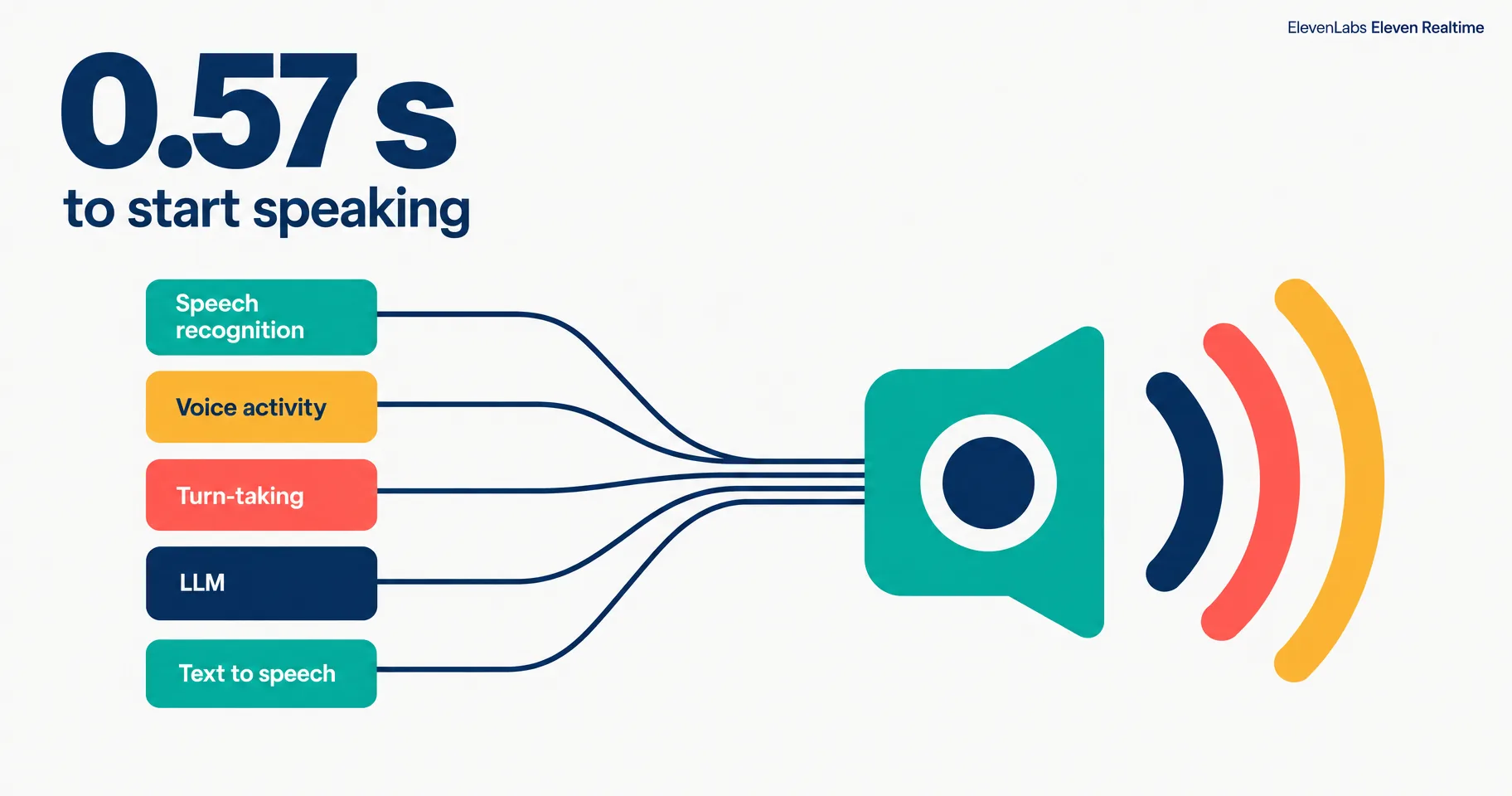
ElevenLabs has launched Eleven Realtime, two speech-to-speech models that each work as a complete voice agent: audio goes in, a spoken answer comes out, with no separate transcriber, language model and voice to wire together. The launch post carries a publish time of 12:00 UTC on October 20, 2026, and ElevenLabs announced it on X at 14:25 UTC.
The pitch in one line from ElevenLabs: “Each model is a complete voice agent, optimized for separate use cases.” This page reads the launch post directly, scores included.
On this page · 8 sectionsOpen
 ElevenLabs launched Eleven Realtime on October 20, 2026: two speech-to-speech models, v1 Mini and v1 Max, each a complete voice agent in one model.
 On Big Bench Audio, Max answered 98.8% of 1,000 spoken reasoning questions correctly and Mini 75.9%, in Artificial Analysis’s evaluation as reported by ElevenLabs.
 Max starts speaking in 0.57 seconds on average and Mini in 0.62 seconds, a little slower than the half second in the launch posts on X.
 Max completed 87.1% of tool-use tasks against 60.3% for Mini, which is why ElevenLabs recommends Max for support and multi-step workflows.
 The API follows OpenAI’s Realtime spec over WebSocket only, and the launch post lists no price.
§ 01What ElevenLabs released
| Model | Built for | Spoken reasoning | Time to start speaking | Tool use |
|---|---|---|---|---|
| Eleven Realtime v1 Mini | Natural conversation at low cost: assistants, teachers, characters | 75.9% | 0.62 s | 60.3% |
| Eleven Realtime v1 Max | Complex tasks: support, lead qualification, multi-step workflows | 98.8% | 0.57 s | 87.1% |
Both models support more than 90 languages and any of the 17,000+ voices in the ElevenLabs library.
§ 02One model instead of a stack
A voice agent today is usually a chain: speech recognition, voice activity detection, turn-taking, a language model and text to speech. ElevenLabs’ description of that work: “Building this stack is a project in itself, and getting all the components to work well together takes more testing and tuning.”

The judgment calls do not disappear, they move inside the model: “how long to wait after a pause before answering, how to recover when the user interrupts the agent.” In ElevenAgents, ElevenLabs’ hosted platform, those stay as settings you can adjust.
§ 03The numbers
All scores come from Artificial Analysis’s tests, as ElevenLabs reports them. Big Bench Audio asks 1,000 reasoning questions by voice and scores the spoken answer. On Full-Duplex-Bench, which tests pauses, turn-taking, interruptions and backchannels, Mini scores 95.8% and Max 94.1%, so the cheaper model is slightly better at the rhythm of conversation. In the Speech Agent Arena’s blind live comparisons, Max scored 998 and Mini 988.
The gap that matters for business use is tool calling: 87.1% for Max against 60.3% for Mini, “which is why we recommend Max for use cases with heavy tool calling.”

One number to read carefully. The launch post on X says the agent “starts talking in half a second,” and Mati Staniszewski’s post says “under half a second.” The blog’s measured averages are 0.57 seconds for Max and 0.62 seconds for Mini, both a little over half a second.
§ 04How you use it
Two routes. In ElevenAgents, you pick a Realtime model from a dropdown and get the platform’s phone, web, WhatsApp and contact-center channels, workflows, knowledge base, guardrails, testing and monitoring.
Developers can also call the Realtime API directly. “Ours is compatible with OpenAI’s Realtime API, so trying Eleven Realtime simply means changing the endpoint and model name in the code you might already have.” The catch: “The Realtime API connects over WebSocket only, so a WebRTC integration needs to move to WebSocket first.” The API also runs separately from ElevenAgents, so channels and the knowledge base come only with the hosted platform.
§ 05Same day, two answers
Mistral shipped Voxtral 3 the same morning, and the two launches take opposite bets. Voxtral is a parts kit: separate transcription and speech models joined by an SDK, with the reasoning model of your choice in the middle, priced per minute and self-hostable. Eleven Realtime is one model with the loop inside it, priced (when ElevenLabs says) as a single service. Parts give you control of each stage; one model removes the plumbing.
§ 06What is not on the record
- A price for either model. The launch post gives none.
- Artificial Analysis’s own pages for these results; the scores here are as ElevenLabs reports them.
- How the models perform on phone lines, where audio is compressed and latency adds up.
§ 07What we are watching for
- Eleven Realtime prices on ElevenLabs’ pricing page.
- Independent leaderboard entries that place the models against OpenAI’s and Google’s realtime voices.
- WebRTC support, which the post says the API lacks today.
§ 08Sources
- ElevenLabs, Introducing Eleven Realtime: a simpler way to build natural voice agents, Min Kim, October 20, 2026, 12:00 UTC. Read directly.
- ElevenLabs on X, launch post, October 20, 2026, 14:25 UTC.
- Mati Staniszewski on X, launch post, October 20, 2026.
- Our records on Mistral Voxtral 3 and Eleven v4.
Q1When did ElevenLabs launch Eleven Realtime?
October 20, 2026. The blog post carries a publish time of 12:00 UTC, and ElevenLabs announced it on X at 14:25 UTC.
Q2How much does Eleven Realtime cost?
The launch post does not say. Check ElevenLabs’ pricing page before you build a business case on it.
Q3Can I use it with code written for OpenAI's Realtime API?
ElevenLabs says yes: change the endpoint and model name and OpenAI’s SDK works as is. It connects over WebSocket only, so a WebRTC setup has to move to WebSocket first.
Q4How is it different from Mistral's Voxtral 3, released the same day?
Voxtral 3 is a set of parts (transcription, a language model you choose, speech) joined by an SDK. Eleven Realtime puts the whole loop in one model. Parts give control; one model gives simplicity.
Q5Does CellCog use Eleven Realtime?
No. CellCog’s agent tiers run on Claude Opus 5.5, and its AI employees’ meeting and phone voice runs on another vendor’s live voice model. We follow voice models because they decide how an AI employee sounds on a call.