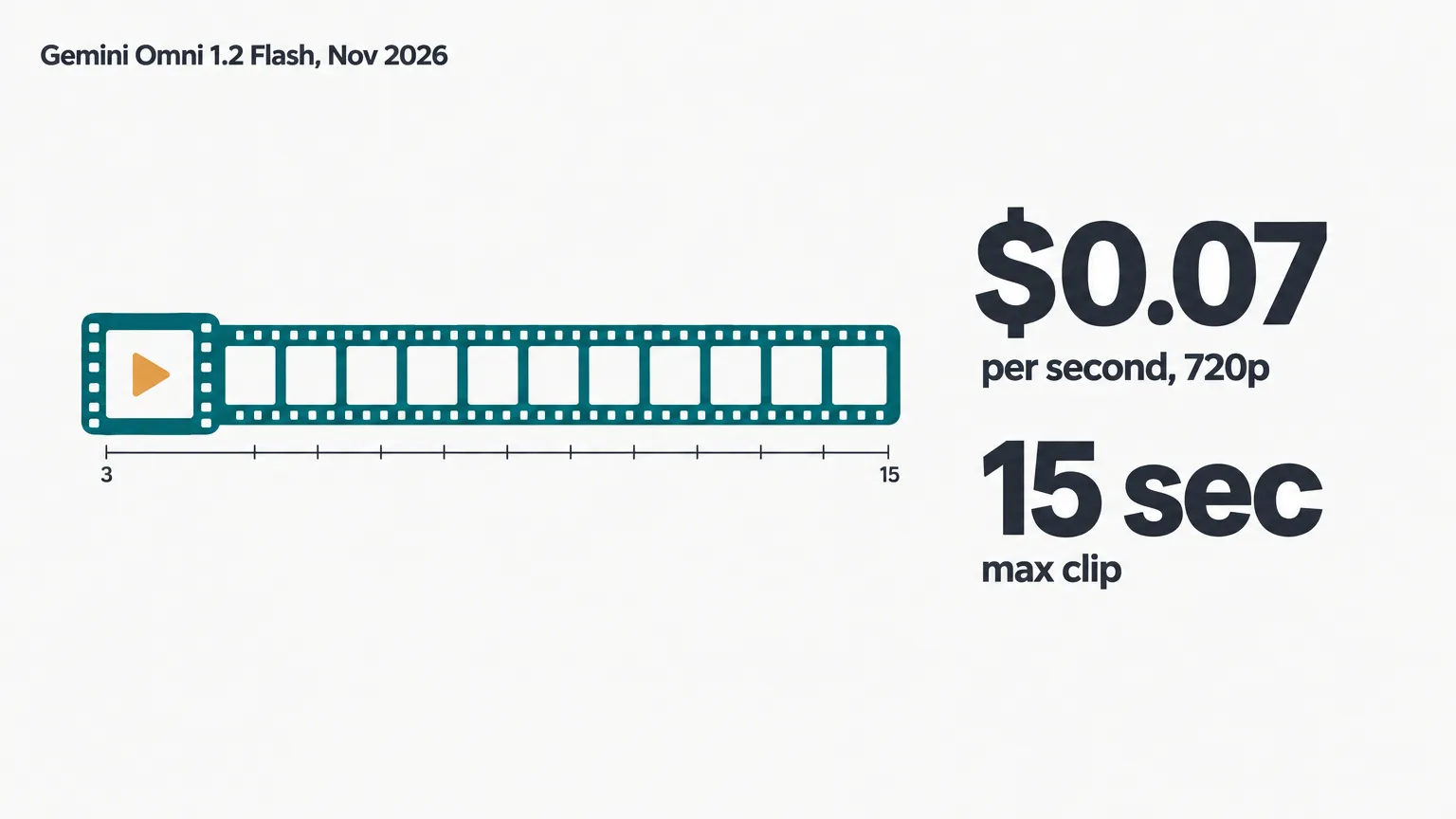
Google shipped a video model on the same day as OpenAI’s GPT-6 Cyber and Perplexity’s teammates, and the headline for anyone making video is the price. On November 5, 2026 Google made Gemini Omni 1.2 Flash generally available, cut its price 30% to $0.07 a second for 720p, and raised the clip length to 15 seconds. This page is read from Google’s announcement and its post on X.
Google’s own framing: “Gemini Omni 1.2 Flash introduces native 15-second video creation, multi-turn conversational editing capabilities, and enhanced reference following.”
On this page · 6 sectionsOpen
 Google made Gemini Omni 1.2 Flash generally available on November 5, 2026, on the Gemini API and Google Cloud, with a SynthID watermark on every output.
 Clips now run up to 15 seconds, up from 10, in 1-second steps from 3 to 15 seconds.
 The price drops 30% to $0.07 a second for 720p, so a full 15-second clip costs about $1.04; existing Omni 1.1 calls route to 1.2 rates from December 3.
 Reference following is stronger: faces, garments, packaging text and brand colors hold across camera angles from the first frame to the last.
 You can edit a clip in conversation, swapping a product, background, lighting or aspect ratio turn by turn instead of re-generating the whole clip.
 It is available to developers on the API and Google Cloud, and to users in Flow, Google Vids and the Gemini app, 15-second clips rolling out to Google AI Ultra.
§ 01What changed
| Omni 1.1 Flash | Omni 1.2 Flash | |
|---|---|---|
| Max clip length | 10 seconds | 15 seconds (3 to 15, in 1-second steps) |
| Price, 720p | $0.10 a second | $0.07 a second |
| Editing | regenerate the clip | multi-turn conversational edits |
| Reference inputs | images | character, product and style images, motion clips up to 3s, audio cues |
The price cut is the lever. At $0.07 a second, a full 15-second 720p clip is about $1.04, and you can draft at 360p or 720p, fix one detail with a follow-up edit instead of re-rendering, then upscale the keeper to 1080p or 4K. Google says existing 1.1 calls route to 1.2 rates from December 3.
§ 02The two features that matter for product work
Google spent most of the announcement on consistency, which is what separates a demo from a usable ad. It says 1.2 holds “faces, garments, packaging typography, and brand colors” consistent across camera angles, and keeps “stronger character, object, and scene consistency from the first to the last frame, with less visual drift or morphing.” You can feed it a model photo plus front-and-back product shots and get a 15-second virtual try-on with the garment’s cut and back details intact.
The second is editing in conversation. Instead of re-briefing from scratch, you refine one clip turn by turn, swapping a product, a background, the lighting or the aspect ratio, “across full 15-second clips” to spin out ad variants for different placements. Google also claims more natural multi-speaker dialogue with clearer lip-sync, and steadier continuous camera moves with fewer unwanted jump cuts.
§ 03Where you reach it, and who gets it
Gemini Omni 1.2 Flash is generally available on the Gemini API and Google Cloud for developers and businesses, with Provisioned Throughput and a SynthID watermark on every output. In Google’s own apps, you direct scenes and multi-turn edits in Flow, generate 15-second clips at no extra cost in Google Vids, and create 15-second videos in the Gemini app, rolling out to Google AI Ultra subscribers.
§ 04Where CellCog sits
Our conflict, declared: CellCog is an AI employee platform, and our employees generate video, so this is a model our own stack weighs. We have run head-to-heads on reference-to-video quality (our Seedance 2.5 vs Kling 4.0 test), and the questions are the same for Omni 1.2: does the consistency hold outside Google’s chosen demos, and does the 15-second length survive a real brief. The price is the clearest part; the quality is for independent tests.
§ 05What is not established yet
- Independent quality tests. Google’s consistency claims are its own demos; no third party has published results.
- 1080p and 4K pricing. Early reads put upsampled 1080p near $0.104 a second, but Google’s page prices only 720p.
- The Gemini app rollout. 15-second clips are limited to Ultra subscribers, rolling out.
- Weak spots. Google names fast sports action, rapid script changes and complex physics as still in development.
§ 06Sources
- Google, Gemini Omni 1.2 Flash, November 5, 2026.
- Google AI on X, announcement, November 5, 2026, 17:08 UTC.
- Our Seedance 2.5 vs Kling 4.0 test, read from both models on our own account.
Q1When did Google release Gemini Omni 1.2 Flash?
On November 5, 2026, when Google made it generally available on the Gemini API and Google Cloud and posted the announcement on X at 17:08 UTC.
Q2What is new in Gemini Omni 1.2 Flash?
Native 15-second clips, a 30% price cut, multi-turn conversational editing, stronger reference consistency across frames, more natural multi-speaker speech and fewer jump cuts.
Q3Where can I use Gemini Omni 1.2 Flash?
Developers use it on the Gemini API and Google Cloud. In Google’s apps it powers Flow, Google Vids and the Gemini app, with 15-second clips rolling out to Google AI Ultra subscribers.
Q4Does the output carry a watermark?
Yes. Google says every output carries an imperceptible SynthID watermark, and Provisioned Throughput is available for production use.
Q5Where does CellCog fit?
CellCog is our product, an AI employee platform whose employees generate video, so Omni 1.2 is a model our own stack weighs against alternatives like Seedance and Kling.