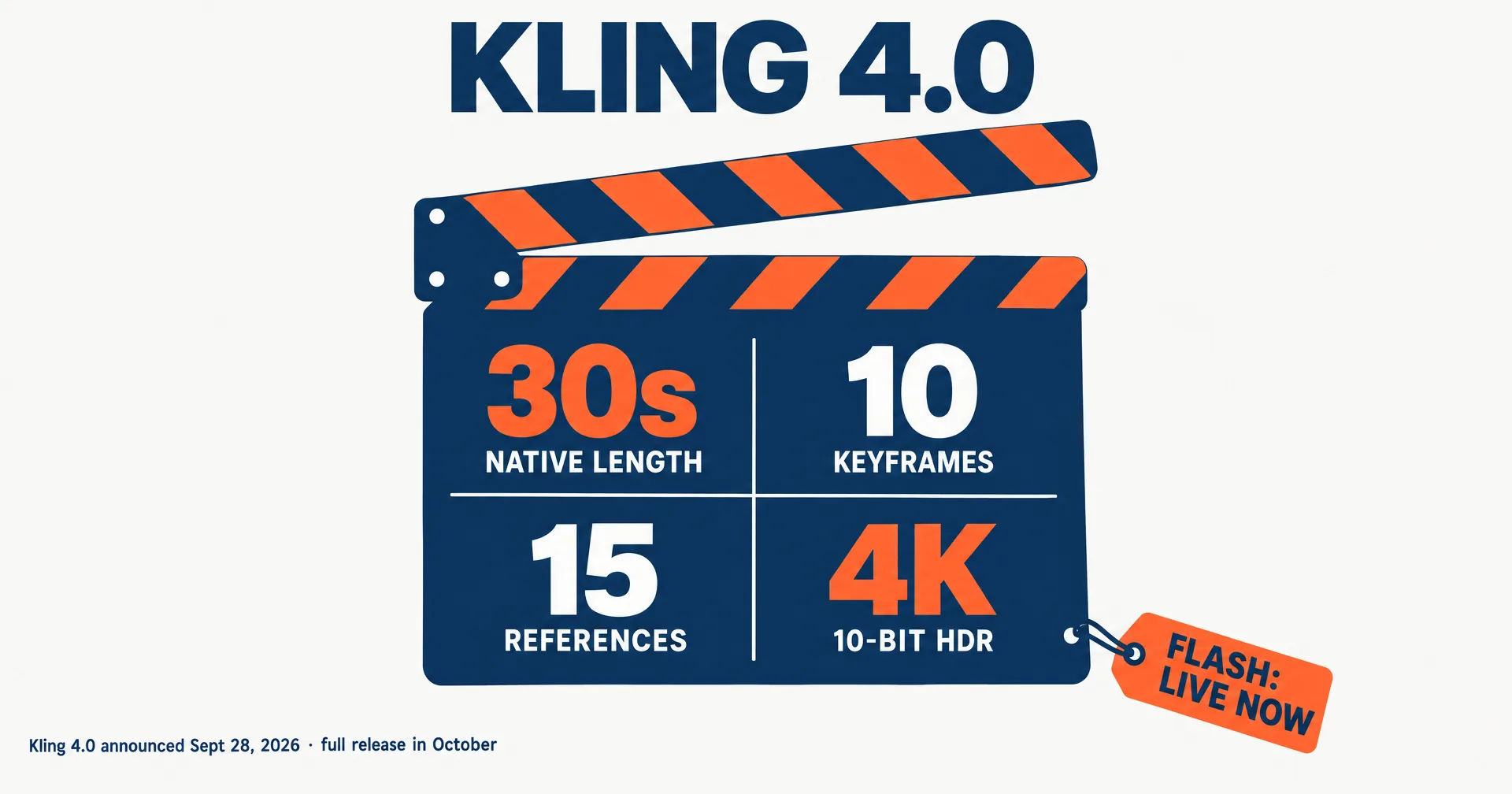
Update, October 28: the Kling 4.0 API is live. Kling’s API notice says the “Kling 4.0 API Is Now Fully Available, with Native Video Generation up to 30s”, on three request paths: text-to-video, image-to-video and omni reference-to-video. Output runs at 720p or 1080p, the omni endpoint can reference a voice, and 4K in the API is still marked coming soon. At Kling’s list rate, a 30-second 1080p clip with no input video costs $7.05.
Kling 4.0 is out. Kling made the full model available on October 15, 2026. At 15:00 UTC it posted “KLING 4.0 Is Now Fully Available” on X, with access on kling.ai and “through MCP and CLI for greater flexibility in your video creation workflow.” Two items stay on the “Coming Soon” list: “10-bit HDR video output at 4K and 1080p resolutions” and “API access for enterprise customers and developers.”
The specs below come from Kling’s own release note for 4.0. The September 28 announcement record follows them.
On this page · 9 sectionsOpen
- Kling made Kling 4.0 fully available on October 15, 2026, per its post on X at 15:00 UTC. It first announced the model on September 28, when only Flash was open.
- Clips run 3 to 30 seconds at 720p, 1080p or 4K, in 21:9, 16:9, 1:1 or 9:16, with two-channel stereo sound, per Kling’s release note.
- One generation takes up to 15 references in total: at most 10 images, 5 videos (30 seconds combined) and 7 subjects, plus up to 10 keyframes.
- Kling 4.0 Flash runs 3 to 20 seconds at 720p in 8-bit SDR. The full model’s 10-bit HDR at 1080p and 4K, and extension to 2 minutes, are marked coming soon.
- Access is through kling.ai, MCP, CLI and, since October 28, the API, at $0.157 a second for 720p and $0.235 for 1080p with no input video.
§ 01The API and its prices, from October 28
Kling opened the 4.0 API thirteen days after the apps. Prompts take up to 26,000 English characters, a task takes up to 15 inputs (at most 10 images and 5 videos), and the 21:9 and adaptive aspect ratios are new to the API. Billing is per second of total duration, and Kling 4.0 lists no 4K rate yet.
| Model and input | 720p | 1080p | 4K |
|---|---|---|---|
| Kling 4.0, no input video | $0.157 | $0.235 | Not listed |
| Kling 4.0, with input video | $0.094 | $0.141 | Not listed |
| Kling 3.0 with native audio, for comparison | $0.126 | $0.168 | $0.42 |
The lower rate with an input video is not a discount. When the input video is shorter than the output, Kling bills the output length twice; when it is longer, Kling bills input plus output. A 30-second 1080p clip guided by a 10-second reference video therefore lists at $8.46, more than the same clip with no video at all. Reference images do not change the rate.

§ 02Kling 4.0 specs, from the release note
| Spec | Kling 4.0 | Kling 4.0 Flash |
|---|---|---|
| Length per generation | 3 to 30 seconds | 3 to 20 seconds |
| Resolution | 720p, 1080p, 4K | 720p |
| Dynamic range | 10-bit HDR at 1080p and 4K (coming soon) | 8-bit SDR |
| Aspect ratios | 21:9, 16:9, 1:1, 9:16, smart | Not listed |
| Keyframes | Up to 10 | First frame only |
| References | Up to 15 in total | Supported, no count given |
| Prompt length | Up to 8,000 tokens | Not listed |
| Audio | Two-channel stereo | Not listed |
The reference cap is a total. One task can mix at most 10 images, 5 videos with 30 seconds combined, and 7 subjects (a subject can carry a voice), up to 15 inputs in all. Video editing takes up to 5 clips, one of them the main video, with 30 seconds combined. Text in frame renders in Chinese, English, Japanese, Korean, Spanish, Portuguese, German, French and Hindi, and the release note marks extending a video to 2 minutes as coming soon.
Kling also rebuilt its creation page around one input box, a timeline for editing while previewing, and a canvas where an agent can call tools for you. Its MCP server and CLI cover 4.0’s omni reference and keyframe modes, so another agent can drive Kling 4.0 directly.
§ 03The September 28 announcement
Kling put a month on its next model. At 15:38 UTC on September 28, 2026, Kling AI posted that “Kling 4.0 is coming this October” and that “Kling 4.0 Flash is live now for Ultra Yearly subscribers.” Its homepage already leads with “All-New Kling 4.0” and pitches it as professional-grade production.
This page is read from Kling’s own post and site. Where Kling did not say something, we say so.
§ 04What Kling announced
The announcement lists four groups of changes: audio and visuals, references, storytelling, and languages. In Kling’s words, the model brings “up to 4K resolution, and 10-bit HDR output”, “up to 15 multi-modal references”, “Multi-keyframe control supporting up to 10 keyframes” and “native 30-second generation.”
| Feature | Kling 3.0 | Kling 4.0 (Sept 28 announcement) |
|---|---|---|
| Length per generation | 3 to 15 seconds (VIDEO 3.0 guide) | Native 30 seconds, plus video extension |
| References | Not given as one count in the 3.0 guides | Up to 15 multi-modal references |
| Keyframes | Not stated in the 3.0 guides | Up to 10 |
| Resolution | Native 4K in the 3.0 series | Up to 4K, 10-bit HDR |
| Audio | Native audio-visual output | Stereo audio, more accurate lip sync |
| Languages | Five languages, dialects and accents | Multiple languages, accents and dialects |
The length is the headline. A 15-second ceiling means most ads and short films are stitched from clips; 30 seconds covers a full spot in one generation. Ten keyframes is the control that makes that length usable, because it lets a director pin where the shot goes rather than hoping the model gets there.
§ 05What is live today
Almost everything. Kling 4.0 and Kling 4.0 Flash are both live on kling.ai and through MCP and CLI since October 15, and the Kling 4.0 API since October 28. Still marked coming soon: 10-bit HDR at 1080p and 4K, 4K in the API, and extension to 2 minutes.
§ 06What Kling did not say
- App price. The API has per-second rates since October 28; the October 15 post and the release note give no price for 4.0 on kling.ai.
- 4K rate. The API price table has no 4K figure for 4.0 yet.
- Benchmarks. No comparison against other video models.
§ 07Where CellCog sits
Our conflict, declared: CellCog’s video agent runs on Seedance 2.5 today, and it assembles longer films from segments with native audio. We do not route to Kling. We track new video models as candidate engines, and with the Kling 4.0 API open since October 28, it joins the engines we track. Nothing in our routing changes today. Our records of Seedance 2.5 and character consistency and of MiniMax H3 Max sit next to this one.
Choosing a tool for a business’s video, and not a model? Our ranked list of eight AI content creator tools compares them on video, graphics and posts, with prices read on October 21, 2026. We wrote that list, and we rank CellCog, an AI employee platform, first on it.
§ 08What we are watching for
- A 4K rate and 10-bit HDR in the Kling 4.0 API.
- Kling 4.0 on hosts like fal and Replicate, and their per-second prices.
- First independent tests of the 30-second and 10-keyframe claims.
§ 09Sources
- Kling AI on X, Kling 4.0 announcement, September 28, 2026, 15:38 UTC, read 16:28 UTC.
- Kling, klingai.com, read September 28, 2026, 16:31 UTC.
- Kling, VIDEO 3.0 user guide and VIDEO 3.0 Omni user guide.
- Kling, API update notice, October 28, 2026, read October 29, 2026.
- Kling, API video pricing, read September 28 and October 29, 2026.
Q1When did Kling 4.0 launch?
Kling 4.0 went fully live on October 15, 2026. Kling announced it on September 28, when Kling 4.0 Flash opened to Ultra Yearly subscribers first.
Q2How long can a Kling 4.0 video be?
3 to 30 seconds per generation for Kling 4.0 and 3 to 20 seconds for Flash, per Kling’s release note. Extending a video to 2 minutes is marked coming soon.
Q3How many references does Kling 4.0 take?
Up to 15 in total per task: at most 10 images, 5 videos with 30 seconds combined, and 7 subjects, per Kling’s release note.
Q4Does Kling 4.0 cost more?
On the API, $0.157 a second at 720p and $0.235 at 1080p with no input video, per Kling’s pricing page on October 29, so a 30-second 1080p clip lists at $7.05.
Q5Does CellCog use Kling?
No. CellCog’s video agent runs on Seedance 2.5 today. We track new video models as candidate engines and test them when they are available to us.