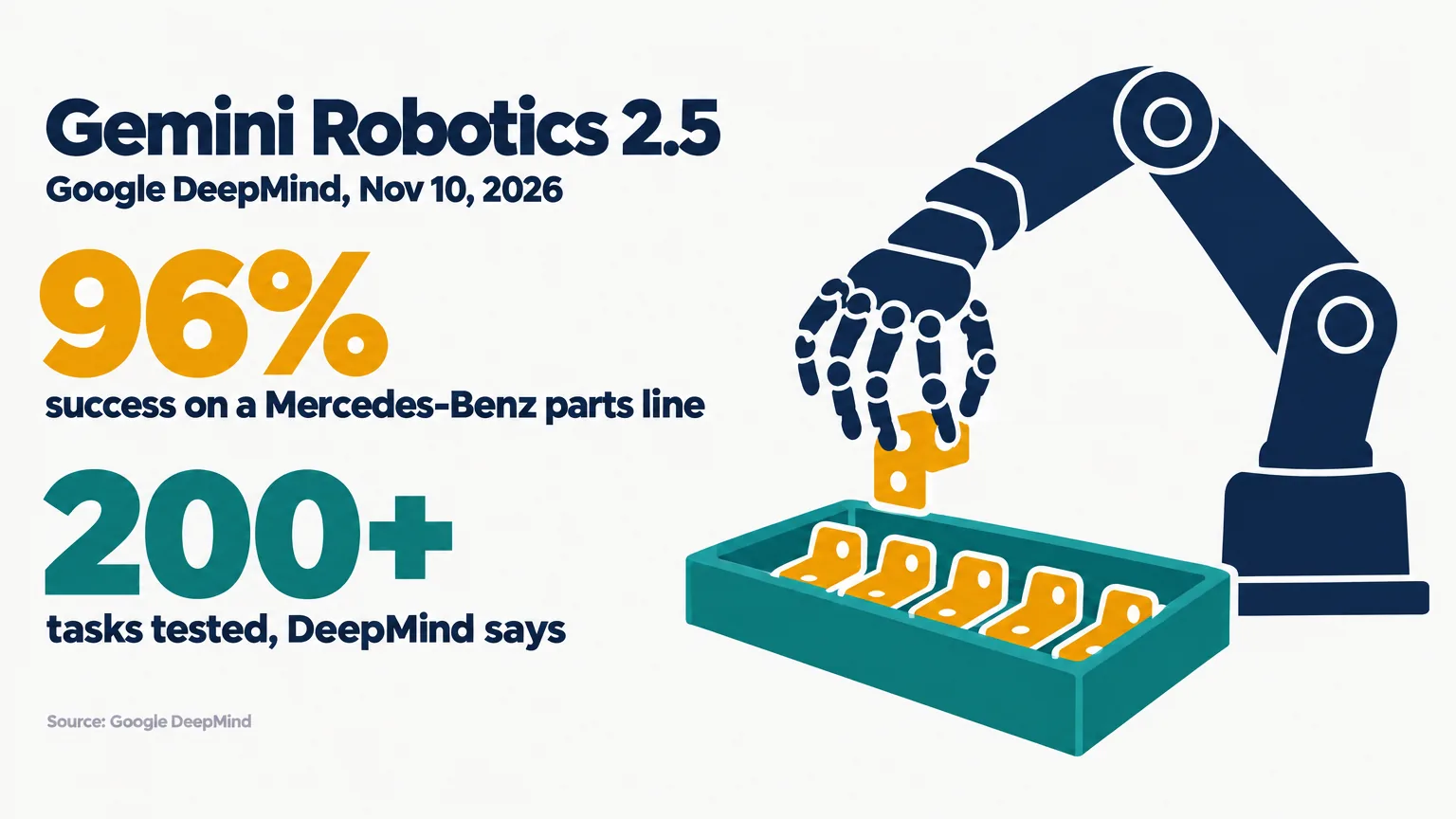
Google DeepMind introduced Gemini Robotics 2.5 on November 10, 2026. The announcement calls it “our most capable vision-language-action (VLA) model to date”. A VLA model takes what a robot sees and what it is told, and turns that into movement.
DeepMind gives two headline numbers. In its own tests the model handled over 200 tasks. On Mercedes-Benz production lines, a humanoid robot running it picked and packed car parts with a 96% success rate. DeepMind says it is rolling out to robotics partners, and the post names no public release. This page sets out the numbers, where they come from, and what the post leaves out.
On this page · 9 sectionsOpen
 Google DeepMind introduced Gemini Robotics 2.5 on November 10, 2026. It calls it its most capable vision-language-action model, the kind that turns what a robot sees and is told into movement.
 DeepMind tested it on over 200 tasks and reports a 30% to 100% higher success rate than earlier baselines, with tasks finished 20% to 30% faster. It does not name the baselines.
 On Mercedes-Benz production lines, Apptronik’s Apollo 2 humanoid picked and packed car parts with a 96% success rate. DeepMind calls it a proof of concept.
 A new safety benchmark, ASIMOV-Jailbreak, shows 99.5% jailbreak resistance. That score belongs to Gemini 4 Argon, a separate Gemini model, not to Gemini Robotics 2.5 itself.
 The model is rolling out to DeepMind’s robotics partners. The post gives no price, no public access and no technical paper.
§ 01What DeepMind announced

The post says the model “increases both the breadth of skills a robot can learn and the speed at which it can acquire them”. DeepMind groups the gains under three words: dexterity, reliability and safety. It thanks three partners for the release: Agile, Apptronik and Mercedes-Benz.
| Item | What DeepMind says |
|---|---|
| Announced | November 10, 2026 |
| What it is | A vision-language-action model that controls robots |
| Tasks tested | Over 200 distinct tasks |
| Success rate | 30% to 100% higher than previous baselines, depending on the task |
| Speed | Tasks completed 20% to 30% faster |
| Factory pilot | 96% success rate picking and packing car parts on Mercedes-Benz lines |
| Robots named | Apptronik’s Apollo 2 humanoid and the Franka Duo two-arm platform |
| Safety | Safe task completion up 33% around obstacles and 43% around nearby people |
| Availability | Rolling out to DeepMind’s robotics partners |
| Price | Not stated |
§ 02The lab results
- The task set. DeepMind tested the model “across over 200 distinct tasks, though this approach could scale to many more”. Its examples are “serving food with tongs, tying a bow on a gift box, and pipetting a liquid”.
- The gain. The model “achieves a 30% to 100% higher success rate depending on the type of task, while completing tasks 20% to 30% faster”.
- The comparison. That sentence opens with the words “Compared to previous baselines”. The post does not name the baselines or give their scores, so the success rates themselves are unknown.
- The robots. The model runs on Apptronik’s Apollo 2 humanoid, whose five-finger hand has 22 degrees of freedom, and on the Franka Duo platform with two-fingered grippers.
One wording gap: DeepMind’s post on X says the model is “able to learn hundreds of everyday skills”. The tested figure in the blog post is over 200 tasks.
§ 03The Mercedes-Benz pilot
The reliability claim rests on one pilot. Apptronik’s Apollo 2 humanoid robots worked on active Mercedes-Benz production lines in Kecskemét, Hungary, and Sindelfingen, Germany.
- The job. It is called automotive kitting: “sorting individual parts from bulk bins into organized trays in the exact order needed for each vehicle on the line”.
- The result. The robot could “pick and pack automotive parts with a 96% success rate”.
- Two models, not one. A separate reasoning model, Gemini Robotics ER, kept track of the workflow. Gemini Robotics 2.5 controlled the hands and arms.
- The label. DeepMind calls the pilot a proof of concept. It does not say how many picks the 96% covers.
Apptronik’s chief executive, Jeff Cardenas, is quoted in the post: “we saw the models improve dramatically in just a few weeks of post-training and carry over to Mercedes-Benz production with very little drop-off”.
§ 04Safety, and whose score it is
- Steering around hazards. The model uses what DeepMind calls inference-time reasoning guidance. The post says this “boosted safe task completion around obstacles by 33% and around nearby people by 43%”.
- A new benchmark. DeepMind is releasing ASIMOV-Jailbreak. It describes it as “a new open-source benchmark containing hundreds of prompts that disguise unsafe requests across dozens of scenes”.
- The score. The post reports that “Argon achieves a 99.5% jailbreak resistance”. DeepMind compares that with “the 82% rate of our previous baseline, Gemini Robotics ER 2”.
| Model | Jailbreak resistance |
|---|---|
| Gemini 4 Argon | 99.5% |
| Gemini Robotics ER 2, the previous baseline | 82% |
Read the row labels. The 99.5% belongs to Gemini 4 Argon, a separate Gemini model that DeepMind says leads its agentic robotics evaluations. The post gives no ASIMOV-Jailbreak score for Gemini Robotics 2.5 itself.
§ 05How Gemini 4 Argon helped build it
DeepMind credits part of the progress to another of its models. It says Gemini 4 Argon sped up the work by “acting as a simulation engine”. DeepMind says Argon can “generate thousands of varied, simulated practice runs from a real-world camera scene and build a realistic digital twin”. It also helps researchers work out from video why a task failed.
DeepMind links a companion post on Gemini 4 Argon for robotics for developers. It ends its own post by calling Gemini Robotics 2.5 “an important milestone on the path toward solving physical AGI”.
§ 06What the post does not say
- No price and no public access. The only line on availability is “Gemini Robotics 2.5 is rolling out to our robotics partners”. The post names no price, no API and no date for a wider release.
- No named baseline. The 30% to 100% gain is measured against baselines the post does not name.
- No sample size for the 96%. The post gives the rate, not the number of picks behind it.
- No technical paper. The post links a Gemini 4 safety report. It links no paper on Gemini Robotics 2.5.
- No independent test. Every number on this page comes from DeepMind or its partners.
§ 07What to watch
- ASIMOV-Jailbreak in other hands. DeepMind says the benchmark is open source. Scores from other labs would show how hard it is.
- A production deployment. A proof of concept is a test. A robot kept on the line is a different claim.
- Wider access. Whether the model reaches developers beyond the partner group.
- Outside tests. Results from anyone who is not DeepMind, Apptronik or Mercedes-Benz.
Related on this blog: Ring Robotics: Amazon’s Drone Cam and Rover Cam, Explained and LingBot-Touch: An Open Touch Model for Robot Hands.
§ 08Where CellCog sits
CellCog builds AI employees that do computer work: research, writing, analysis and outreach. It does not build or run robots, and it has not tested Gemini Robotics 2.5. Nothing on this page rates the model.
§ 09Sources
- Google DeepMind, Gemini Robotics 2.5 accelerates real-world general dexterity, November 10, 2026
- Google DeepMind, announcement on X, November 10, 2026, 15:00 UTC
- Google DeepMind, Gemini Robotics model page, read November 10, 2026
- Google, Gemini 4 Argon for robotics, the companion post linked from the announcement, not read for this page
- Google DeepMind, Gemini 4 safety report, linked from the announcement, not read for this page
Q1What is Gemini Robotics 2.5?
Gemini Robotics 2.5 is a vision-language-action model that Google DeepMind introduced on November 10, 2026. It controls robots. DeepMind calls it its most capable model of this kind and says it raises both how many skills a robot can learn and how fast it learns them.
Q2What results did DeepMind report for Gemini Robotics 2.5?
DeepMind says it tested the model on over 200 distinct tasks and saw a 30% to 100% higher success rate than previous baselines, with tasks completed 20% to 30% faster. It does not name the baselines or give their scores.
Q3What happened in the Mercedes-Benz pilot?
Apptronik’s Apollo 2 humanoid robots sorted car parts into trays on Mercedes-Benz production lines in Hungary and Germany. DeepMind reports a 96% success rate and calls the pilot a proof of concept. It does not say how many picks the rate covers.
Q4What is ASIMOV-Jailbreak?
ASIMOV-Jailbreak is an open-source benchmark DeepMind says it is releasing. It holds hundreds of prompts that disguise unsafe requests to a robot. DeepMind reports 99.5% jailbreak resistance for Gemini 4 Argon, against 82% for Gemini Robotics ER 2.
Q5Can developers use Gemini Robotics 2.5?
Not by any route the post names. DeepMind says the model is rolling out to its robotics partners. The post gives no price, no API and no date for a wider release.
Q6Does CellCog use Gemini Robotics 2.5?
No. CellCog, which publishes this blog, builds AI employees that do computer work. It does not build or run robots and has not tested Gemini Robotics 2.5.