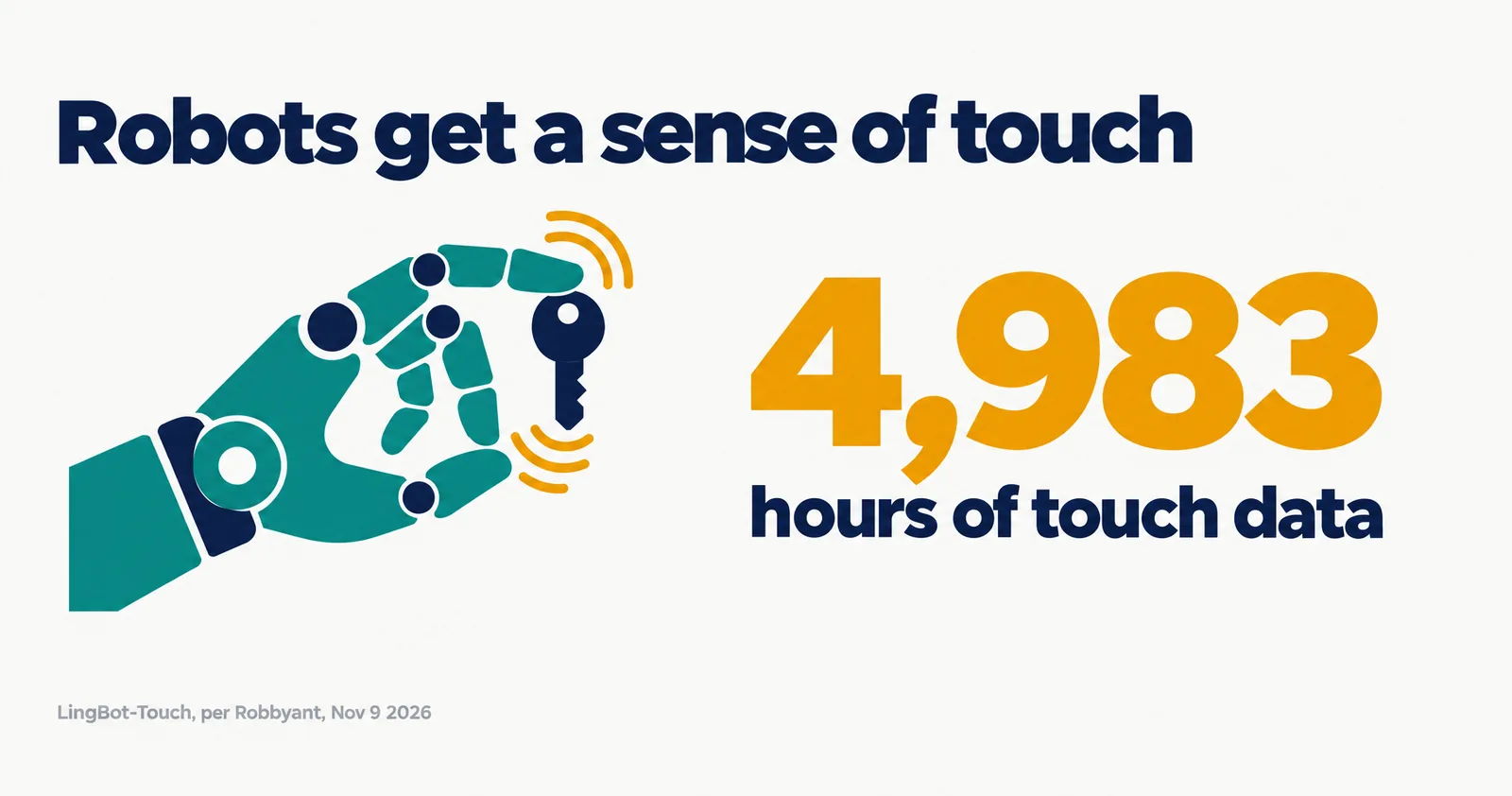
Robbyant, the robotics company under Ant Group, has released LingBot-Touch, an open model that gives robot hands a sense of touch. It was trained on 4,983 hours of touch recordings from three kinds of sensor, per the project page. Robbyant says adding it to four different robot control models raised their success on real tasks by 14 to 26 percentage points.
The company’s launch post on X, on November 9, 2026, had about 685,000 views by 08:05 UTC the next day. It describes a model “pretrained on nearly 5,000 hours of real tactile data”. Every result below is Robbyant’s own. Nobody outside the company has reproduced them yet.
On this page · 7 sectionsOpen
 Robbyant, a robotics company under Ant Group, released LingBot-Touch on November 9, 2026: an open model that turns touch sensor signals into tokens a robot control model can read.
 It was trained on 4,983 hours of touch recordings, 464,431 episodes and about 1.33 billion frames, from piezoresistive, magnetic and visuotactile sensors.
 Robbyant reports 14 to 26 percentage points more task success on 26 real-robot tasks across four control models, and 69% success in simulation against 21% with no touch.
 The code is under Apache 2.0. The repository holds the frozen encoder and inference code. The README does not mention training code or the training data.
 The results are Robbyant’s own. Its report says more robot hands need testing, capacitive sensors are missing and the palm is underrepresented.
§ 01What LingBot-Touch is

Most robot models see. A camera tells a robot where an object is. It does not tell the robot how hard it is gripping, or whether a key has seated in a lock. Touch sensors can, but each kind of sensor produces a different signal, so a model trained on one usually does not work with another.
LingBot-Touch is an encoder that sits between the sensors and the robot’s control model. It takes signals from three sensor families and turns them into one shared set of touch tokens:
- Piezoresistive sensors, whose electrical resistance changes under pressure: 2,197 hours, 86,906 episodes.
- Magnetic sensors, which track a small magnet under a soft skin: 1,136 hours, 294,871 episodes.
- Visuotactile sensors, which point a camera at a soft surface from behind: 1,650 hours, 82,654 episodes.
The control model reads those tokens next to its camera input. The encoder stays frozen, so the same one can be added to different robots and different control models. Robbyant describes itself as “An embodied AI company under Ant Group, building one brain for all robots.”
| Question | Answer |
|---|---|
| What it is | A touch encoder for robot hands |
| Who made it | Robbyant (Shanghai Ant Robbyant Technology Co., Ltd.), under Ant Group |
| Released | November 9, 2026 |
| Training data | 4,983 hours, 464,431 episodes, about 1.33 billion frames |
| Sensor types | Piezoresistive, magnetic, visuotactile |
| Sizes | Tiny and Small. The Tiny encoder has 5.46 million parameters |
| Method | Predicts hidden parts of the touch signal in a learned space (JEPA), with one shared transformer |
| License | Apache 2.0 |
| What is released | A technical report, the frozen encoder and inference code |
§ 02What Robbyant reports
On real robots. Robbyant tested 26 tasks on two robot hands, Sharpa Wave and XHand. The project page gives the method in one line: “Mean success rate over all 26 tasks on both dexterous hands, 20 trials per task.” The tasks include unlocking with a key, dispensing toothpaste and sealing a resealable bag. Four control models were tested: Diffusion Policy, π0.5, LingBot-VLA and T-Rex.
The headline result, from the X thread: “Average task success gains across the four action models ranged from approximately 14 to 26 percentage points over the no-touch baseline.” The technical report adds the fairer comparison. Giving the robot touch data without the encoder helps less: “feeding the same policies raw tactile signals yields at most about half that gain”.
In simulation. Across 12 simulated tasks, with three training runs each, a robot learning from LingBot-Touch features succeeded on 69% of attempts. With features from a touch model built for the single task it was 46%. With no touch it was 21%.
Reading touch itself. The report also tests what the encoder knows about contact, against an earlier touch model called FTP-1. Lower is better in the first four rows.
| Test | LingBot-Touch | FTP-1 |
|---|---|---|
| Fingertip force error | 0.81 N | 2.31 N |
| Contact location error | 0.12 mm | 2.19 mm |
| Contact area error | 0.66 points | 2.90 points |
| Future force error | 1.04 N | 1.67 N |
| Matching touch to video, top-5 recall | 72.6% | 16.5% |
§ 03What is open, and what is not
- The license is permissive. The GitHub repository, created on November 9, is under Apache 2.0. Robbyant’s thread says “Technical report, models & code are open source”.
- It is an inference release. The README says: “This repository provides the frozen target encoder and utilities for extracting token-level tactile features and their spatiotemporal addresses.” It does not mention training code or the 4,983 hours of training data.
- Model access. The weights are on Hugging Face and ModelScope. The README says “Access requires an account with permission to the model repository.” When we checked Hugging Face on November 10, both models were listed as public.
- The report is a company document. It is a PDF in the repository, not a peer-reviewed paper. The README notes “The BibTeX entry will be added when the paper is available.”
§ 04The limits the report names
Robbyant’s report lists three:
- More hands. It says “real-world and simulation experiments need to be conducted using a wider variety of hand embodiments”.
- A missing sensor type. “Capacitive sensors are currently absent from pretraining”.
- Fingertips only. The training layouts focus on the fingertips, “leaving contacts on the palm and elsewhere along the fingers underrepresented”.
Two more from us. Every number here is self-reported. And 20 trials per task is a small sample: one or two lucky runs move a task’s score by 5 to 10 points.
§ 05What to watch
- Reproductions by labs outside Robbyant, on hands other than Sharpa Wave and XHand.
- Whether the training code or the touch dataset is released.
- Capacitive sensors and palm coverage in a later version.
Related on this blog: Nvidia GR00T 2 at CoRL and the RoboSpoof camera attack study.
§ 06Where CellCog sits
CellCog does not build robots. Its AI employees work in software: research, code, documents and calls. We cover robotics because the same pattern is arriving there: one pretrained model, reused across many machines.
§ 07Sources
- Robbyant, LingBot-Touch project page, read November 10, 2026
- Robbyant, technical report (PDF), Learning Heterogeneous Tactile Representation for General Dexterous Manipulation
- Robbyant/lingbot-touch on GitHub, README and license (repository created 09:02 UTC, November 9, 2026)
- Robbyant on X, launch thread (19:11 UTC, November 9, 2026; about 685,000 views at 08:05 UTC on November 10)
- LingBot-Touch models on Hugging Face
Q1Is LingBot-Touch open source?
The code is under Apache 2.0 and the weights are on Hugging Face and ModelScope. The repository is an inference release: the README does not mention training code or the training data.
Q2Which robots was it tested on?
Two robot hands, Sharpa Wave and XHand, on 26 real tasks with 20 trials each, plus 12 simulated tasks, per Robbyant.
Q3Who is Robbyant?
Robbyant is an embodied AI company under Ant Group. Its legal name is Shanghai Ant Robbyant Technology Co., Ltd.
Q4What are the limits?
The report names three: more robot hands need testing, capacitive sensors are absent from the training data, and the training layouts focus on fingertips.
Q5Does CellCog use LingBot-Touch?
No. CellCog AI employees work in software, not on robots.