Gemini 4 Argon is now open to anyone who pays for it. On October 13, 2026 at 16:00 UTC Google made it “globally available today for developers and enterprises via the API”, and to Google AI Ultra and Pro subscribers in the Gemini app. Thirteen days earlier, on September 30, 2026, Google announced “our new frontier model, Gemini 4 Argon, which is rolling out to a set of trusted cyber defenders through our Fairwind Program.” Sundar Pichai, Google DeepMind and Logan Kilpatrick posted it on X at about 20:03 UTC.
This page tracked Gemini 4 from its pre-training announcement in July. It is now the release record, read from Google’s announcement by Koray Kavukcuoglu. The dated rumor record stays below.
On this page · 17 sectionsOpen
- October 13: general availability
- What Google launched
- The benchmarks Google cites
- What Google says Argon already does inside Google
- What Google staff told Bloomberg
- What Google staff told Business Insider: Carbon
- What we are watching for now
- The rumor record, before launch
- What we actually know
- What Google has said, word for word
- The rumor chain, dated
- The Gemini 3.5 Pro question
- Why November or December keeps coming up
- What Google did ship this week
- What we are watching for
- The tracker
- Update log
- Gemini 4 Argon became generally available on October 13, 2026: the Gemini API paid tier, AI Studio and Gemini platform, Google Antigravity for AI Ultra, and the Gemini app and AI Mode in Search for AI Ultra and Pro.
- Google announced it on September 30, 2026 for trusted cyber defenders first; general release came 13 days later, with the Fairwind Program expanding to hundreds of additional partners.
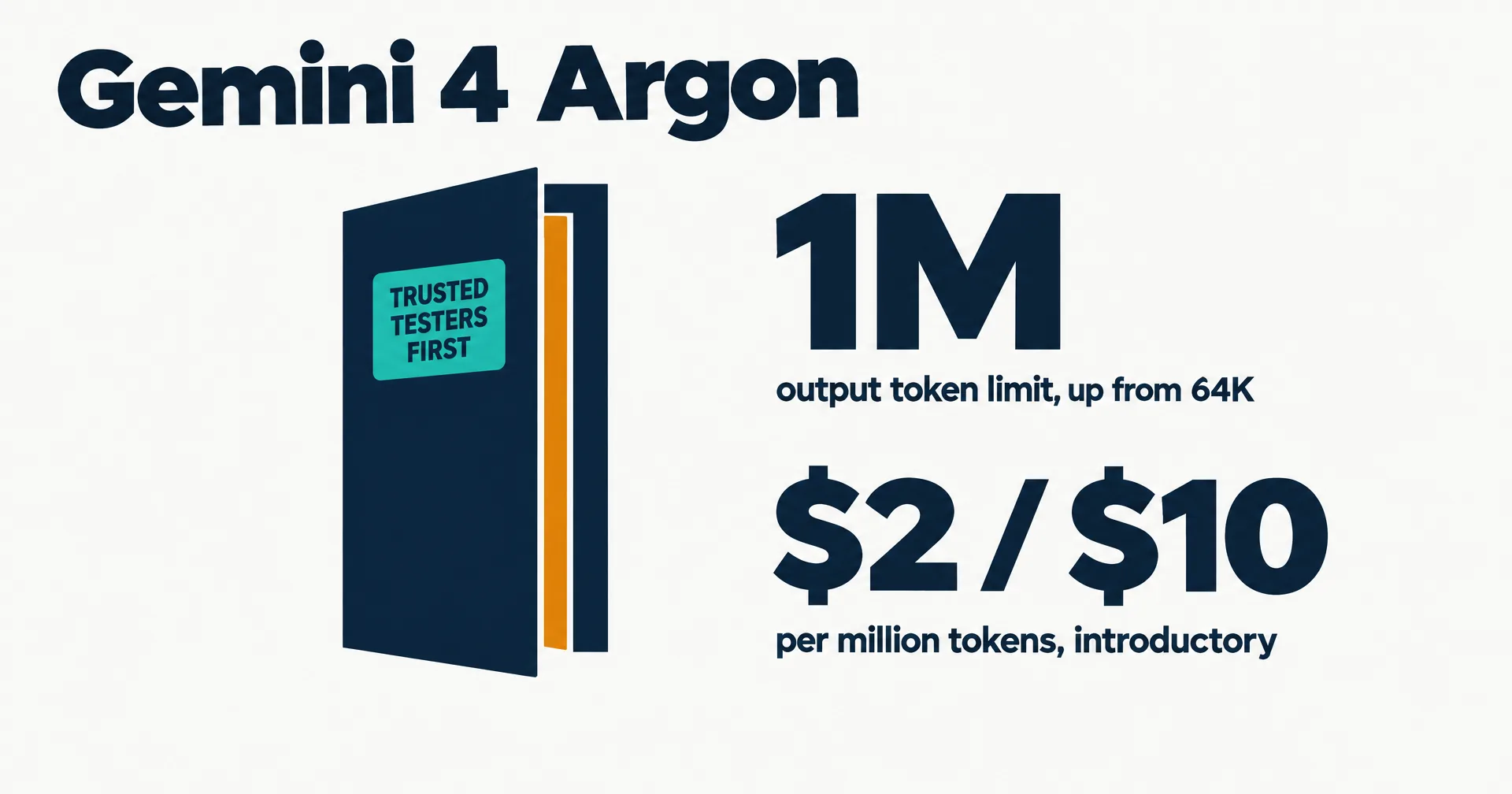
- Introductory API pricing is $2 per million input tokens and $10 per million output tokens, rising to $4 and $20 when the introductory period ends on November 30, 2026.
- The output token limit rises to 1 million tokens, up from 64K.
- Google claims state of the art on DeepSWE v1.1 (77.9%), LVBench (91.7%), first place on AutomationBench (51.3%) and a tie for first on CWE-bench v1 (68%).
- For trusted defenders, Google says Argon ships without cyber guardrails; the rest of this page keeps the dated rumor record that led here.
§ 01October 13: general availability
| Surface | Who gets it |
|---|---|
| Gemini API, AI Studio, Gemini platform | Developers and enterprises on the paid tier |
| Google Antigravity | Google AI Ultra subscribers; enterprises |
| Gemini app and AI Mode in Search | Google AI Ultra and Pro subscribers |
| Fairwind Program | Cyber defenders, expanding to hundreds of additional partners, without cyber guardrails |
| OpenRouter | Listed as google/gemini-4-argon at 16:04 UTC, 1,048,576-token context, $2/$10 |
The introductory price holds: $2 per million input tokens and $10 per million output, cached input 95% off, until the introductory period “expires on November 30, 2026”, after which $4 and $20 apply. Google calls the output side an “industry-leading 1M unified input-output token limit” through the Gemini API, reached with a new continuation protocol.
| Claim | Google’s figure |
|---|---|
| Vals Index (finance, coding, legal, tax) | #1 |
| Embodied Reasoning (ERQA) | 87%, ahead of all other frontier models |
| Gray Swan indirect prompt injection | 0.7% attack success across 15 adaptive attempts |
| Shortcut attempts on coding benchmarks | 2%, lowest of any Gemini model |
| Antigravity for scientists | Top usage tier free for 6 months, 10,000 places |
All of these are Google’s own numbers, read from its announcement by Koray Kavukcuoglu. Google closes with “Gemini 4 Argon is just the beginning”, the first sign of more Gemini 4 models; the Carbon report below names one candidate.
§ 02What Google launched
| Item | What Google says |
|---|---|
| Name | Gemini 4 Argon |
| First access, September 30 | Trusted cyber defenders and testers, through the Fairwind Program |
| General release, October 13 | Gemini API paid tier; Antigravity for AI Ultra; Gemini app and AI Mode for AI Ultra and Pro |
| Introductory price | $2 per 1M input tokens, $10 per 1M output tokens; cached input 95% off |
| Price after the intro period | $4 input, $20 output per 1M tokens, from November 30, 2026 |
| Output token limit | 1M tokens, up from 64K |
| Cyber guardrails | Released without them for trusted defenders and internal teams |
Google is careful about the pace: “Safely releasing frontier capabilities at this level requires a phased approach,” and it says it is taking part in the U.S. government’s voluntary process for pre-release model access.
§ 03The benchmarks Google cites
| Benchmark | What it measures | Argon |
|---|---|---|
| DeepSWE v1.1 | Long-horizon software engineering | 77.9%, state of the art |
| LVBench | Long video understanding | 91.7%, state of the art |
| CWE-bench v1 | Fixing security vulnerabilities | 68%, tied for first |
| AutomationBench (Zapier) | End-to-end business tasks | 51.3%, first |
These are Google’s figures, and they are not comparable to one another; each benchmark has its own scale of difficulty. Google also says Argon leads the Vals Index across finance, coding, legal and tax work.
§ 04What Google says Argon already does inside Google
- A team of Argon agents found memory optimizations across Google’s data centers, “freeing up over 300 TiB of memory once rolled out.”
- Argon agents are migrating C and C++ code to Rust, up to 800K+ lines for the Fuchsia Zircon kernel, under auditing and review before production.
- For the libgav1 video decoder, Google says the result “runs 2.7x faster than the Rust port, with identical video output.”
§ 05What Google staff told Bloomberg
On September 30, hours after the announcement, Bloomberg’s Julia Love and Davey Alba reported internal doubts about Argon. The report says: “While Gemini 4 has performed well on benchmarks the industry uses to gauge model efficacy, it does less well when employees actually put it to work, according to people with direct access to the effort.” And: “The model struggles to handle certain coding tasks, said the people, who requested anonymity to discuss an internal matter.”
Google disputes it: “Google said it would be inaccurate to say that Gemini 4 is underperforming in areas such as coding.” The same report quotes a Google employee who says there is “large consensus” internally that Gemini 4 is at the frontier. Both accounts are anonymous or company statements; independent coding benchmarks on Argon do not exist yet, which is why they stay on our watch list.
§ 06What Google staff told Business Insider: Carbon
On October 9 at 19:37 UTC, Business Insider reported that Google employees are testing newer Gemini 4 versions inside the company. The newest is internally named Carbon: “Most recently, employees have been trying a new version of Gemini 4 internally named Carbon, according to documents and screenshots seen by Business Insider.” It was made available in Google’s internal coding platform, Jetski, in recent days.
The coding claim is one employee’s, with a caveat: Carbon “feels like Opus 5.5” for coding, though the employee said they would need to test it more. Another message read “Feels comparable to Opus 5.5”. The report also says early Argon versions felt behind on some coding tasks, compared with Claude Opus 5, which squares with the Bloomberg account above.
| Internal name | What the report says |
|---|---|
| Argon | Name of the series and of the public model Google announced September 30 |
| Barium-B | The internal model “chosen to be the model that will be known publicly as Argon” |
| Carbon | Newest internal version, in Jetski in recent days; one employee compares it to Opus 5.5 for coding |
What the report leaves open: “It could not be determined whether Carbon will be another update under the Argon name or a different model in the Gemini 4 family.” Google is not guaranteed to release it, and “Google declined to comment.” The report does not mention recursive self-improvement; that claim comes from a separate anonymous X post, which we graded here.
§ 07What we are watching for now
- The first independent runs now that the API is open, and our own tests.
- Independent benchmark runs, and Argon on public leaderboards.
- The rest of the Gemini 4 family, and pricing after November 30.
- Whether Carbon ships, and under which name: an Argon update or a new Gemini 4 model.
- Our own routing: every CellCog tier runs Claude Opus 5.5 today. Argon has been open to us since October 13; when it wins on our own tests, this page records the switch.
§ 08The rumor record, before launch
Everything below was written before September 30, while Gemini 4 was unreleased. It is kept as the dated record of what was said and when. Gemini 4 exists in exactly one official form: a sentence. On July 21, 2026, in the post announcing Gemini 3.6 Flash, Google DeepMind wrote that it had “started our most ambitious pre-training run yet, for Gemini 4,” and was “excited by the progress.” Sundar Pichai read almost the same words to analysts on Alphabet’s second-quarter call the next day. Everything else people are searching for, a launch date, a “Gemini 4 Pro,” a 1.5 million token context window, a benchmark sheet where it beats GPT-6 Astra, comes from somewhere other than Google.
Update, September 28, 2026, 15:23 UTC. The morning’s viral table is a claim, not data. A post at 04:40 UTC, past 1.1 million views by midday, shows a column labeled Gemini 4 Pro (leak) ahead of Claude Opus 5.5 and GPT-6 Astra: 88.7 on DeepSWE v1.1, 95.3 on Terminal-Bench 2.1, 86.8 on OSWorld 2.0, 2,064 on GDPval-AA, a 2 million token context window and $2.25 input, $11.25 output per million tokens. It names no source and attaches no evaluation files. The one cell we could check against a public board, Opus 5.5 at 1,846 on GDPval-AA, matches Artificial Analysis’s v2.1 leaderboard, which lists no Gemini 4; the Gemini figure is labeled v2, a different version. Google and Arena have said nothing.
Update, September 28, 2026, 06:34 UTC. Two days of Arena demos have not produced an identifier. On September 26, side-by-side clips labeled Gemini 4 Pro against Claude Opus 5.5 and GPT-6 Astra passed 170,000 and 220,000 views on X, and one account named a new checkpoint, barium-b. The same day a tier list of released models, with Google’s four Flash models in a row of their own at the bottom, passed three million views, and Elon Musk called it accurate, for now, on September 28. We read Arena’s leaderboard, OpenRouter’s catalog and Google’s blog again this morning: no Gemini 4, barium or argon anywhere. The confirmed record is unchanged.
Update, September 17, 2026, 15:50 UTC. Since 13:21 UTC today, posts on X have been reading a model labeled gemini-3.8-flash in Arena battle mode as a Gemini 4 Pro checkpoint, on the strength of its output. We checked Arena’s leaderboard and Google’s model page again: no Gemini 4 anywhere. The claim, the evidence offered for it and what would confirm it are logged in the rumor chain below; the confirmed record is unchanged.
As of September 4, 2026, we pulled Google’s Gemini model page, the API model list and the API changelog directly. None of the three contains the string “Gemini 4.” The top of the lineup is Gemini 3.8 Flash, released September 2, and the flagship Google promised for June, Gemini 3.5 Pro, is still described as testing with partners.
So this page does what our Astra tracker and GPT Image 2.5 tracker do: every claim dated, official statements separated from reporting and both separated from rumor, updated the same day the story moves. When Google ships, the rumor chain below gets graded.
§ 09What we actually know
| Claim | Status |
|---|---|
| Gemini 4 is being trained | Confirmed by Google, July 21 and 22, 2026 |
| “Most ambitious pre-training run yet” | Google’s own words, both times |
| Early post-training; launch “much earlier” than year-end | Said by Google DeepMind chief Koray Kavukcuoglu at The Information’s AI Agenda Live, September 23, 2026; reported, no Google post or transcript |
| Release date | None from Google; November or December is an estimate by 9to5Google (Jul 26) and TestingCatalog (Aug 24) |
| September 2026 launch | Rumored in mid-August; graded unproven by the outlet that carried it on August 25; did not happen |
| Model variants (Gemini 4 Pro, Gemini 4 Flash) | Leaker and community names; no Google product name exists |
| Beats GPT-5.6 Sol and Claude Fable 5 | Unverified post on X, August 12; no evaluation files |
| 1.5 million token context window | Same post; unverified |
| “Leaked benchmark sheet” beating Astra, Fable 5.1 and Sol | Circulating on X, September 4; the Gemini 4 column is labeled PREDICTED on the image, the other columns are OpenAI’s published Astra table |
| September 28 “leaked” table: DeepSWE 88.7, 2M context, $2.25/$11.25 | Unsourced image on X, past 1.1 million views; no evaluation files, no Google or Arena statement. Its GDPval-AA 2,064 is labeled v2, and Artificial Analysis’s published v2.1 board, read September 28, lists no Gemini 4 |
| Gemini 4 in the Gemini desktop app | TestingCatalog found preparation in an app update, August 24 |
| Arena checkpoint attributed to Gemini 4 | Claimed on X from 13:21 UTC, Sep 17: a model labeled gemini-3.8-flash in Arena battle mode, read as Gemini 4 Pro from output quality; no identifier, no Arena or Google statement. The July Flash checkpoint shipped as 3.6 Flash; Ox Alpha was GLM-5.3-Flash |
| Pricing, model card, benchmarks | Nothing exists |
| Google’s current top model | Gemini 3.8 Flash, released September 2, per Google’s docs |
§ 10What Google has said, word for word
There are two written texts, one day apart and short, and one reported remark from September.
July 21, Google DeepMind blog, in the post introducing Gemini 3.6 Flash, 3.5 Flash-Lite and 3.5 Flash Cyber: “Beyond today’s releases, Gemini 3.5 Pro is currently testing with partners and we plan to make it broadly available as soon as it’s ready. We have started our most ambitious pre-training run yet, for Gemini 4, and are excited by the progress.” (source)
July 22, Alphabet Q2 earnings call, Sundar Pichai’s prepared remarks as published by Google: “Gemini 3.5 Pro is currently in testing. We have started our most ambitious pre-training run yet, for Gemini 4, and are excited by the progress we are seeing at the frontier.” (source)
The analyst Q&A on the same call is where the tone changed. Asked whether Google could stay at the frontier, Pichai acknowledged “areas where we have acknowledged we need to improve. Coding and agentic coding is an example of that,” and then set the target: “We want to compete at the frontier level of where the frontier will be when Gemini 4 comes out, and so we are applying a lot of our compute and effort in that direction.” He added that “for the next generation of frontier, you’re going to need much larger base models,” and closed with “I’m confident that people will be pleased when we are putting it outside.” Those quotes are from 9to5Google’s account of the call and CRN’s interview coverage; Google’s published transcript carries the prepared remarks only.
September 23, The Information’s AI Agenda Live summit, San Francisco, reported by The Information and quoted in full by Stocktwits: Kavukcuoglu, in his first public appearance as head of Google DeepMind, said Gemini 4 has entered early post-training and that he expects it to launch “much earlier” than the end of the year. “Our intention is to roll out an early post-training version as soon as possible, because we’ve already seen promising results and are very excited,” he said. Google has published no post, transcript or video of the remarks.
September 24, 9to5Google, reporting the same remarks from The Information, carries a different transcription of the key sentence: the intention is to release “an early post-training output” “as soon as possible”, because “we see the results and we are excited”, to “continue the fast-paced iterations”. 9to5Google adds that internal testing is underway with Gemini 4 powering Antigravity. On Gemini 3.5 Pro, Kavukcuoglu said Google “took a little bit of a step back” to focus on its Flash models and that the current focus is Gemini 4. Asked whether Google had fallen behind, he said “I have the utmost trust in the team”. Still no Google post, transcript or video.
That is the record. No date, no spec, no name beyond “Gemini 4”, and since September 23 a direction from the lab’s own chief: sooner than year-end.
§ 11The rumor chain, dated
| Date | Event | Source type |
|---|---|---|
| May 19 | Google I/O: Gemini 3.5 Pro “coming next month” | Google, official |
| Jul 1 | Anonymous Gemini Flash checkpoint on LM Arena; testers debate 3.6 Flash vs “Gemini 4 Flash” | Community sighting |
| Jul 16 | Gemini 3.5 Pro reported months behind schedule, coding cited | Bloomberg, ten employees |
| Jul 21 | Gemini 3.6 Flash ships; Google confirms Gemini 4 pre-training | Google, official |
| Jul 22 | Pichai: “most ambitious pre-training run yet”; coding gap acknowledged | Google, official |
| Jul 26 | “Should launch in November or December” | 9to5Google, inference |
| Aug 12 | “Gemini 4 Pro benchmark leak”: beats Sol and Fable 5, 1.5M context; September launch rumor | Leaker post on X; rumor |
| Aug 13 | Gemini 3.7 Flash ships; 3.5 Pro still delayed | Google, official |
| Aug 24 | Gemini 4 preparation found in the Gemini desktop app; “around December” | TestingCatalog, build artifact |
| Aug 25 | September launch claim graded unproven: no endpoint, no listing | Independent analysis |
| Sep 2 | Gemini 3.8 Flash ships; no mention of Gemini 4 | Google, official |
| Sep 4 | “Leaked benchmark sheet” circulates: Gemini 4 column labeled PREDICTED, comparison columns copied from OpenAI’s Astra table | Prediction graphic on X |
| Sep 4 | Model page, API list, changelog: no “Gemini 4” string | Our own read |
| Sep 12 | Logan Kilpatrick posts “the Gemini journey”, then that Koray Kavukcuoglu “talked about the Gemini journey”; read on X as a pre-training milestone. Neither post names Gemini 4 | Community reading of a two-word post |
| Sep 14 | A leak account posts what it calls the first output of a Gemini 4 Pro checkpoint, a voxel pagoda: “Gemini 4 Pro checkpoints have finally started appearing internally a few days ago”, internal codename argon, a 256k output limit against 64k in prior Gemini models, a 2M context window “still not decided”; no Google source, no model page, one account | @Lentils80 on X, single account |
| Sep 17 | From 13:21 UTC, posts on X read a model labeled gemini-3.8-flash in Arena battle mode as a Gemini 4 Pro checkpoint, citing SVG and interactive 3D output; one account names it argon-d. Arena’s leaderboard lists no Gemini 4; Arena and Google silent | Community inference from output |
| Sep 23 | Google DeepMind chief Koray Kavukcuoglu at The Information’s AI Agenda Live: Gemini 4 in early post-training, launch “much earlier” than year-end | Google executive, reported; no Google post |
| Sep 26 | Side-by-side demos labeled Gemini 4 Pro in Arena against Claude Opus 5.5 and GPT-6 Astra; one account names a new checkpoint, barium-b. A viral tier list of released models gives Google a bottom row of Flash models; Elon Musk calls it accurate on Sep 28. Arena’s leaderboard still lists no Gemini 4 | Community demos on X |
| Sep 28 | A table labeled Gemini 4 Pro (leak) passes 1.1 million views: DeepSWE v1.1 88.7, Terminal-Bench 2.1 95.3, OSWorld 2.0 86.8, GDPval-AA 2,064 (v2), 2M context, $2.25/$11.25 per million tokens. No source, no evaluation files | Unsourced table on X |
The desktop app finding is the only hard artifact. On August 24 TestingCatalog reported that a Gemini desktop app update, alongside new Avatars and hints of app and plugin discovery, showed Google “preparing internally for Gemini 4.” A client being readied for a model is real evidence that a launch is planned. It says nothing about when, and TestingCatalog’s own “around December” is explicitly reasoned from “roughly six-month training cycles,” not from anything in the build. (source)
The benchmark leak is the weakest link. The August 12 post on X presents itself as a “Gemini 4 Pro Benchmark Leak”: better coding than earlier Gemini models, wins over GPT-5.6 Sol and Claude Fable 5 on several internal evaluations, better tool use and long-running task execution, a 1.5 million token context window. It carries no evaluation files, no screenshots of a Google document, and no named source. Secondary outlets repeated the figures on August 19 while noting Google had verified none of them. We log it because it is what most “Gemini 4 benchmarks” searches lead to, and we grade it as rumor.
The benchmark sheet is a forecast wearing a leak’s clothes. On September 4 a chart spread on X showing Gemini 4 ahead of GPT-6 Astra, Claude Fable 5.1 and GPT-5.6 Sol on seven benchmarks: 72.8% on Terminal-Bench Science 0.1, 48.7% on AutomationBench, 99.1% on FrontierMath Tier 4 v2, 62.3% on Terminal-Bench 4.0, 70.2% on HealthBench Professional, 98.6% on BenchCAD, “99.9%+” on ARC-AGI-3. Read the column header: under “Gemini 4” the image says “(PREDICTED)”. Then read the other three columns against OpenAI’s Astra launch page, published September 3: all twenty-one values match OpenAI’s own comparison table, including the dash where Anthropic reports no ARC-AGI-3 score. The author took a real vendor table, added a guessed column that beats every row by a few points, and the crop did the rest. One more caveat travels with the copied numbers: Astra’s 99.9% on ARC-AGI-3 is the score under a provider-adapter setup, per ARC Prize; the ordinary harness result is lower. Google has published no Gemini 4 number on any benchmark, and no one has produced a Google document that does.
The September rumor already failed. It arrived with the leak on August 12, pointing at late August or early September. By August 25 the outlet carrying it had published its own “speculation analysis” concluding there was no Gemini 4 endpoint, no developer listing and no evidence for the date. September 4 has come; Google shipped 3.8 Flash instead.
The “pre-training complete” reading is two words long. On September 12 Google’s Logan Kilpatrick posted “the Gemini journey” at 15:45 UTC and, twenty-five minutes later, that Koray Kavukcuoglu of Google DeepMind had “talked about the Gemini journey” in a conversation that “has stuck with me” (post one, post two). Within hours the two posts were being summarized on X as Gemini 4 finishing pre-training. Neither post names a model, a phase or a date, and Google published nothing that day. We log it as the kind of post that precedes a launch by anywhere from days to months, and grade it as rumor.
The Arena claim is an inference from output, not an identifier. From 13:21 UTC on September 17, posts on X (the first in Chinese, English accounts from 13:29) reported that a model labeled gemini-3.8-flash in Arena battle mode was producing animated SVGs and interactive 3D product pages that testers judged beyond a Flash model, and concluded it was a Gemini 4 Pro checkpoint; one account wrote “testing under Gemini 3.8 flash, the Gemini 4 Pro checkpoint is (argon-d)”, tying it to the September 14 argon leak. The honest question came from a reader at 13:48 UTC: “How did you identify it as Gemini 4 Pro when Arena is labeling it as 3.8 Flash?” Nobody in the thread answered it with a string. We read Arena’s text leaderboard and Google’s model page at 15:41 UTC: neither carries the words Gemini 4, and Arena’s own posts since September 15 cover Astra, Fable 5.1 and a harness study, not a new Google checkpoint. Two readings fit the evidence equally: Google is testing a new checkpoint behind a released model’s label, which would be unusual against Arena’s practice of anonymized codenames for unreleased models; or Gemini 3.8 Flash at a high thinking setting is simply good at SVG. What would settle it is an identifier, listed in the watch section below.
The September 26 demos add a codename, not an identifier. At 06:17 UTC on September 26 an account on X posted a side-by-side it labeled Gemini 4 Pro in Arena against Claude Opus 5.5 on a 3D floatplane physics simulation, and at 13:51 UTC a second against GPT-6 Astra; by September 28 the two clips had about 174,000 and 225,000 views. At 19:39 UTC another account wrote that a new “checkpoint just appeared in Arena”, codename barium-b, pointing at a 3D F1 studio output. None of the posts shows a model string, and the clips are judgments of taste on single prompts, not measured results. The post most people saw that weekend was not about Gemini 4 at all: a tier list of released models, with Opus 5.5 alone at the top and Gemini 3.8, 3.7, 3.6 and 3.5 Flash in a separate bottom row labeled Google, which Elon Musk quoted on September 28 as accurate, for now. It ranks what has shipped; Gemini 4 is not on it. Arena’s text leaderboard, read at 06:29 UTC on September 28, carries no Gemini 4, barium or argon entry, and Google’s last word is still Kavukcuoglu’s September 23 remark.
§ 12The Gemini 3.5 Pro question
Every Gemini 4 rumor sits on top of a delayed flagship, and the two stories are hard to separate.
At Google I/O on May 19, Google said Gemini 3.5 Pro was already in internal use and would be “coming next month.” June passed. On July 16 Bloomberg reported, citing ten current and former employees, that the model was months behind schedule because Google was still trying to improve it, coding in particular. On July 21 Google’s language had softened to “testing with partners” and “as soon as it’s ready,” and the same paragraph introduced Gemini 4. On August 13 Bloomberg noted that Google shipped 3.7 Flash while the flagship was still delayed.
On September 23 Google gave its first account of the pause. Kavukcuoglu said Google “took a little bit of a step back” to focus on its Flash models, and that the current focus is releasing Gemini 4, per 9to5Google’s report of the remarks. He did not say whether 3.5 Pro will ship.
From there, some readers connected the dots: a flagship that keeps slipping, a next generation already training, a CEO saying the next frontier needs “much larger base models.” TestingCatalog wrote on August 24 that 3.5 Pro was “now canceled” and Google “may move directly to Gemini 4.” We could not find a Google statement that says either thing. The last official word on 3.5 Pro is July 21, and it says the model is coming. If Google skips it, that will be news, and this page will log it as such. Until then, “canceled” is an inference and we file it that way.
§ 13Why November or December keeps coming up
Two reasons, and only one of them is about Gemini 4.
The first is generational rhythm. Gemini 1.0 arrived in December 2023, Gemini 2.0 in December 2024 and Gemini 3 in November 2025. A November or December Gemini 4 fits the pattern exactly, which is what 9to5Google meant by “based on past releases.” A pattern is not a plan, and Google broke its own with 3.5 Pro this summer.
The second is that Google is shipping faster than ever below the flagship, which makes the flagship gap more visible. Pichai has said Google is targeting “releasing models almost at a monthly cadence,” and the Flash line has kept that promise.
| Model | Released | Days since previous Flash |
|---|---|---|
| Gemini 3.5 Flash | May 19, 2026 (Google I/O) | n/a |
| Gemini 3.6 Flash | July 21, 2026 | 63 |
| Gemini 3.7 Flash | August 13, 2026 | 23 |
| Gemini 3.8 Flash | September 2, 2026 | 20 |
Three Flash models in six weeks is a company that can ship. It is also a company whose “most ambitious pre-training run yet” started in July, and pre-training runs of that size, followed by post-training and safety evaluation, are measured in months. That arithmetic, not any leak, is the honest basis for a late-2026 estimate.
§ 14What Google did ship this week
The reference point for any Gemini 4 claim is the model Google actually released on September 2. Gemini 3.8 Flash is a drop-in successor to 3.7 Flash: the same 1 million token context window, the same output limit and thinking levels, and the same price, $0.75 per million input tokens and $3.75 per million output tokens, held through December 31, 2026. Google’s own table puts it ahead of 3.7 Flash on every published row, led by DeepSWE v1.1 (73.7% vs 65.3%), OSWorld-2.0 (59.0% vs 50.6%) and Terminal-bench 2.1 (89.4% vs 85.8%); those are vendor numbers, labeled as such. Our full record is on the launch post, and Google’s is here.
We moved our own Flash tiers to 3.8 Flash the day it existed, as we did with 3.7 Flash on August 13 and with Claude Fable 5.1 on September 1. The reason belongs in a Gemini 4 tracker: when a successor is a clean superset at the same price, waiting costs users capability for nothing. Whatever Gemini 4 turns out to be, the question we will ask on its launch day is the same one, and the answer lands on this page.
§ 15What we are watching for
We have moved our tiers between Gemini and Claude models five times since August 13, so this list is an operator’s, not a spectator’s.
- A date from Google. Kavukcuoglu’s “much earlier” than the end of the year is a direction, not a date; any Google post, earnings remark or event agenda that names a month moves this page. The next scheduled chances are Gemini at Work on October 8 and Alphabet’s third-quarter earnings call, which third-party calendars place around October 28 but Alphabet has not yet announced.
- A model page or changelog line. The moment ai.google.dev lists any Gemini 4 identifier, this stops being a rumor page.
- An Arena checkpoint that holds up. Testers now point at output under the gemini-3.8-flash label (September 17) and at demos under a codename, barium-b (September 26). What moves it to the confirmed table is an identifier: a self-identification string, a codenamed Arena entry, an Arena or Google statement, or a model page. Anonymous Google checkpoints have preceded releases before; a released model’s label has not.
- The fate of Gemini 3.5 Pro. A release, or an official skip, either way changes this page’s first table.
- Agentic coding. Pichai named it as the gap. If Gemini 4’s first published table leads with coding and computer-use benchmarks, the July acknowledgment will have been the roadmap.
- Our own routing. When Gemini 4 is real and better on our axes, our tiers move to it and this page records the day. If it is not, this page records that too.
§ 16The tracker
This page updates when facts change, not when rumors get louder. As of September 28, 2026: Gemini 4 is in early post-training by the account of Google DeepMind’s chief, who expects it to launch “much earlier” than the end of the year. No date, no variant, no spec, no benchmark and no price is confirmed. November or December, the estimate this page led with, is now the late edge of that window rather than its center; the next scheduled Google stage is Gemini at Work on October 8. When Google moves, the confirmed facts and a graded scorecard of the claims above land here the same day.
§ 17Update log
As of October 13, 2026, 16:15 UTC: GENERALLY AVAILABLE. Google opened Gemini 4 Argon to the paid Gemini API, AI Studio and Gemini platform, Antigravity for AI Ultra, and the Gemini app and AI Mode for AI Ultra and Pro at 16:00 UTC; OpenRouter listed google/gemini-4-argon at 16:04 UTC. Introductory $2/$10 runs to November 30. New section, tables and answers updated.
As of October 10, 2026, 06:28 UTC: Business Insider reported (Oct 9) an internal Gemini 4 version named Carbon that one employee compares to Opus 5.5 for coding; Barium-B named as the model behind public Argon. Section added; Google declined to comment.
As of October 1, 2026, 07:15 UTC: Bloomberg reported internal skepticism about Argon’s real-world coding; Google disputes it. Section added.
As of September 30, 2026, 20:40 UTC: RELEASED. Google announced Gemini 4 Argon, trusted testers first, $2/$10 introductory pricing, 1M output tokens. Page flipped to the release record; the rumor record below is kept as written.
This is a living page; when the story moves, the update lands here.
As of September 4, 2026: page opened. No official movement to log. As of September 15, 2026, 01:10 UTC: the rumor chain gained two rows. Logan Kilpatrick’s two-word Gemini journey posts of September 12, which name no model, and a September 14 leak account’s claim of internal Gemini 4 Pro checkpoints, codename argon, with a 256k output limit and an undecided 2M context window. Neither is a Google statement; the confirmed record above is unchanged. As of September 24, 2026, 18:10 UTC: 9to5Google’s account of the same AI Agenda Live remarks adds three things: a second transcription of the “as soon as possible” line, internal Gemini 4 testing powering Antigravity, and Kavukcuoglu’s first word on Gemini 3.5 Pro, that Google “took a little bit of a step back” to focus on Flash. The word-for-word section, the Gemini 3.5 Pro section and its FAQ are updated; still no Google post.
As of September 24, 2026, 07:15 UTC: the first timeline from Google’s side. At The Information’s AI Agenda Live summit in San Francisco on September 23, Google DeepMind’s chief Koray Kavukcuoglu said Gemini 4 has entered early post-training and that he expects it to launch “much earlier” than the end of the year, per The Information and Stocktwits’ account. No Google post, transcript or video carries it yet; the claims table, the word-for-word section, the chain and the watch list are updated, and November or December is now the late edge of the window rather than its center. As of September 17, 2026, 15:50 UTC: the Arena claim. From 13:21 UTC, posts on X read a model labeled gemini-3.8-flash in Arena battle mode as a Gemini 4 Pro checkpoint (argon-d, per one account) from its SVG and 3D output. Arena’s leaderboard, Arena’s posts and Google’s model page carry no Gemini 4; logged as an inference, with the identifiers that would confirm it added to the watch list. As of September 28, 2026, 06:34 UTC: September 26 Arena demos against Opus 5.5 and GPT-6 Astra, a new codename (barium-b) from one account, and a viral tier list of released models that Elon Musk called accurate on September 28. No identifier, no Google statement; Arena’s leaderboard and OpenRouter list no Gemini 4. Confirmed record unchanged. As of September 28, 2026, 15:23 UTC: an unsourced table labeled Gemini 4 Pro (leak) passed 1.1 million views on X; logged in the chain and the claims table with the one check a public board allows. Our routing lines corrected: every CellCog tier has run on Claude Opus 5.5 since September 26. Confirmed record unchanged.
Q1When was Gemini 4 released?
Google announced Gemini 4 Argon on September 30, 2026 for trusted cyber defenders through the Fairwind Program, and made it generally available on October 13, 2026 through the Gemini API and to Google AI Ultra and Pro subscribers.
Q2What is Gemini 4 Argon?
Google’s new frontier model, built for long, multi-step work in software engineering, knowledge work like legal and finance, and cybersecurity defense, with a 1 million token output limit.
Q3How much is Gemini 4 Argon?
Introductory pricing is $2 per million input tokens and $10 per million output tokens, with cached input 95% off. After the introductory period Google lists $4 and $20.
Q4Can I use Gemini 4 now?
Yes, since October 13, 2026: through the Gemini API paid tier, AI Studio and Gemini platform; in Google Antigravity with AI Ultra; and in the Gemini app and AI Mode in Search with AI Ultra or Pro. It is also listed on OpenRouter as google/gemini-4-argon.
Q5Did the leaks get Gemini 4 right?
The Argon codename testers passed around in September held. The November-or-December estimates were late: Google announced on September 30.
Q6Does CellCog use Gemini 4?
Not today. Every CellCog tier runs Claude Opus 5.5. Argon is open to API customers since October 13, 2026; if it beats our current lanes on our own tests, this page records the switch.