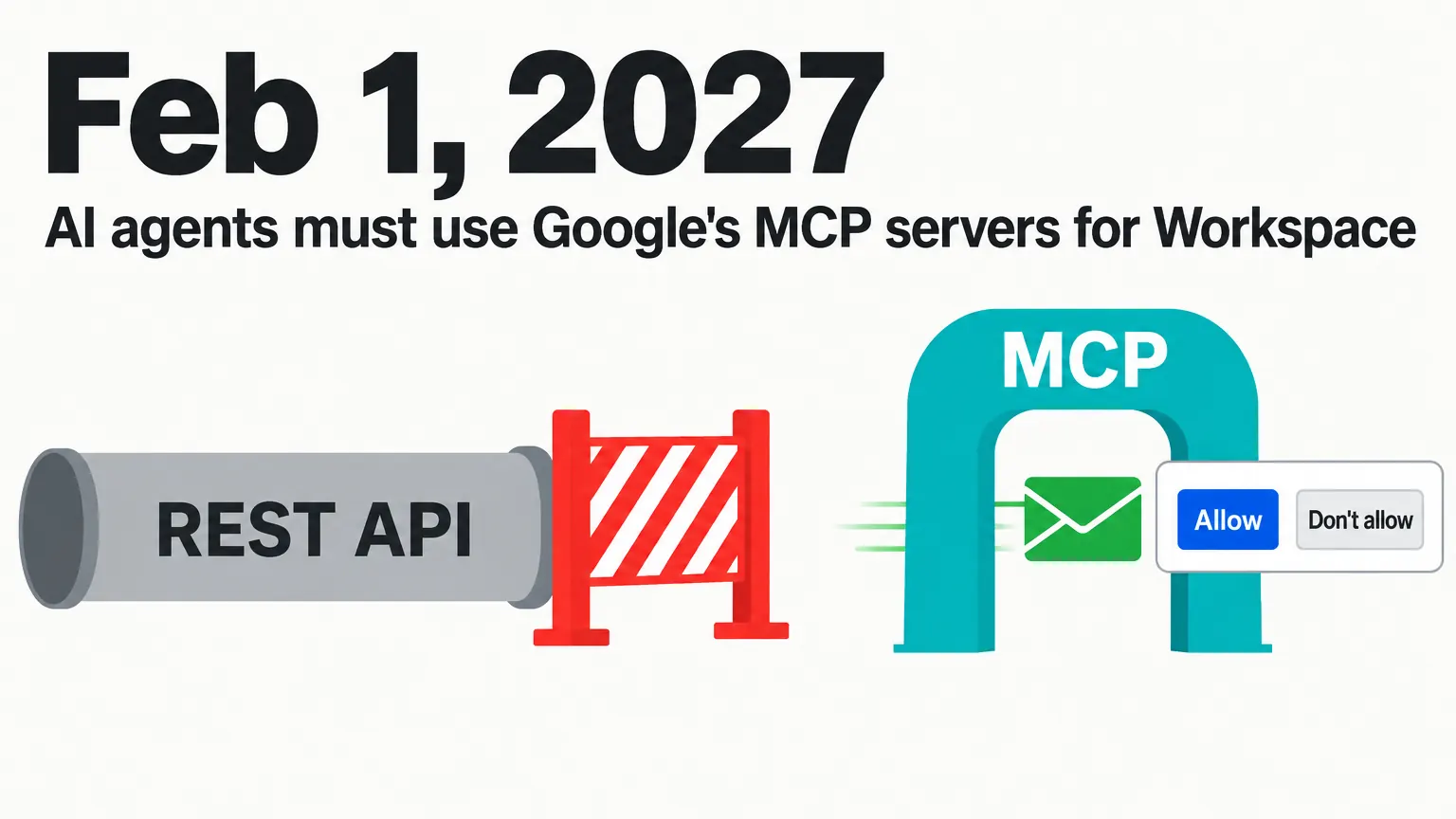
Google will require AI agents to reach Gmail, Drive, Calendar and the rest of Workspace through its own MCP servers or its command-line tool, not its REST APIs, from February 1, 2027. Google announced it on November 24, 2026: AI agents “must use Workspace MCP servers or the Workspace CLI to access Workspace data, rather than calling Workspace REST APIs directly.” The rule sits in a new Workspace AI Tools Addendum to Google’s API terms.
Developers noticed it two days later. Gergely Orosz wrote that the “Gmail MCP cannot update drafts, or send emails” (90,692 views), and Dax Raad wrote that “the official gmail mcp does not expose a tool to send email, only create drafts” (67,388 views). Google’s own tool reference, read on November 28, tells a fuller story.
On this page · 6 sectionsOpen
 From February 1, 2027, Google says AI agents must reach Workspace data through its MCP servers or the Workspace CLI, not its REST APIs.
 The free Standard tier allows up to 5,000 MCP requests a day per project per product; Google says over 99% of active developers fit in it.
 Gmail’s MCP server lists send, reply and forward tools, but only on the endpoint where Google’s server asks the user to approve.
 Gergely Orosz and Dax Raad say the Gmail MCP cannot send email, which matches the endpoint that runs without approval prompts.
 Scaled tier billing starts April 1, 2027, and there Gmail, Calendar and Drive MCP use is billed from the first request.
§ 01What changes, and when
| Date | What happens |
|---|---|
| November 24, 2026 | MCP servers and CLI generally available; Standard and Scaled usage tiers launch |
| February 1, 2027 | AI Tools Addendum takes effect; AI agents must use the MCP servers or the CLI |
| April 1, 2027 | Scaled tier billing starts; usage limits enforced on all projects |
- Who it covers. The addendum says the tool “must use a Google MCP where the GWS Access Tool is or is driven by an AI Agent, an AI Harness or an AI model or service employing an AI model”, and that you “may not obfuscate” a tool to avoid it.
- Which apps. Google lists generally available MCP servers for Gmail, Google Calendar, Google Drive, Google Docs, Google Sheets, Google Slides, Google Chat and Google Tasks in its quota guide.
- What it costs. The Standard tier allows “up to 5,000 requests per day, per project, per product” with no billing account, and Google says “Over 99% of active developers currently operate within the Standard tier”. On the Scaled tier, Gmail, Calendar and Drive MCP use “is billed from the first request” from April 1, 2027. Google’s per-request prices are not covered here.
- OAuth. Google asks developers to mark OAuth clients used by agents with “Use this client for an AI-powered agent” and keep an app’s other features on a separate client.
§ 02Can the Gmail MCP send email?
Yes, with a prompt. Google’s tool reference lists send_message, reply and forward among Gmail’s tools, all three on the primary /mcp/v1 endpoint only. That endpoint carries the tools that need the user’s confirmation through MCP form elicitation: Google’s server asks the user to approve before the send. The fallback /mcp/v1self endpoint, for apps that cannot show that prompt, “Omits tools that always require interactive approval under default policy.”
| Endpoint | Approval prompts | Gmail tools |
|---|---|---|
| /mcp/v1 | Yes, through MCP form elicitation | 30 |
| /mcp/v1self | No | 25 |
So an agent whose app cannot show Google’s approval prompt sees no send tool at all, which matches what the critics describe. The same reference lists update_draft on both endpoints as of November 28; we cannot tell whether it was there on November 26. Google’s elicitation guide says prebuilt hosts that support form elicitation, such as Claude Desktop, need no extra code.

§ 03Google’s reason
Google’s Workspace blog post puts it plainly: “Because traditional APIs and access models were built for human-paced predictable software, they cannot effectively secure this frontier.” Through the MCP route, admins manage agent access, set human-in-the-loop confirmation rules and read agent audit logs in the Admin console. “Routine actions like creating a draft stay seamless”, Google says, while admins can require a confirmation for sensitive ones.
We found no Google reply to the developers’ posts as of November 28, 2026.
§ 04What it means for agents that work in Workspace
- A deadline. Any agent that calls Workspace REST APIs today has until February 1, 2027 to move to the MCP servers or the CLI.
- The send question becomes a design question. An agent that sends mail for its user either runs in an app that shows Google’s approval prompt or gets no send tool.
- Admins gain a switch. Agent access becomes something a Workspace admin can see and set rules for, next to ordinary apps.
§ 05Where CellCog stands
Our interest, declared: CellCog’s AI employees work in Gmail and Google Calendar for the people who hire them, so this rule is about products like ours. This post reports Google’s documents; it is not a statement of our plans.
§ 06Sources
- Google Workspace Updates, November 24, 2026 (updated November 27)
- Google Workspace blog, November 24, 2026
- Workspace AI Tools Addendum, last modified November 24, 2026
- Usage tiers and quotas, MCP server tools and MCP form elicitation, Google for Developers, read November 28, 2026
- Gergely Orosz on X, 07:11 UTC, November 26, 2026, read through the X API
- Dax Raad on X, 17:24 UTC, November 28, 2026, read through the X API
Q1When does Google require MCP for AI agents in Workspace?
From February 1, 2027. The Workspace AI Tools Addendum takes effect that day and Google says technical enforcement begins then. It was announced on November 24, 2026.
Q2Which Google apps have Workspace MCP servers?
Gmail, Google Calendar, Google Drive, Google Docs, Google Sheets, Google Slides, Google Chat and Google Tasks are generally available, per Google’s quota guide.
Q3Is the Workspace MCP free?
The Standard tier allows up to 5,000 requests a day per project per product with no billing account. Projects that need more join the Scaled tier, billed from April 1, 2027.
Q4Can the Gmail MCP send email?
Google’s tool reference lists send_message, reply and forward on the primary endpoint, which uses MCP form elicitation to ask the user to approve. The self-mode endpoint omits them.
Q5Why is Google doing this?
Google says traditional APIs were built for human-paced software and cannot secure agents; the MCP route lets admins see agents, set approval rules and read audit logs.