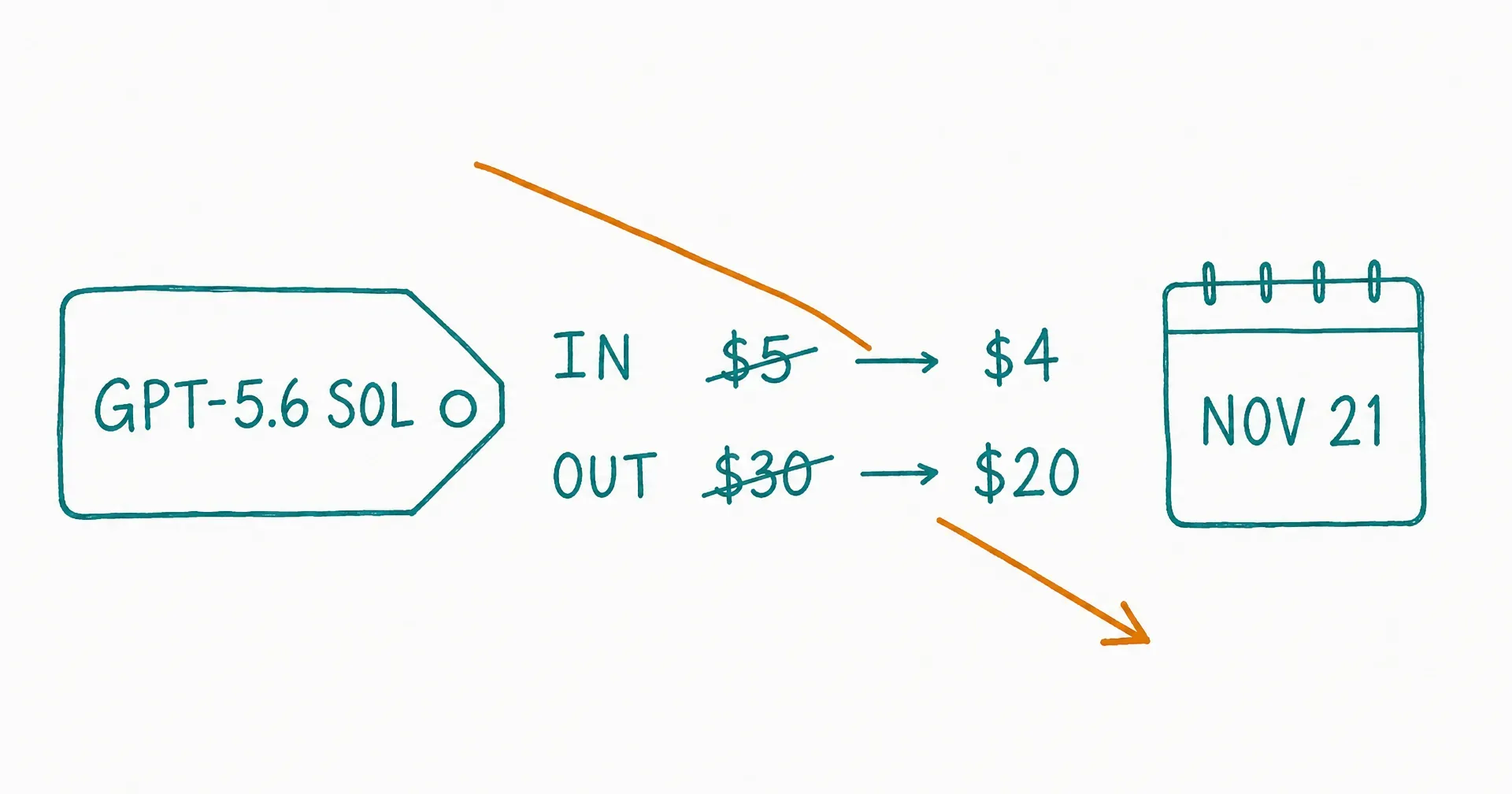
On August 21, 2026, OpenAI cut GPT-5.6 Sol’s API prices: input fell 20% from $5 to $4 per million tokens, and output fell a third, from $30 to $20. It is the biggest direct pricing move of the current cycle, and it came with an unusual clause: the promotional pricing is promised “at least through November 21, 2026.”
This page is the current rate card for all three GPT-5.6 models, what changed when, and the fine print that actually moves bills. It is a living page: we re-verify the figures against OpenAI’s model documentation, and every number carries its as-of date.
On this page · 6 sectionsOpen
- On August 21, 2026, OpenAI cut GPT-5.6 Sol API pricing from $5 to $4 per million input tokens and from $30 to $20 per million output tokens, with cached input down from $0.50 to $0.40.
- OpenAI’s exact wording: “GPT-5.6 Sol’s promotional pricing is available at least through November 21, 2026” - a floor, not an expiry date.
- Terra ($2 in / $12 out) and Luna ($0.20 in / $1.20 out) were cut earlier, on July 30 - Luna fell 80% from its launch price.
- The long-context surcharge is the fine print that moves real bills: prompts over roughly 272,000 input tokens bill at 2x the input rate and 1.5x the output rate for the entire request.
- Cache reads bill at a tenth of the input rate; cache writes at 1.25x the uncached input rate.
- In ChatGPT, Sol is included from Plus up; Free and Go plans get Luna as the default model. All three models are callable directly via the API.
- This is a living page: rates are re-verified against OpenAI’s model docs, and every figure carries its as-of date.
§ 01The rate card
| Model | Input | Cached input | Output |
|---|---|---|---|
| GPT-5.6 Sol | $4.00 | $0.40 | $20.00 |
| GPT-5.6 Terra | $2.00 | $0.20 | $12.00 |
| GPT-5.6 Luna | $0.20 | $0.02 | $1.20 |
All three are callable directly: gpt-5.6-sol (also reachable through the plain gpt-5.6 alias), gpt-5.6-terra, and gpt-5.6-luna.
§ 02What changed, and when
The family launched at $5.00 / $30.00 for Sol, $2.50 / $15.00 for Terra, and $1.00 / $6.00 for Luna. Two rounds of cuts followed. On July 30, Terra fell 20% and Luna fell a remarkable 80%, taking the budget tier to $0.20 input. Sol held its launch price until August 21, when it took the 20%-input, one-third-output cut this page led with.
| Model | At launch | August 24, 2026 |
|---|---|---|
| GPT-5.6 Sol | $30.00 | $20.00 |
| GPT-5.6 Terra | $15.00 | $12.00 |
| GPT-5.6 Luna | $6.00 | $1.20 |
OpenAI’s exact wording on the Sol cut is worth reading precisely: “GPT-5.6 Sol’s promotional pricing is available at least through November 21, 2026.” That is a floor, not an expiry date. The price may persist past November 21; a budget planned around it should not assume so. OpenAI also notes that included subscription usage, weekly limits, and five-hour limits are unchanged - the promotion is about metered API dollars.
§ 03The fine print that moves real bills
Three mechanics matter more than the headline rates for anyone running serious workloads.
The long-context surcharge. Requests whose input exceeds roughly 272,000 tokens bill at 2x the input rate and 1.5x the output rate - for the entire request, not just the overage. A 300k-token Sol request pays $8 per million on all of its input, not $4. Agent workloads that accumulate long transcripts hit this threshold in ordinary operation, which makes context discipline a billing lever, not just a quality one.
Caching asymmetry. Cache reads bill at a tenth of the input rate (the cached-input column above). Cache writes bill at 1.25x the uncached rate. Prompt structures that reuse a stable prefix get most of the benefit; churning caches can cost more than skipping them.
Standard is not the only lane. The table above is standard processing. Batch and fast modes carry different rates, and enterprise token rate cards are their own document.
One practical warning: OpenAI’s general pricing landing page lagged the August 21 change for a while, still showing Sol at $5 / $30. The model-specific docs and the announcement carry the cut. When two OpenAI pages disagree, the model docs are the better reference.
§ 04Where Sol shows up in ChatGPT
| Plan | Sol (medium/high) | Extra high | Sol Pro |
|---|---|---|---|
| Free / Go | No (Luna default) | No | No |
| Plus | Yes | No | No |
| Pro / Business / Enterprise | Yes | Yes | Yes |
In Codex, Free and Go users can access Terra, while Plus and above get all three models. The API is independent of any ChatGPT plan: developers pay the metered rates above regardless of subscription.
§ 05What cheaper Sol means for agent workloads
The output cut is the one that matters for agents. Reasoning-heavy agent work is output-dominated: plans, tool calls, drafts, and revisions are all output tokens. A run consuming 2 million input and 500 thousand output tokens cost $25 at the old rates ($10 in, $15 out) and costs $18 now ($8 in, $10 out) - 28% cheaper, with the saving concentrated exactly where agent workloads spend.
We watch this rate card from the inside: GPT-5.6 Sol is one of the frontier models CellCog routes to for search-heavy deep research under Agent Team Max, so its price moves flow directly into what our own workloads cost.
§ 06The honest caveats
Two cuts in three weeks across one model family says these numbers move without much ceremony, which is why every figure here carries a date. The November 21 language is a floor and could go either way after it. The rates above are standard-processing API prices in USD; batch, fast, enterprise rate cards, and included-subscription usage all differ. And the comparison that matters for a buyer is rarely tokens against tokens: it is the total cost of the finished work, which depends far more on how much output a workload burns - and at what context length - than on any single line of the rate card.
Q1How much does GPT-5.6 Sol cost via the API?
As of August 24, 2026: $4.00 per million input tokens, $0.40 per million cached input tokens, and $20.00 per million output tokens at standard processing. Before August 21 it was $5.00 / $0.50 / $30.00. The gpt-5.6 API alias points at Sol.
Q2How long does the promotional pricing last?
OpenAI’s wording is that Sol’s promotional pricing is available at least through November 21, 2026. That is a minimum commitment, not an announced end date - the price could stay, but planning past November 21 should not assume it.
Q3Is GPT-5.6 Sol API-only or in ChatGPT too?
Both. In ChatGPT, Sol at medium and high reasoning is included from Plus up; extra-high reasoning and Sol Pro are reserved for Pro, Business, and Enterprise. Free and Go users get Luna as their default model. API billing is separate from any ChatGPT subscription.
Q4What is the long-context surcharge?
Requests whose input exceeds roughly 272,000 tokens bill at 2x the input rate and 1.5x the output rate - applied to the entire request, not just the excess. For long-context agent work this can matter more than the headline rate.
Q5Did Terra and Luna prices change in August?
No. Their cuts landed July 30, 2026: Terra fell 20% from launch to $2 input / $12 output, and Luna fell 80% to $0.20 input / $1.20 output. Only Sol changed on August 21.
Q6Why do some OpenAI pages still show the old Sol prices?
OpenAI’s general pricing landing page lagged the August 21 change for a while, still displaying $5 / $30. The model-specific documentation and the announcement itself carry the current $4 / $20 rates, and they are the better reference when the two disagree.