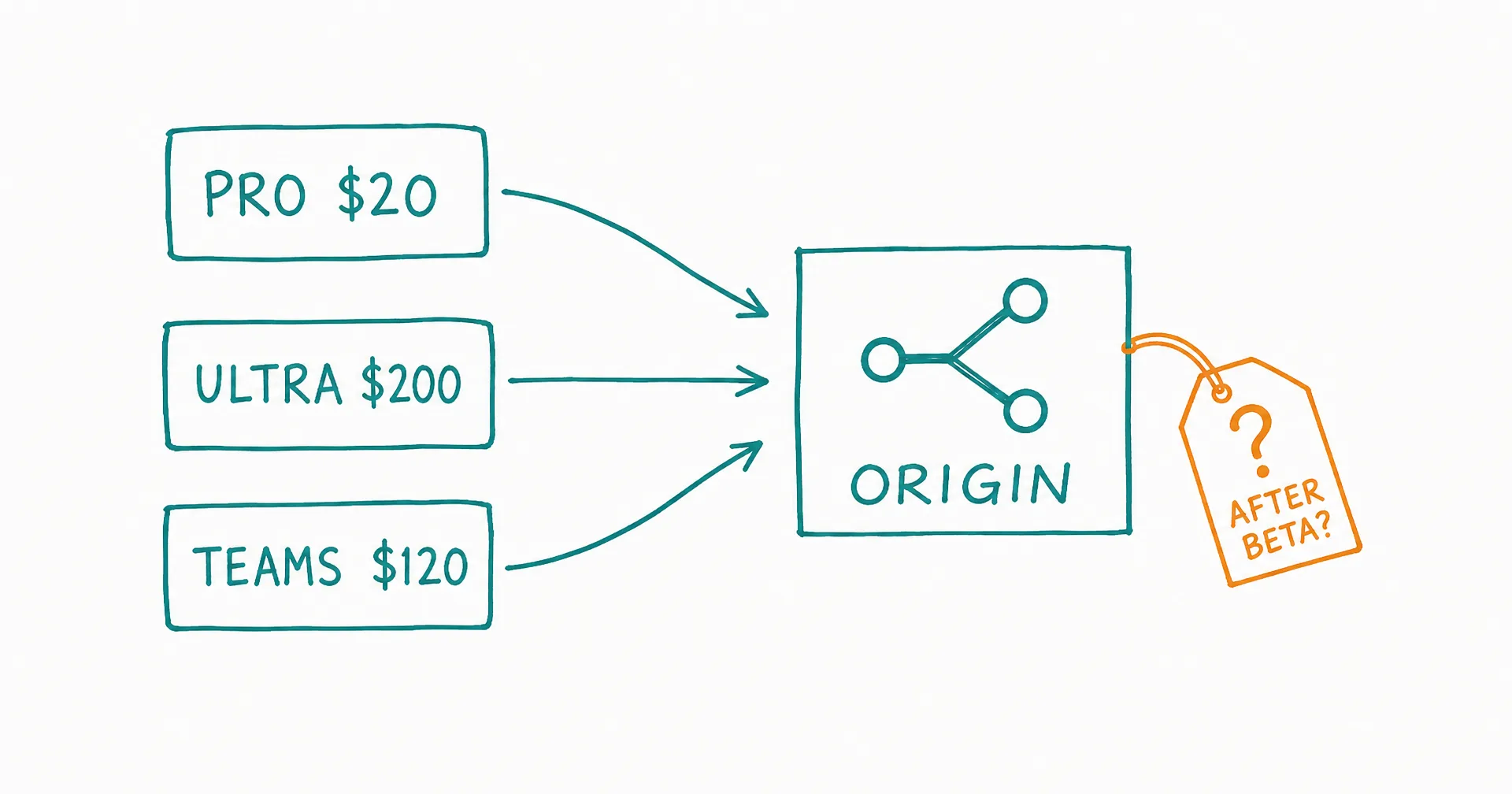
Cursor launched Origin, its own Git hosting and code review platform, in early beta on August 17, 2026. Within a day, the most-asked question about it was not a feature question. It was a pricing question: is Origin free with Cursor Pro?
The honest answer, from Cursor’s own documentation as of August 19, 2026: Origin has no price of its own. It is bundled with every paid Cursor plan during the beta, from the $20 Pro plan up, with no published storage limits and no committed post-beta price. That is genuinely good news for anyone already paying for Cursor, and a real planning question for anyone thinking about moving repositories to it.
This guide lays out the routes in, what is deliberately unpriced, what three common buyers actually pay, and the questions that only get answered after the beta.
On this page · 6 sectionsOpen
- Cursor Origin has no standalone price as of August 19, 2026: code storage is included with every paid Cursor plan, from Pro at $20/mo to Ultra at $200/mo and Teams from $40/user/mo. The free Hobby plan is excluded.
- Cursor has published no numerical limits: no repository count, no storage cap, no bandwidth or LFS terms, and no PR or API quotas. ‘Included’ is real but unquantified.
- There is no committed post-beta price. Cursor’s pricing terms explicitly allow add-on and beta-service pricing to appear later, so nobody should budget on $20/mo permanently including unlimited Git hosting.
- For an existing paid Cursor subscriber the incremental cost is zero, which makes mirroring a GitHub repository into Origin a free experiment: GitHub stays the source of truth and you can detach either way.
- Origin is not competing with GitHub on price: GitHub hosts public and private repositories on a free tier, while Origin has no free tier and no public repositories. The product is agent integration, and the plan is the price.
- The namespace you claim cannot be renamed during the beta, and team admins can disable Origin entirely, so the cheap experiment still deserves five minutes of setup care.
§ 01Is Origin free with Cursor Pro? The plan-by-plan answer
| Plan | Published price | Origin access |
|---|---|---|
| Hobby | Free | No |
| Pro | $20/mo | Yes |
| Pro+ | $60/mo | Yes |
| Ultra | $200/mo | Yes |
| Teams Standard | $40/user/mo | Yes |
| Teams Premium | $120/user/mo | Yes |
| Enterprise | Custom | Yes, unless an admin disables it |
Cursor’s launch language is “all paid plans,” and the documentation names Pro, Teams, and Enterprise specifically. The plan differences that do exist concern AI model usage and agent allowances, not Origin: nothing in the docs distinguishes what a Pro subscriber gets from Origin versus an Ultra subscriber.
Two practical notes. Access is rolling out in stages, so an eligible subscriber may not see Origin immediately. And on Enterprise, a team admin can disable Origin entirely, so availability inside a company is a policy decision, not just a plan decision.
§ 02What is deliberately unpriced
The more interesting half of Origin pricing is what Cursor has not published. As of August 19, 2026 there are no stated limits on repository count, repository size, total storage, bandwidth, Git LFS, pull requests, API requests, or the number of GitHub mirrors. There is no per-GB rate card and no Origin-only subscription.
There is also no committed post-beta price. Cursor’s pricing terms allow add-on and beta-service pricing to be surfaced later in the product, which leaves room for Origin to gain its own meter after the beta. None of that is sinister; it is what an early beta looks like. But it changes how you should plan: “included with my $20 plan” is true today and unguaranteed tomorrow. Teams hosting serious repository volume should treat today’s terms as beta terms.
§ 03Three worked scenarios
A solo developer already on Cursor Pro. Your incremental cost is zero. For $20 a month you already pay, you get a private Git forge with pull requests, code review, and native agent integration. This is the buyer the bundle genuinely rewards, and the experiment costs nothing but the namespace decision (see below).
A five-person team on Cursor Teams Standard. At $40 per user, the team pays $200 a month, and every seat gets Origin: there is no premium-seat gate for repository access. That is a different shape from the same company’s Grok Bot bundle, where only $120 Premium seats carry the agent allowance (we broke that down in our Grok Bot pricing guide). Cursor’s paid plans are quietly becoming a platform bundle: the editor, the agents, and now the forge ride one subscription.
A GitHub team evaluating a move. The evaluation itself is free with any paid plan: mirror the repositories you care about, and GitHub remains the source of truth while history, branches, tags, and pull requests sync into Origin. The real costs are operational. GitHub Issues do not sync, GitHub Actions secrets and configuration do not migrate, and CI for native Origin repositories runs through partners (Depot and Buildkite, which run existing GitHub Actions workflows, and Vercel for deploys), each with its own pricing. Budget the workflow, not the host.
§ 04Origin is not competing on price
It is worth saying plainly: GitHub hosts public and private repositories on a free tier, and Origin has no free tier and no public repositories at all (visibility options in the beta are Internal and Private only). If cheap hosting were the contest, Origin would lose it on day one.
The actual product is the agent loop. Cursor’s cloud agents can clone Origin repositories, branch, commit, push, and open pull requests; Automations react to pushes and PR events; and as of the August 19 changelog, agents subscribe to the PRs they create and keep working until completion, monitoring CI and fixing failed checks. Origin is priced as a bundle feature because its job is to make the rest of the bundle more valuable. Our Origin explainer covers that architecture in depth.
§ 05The fine print that costs nothing today and something later
Three gating details from Cursor’s documentation belong in any adoption decision, because they are free to get right now and expensive to get wrong later.
- The namespace is permanent during the beta. The team or personal namespace you claim appears in every repository URL and cannot be renamed. Choose it like a domain name, not a username.
- Legacy privacy mode blocks Origin. Teams on Cursor’s legacy privacy setting cannot enable Origin until they move to the current Privacy Mode, which is an admin decision with its own review.
- Admins can turn it off. Enterprise and team admins can disable Origin, so a bottom-up adoption inside a company can hit a policy wall.
§ 06Where this sits in agent economics
The pattern across the always-on agent category in 2026 is consistent: the software is bundled or cheap at the door, and the real cost scales with the work. Origin bundles hosting into a subscription whose price is driven by agent usage tiers. Grok Bot gates access behind premium plans and meters weekly usage. And AI employee platforms price the work directly: CellCog plans start at $8 a month with no card required to try it; you pay for the work of an AI employee, not the hire, and the cost depends purely on how much work you assign. The full arithmetic lives in our AI employee cost guide.
The honest summary for a buyer: Origin is the cheapest serious Git forge experiment available right now if you already pay for Cursor, and an unpriced commitment if you are moving your source of truth. Run the mirror, keep GitHub authoritative, and revisit when the beta terms become real terms.
Q1How much does Cursor Origin cost per month?
There is no separate Origin fee as of August 19, 2026. You need any paid Cursor plan: Pro at $20/mo, Pro+ at $60/mo, Ultra at $200/mo, Teams Standard at $40/user/mo, or Teams Premium at $120/user/mo. Origin code storage is included during the early beta, and Cursor has published no storage or usage limits.
Q2Will Origin stay free after the beta?
Unknown, and worth being honest about. Cursor has not committed to keeping Origin bundled without an add-on fee, and its pricing terms explicitly allow beta-service and add-on pricing to be introduced. The safe planning assumption is that today’s terms are beta terms.
Q3Is Origin included on the free Cursor plan?
No. Hobby users do not get Origin code storage. The cheapest route in is Cursor Pro at $20 a month, and even eligible paid users may see staged rollout delays during the early beta.
Q4Does Origin pricing compare well with GitHub?
They are priced on different logic. GitHub offers free public and private repository hosting and mature paid tiers; Origin has no free tier, no public repositories, and no published post-beta price. Origin’s pitch is not cheaper hosting, it is a forge where Cursor’s coding agents are first-class actors.
Q5What does mirroring a GitHub repo into Origin cost?
Nothing beyond the paid Cursor plan you already hold. Mirroring copies history, branches, tags, and pull requests into Origin while GitHub remains the source of truth, and detaching later does not modify the GitHub repository. It is the lowest-risk way to evaluate the product.
Q6Are there costs Origin does not cover?
Yes. GitHub Issues do not sync, GitHub Actions secrets and configuration stay on GitHub, and CI for native Origin repositories runs through partners like Depot and Buildkite, which have their own pricing. Budget the whole workflow, not just the repository host.