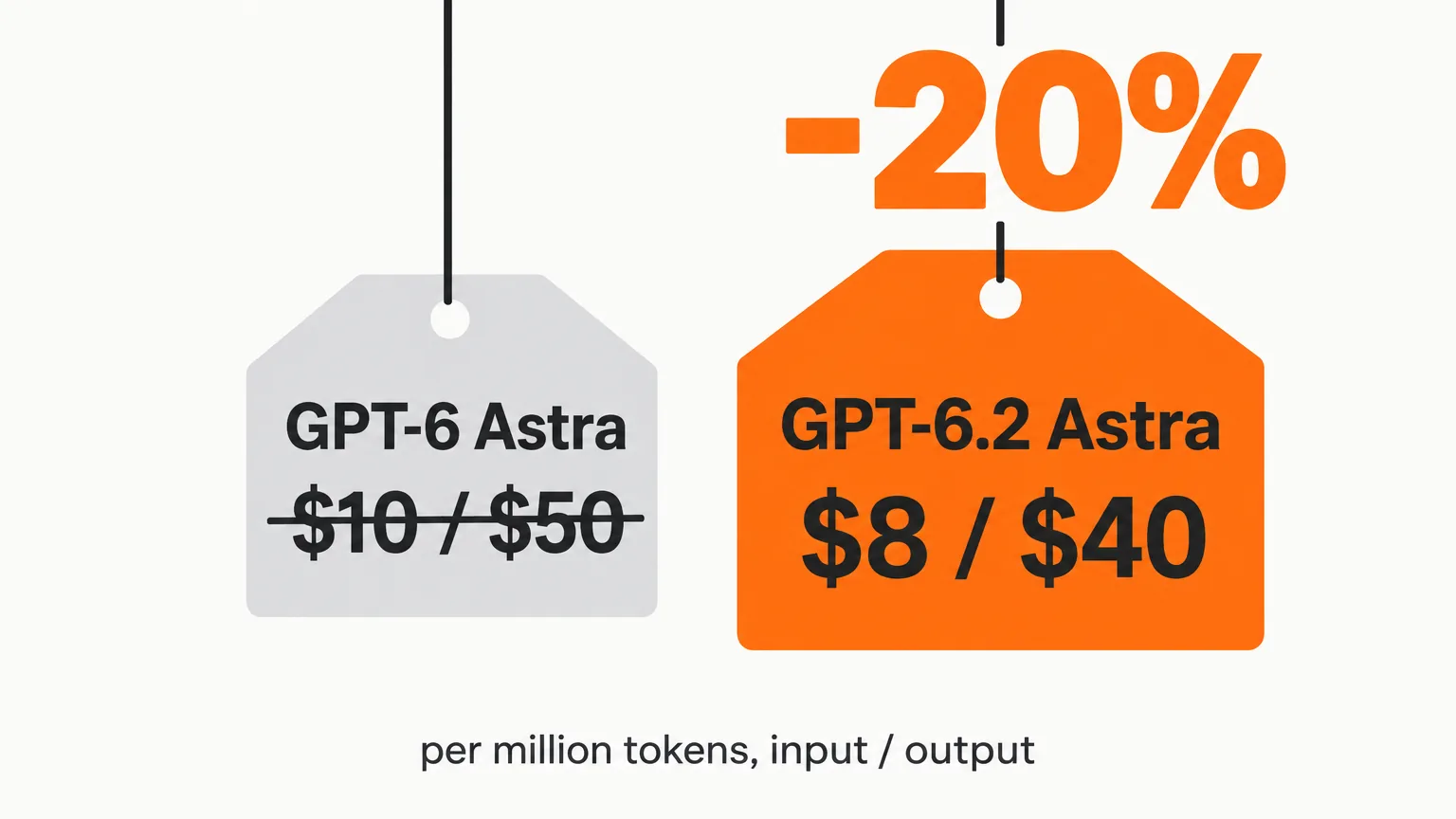
OpenAI released GPT-6.2 Astra on November 17, 2026. The API changelog entry dated that day recommends it for “demanding reasoning and coding tasks”, and the model page lists it at $8 per million input tokens and $40 per million output, 20% below GPT-6 Astra’s $10 and $50. Cached input drops from $1 to $0.40.
It shipped alongside GPT-6.2 Sol, which keeps GPT-6.1 Sol’s price. OpenAI announced both in a thread on X at 17:54 UTC, putting them in ChatGPT Work and Codex for Plus, Pro, Enterprise and Edu users. Its launch charts, which are OpenAI’s own evals, put GPT-6.2 Astra’s best run at about 78% on Agents’ Last Exam for about $3 a task, against about 73% for Claude Fable 5.2 at about $60. This page tracked GPT-6.2 Astra as a rumor from November 1; that record is below, with every claim graded against what shipped.
On this page · 15 sectionsOpen
- GPT-6.2 Astra against GPT-6 Astra
- What OpenAI said at launch
- What OpenAI’s launch charts show
- What GPT-6.2 Astra costs
- What changed for developers
- What independent tests found
- What one early tester said
- The rumors, graded
- What the Codex screenshots showed
- What OpenAI said before the launch
- Where Bel fits
- What the market expected
- What we are watching
- The tracker
- Sources
 OpenAI released GPT-6.2 Astra on November 17, 2026, in its API and in ChatGPT Work and Codex for Plus, Pro, Enterprise and Edu users.
 Standard API price is $8 per million input tokens and $40 per million output, 20% below GPT-6 Astra; cached input falls from $1 to $0.40.
 It keeps the 1,050,000-token context window and 128,000-token output limit, with a knowledge cutoff of May 18, 2026.
 On OpenAI’s own launch charts, its best run scores about 78% on Agents’ Last Exam at about $3 a task; Claude Fable 5.2’s best is about 73% at about $60.
 OpenAI launched it with tighter safeguards for higher-risk cybersecurity help, citing a 22-point jump on ExploitBench Internal Port.
§ 01GPT-6.2 Astra against GPT-6 Astra
The model page calls it “A frontier reasoning model for coding and professional work.” Side by side with the model it follows:
| Spec | GPT-6 Astra | GPT-6.2 Astra |
|---|---|---|
| Released | September 3, 2026 | November 17, 2026 |
| Input, per million tokens | $10 | $8 |
| Cached input | $1 | $0.40 |
| Cache write, 30 minutes | $12.50 | $10 |
| Output, per million tokens | $50 | $40 |
| Context window | 1,050,000 tokens | 1,050,000 tokens |
| Maximum output | 128,000 tokens | 128,000 tokens |
| Knowledge cutoff | April 30, 2026 | May 18, 2026 |

§ 02What OpenAI said at launch
OpenAI announced both models in a six-post thread on X at 17:54 UTC on November 17. It opened: “Some of you have been asking very politely. Some of you have just been asking.” The thread’s claims:
- Where they run: “Starting today, GPT-6.2 Astra and Sol are available in ChatGPT Work and Codex for Plus, Pro, Enterprise, and Edu users.” Pro 500 subscribers can use Ultrafast with either model, and OpenAI added: “For the first time, we’re also bringing Ultrafast to Pro 200 subscribers, starting with GPT-6.2 Sol.”
- Astra: “It sets new highs on evals across professional work and scientific research at less than a third of the cost per task of GPT-6 Astra.”
- Sol: “Many OpenAI employees use GPT-6.2 Sol as their go-to model across technical and non-technical work.”
- Cyber: GPT-6.2 Astra “jumps 22 points over GPT-6 Astra on ExploitBench Internal Port”, and “we’re launching GPT-6.2 Astra and Sol with tighter safeguards for higher-risk cybersecurity assistance”. OpenAI is working to bring both to Daybreak, its program for approved defenders, with fewer refusals.
At 18:09 UTC, OpenRouter’s catalog listed gpt-6.2-astra at $8 and $40 per million tokens and gpt-6.2-sol at $2 and $10.
§ 03What OpenAI’s launch charts show
The thread carried five charts. Four plot score against cost per task for several runs of each model; the fifth, ExploitBench, plots success rate against output tokens. Two of the models on them, Claude Fable 5.2 and Claude Opus 5.5, are the models CellCog runs on. OpenAI ran these evals itself, and no independent scores exist yet. We read each model’s best point off the chart images, so every figure below is within about a point.
| Eval | GPT-6.2 Astra | GPT-6 Astra | Claude Fable 5.2 | Claude Opus 5.5 |
|---|---|---|---|---|
| Agents’ Last Exam v1.1 | 78% | 73% | 73% | 72% |
| Terminal-Bench-Science 0.1 | 77% | 68% | 73% | 63% |
| Harvey-LAB-AA v1.1 | 15% | 9% | 7% | 4% |
| BenchCAD 2.1 Core | 83% | 63% | 84% | 65% |
| ExploitBench Internal Port | 54% | 32% | Not charted | Not charted |
GPT-6.2 Astra has the best run on four of the five. On BenchCAD 2.1 Core, Claude Fable 5.2’s best run scores about a point higher, at about ten times the cost per task. On Terminal-Bench-Science, OpenAI’s chart notes that Fable 5.2 ran in the mini-swe-agent harness. On Harvey-LAB-AA, a legal benchmark, the score is a hallucination-gated all-pass rate, which is why every model sits low. The 22-point gap on ExploitBench matches the figure OpenAI wrote in the thread.
OpenAI says Astra gets there “at less than a third of the cost per task of GPT-6 Astra”. Comparing each model’s best run on the four charts that price runs, Astra’s cost per task is between 29% and 50% of GPT-6 Astra’s; OpenAI did not say which runs its figure compares. The widest spread is on Agents’ Last Exam, where Gemini 4 Carbon also appears:
| Model | Best score | Cost per task |
|---|---|---|
| GPT-6.2 Astra | 78% | $3 |
| Gemini 4 Carbon | 77% | $4.50 |
| GPT-6 Astra | 73% | $9 |
| Claude Opus 5.5 | 72% | $17 |
| Claude Fable 5.2 | 73% | $60 |
§ 04What GPT-6.2 Astra costs
Every price here is per million tokens, from OpenAI’s pricing page. A request with more than 272,000 input tokens pays $16 input and $60 output for the whole request: double the input rate and 1.5 times the output rate.
| Tier | Input | Output |
|---|---|---|
| Standard | $8 | $40 |
| Batch | $4 | $20 |
| Fast mode | $16 | $80 |
| Ultrafast, to February 28, 2027 | $24 | $120 |
| Ultrafast, from March 1, 2027 | $48 | $240 |
Ultrafast doubles in price on March 1, 2027, from three times the Standard rate to six times. The background completion windows, opened in public beta the same day in the Responses API, go the other way. The two window rows are computed from the changelog, which puts the two-hour window 30% below Standard and the eight-hour window 40% below:
| Window | Input | Output |
|---|---|---|
| Standard | $8 | $40 |
| Two-hour window | $5.60 | $28 |
| Eight-hour window | $4.80 | $24 |
On two example requests the cut against GPT-6 Astra holds at both sizes, and GPT-6.2 Sol stays at a quarter of Astra’s price. The larger request is past 272,000 input tokens, so all three models pay their long-context rates:
| Model | 50K in, 5K out | 400K in, 20K out |
|---|---|---|
| GPT-6 Astra | $0.75 | $9.50 |
| GPT-6.2 Astra | $0.60 | $7.60 |
| GPT-6.2 Sol | $0.15 | $1.90 |
§ 05What changed for developers
GPT-6.2 Astra and GPT-6.2 Sol share one specification. Both take text and images and return text, with a 1,050,000-token context window, up to 922,000 input tokens and 128,000 output tokens. Both run on Chat Completions and the Responses API, but tool calling needs the Responses API, where the model pages list web search, file search, code interpreter, hosted shell, computer use, MCP and tool search, plus the Multi-agent beta for handing work to subagents. Neither accepts audio or video, and neither can be fine-tuned.
Two changes matter when you migrate. The API rejects requests that set reasoning effort to none on these models. And starting with GPT-6.2, it drops a conversation’s earlier reasoning when the history is edited mid-conversation, when the model is downgraded, or when the end user or organization changes. OpenAI’s migration guide warns: “When the model loses access to reasoning items, answer quality can decline and the model may use more tokens to repeat earlier work.” Keeping the start of the conversation unchanged between turns avoids it. The same guide says “GPT-6.2 Astra is more concise and direct by default than earlier models.” Its prompting tips cover writing self-contained final answers, following through on long tasks and asking the model for an exhaustive pass.
Both models support Zero Data Retention for approved organizations, and both get the background completion windows OpenAI opened in public beta the same day.
§ 06What independent tests found
Two independent labs published scores on launch day. Artificial Analysis put GPT-6.2 Astra second in its Intelligence Index in a thread on X at 17:56 UTC, which had about 264,000 views when we read it at 22:07 UTC: “OpenAI now trails only Anthropic’s Claude Fable 5.2 in the Artificial Analysis Intelligence Index”. Epoch AI posted its results at 18:42 UTC and a second thread at 21:44 UTC, with Astra tied with Fable 5.2 on its ECI score and behind it on realistic work tasks.
| Test | Who ran it | GPT-6.2 Astra |
|---|---|---|
| Intelligence Index | Artificial Analysis | Second, behind Claude Fable 5.2; up 5 points on GPT-6 Astra |
| Coding Agent Index (Codex harness, max effort) | Artificial Analysis | Flat with GPT-6 Astra |
| AA-3D | Artificial Analysis | First, at 1318 |
| AA-Robotics v0.1 | Artificial Analysis | First, at 79, up 10 points on GPT-6 Astra |
| AA-Omniscience hallucination rate | Artificial Analysis | 59% at max effort |
| ECI | Epoch AI | 174, tied with Claude Fable 5.2 |
| Epoch Automation Reports | Epoch AI | Fourth, averaging 65%; Fable 5.2 averaged 82% |
| FrontierMath Erdős | Epoch AI | 7 of 68 unsolved problems, a record (the previous was 3 of 68) |
| Serial reasoning steps without chain of thought | Epoch AI | 12.3, up from 10.5 for GPT-6 Astra |
- Where it led. Artificial Analysis puts Astra first on AA-3D and AA-Robotics; controlling a real robot arm through Codex, “it passed six of our eight physical tasks”. Epoch’s FrontierMath Erdős record includes one problem “for which no prior solution was known”.
- Where it fell short. On Epoch’s AI data center task, Astra “was overly cautious and left out critical information”, and Epoch adds that “All models failed to meet the Epoch employee standard.”
- Coding. Artificial Analysis calls it “flat with GPT-6 Astra” on its Coding Agent Index.
- Monitoring. Epoch notes that models able to reason without a chain of thought “may be harder to monitor”.
Claude Fable 5.2, the model CellCog runs on Agent Max and Creative Max, placed ahead of GPT-6.2 Astra on both labs’ headline work measures and tied with it on ECI; we say so because it is the model we route to, and CellCog routes no work to Astra. Epoch says a full report on its updated Automation Reports benchmark is coming.
§ 07What one early tester said
On November 17 at 18:35 UTC, the developer Theo, who posts as @theo on X, published a letter he says he wrote to OpenAI during early testing, under the title “Why I hate GPT-6.2 Astra”. It had about 731,000 views when we read it at 21:59 UTC. He says OpenAI “fixed a small handful of my complaints, but not enough for me to recommend using it.” His verdict: “I would not choose this over Opus 5.5 for my work as a developer.”
What he praised:
- Review and code. A “Great reviewer, catches things other models miss”, and he writes that “Code quality has improved meaningfully”.
- New ideas. He credits it with a reverse proxy that he says will save him $25k a month.
- 3D, games and computer use. He calls it “World class at 3d & game stuff” and writes “Computer use is nuts”.
What he flagged:
- No sense of what the user knows. “It has no concept of knowledge gaps”, he writes. On long tasks it stops to ask about its own implementation details; two hours into a new Outer Wilds level, it blocked itself on a question about which file a reviewer wrote its clips to.
- Explanations he cannot read. Asked why worktrees were slow on one machine and fast on three others, it wrote four paragraphs on pnpm internals; Opus 5.5 answered “it’s because the ssd is slow”. He now switches to Opus 5.5 to summarize long Astra runs.
- Loops with no progress. On ts-rust, his rewrite of TypeScript in Rust, Astra “ran for 7 days and landed 0 improvements” and made the compiler 56% slower; told to work on speed instead, it ran four more days and landed nothing. He says no OpenAI model had broken ground on the project after more than $300k in tokens, and that Opus finished it in under two weeks for about $20k.
He saw the same behavior when he tried Codex, not only in T3 Code, and he adds “I am likely overreacting”. It is one tester’s account in his own words, not a measurement; the independent scores above come from Artificial Analysis and Epoch AI.
§ 08The rumors, graded
This page graded each claim as it came. Here is each one against the November 17 release:
| Claim | Who said it | Grade | What shipped |
|---|---|---|---|
| A model named gpt-6.2-astra exists | Codex usage screenshots, October 31 | Confirmed | Model page, changelog entry and launch thread, November 17 |
| The October 31 usage label was this model | Several X accounts | Cannot check | OpenAI has not linked the two |
| A new Astra by Friday, November 6 | The Information, November 4 | Contradicted | Shipped 11 days later |
| Release on Thursday, November 12 | Two X accounts | Contradicted | Shipped 5 days later |
| Delayed by safety and alignment failures | Anonymous X account, November 15 | Unconfirmed | OpenAI gave no reason for the timing; it launched with tighter cyber safeguards |
| Delayed after Claude Fable 5.2 | X account, November 13 | Unconfirmed | No source then or now |
| It is the shelved GPT-6.1 Astra, retrained | Several X posts | Unconfirmed | The model page and the thread say nothing about its lineage |
§ 09What the Codex screenshots showed
The page in the screenshots is ChatGPT’s usage analytics (Settings, Usage, Analytics, by model). OpenAI’s own description on it: “Conversations in Chat are not included.” It counts Codex, Work and other agent tasks.
In the three breakdowns we could read, the 6.2 usage lands on the same day, October 31:
- A seven-day view for October 26 to November 1: gpt-6-astra 80%, gpt-6.2-astra 19.8%, with the orange 6.2 bar on October 31 only.
- A seven-day view for October 25 to 31: gpt-6-astra 97.7%, gpt-6.2-astra 1.6%, again only on October 31.
- A one-day view for October 31, carried by the WeChat account 探索AGI: gpt-6.2-astra 100%.
A fourth post, from @Mr_Salio at 10:30 UTC, shows a raw event instead of a chart: a response.completed event whose model field reads gpt-6.2-astra. He wrote: “The UI still GPT-6 Astra but the API response breakdown now shows”. That is the shape of a Responses API streaming event, the format Codex receives, but it is a cropped screenshot with no account or time on it.

The spread of shares, from 1.6% of one person’s week to all of another’s day, is what a partial rollout looks like: some requests labelled 6.2, most not. It is also what a new label for the same model would look like if it reached some accounts first. The screenshots cannot tell those two apart.
§ 10What OpenAI said before the launch
Nothing with the name, until November 17. On November 1 at 12:07 UTC, OpenAI’s model docs and API changelog listed GPT-6 Astra, GPT-6.1 Sol and GPT-6 Luna and no 6.2 model. OpenRouter’s catalog carried gpt-6-astra and gpt-6-astra-pro and no 6.2 ID. The newest Codex CLI release then, rust-v0.166.0 on October 29, did not mention it.
The closest thing to a hint is the Codex lead’s daily posts. Thibault Sottiaux has been running a numbered shipping series; his Day 26 post on October 31 said “Next two days will be resets” and he followed it on November 1 with a two-word note that the first reset was banked. Smlay and others read the end of the series as a launch slot. Sottiaux has named no model.
GPT-6 Astra itself shipped on September 3 (our release record). Its planned successor, GPT-6.1 Astra, was shelved on September 28 over deception and scope problems, with OpenAI saying it would reuse the base model for further training. Several posts guess that 6.2 is that model, fixed and renumbered. That is a guess; OpenAI has not drawn the line.
§ 11Where Bel fits
The 6.2 number was already in circulation. On October 30, @Policifyai posted that “The model ID gpt-6.2-betelgeuse was spotted in an internal tracker.” and called the model GPT-6.2 Bel. No screenshot of that tracker has surfaced, and our Bel page still grades the Bel claims unconfirmed. The two rumors share a number and nothing else: Bel is described as a new giant pretrain, gpt-6.2-astra appeared first as a label on the existing Astra slot, then shipped on November 17 with no mention of Bel.
§ 12What the market expected
Polymarket’s market on the next Astra covers any GPT Astra numbered 6.1 or higher, so a 6.2 release would count. Read at 12:10 UTC on November 1:
| Week | Odds |
|---|---|
| Oct 26 to Nov 1 | 5.7% |
| Nov 2 to 8 | 37.3% |
| Nov 9 to 15 | 18.0% |
| Nov 16 to 22 | 21.5% |
| Nov 30 to Dec 6 | 12.5% |
The same market puts no new Astra by January 31, 2027 at 7.0%. A market is a sentiment read, not evidence. The release on November 17 landed in the week it rated second most likely.
§ 13What we are watching
- Epoch AI’s full report on its updated Automation Reports benchmark, and further independent scores.
- GPT-6.2 Astra reaching Daybreak for approved defenders.
- A word from OpenAI on whether the October 31 usage label was this model.
- The Polymarket market on the next GPT Astra resolving.
CellCog runs on Anthropic’s Claude models (Claude Opus 5.5 on most tiers; Claude Fable 5.2 on Agent Max and Creative Max since November 11, 2026) and routes no work to GPT-6 Astra or GPT-6.2 Astra, so this release changes nothing in how CellCog runs.
§ 14The tracker
November 1, 2026: page opened. The gpt-6.2-astra label is in users’ Codex usage analytics; OpenAI has not named the model.
November 4, 2026, 21:35 UTC: The Information’s AI Agenda item read in a browser (published 7:02 a.m. PST): new Astra, Sol and cyber models could come as soon as Friday. No OpenAI announcement; developers.openai.com changelog checked at 20:00 UTC, latest entry October 30.
November 12, 2026, 20:03 UTC: Thibault Sottiaux posted on X on November 11 at 06:55 UTC: “It’s been a while without resets. Maybe I should come back out of the basement”. Two minutes later he replied to himself: “Thursday is feeling codexy to me. Perhaps also a good time for a banked reset.” Thursday is November 12. The two posts had about 2.19 million and 1.65 million views when we read them at 20:02 UTC. He named no model. Two accounts on X said today that GPT-6.2 Astra and GPT-6.2 Sol would arrive today; those are their claims. At 20:03 UTC OpenAI’s API changelog had no entry newer than November 5, the ten newest items in its news feed named no 6.2 model, and OpenRouter’s catalog listed no 6.2 ID. We did not read the Codex release notes or open the Codex app.
November 13, 2026, 23:23 UTC: Thursday passed without a new model. Sottiaux posted on X on November 12 at 21:59 UTC: “We shipped some good updates to dots today and the banked reset has been activated and should land in everyones accounts sometime soon!” OpenRouter’s catalog, read at 23:23 UTC on November 13, lists no OpenAI model with 6.2 in its ID. OpenAI’s API changelog, read at 23:23 UTC, names no 6.2 model. One post on X on November 13 claims OpenAI delayed the model after seeing Claude Fable 5.2. It cites no source and had about 2,100 views when we read it. A larger post, at about 86,000 views, only guesses at reasons the model is not out. OpenAI has said nothing about a delay.
November 16, 2026, 08:21 UTC: A post on X from an anonymous account on November 15 at 16:53 UTC claims GPT-6.1, GPT-6.2 and GPT-6.5 have each slipped by several weeks because of “catastrophic safety and alignment failures”. It names no source and had about 800,000 views when we read it at 08:20 UTC. OpenAI has said nothing about a delay. OpenRouter’s catalog, read at 08:21 UTC on November 16, lists no OpenAI model with 6.2 in its ID. We grade the delay claim unconfirmed.
November 17, 2026, 18:09 UTC: released. OpenAI’s API changelog has an entry dated November 17 naming GPT-6.2 Astra and GPT-6.2 Sol, the model page lists $8 input and $40 output per million tokens, and OpenAI announced both models in a thread on X at 17:54 UTC. This page is now the release record.
November 17, 2026, 21:59 UTC: added the letter the developer Theo published on X at 18:35 UTC under the title “Why I hate GPT-6.2 Astra”, read through the X API; about 731,000 views when we read it. One tester’s account, not a measurement.
November 17, 2026, 22:07 UTC: added the first independent scores, from Artificial Analysis (thread at 17:56 UTC) and Epoch AI (threads at 18:42 and 21:44 UTC), read through the X API.
§ 15Sources
- Introducing GPT-6.2 Astra and Sol, OpenAI’s launch post, listed at 17:45 UTC on November 17, 2026 in its news feed
- OpenAI launch thread on X, November 17, 2026
- OpenAI API changelog, November 17, 2026
- GPT-6.2 Astra model page
- GPT-6.2 Sol model page
- GPT-6 Astra model page
- OpenAI API pricing
- GPT-6.2 migration and prompting guide
- Background completion windows
- @leo114119 on X, November 1, 2026, 07:37 UTC
- @Mashiro_0619 on X, three usage breakdowns, November 1, 2026
- @Mr_Salio on X, raw response event, November 1, 2026
- Thibault Sottiaux, Day 26, October 31, 2026
- @Policifyai on X, the Bel claim, October 30, 2026
- OpenAI model docs and API changelog, read November 1, 2026
- Polymarket: When will GPT Astra 6.1+ be released?, read November 1, 2026
- The Information, AI Agenda: The Security Companies Trying to Get AI Agents Under Control, Tiffany Li and Stephanie Palazzolo, November 4, 2026.
- Thibault Sottiaux on X, November 12, 2026, 21:59 UTC
- Theo on X, “Why I hate GPT-6.2 Astra”, 18:35 UTC, November 17, 2026, read through the X API at 21:59 UTC
- Artificial Analysis on X, GPT-6.2 results thread, 17:56 UTC, November 17, 2026
- Artificial Analysis on X, AA-Robotics v0.1, 18:21 UTC
- Epoch AI on X, GPT-6.2 Astra results, 18:42 UTC, and full results page (linked, not read)
- Epoch AI on X, Epoch Automation Reports, 21:44 UTC
- OpenRouter’s model catalog and OpenAI’s API changelog, read November 13, 2026
Q1What is GPT-6.2 Astra?
OpenAI’s frontier reasoning model for coding and professional work, released on November 17, 2026. It takes text and images and returns text.
Q2How does it compare with GPT-6 Astra?
It costs 20% less per token, keeps the 1,050,000-token context window and 128,000-token output limit, and has a later knowledge cutoff, May 18, 2026 against April 30.
Q3Is GPT-6.2 Astra in ChatGPT?
Yes, in ChatGPT Work and Codex for Plus, Pro, Enterprise and Edu users, per OpenAI. Pro 500 subscribers can use it in Ultrafast.
Q4Was the gpt-6.2-astra label in Codex usage this model?
OpenAI has not said. The label appeared in users’ usage analytics on October 31, 17 days before the release.
Q5Did the rumored release dates hold?
No. The Information pointed to November 6 and two X accounts to November 12; it shipped November 17, in the week Polymarket rated second most likely on November 1.
Q6Does CellCog use GPT-6.2 Astra?
No. CellCog runs on Anthropic’s Claude models (Claude Opus 5.5 on most tiers; Claude Fable 5.2 on Agent Max and Creative Max since November 11, 2026) and routes no work to GPT-6.2 Astra, so this release changes nothing in how CellCog runs.