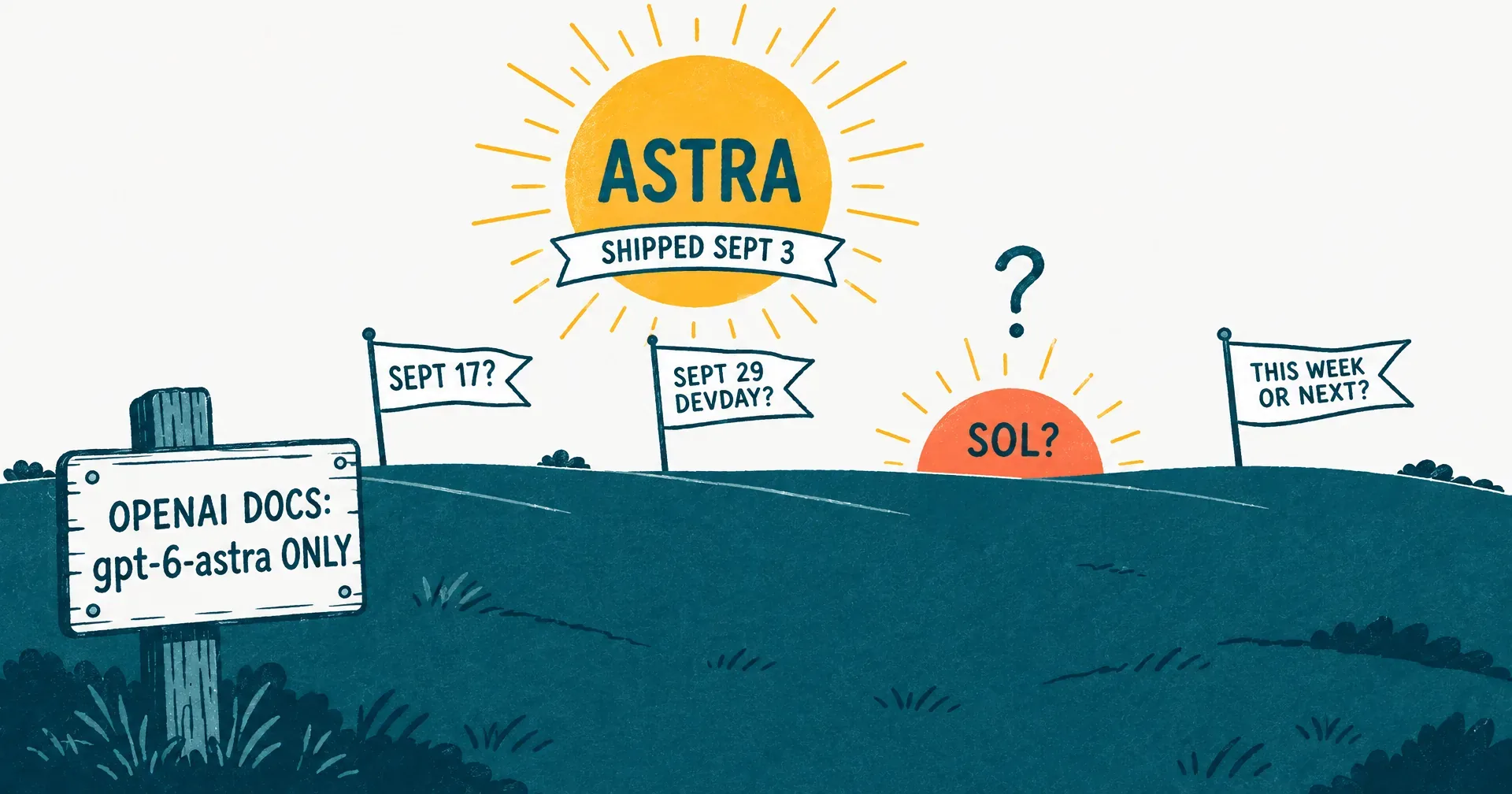
GPT-6 Sol has a release date in exactly the sense that several X accounts have posted one, and the dates do not agree. On September 6, 2026, three days after OpenAI shipped GPT-6 Astra, one account said a smaller, faster Sol was in internal testing and “could launch at OpenAI DevDay on September 29.” On September 10 another said it “has been spotted” and “will likely be released sometime next week.” On September 13 the loudest thread said that gpt-6-sol “reportedly appeared in the OpenAI API.” OpenAI has published nothing: no post, no identifier, no price, no card.
As of September 13, 2026, 19:00 UTC, we pulled OpenAI’s model list, its pricing page, its API changelog, the openai.com news feed and the OpenAI section of OpenRouter’s catalog. None contains the string gpt-6-sol. The only Sol OpenAI documents is GPT-5.6 Sol, released July 9, 2026, at a promotional $4 per million input tokens and $20 per million output tokens that the pricing page says runs at least through November 21, 2026. The only GPT-6 identifiers anywhere are gpt-6-astra and gpt-6-astra-pro, which our Astra record covers line by line.
So this page does what our Fable 5.2 and Grok 4.7 trackers do: every claim dated, the accounts separated from the write-ups that repeat them, the company’s documents checked directly, and the page rewritten on this URL the day OpenAI moves. Sol has a wrinkle the other two did not: the name already belongs to a shipping model, so even the question “what is GPT-6 Sol” has two answers until an id appears.
On this page · 11 sectionsOpen
 GPT-6 Sol does not exist in any OpenAI document as of September 13, 2026, 19:00 UTC. The model list, the pricing page, the API changelog, the openai.com news feed and OpenRouter’s OpenAI catalog carry gpt-6-astra and gpt-6-astra-pro as the only GPT-6 identifiers. The only Sol OpenAI ships is GPT-5.6 Sol.
 The API sighting is a relay, not a screenshot. The September 13 post says gpt-6-sol “reportedly appeared in the OpenAI API”; the two leaked-output posts around it credit another account and show model output, not a catalog. Nobody has published the model list with the string in it.
 Three dates are in circulation and none is OpenAI’s: DevDay, September 29 (posted September 6); “sometime next week” with a Thursday best guess, which is September 17 (posted September 10); and “this week or next” (posted September 13).
 The accounts do not agree on what Sol is. September 6: fast, “not at the level of Astra”, a middle ground for Plus users. September 13: it “beats GPT-6 Astra in coding and frontend generation”. The one consistent claim is cheaper with better usage limits.
 The name is already taken. GPT-5.6 Sol is a live model at a promotional $4 per million input tokens and $20 per million output tokens, priced through at least November 21, 2026. A GPT-6 Sol would be the second Sol in the catalog, so only a model-id string settles what the model is called.
 OpenAI’s own rhythm allows it. Smaller siblings followed their flagship after 0 days (GPT-5 mini and nano), 12 days (GPT-5.4 mini and nano) and 0 days (GPT-5.6 Terra and Luna). September 17 would be 14 days after Astra; September 29 would be 26.
 What would confirm it: a model page or pricing row on developers.openai.com, a changelog entry, an openai.com post, or a provider catalog line. CellCog runs GPT-5.6 Sol only as the web-search engine inside Agent Team Max; a GPT-6 Sol would be tested for that seat first, and this page becomes a graded record on this URL the day OpenAI moves.
§ 01What we actually know
| Claim | Status |
|---|---|
| A second GPT-6 model called Sol is in internal testing | @pankajkumar_dev and @AGTPinsights on X, September 6; no OpenAI document |
| gpt-6-sol appeared in the OpenAI API | @Mr_Salio, September 13, worded “reportedly”; not in the public model list, pricing page or changelog |
| Release at DevDay, September 29 | @pankajkumar_dev, September 6, worded “could”; OpenAI’s DevDay page names no model |
| Release “sometime next week”, best guess Thursday (September 17) | @AILeaksAndNews, September 10; nothing shipped as of September 13 |
| Release “this week or next” | @matthewmillerai, September 13 |
| Faster and cheaper than Astra, better usage limits | Every account; no price, no spec |
| Weaker than Astra | @pankajkumar_dev, September 6 |
| Beats Astra in coding and frontend generation | @Mr_Salio, September 13, from a leaked-output credited to another account |
| Leaked benchmark sheet, model card, context window, price | None exists |
| OpenAI’s newest announced model | GPT-6 Astra, September 3, 2026, per openai.com |
§ 02What the accounts said, word for word
All posts were read directly on X on September 13; times are UTC from the posts’ own timestamps.
September 6, 09:35, @pankajkumar_dev: “OpenAI is now internally testing GPT-6 Sol. It is fast and quite good, though not at the level of Astra. The outputs may not feel as strong, but it should still be a good model.” And: “It could launch at OpenAI DevDay on September 29.” The same post frames Sol as “the middle ground between performance and limit especially for Plus users, with much better usage limits than Astra.”
September 10, 18:24, @AILeaksAndNews: “GPT-6 Sol has been spotted”, “The upcoming frontier mid sized AI model from OpenAI is being prepared and will likely be released sometime next week” and “The second model of the GPT-6 family is right around the corner”. Asked what made it next week, the account replied: “My best guess if everything goes according to plan is it will be Thursday”, adding “there is always a possibility of delays.”
September 13, 12:00, @Mr_Salio, in a bulleted post: gpt-6-sol “reportedly appeared in the OpenAI API”; “OpenAI is reportedly already testing Sol internally”; “Sol is said to be much faster than Astra”; “Better usage limits could make it the everyday GPT-6 Sol.” Two hours later the same account posted a second leaked-output and wrote that “It beats GPT-6 Astra in coding and frontend generation and it will be a lot cheaper.” The first of the two output posts, on September 12, credits @lyraxana as its source.
September 13, 13:34, @matthewmillerai: “GPT 6 Sol will drop this week or next.”
Three things stand out. Every date-bearing sentence is hedged in the source itself: “could launch”, “will likely”, “reportedly”, “is said to”. The two accounts that describe the model’s quality describe different models, one below Astra and one above it. And the API claim travels without the one artifact that would make it checkable, a screenshot of the model list or a pricing row, which is exactly what the Astra leak in July had within a day.
§ 03The chain, dated
| Date (2026) | Event | Source |
|---|---|---|
| Jul 9 | GPT-5.6 Sol, Terra and Luna released | OpenAI |
| Sep 3 | GPT-6 Astra released | OpenAI |
| Sep 6 | “Internally testing GPT-6 Sol”, “could launch at OpenAI DevDay on September 29” | @pankajkumar_dev, @AGTPinsights on X |
| Sep 10 | “Spotted”, “sometime next week”, best guess Thursday | @AILeaksAndNews on X |
| Sep 12 | “First demo” output posted, credited to another account | @Mr_Salio on X |
| Sep 13 | gpt-6-sol “reportedly appeared in the OpenAI API”; “this week or next”; second output | @Mr_Salio, @matthewmillerai on X |
| Sep 13 | OpenAI model list, pricing, changelog, news feed, OpenRouter: no gpt-6-sol | Our read, 19:00 UTC |
The rumor is a week old and has produced three windows, two of which cannot both be right: a Thursday in the week of September 14 and a DevDay keynote on September 29 are twelve days apart. The write-ups that describe Sol as confirmed are grading a sentence that says “reportedly.”
§ 04The name that is already taken
Sol is not a new name. OpenAI shipped GPT-5.6 Sol on July 9, 2026 as the top of a three-model family with Terra and Luna, and it is still the model the API points at for gpt-5.6. Its promotional price is the reference point every Sol rumor is implicitly quoting when it says cheaper than Astra.
| Model | Input | Output | Notes |
|---|---|---|---|
| GPT-6 Astra | $10.00 | $50.00 | Flagship, launched September 3 |
| GPT-5.6 Sol | $4.00 | $20.00 | Promotional, at least through November 21, 2026 |
| GPT-5.6 Terra | $2.00 | $12.00 | |
| GPT-5.6 Luna | $0.20 | $1.20 | |
| GPT-6 Sol | none | none | No pricing row exists |
If a GPT-6 Sol exists, it has to land somewhere on this ladder, and where it lands decides the story. Priced near GPT-5.6 Sol, it is the everyday GPT-6 the September 6 post described, and the interesting question becomes what happens to the 5.6 family. Priced near Astra, the “beats Astra” claim would mean OpenAI undercutting a tier it set ten days ago, which is the objection one reply to the September 13 post made. Until a pricing row exists, both readings are open.
§ 05What OpenAI’s own rhythm says
OpenAI does not pre-announce models either, but it has shipped smaller siblings after flagships before, and the gaps are on record in its model documentation.
| Flagship | Smaller sibling | Days after |
|---|---|---|
| GPT-5, August 7, 2025 | gpt-5-mini and gpt-5-nano, same day | 0 |
| GPT-5.4, March 5, 2026 | GPT-5.4 mini and nano, March 17 | 12 |
| GPT-5.6 Sol, July 9, 2026 | Terra and Luna, same day | 0 |
| GPT-6 Astra, September 3, 2026 | GPT-6 Sol, if September 17 | 14 |
| GPT-6 Astra, September 3, 2026 | GPT-6 Sol, if September 29 (DevDay) | 26 |
Two readings. Astra is the first OpenAI flagship in a year to ship alone, without a smaller sibling on day one, which is the strongest structural argument that one is coming. And a two-week gap is inside OpenAI’s own range. What the record does not support is a date: the mini and nano models arrived without leaks, on ordinary weekdays, when their model pages went up. That is the artifact to watch for, and it is the one no account has shown.
§ 06What would confirm it
Any one of these flips this page from tracker to record:
- A model page at developers.openai.com/api/docs/models/gpt-6-sol, which is where gpt-6-astra appeared about four hours after Astra’s briefing.
- A pricing row on OpenAI’s pricing page.
- An entry in the API changelog, which carried the Agents API and GPT-Live 1 on September 10.
- A post on openai.com, or a keynote mention at DevDay on September 29.
- A catalog line on Amazon Bedrock, Microsoft Foundry, Cloudflare or OpenRouter, where GPT-5.6 Sol and Astra both landed on day one.
What would not confirm it: another leaked-output screenshot, a config string without a public page, or a third write-up of the same posts. We will log those if they appear, in the rumor table, not the fact table.
§ 07Where CellCog stands
CellCog’s agent tiers do not run on an OpenAI model today: Core and Max run on Claude Fable 5.1, Flash on Gemini 3.8 Flash, Creative on Claude Opus 5. The one OpenAI seat in our stack is the web-search engine inside Agent Team Max, which moved to GPT-5.6 Sol on August 14. A GPT-6 Sol would be evaluated for that seat first, on price, then on citation accuracy across long research runs, and a swap would be a same-day product note, as our Fable 5.1 day was. Nothing changes for our users until an id exists.
§ 08What we are watching for
- OpenAI’s model list, pricing page and changelog, read on every scan.
- The openai.com news feed and the DevDay keynote on September 29.
- Provider catalogs for any gpt-6 identifier other than astra.
- A screenshot of the model list or a pricing row, from anyone, with the string in it.
- Either account revising its window.
§ 09The tracker
This page updates when facts change, not when posts get louder. As of September 13, 2026: GPT-6 Sol has been described by a handful of X accounts and by nobody at OpenAI. No date, no spec, no price, no identifier exist in any OpenAI document; the only Sol that exists is GPT-5.6 Sol. The most likely picture is a real smaller GPT-6 model arriving on OpenAI’s schedule, not the rumor’s, and when OpenAI moves the confirmed facts land here the same day next to a graded scorecard of every claim above.
§ 10Update log
This is a living page; when the story moves, the update lands here.
As of September 13, 2026: page opened. Latest rumored windows are the week of September 14 and DevDay, September 29; no official movement to log.
§ 11Sources
- @pankajkumar_dev on X, September 6, 2026 post; @AGTPinsights, September 6 post; @AILeaksAndNews, September 10 post; @Mr_Salio, September 12 and September 13 posts; @matthewmillerai, September 13 reply. All read directly.
- OpenAI, model list, pricing, API changelog, GPT-5.6 Sol model page, GPT-5.4 mini and gpt-5-mini model pages, all read September 13, 2026.
- OpenAI, DevDay 2026, read September 13, 2026.
- OpenRouter, model catalog, read September 13, 2026.
Q1Has OpenAI announced GPT-6 Sol?
No. We read OpenAI’s model list, pricing page and API changelog on developers.openai.com, the openai.com news feed and the OpenAI section of OpenRouter’s catalog on September 13, 2026 at 19:00 UTC. None contains the string gpt-6-sol. The GPT-6 identifiers that exist are gpt-6-astra and gpt-6-astra-pro. The latest changelog entries are dated September 10 and cover the Agents API beta, GPT-Live 1 and API key expiry.
Q2Did gpt-6-sol really appear in the OpenAI API?
Not in anything public. The claim is a relay: the September 13 post says the id reportedly appeared, and the posts that repeat it add no screenshot of a model list, a pricing row or a response header. A model id can exist in a private test tenant without appearing in public documentation, so the claim is unverifiable rather than false. What is checkable, the public model list and pricing page, shows no such id.
Q3When is GPT-6 Sol coming out?
Three dates circulate, none from OpenAI. September 6: it could launch at OpenAI DevDay on September 29. September 10: sometime next week, with the poster’s best guess of Thursday, which is September 17. September 13: this week or next. OpenAI’s DevDay page confirms only the event: Tuesday, September 29, 2026, in San Francisco, keynote at 10 AM Pacific. It says nothing about a model.
Q4Is GPT-6 Sol faster or smarter than GPT-6 Astra?
The posts contradict each other. The September 6 account described a fast model that is not at Astra’s level and would suit Plus users with better usage limits. The September 13 account said Sol beats Astra in coding and frontend generation and will be a lot cheaper. Neither has published a benchmark, a spec or a price. The one claim they share is that Sol would be cheaper and less limited than Astra, which is how every OpenAI mid-tier model has been positioned since GPT-5 mini.
Q5Should I wait for GPT-6 Sol before choosing a model?
Not on this evidence. GPT-6 Astra is live at $10 per million input tokens and $50 per million output tokens; GPT-5.6 Sol is live at $4 and $20 on promotion; a GPT-6 Sol would arrive as a new id when it ships. If you are choosing where your agents run rather than which API to call, the model version matters less than the layer around it: memory that survives the conversation, a task board, an inbox, approvals. A CellCog AI employee keeps its role across every engine swap; plans start at $8 a month, and you pay for the work, not the hire, so the cost depends purely on how much work you assign.