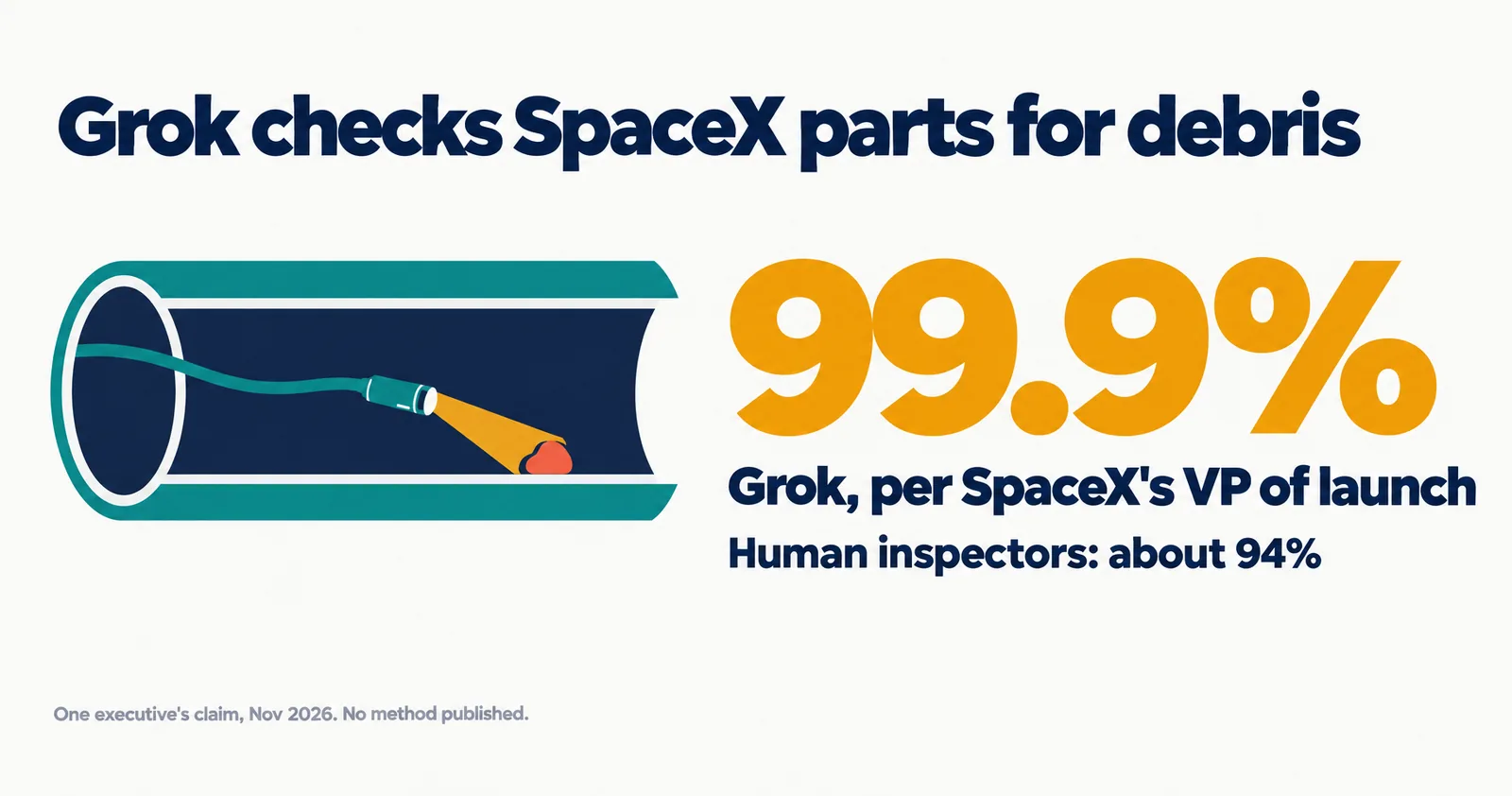
SpaceX’s head of launch says Grok now reviews inspection video of aerospace parts for stray debris, and finds it more often than people do. “We’ve automated being able to detect FOD,” said Kiko Dontchev, SpaceX’s vice president of launch, at the UP.Summit conference in Florida. FOD is foreign object debris: a loose scrap of material left inside a part. Ars Technica reported his remarks on November 9, 2026.
His two figures: human inspectors are “about 94 percent perfect” at finding debris in the video, and Grok is “99.9 percent perfect”. A post by Sawyer Merritt carrying the quote had about 616,000 views by 08:56 UTC on November 10. No method, sample size or study has been published. This page sets out what was said, what the two numbers would mean, and what is missing.
On this page · 8 sectionsOpen
 SpaceX’s vice president of launch, Kiko Dontchev, says Grok now reviews borescope video of parts for foreign object debris, and that the work is automated.
 His figures, as printed by Ars Technica on November 9, 2026: human inspectors are about 94 percent perfect at finding debris, and Grok is 99.9 percent perfect on the same video.
 If those are detection rates, people miss about 60 pieces of debris in every 1,000 and Grok misses 1. That is our arithmetic, not a SpaceX measurement.
 Not stated: how many videos were tested, what the figures measure, how often Grok raises a false alarm, and which Grok model does the work.
 Ars Technica also reports that SpaceX has automated visual inspection of other hardware, such as Starlink customer terminals. No figures were given.
§ 01What Dontchev said

The full quote, as Ars Technica printed it: “We’ll have an inspector go in and borescope a tube, and we find that humans are about 94 percent perfect (at) finding a piece of it. Grok analyzing the same video is 99.9 percent perfect.”
A borescope is a thin camera on a flexible cable. An inspector pushes it inside a tube or an engine to look for problems. Debris matters because, in the article’s words, it “can cause catastrophic damage to engines and other spacecraft components”.
Two details in the quote are easy to miss:
- A person still runs the camera. In his description, an inspector goes in and records the video. Grok reviews the footage.
- Both reviewers see the same video. That makes the comparison fairer than testing people and software on different parts.
Ars Technica’s own summary is that the work of finding debris “has been largely automated using the AI assistant Grok”. Merritt’s post put it more strongly: “Grok (99.9%) is better at it than humans (94%)”.
| Question | Answer |
|---|---|
| Who said it | Kiko Dontchev, vice president of launch at SpaceX |
| Where | On stage at the UP.Summit conference in Florida |
| Reported by | Eric Berger, Ars Technica, November 9, 2026 |
| The task | Finding foreign object debris in borescope video of a tube |
| Human inspectors | About 94 percent |
| Grok, same video | 99.9 percent |
| Published method | None |
§ 02What the two numbers would mean
Dontchev did not say what his figures measure. The plain reading is a detection rate: the share of debris a reviewer finds. On that reading, the gap is bigger than it looks.
- At about 94 percent, a human inspector misses about 6 pieces in every 100.
- At 99.9 percent, Grok misses 1 piece in every 1,000.
- That is about 60 times fewer misses.
The chart below is our arithmetic from his two figures. It is not a SpaceX measurement.
§ 03What was not said
| Question | Status |
|---|---|
| How many videos or parts were tested | Not stated |
| What the figures measure: per piece of debris, or per video | Not stated |
| False alarms: how often Grok flags debris that is not there | Not stated |
| Which Grok model does the work | Not stated |
| Whether a person checks what Grok flags | Not stated |
| Which parts are covered | Not stated beyond a tube |
| A paper, a study or a company post | None found |
False alarms are the biggest gap. Software can find more debris simply by flagging more often. Every false flag sends a person back into the part. A fair test would plant known debris, then count the finds, the misses and the false alarms for both reviewers.
The figures are also round, and one of them starts with the word about. They read like a summary given on stage, not a test result.
As of 09:01 UTC on November 10, we found no post about the figures from Dontchev, SpaceX or xAI on X.
§ 04What a published test looks like
Finding debris by machine is not new, and it has been tested in public before. The FAA’s foreign object debris program covers a different setting: airport runways, not the inside of rocket parts. Its definition: “FOD is any object, live or not, located in an inappropriate location in the airport environment that has the capacity to injure airport or air carrier personnel and damage aircraft.”
The same FAA page lists published performance assessments of four kinds of automated detection system: radar, electro-optical, a hybrid of the two, and mobile radar. That is the kind of document the Grok figures do not have yet.
§ 05What else he said about AI at SpaceX
SpaceX acquired xAI, the company that makes Grok, earlier this year, per Ars Technica. Dontchev said the use of AI inside SpaceX changed quickly after that:
- On speed of adoption: “we’ve really gone through a huge acceleration of adoption”.
- On the effect: “And the acceleration we have seen in our ability to do engineering is unlike anything I’ve ever seen at the company in my 16 years.”
- On who uses it: “every single person, including the technicians and the technician leaders, are starting to use it in their day-to-day”.
Ars Technica also reports that SpaceX has automated visual inspection of other hardware, such as Starlink customer terminals. And it reports Dontchev saying that tasks which took employees hours or days now take seconds or minutes. No figures were given for either.
§ 06What to watch
- A published test: the sample, the misses and the false alarms.
- Whether SpaceX or xAI names the Grok model and how it is set up for this work.
- Whether inspectors still review every flag, or only some.
- Whether regulators or customers accept AI review of inspection video on flight hardware.
Related on this blog: LingBot-Touch: An Open Touch Model for Robot Hands and Anthropic Is SpaceX’s Largest Customer: The Filings.
§ 07Where CellCog sits
CellCog does not inspect hardware. Its AI employees work in software: research, code, documents and data. They run on Claude Opus 5.5, not Grok. We cover this claim because it is the kind of number that gets repeated at work without the method behind it.
§ 08Sources
- Eric Berger, Ars Technica, SpaceX now fundamentally an “infrastructure company,” senior official says, November 9, 2026
- Federal Aviation Administration, FAA Foreign Object Debris Program, read November 10, 2026
- Sawyer Merritt on X, the post carrying the quote (18:18 UTC, November 9, 2026; about 616,000 views at 08:56 UTC on November 10)
Q1Is the 99.9 percent figure verified?
No. It comes from one SpaceX executive speaking on stage, reported by Ars Technica on November 9, 2026. No method, sample size or study has been published.
Q2What is foreign object debris?
Foreign object debris, or FOD, is loose material left inside a part, such as a scrap of metal. Ars Technica writes that it can cause catastrophic damage to engines and other spacecraft components.
Q3What is a borescope?
A thin camera on a flexible cable. An inspector pushes it inside a tube or an engine to look for problems without taking the part apart.
Q4Did Grok replace the inspectors?
The remarks do not say that. In Kiko Dontchev’s description an inspector still runs the borescope and Grok reviews the video. No staffing figures were given.
Q5Which Grok model does SpaceX use for this?
That was not stated. Neither the model nor how it is set up for inspection video has been published.
Q6Does CellCog use Grok?
No. CellCog AI employees run on Claude Opus 5.5 and work in software, not hardware inspection.