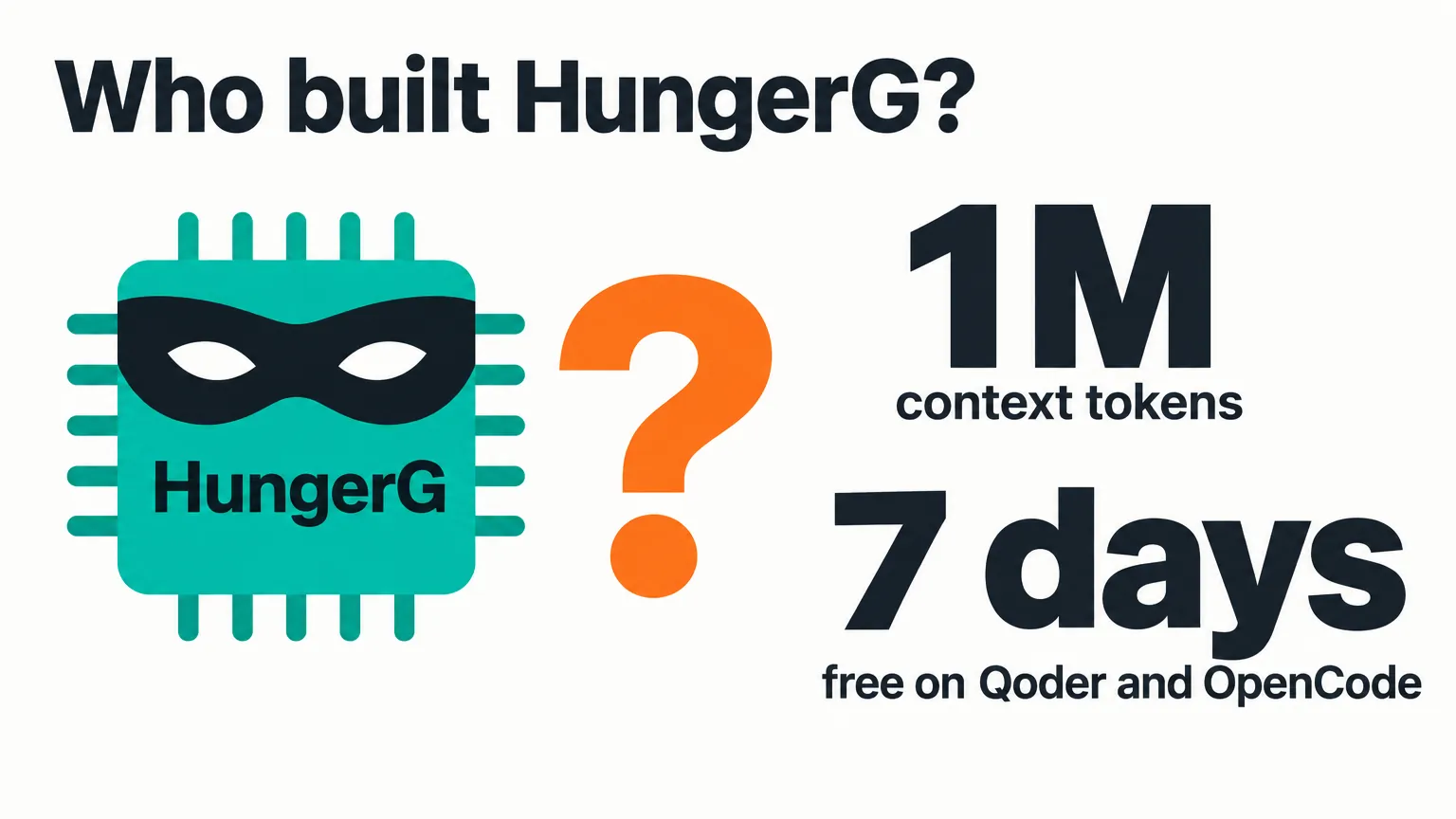
HungerG is a coding model whose maker is being kept secret, and for one week it is free on two coding tools. Qoder, Alibaba’s agentic coding tool, announced it on X at 16:16 UTC on November 23, 2026: “A new stealth model just landed exclusively on Qoder.” The post lists the terms plainly: “Identity: classified.” Then: “Free for 7 days on Qoder and Qoder IDE (Nov 23 to Nov 30). Give it your real task and guess who built it.”
The word exclusively did not last a day. At 03:03 UTC on November 24, OpenCode posted that HungerG “is free for OpenCode Go subscribers this week”, and gave the only specifications either company has shared. This page records what the two posts confirm, what users are guessing, and what nobody has published yet.
On this page · 6 sectionsOpen
- HungerG is an anonymous coding model that Qoder put up on November 23, 2026, free for seven days, with its maker kept secret.
- Qoder’s post says it is free on Qoder and Qoder IDE from November 23 to November 30, and asks users to guess who built it.
- About 11 hours later OpenCode made it free for OpenCode Go subscribers for the week, listing 1M context, multimodal input and no training on data.
- Nobody has named the maker; users on X guess Qwen, StepFun, GLM or DeepSeek, and none of those labs has claimed it.
- No benchmark, price or weights have been published, so the only evidence so far is demos from Qoder and users.
§ 01What is confirmed
| Question | Answer | Source |
|---|---|---|
| Where is it free? | Qoder and Qoder IDE, November 23 to November 30 | Qoder’s post |
| Also free on | OpenCode, for OpenCode Go subscribers, this week | OpenCode’s post |
| Context window | 1M tokens | OpenCode’s post |
| Input | Multimodal | OpenCode’s post |
| Training on user data | None, says OpenCode | OpenCode’s post |
| Maker | Not named | Neither post |
| Benchmarks, price, weights | None published | Neither post |
OpenCode’s post reads, in full after its opening line: “1M context”, “Multi-modal”, “No training on data”. Qoder’s post adds nothing about size or speed; its later posts are demos. One shows “A peacock animation in 7m 51s” (post); another, “A 3D fusion reactor demo, built in just 15 minutes with HungerG” (post).
§ 02Who might have built it
Nobody who would know has said. On X, users testing it guess Qwen, StepFun, GLM and DeepSeek, mostly from speed and style. A guess that it is Qwen would fit Qoder being Alibaba’s product, but that is inference, not a statement, and none of those labs has claimed HungerG. Anonymous launches are a known pattern: Union Alpha also appeared without a maker’s name before it was revealed.
Users have also posted their own side-by-side tests, such as one island-building task that Gemini 4 Neon finished faster than HungerG. Those are single runs by individuals; we did not repeat them, and they are not benchmarks. For a model with published numbers, see our Gemini 4 Neon record.
§ 03How many people saw it
Qoder’s post drew about 2,502,000 views but only 779 likes, a ratio far below OpenCode’s; X does not say how many of those views were paid.
§ 04What we did not check
- The model. We have not used HungerG and cannot say how good it is.
- The vendor sites. We worked from Qoder’s and OpenCode’s posts on X, not from their websites.
- Plan limits. Users report that only personal Qoder accounts get it free, not team or enterprise plans; Qoder’s own post does not say.
§ 05Where CellCog sits
Our conflict, declared: CellCog builds AI employees, including an AI software engineer that writes code and opens pull requests. CellCog has no access to HungerG and does not route any work to it.
§ 06Sources
- Qoder on X, November 23, 2026; demo posts peacock and fusion reactor, November 24, 2026
- OpenCode on X, November 24, 2026
Q1Where can I use HungerG?
In Qoder and Qoder IDE, free from November 23 to November 30, 2026, per Qoder, and in OpenCode for OpenCode Go subscribers this week, per OpenCode.
Q2What does OpenCode say about it?
Its post lists a 1M token context window, multimodal input and no training on user data.
Q3Who made HungerG?
Nobody has said. Qoder’s post calls its identity classified and invites users to guess. Guesses on X include Qwen, StepFun, GLM and DeepSeek.
Q4Are there benchmarks?
Not from a vendor. Qoder posted demos, such as a peacock animation it timed at 7 minutes 51 seconds, and users posted their own tests.
Q5Does CellCog offer HungerG?
No. CellCog has no access to it and has not tested it.