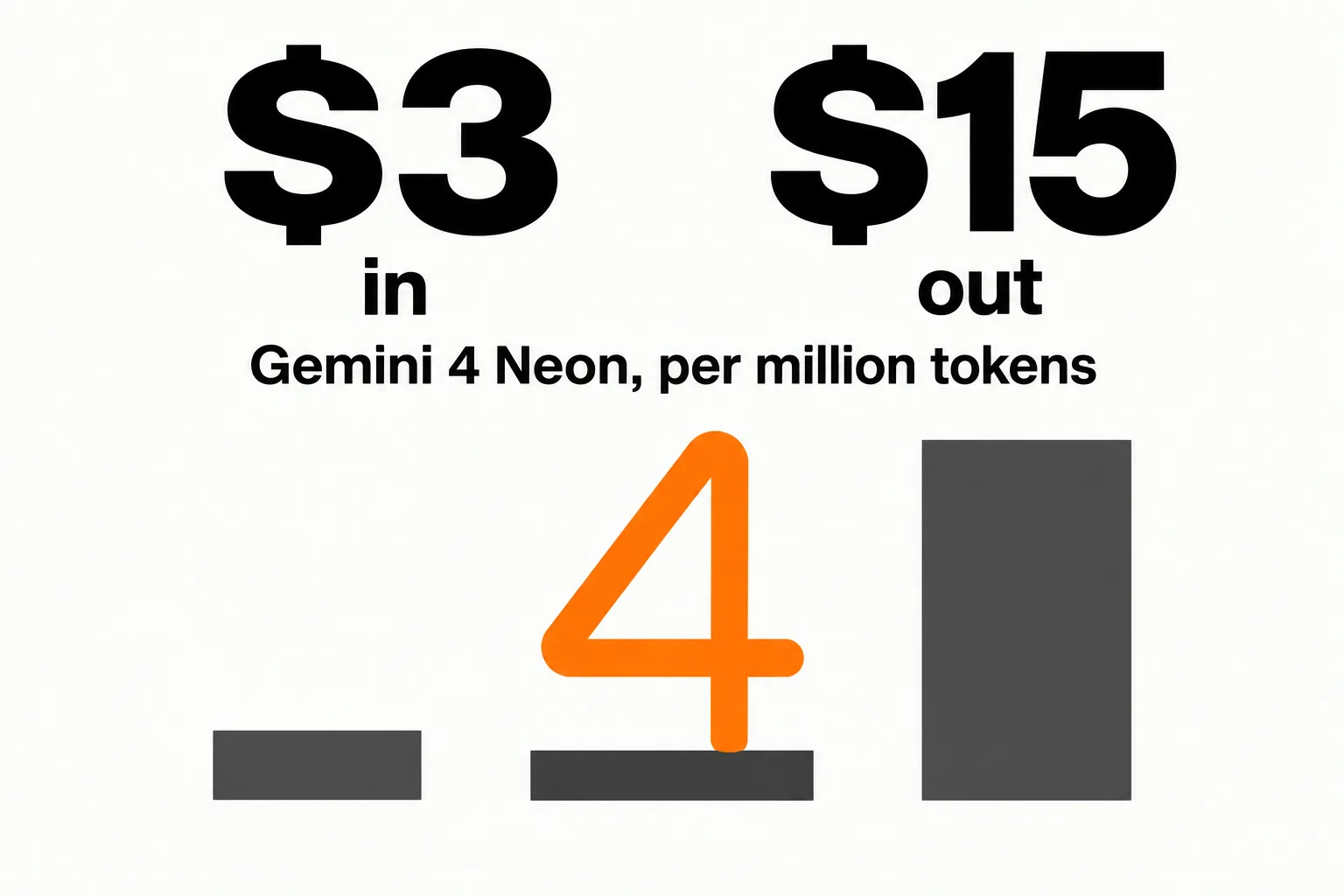
Google made Gemini 4 Neon generally available on November 18, 2026. The Gemini API release notes list gemini-4-neon on the paid tier at $3.00 per million input tokens and $15.00 per million output tokens, with four thinking levels and a context window of about one million tokens.
Google followed the docs with a launch post on its blog the same day, signed by Koray Kavukcuoglu, SVP at Google DeepMind and Chief AI Architect at Google. It adds where Neon runs beyond the API, and Google’s own benchmark and cost claims. OpenRouter listed the model at 13:02 UTC.
On this page · 7 sectionsOpen
 Google made Gemini 4 Neon (gemini-4-neon) generally available on November 18, 2026, per the Gemini API release notes.
 It costs $3 per million input tokens and $15 per million output tokens on the paid tier; Batch and Flex are half that, Priority is $5.40 and $27.
 Google places Neon between Gemini 4 Hydrogen ($1.50 and $7.50) and Gemini 4 Carbon, whose launch price is $2 and $10 through November 30.
 It has a 1,048,576-token context window shared by input, thinking and output, and can write up to that many tokens with long decode.
 There is no free tier. Four thinking levels (low, medium, high by default, xhigh) set depth, speed and token spend.
§ 01What it costs
Google’s pricing page is direct about access: “Gemini 4 Neon is not available on the Free tier.” Every token the model processes is billed, thinking tokens included.
| Tier | Input | Output |
|---|---|---|
| Standard | $3.00 | $15.00 |
| Batch | $1.50 | $7.50 |
| Flex | $1.50 | $7.50 |
| Priority | $5.40 | $27.00 |
Context caching on the standard tier costs $0.15 per million tokens, and only implicit caching is supported.
§ 02Where Neon sits in the Gemini 4 lineup
Google’s own guide places Neon between Gemini 4 Hydrogen and Gemini 4 Carbon. On price the order is less tidy: Carbon and Argon carry a launch price of $2 and $10 through November 30, 2026, below Neon’s $3 and $15. Our Gemini 4 Carbon page records Carbon’s later price of $4 and $20 from December 1.
§ 03Specs and limits
| Item | Gemini 4 Neon |
|---|---|
| Model ID | gemini-4-neon |
| Inputs | Text, image, video, audio, PDF |
| Output | Text |
| Context window | 1,048,576 tokens, shared by input, thinking and output |
| Max output | 65,536 by default; up to 1,048,576 with long decode |
| Thinking levels | low, medium, high (default), xhigh |
| Free tier | Not available |
| Where | Gemini API paid tier, Google AI Studio, Gemini for business, Antigravity and the Gemini app (Pro and Ultra) |
Google says Neon is built for repository-level debugging and multi-file refactoring, long agent sessions with many tool calls, and knowledge work on dense documents and spreadsheets. It also works with the Antigravity agent in Gemini Managed Agents, alone or paired with Hydrogen. Offensive security capabilities are limited to defenders in Google’s Fairwind program.
§ 04The four thinking levels
High is the default. Google suggests low for fast, high-volume work, medium for interactive coding, and xhigh only for hard, multi-step problems where high falls short, since it uses more tokens and takes longer. Google’s launch post adds a cost claim for the default: at high, Neon pairs a high Artificial Analysis Intelligence Index score with a 32% lower cost per task than Carbon.
§ 05What Google’s launch post claims
These are Google’s own numbers from its launch post; we have not run Neon ourselves.
- Where it runs: the Gemini API in Google AI Studio, Gemini for business (API and model dropdown), Google Antigravity for paid Google AI Pro and Ultra subscribers, and the Gemini app for Pro and Ultra subscribers.
- Caching: cached input costs $0.15 per million tokens, a 95% discount on the $3 input price.
- Rankings: #3 overall with a score of 61 on the Artificial Analysis Intelligence Index at xhigh, and #1 on its Coding Agent Index (58.6).
- Agents: #2 on the Vals Index (70.9%) and #2 on Arena’s Agent Arena Index (1336, across 4,200+ agent sessions).
- Code: 65.2% on Terminal-Bench 4.1 and 46.2% on FrontierCode 2.0 at high; on SWE-sweep, 12.8% on the mini-SWE harness and 39.0% inside Antigravity.
- Security: a cyber version of Neon goes to trusted defenders in Google’s Fairwind Program in the coming days.
Google frames the family this way: Carbon takes the hardest long-horizon projects, Hydrogen the fast everyday work, and “Neon balances depth and efficiency.”
§ 06Where CellCog sits
CellCog does not route any work to Gemini 4 Neon. Our agents run Claude Opus 5.5 on Flash and Core, and Claude Fable 5.2 on Agent Max and Creative Max. For the rest of the family, see Gemini 4 Carbon and our Gemini 4 tracker.
§ 07Sources
- Google, Gemini API release notes, pricing, Gemini 4 Neon model page and What’s new in Gemini 4 Neon, read November 18, 2026.
- Google, Introducing Gemini 4 Neon, Koray Kavukcuoglu, November 18, 2026.
- OpenRouter, Gemini 4 Neon, read November 18, 2026.
Q1When did Gemini 4 Neon come out?
Google’s Gemini API release notes list it as generally available on November 18, 2026. OpenRouter listed it at 13:02 UTC that day.
Q2How does Neon compare with Gemini 4 Carbon?
Google places Neon below Carbon in its lineup. On price, Neon’s $3 and $15 is above Carbon’s launch price of $2 and $10, which runs through November 30, 2026. Google’s launch post says Neon costs 32% less per task than Carbon at the default high setting.
Q3What are the thinking levels?
Low, medium, high and xhigh. High is the default; Google suggests xhigh only for hard, multi-step problems, since it uses more tokens and takes longer.
Q4What can it take as input?
Text, images, video, audio and PDF, per Google’s model page. It answers in text only.
Q5Does CellCog use Gemini 4 Neon?
No. CellCog runs Claude Opus 5.5 on Flash and Core and Claude Fable 5.2 on Agent Max and Creative Max.