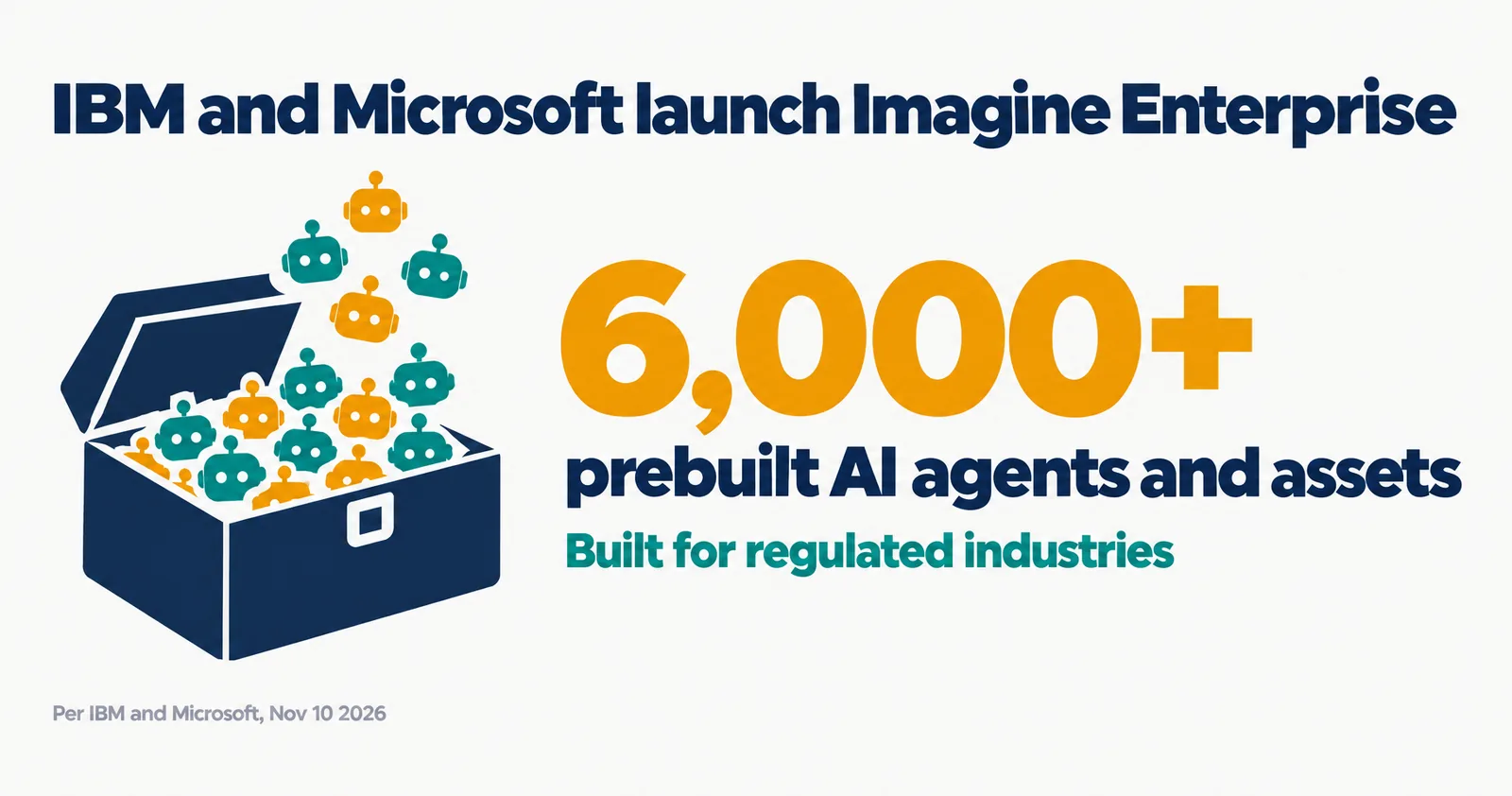
IBM and Microsoft announced Imagine Enterprise on November 10, 2026. The joint release calls it “an agentic platform designed to help enterprises build, run and govern AI agents that help people execute industry-specific processes”. It is aimed at large companies, “especially in regulated industries”.
The headline number is 6,000. IBM Consulting says it brings more than 6,000 prebuilt AI agents and assets. The release names no price and no customer running the platform in production. This page sets out who brings what, how a company would get it, and what the release leaves out.
On this page · 9 sectionsOpen
 IBM and Microsoft announced Imagine Enterprise on November 10, 2026: a platform for large companies to build, run and govern AI agents.
 IBM Consulting brings more than 6,000 prebuilt AI agents and assets. The release does not say how many are agents and how many are other assets.
 Both companies add forward-deployed engineers for qualifying engagements. A client can have IBM run the platform, build with IBM, or manage it itself.
 It starts with financial services, insurance and retail and is aimed at regulated industries, with identity, security and governance tools from Microsoft.
 Not stated: a price, or a customer running it in production. The one named customer, SEI, is described as exploring the technology.
§ 01What IBM and Microsoft announced

Imagine Enterprise is a joint offer, not a product from one vendor. IBM Consulting supplies the agents, the industry knowledge and its delivery platform, IBM Consulting Advantage. Microsoft supplies the software underneath. Both supply engineers: the release promises “forward-deployed engineering support for qualifying engagements”.
| Item | What the release says |
|---|---|
| Announced | November 10, 2026, by IBM and Microsoft |
| What it is | A platform to build, run and govern AI agents |
| IBM Consulting brings | More than 6,000 prebuilt AI agents and assets, industry expertise, Process Studio, Context Studio and Advantage Core |
| Microsoft brings | Foundry, GitHub Copilot, Copilot Studio, Fabric, Entra, Purview, Defender and Azure |
| Engineers | Forward-deployed engineers from both companies, for qualifying engagements |
| First industries | Financial services, insurance and retail |
| Possible later industries | Manufacturing, energy, public sector, mobility and more |
| Named customer | SEI, which is exploring the technology |
| Availability | Available to clients through IBM Consulting |
| Price | Not stated |
The pitch is speed. Instead of a company having to “spend months assembling the pieces themselves”, it starts from agents already built for its industry. IBM’s product page uses its own phrase for the offer: “a digital talent agency for the enterprise”.
§ 02What the 6,000 figure counts
The number appears in two forms in the same release.
- Agents and assets. IBM Consulting brings “a fleet of more than 6,000 AI agents and assets built on IBM Consulting Advantage”.
- Agents alone. A later paragraph cites IBM Consulting’s “hands-on experience building and running more than 6,000 AI agents”.
The release does not split the first figure into agents and other assets. It does not say what counts as an asset. It also does not say how many of the 6,000 are built for the three launch industries. A buyer should ask for that list.
§ 03How a company gets it
The release gives three routes.
- IBM runs it. A client can get the platform “by engaging IBM Consulting to deploy and operate the platform on the client’s behalf”.
- Build it together. The second route is “co-innovating with IBM Consulting on enterprise-scale implementations”.
- Run it yourself. The release adds one line: “Self-management options are also available”.
The industry frameworks “initially include financial services, insurance and retail”. On controls, the platform is meant to connect to the systems a company already has, “with enterprise security, identity, AI governance and control built into the experience”. Engineers from both companies “can help customers move from experimentation to production”.
§ 04The one named customer
The release names one customer: SEI, a financial services firm that manages, advises or administers about $2 trillion in assets. The wording is careful. SEI “is looking to advance its enterprise transformation by exploring emerging and agentic technologies with IBM Consulting”. That describes exploration. The release gives no result, no number and no date for SEI’s work.
§ 05What the two companies said
- IBM. “Clients are no longer looking for AI that simply helps people do the same work a little faster. They want to build an agentic business,” said Mohamad Ali, Senior Vice President and Head of IBM Consulting.
- Microsoft. “Enterprise AI will be won by organizations that can turn their data, industry expertise and AI into action,” said Rodrigo Kede Lima, President, Microsoft Frontier Company.
IBM’s product page adds a survey line: “82% of global business leaders plan to deploy digital labor within eighteen months”. The page links two studies near that line. We have not checked the figure against them.
§ 06What the release does not say
| Question | Answer in the release |
|---|---|
| What does it cost? | Not stated |
| Is it available now? | Yes, through IBM Consulting |
| Which customers run it in production? | None named. SEI is exploring |
| How many of the 6,000 are agents? | Not stated |
| Which AI models power the agents? | No model is named |
| Is every statement a commitment? | No. See the note below |
The release ends with a standard caution. Statements about the two companies’ future direction are “subject to change or withdrawal without notice, and represent goals and objectives only”.
§ 07What to watch
- Microsoft Ignite. IBM’s page lists the event for November 17 to 20 in San Francisco. More detail may come there.
- A production customer. A named company with a result, not a plan.
- A price. Or any packaging beyond a consulting engagement.
- More industries. The release lists manufacturing, energy, public sector and mobility as possible next steps.
Related on this blog: Microsoft Autopilot’s Meeting Agent: How It Decides and AI Employee Platform RFP Checklist: 50 Questions and Proof Requests.
§ 08Where CellCog sits
CellCog also builds AI agents for work, so read this page with that in mind. The two offers are aimed at different buyers. Imagine Enterprise is delivered through IBM Consulting for large companies in regulated industries. CellCog is self-serve: a small team hires one AI employee for a role and gives it work in minutes. We have not used Imagine Enterprise, and nothing on this page rates it.
§ 09Sources
- IBM and Microsoft, IBM and Microsoft announce a new AI agent platform designed for industry-specific transformation, Microsoft Source, November 10, 2026
- IBM, Imagine Enterprise product page, read November 10, 2026
- IBM, IBM Consulting Advantage
Q1What is Imagine Enterprise?
Imagine Enterprise is a platform announced by IBM and Microsoft on November 10, 2026. It is designed to help large companies, especially in regulated industries, build, run and govern AI agents for industry-specific processes.
Q2What does the 6,000 figure count?
The release says IBM Consulting brings more than 6,000 prebuilt AI agents and assets. A later paragraph cites experience building and running more than 6,000 AI agents. It does not split the first figure into agents and other assets.
Q3Which industries does Imagine Enterprise cover?
The first industry frameworks are financial services, insurance and retail. The release lists manufacturing, energy, public sector and mobility as possible later additions.
Q4How much does Imagine Enterprise cost?
The release states no price. It says the platform is available by engaging IBM Consulting to deploy and operate it, by building with IBM Consulting, or through self-management options.
Q5Who is using Imagine Enterprise?
The release names one customer, SEI, a financial services firm. It describes SEI as exploring emerging and agentic technologies with IBM Consulting, and gives no results.
Q6How is this different from CellCog?
Imagine Enterprise is delivered through IBM Consulting for large companies. CellCog, which publishes this blog, is self-serve: a team hires one AI employee for a role. CellCog has not used Imagine Enterprise.