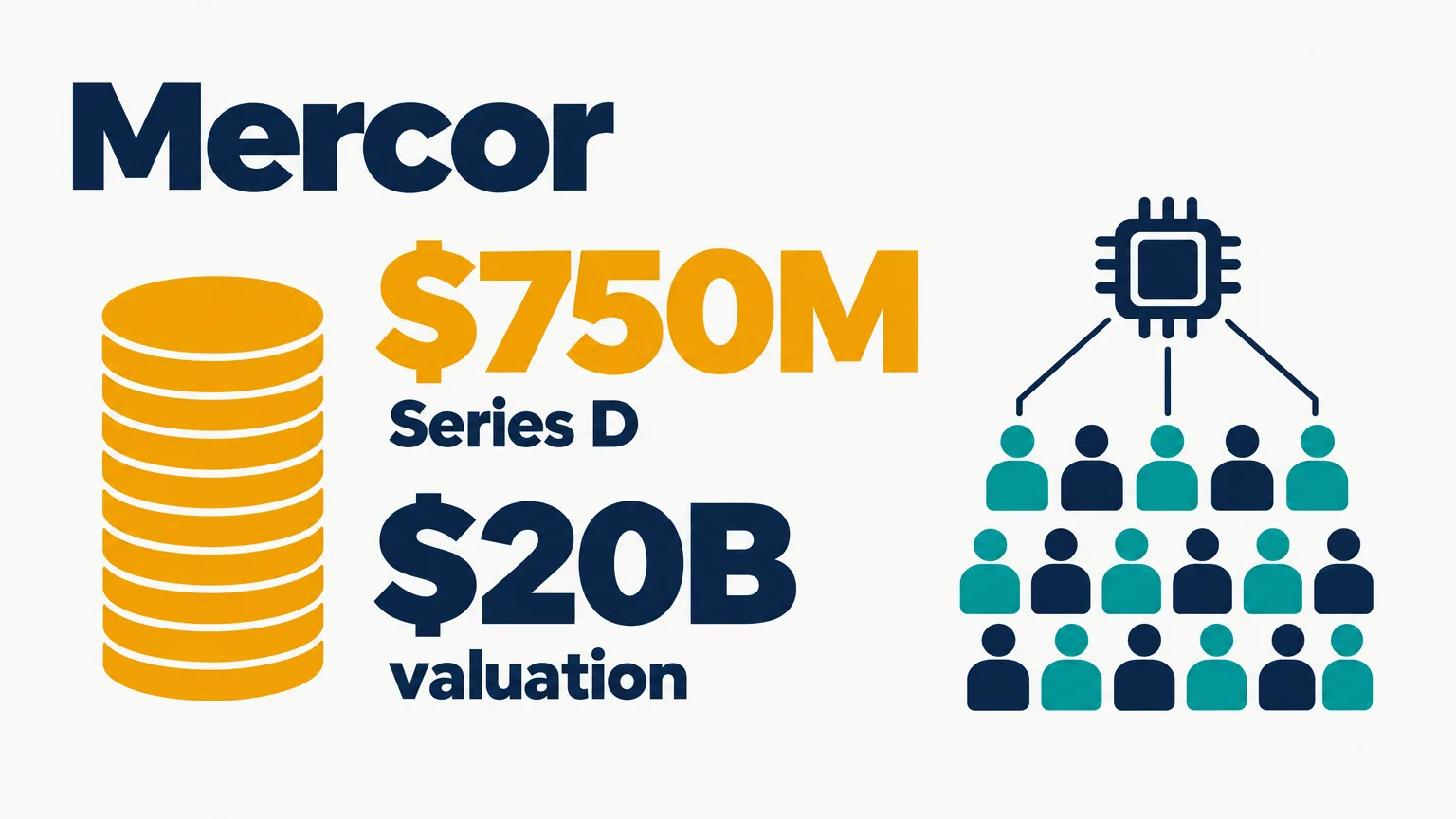
Mercor raised a $750 million Series D at a $20 billion valuation, the AI data company announced on November 10, 2026. That is twice the roughly $10 billion it was valued at about thirteen months earlier, per Reuters. Co-founder Brendan Foody wrote on X at 15:52 UTC that Mercor “scaled from $1M to $3B in run-rate revenue in 27 months”.
Mercor pays human experts to build the training data and tests that AI labs use on their models. Its announcement says the new money goes into selling the same service to ordinary companies. On a day like this it helps to separate two things: what the company put in its press release, and what its chief executive said elsewhere. The revenue figure belongs to the second group.
On this page · 7 sectionsOpen
 Mercor announced a $750 million Series D at a $20 billion valuation on November 10, 2026. The round includes an employee tender.
 Mercor names 13 investors, including Benchmark, General Catalyst, NVIDIA, Salesforce and Zoom. It names no lead.
 Co-founder Brendan Foody says run-rate revenue went from $1 million to $3 billion in 27 months. That figure is in his X post, not in the press release.
 Mercor says more than five million experts are in its network. An interviewer puts its payouts to them above $5 million a day.
 The money goes into evaluation and post-training tools, so companies outside the AI labs can test and train agents on their own work.
§ 01The round
Mercor’s post names 13 investors and says the round “included an employee tender”. A tender means part of the money bought shares from staff and did not go to the company. Mercor does not say how the $750 million splits between the two, and it names no lead investor.

| Item | What Mercor says |
|---|---|
| Round | $750 million Series D |
| Valuation | $20 billion |
| Includes | An employee tender; the split is not given |
| Lead investor | None named |
| Investors named | Benchmark, Felicis, Fundomo, funds managed by affiliates of Apollo, G Squared, General Catalyst, Glade Brook Capital, NVIDIA, Salesforce, Sapphire Ventures, StepStone Group, XTX Ventures, Zoom |
| Use of the money | Research, evaluation and post-training infrastructure, and more practice environments for agents |
| Offices | San Francisco, with New York and London opened this year |
The earlier valuation comes from Reuters, which reports that Mercor “was valued at about $10 billion after raising $350 million in October last year” (Reuters, carried by The Economic Times).
§ 02The numbers that are not in the release
Neither the press release nor Mercor’s blog post gives a revenue figure. The numbers in circulation come from other places:
- Run-rate revenue. Foody’s X post puts it at $3 billion, reached 27 months after $1 million. He also calls that the fastest any company has reached $3 billion, which we have no way to check.
- Earlier milestones. In a May 8, 2026 engineering post, Mercor wrote that it “crossed $1B in annualized revenue run rate earlier this year”. The same post says it went from nothing to a $500 million run-rate in 17 months.
- Payouts in May. That post says Mercor paid “over $2 million every day to more than 30,000 weekly active contractors”.
- Payouts now. Molly O’Shea, who interviewed Foody for the announcement, lists “$5M+ in daily expert payouts” in her summary. That is an interviewer’s note, not a Mercor document.
- Customers. The chart attached to Foody’s post shows the customer count rising to nearly 120. Read by eye, the line for foundation model customers is flat from 2025 and enterprises account for most of the rise.
Four cautions before anyone repeats the $3 billion:
- Run-rate is not revenue. It takes a recent period and scales it to a year. Neither source says which period.
- Nothing here is audited. Mercor is private, and none of these figures sits in a filing.
- A large share goes back out. At $5 million a day, payouts to experts would come to about $1.8 billion a year, or roughly 60% of a $3 billion run-rate. That is our arithmetic on two figures from two different sources.
- The multiple. $20 billion is about 6.7 times a $3 billion run-rate. That is also our arithmetic.
§ 03What Mercor sells
Mercor describes “more than five million experts in our network getting paid to train frontier AI models”. That is the size of a network, not a count of people working in a given week. In May its own figure for contractors active in a week was a little over 30,000.
Reuters notes that the company began as an AI-powered hiring platform and that its backers include Jack Dorsey and Peter Thiel. Today its experts write the tasks, grading rules and reference answers that show whether a model can do a real job. Its public benchmark series is called APEX. We read one of its studies closely in October, where 12 accountants were measured against a model on month-end close tasks (our read of that study).
Earlier this year Mercor bought Deeptune, whose team “spent two years recreating hundreds of enterprise applications” as practice environments for agents.
The work itself is paid, task-based expert work. It sits next to the changes in freelance work that OpenAI and Upwork reported on the same day (our read of that report).
§ 04The pitch: every company tests its own agents
The release names Foody and Adarsh Hiremath as co-CEOs, and each makes one half of the argument.
Foody’s half is about demand. “Every job in the economy will need its own AI agents, and every company will need a way to train and evaluate them on its own work”, he says in the release.
Hiremath’s half is about why public scores are not enough. “A model can score well on a public benchmark and still fail on the systems, policies, and edge cases that define how a specific business runs.”
An investor supplies the market view. Jai Das of Sapphire Ventures says frontier labs “have been the primary buyers of expert-driven training data, which is about to change”.
One line in Foody’s blog post is about Mercor’s own costs. “We already spend 3x as much on inference as on employee salaries”, he writes. He then projects that ratio across the economy to argue for double-digit GDP growth. The first part is a fact about one company. The second is a forecast.
§ 05What it means if you run AI at work
The most useful idea in the announcement costs nothing to apply. A score on a public benchmark does not tell you whether an agent can do your work. Give it your own tasks and your own rules, and count the cost of each finished task.
CellCog runs its AI employees on Claude Opus 5.5, a model from one of the frontier labs that this kind of data is made for. The same test applies to them: judge an AI employee on the work you hand it. This page reports what Mercor and others said. It is not investment advice.
§ 06What to watch
- Whether Mercor publishes revenue, not only run-rate. O’Shea’s interview lists an IPO timeline among its topics.
- The mix of customers, since the pitch depends on enterprises and not only labs.
- Competition. O’Shea’s summary names Scale AI.
§ 07Sources
- Mercor, Organizing human intelligence for the entire economy, Brendan Foody, November 10, 2026
- Mercor press release via Business Wire, Mercor Raises $750 Million Series D at $20 Billion Valuation to Help Enterprises Own Their Intelligence, carried by Yahoo Finance, November 10, 2026 (13:15 UTC)
- Brendan Foody on X (15:52 UTC, November 10, 2026)
- Molly O’Shea on X (14:32 UTC, November 10, 2026)
- Mercor, When you go from $2 million a month to $2 million a day, May 8, 2026
- Reuters, AI training startup Mercor valued at $20 billion in latest funding round, carried by The Economic Times, November 10, 2026
Q1How much did Mercor raise in its Series D?
Mercor announced a $750 million Series D on November 10, 2026. The round includes an employee tender, and Mercor does not say how much went to the company and how much to staff selling shares.
Q2What is Mercor valued at?
$20 billion, per its announcement. Reuters reports it was valued at about $10 billion when it raised $350 million in October 2025.
Q3Who invested in Mercor?
Benchmark, Felicis, Fundomo, funds managed by affiliates of Apollo, G Squared, General Catalyst, Glade Brook Capital, NVIDIA, Salesforce, Sapphire Ventures, StepStone Group, XTX Ventures and Zoom. No lead investor is named.
Q4What is Mercor revenue?
The press release gives none. Co-founder Brendan Foody wrote on X that run-rate revenue went from $1 million to $3 billion in 27 months. That is an annualized figure from a private company, not audited revenue.
Q5What does Mercor do?
It pays human experts to build the training data and tests that AI labs use on their models. It says more than five million experts are in its network, and it now sells the same service to other companies.