OpenAI and Upwork published a joint report on November 10, 2026, on how AI is changing freelance work. OpenAI’s summary carries the main caution itself: “The findings do not point to a simple substitution story.”
The report compares what people do in ChatGPT with the jobs clients post on Upwork, a freelance marketplace. Two results stand out. Content writing is losing share of job posts. Projects that involve AI carry budgets about 52% higher than similar work without it. This page sets out the numbers, how they were measured, and what the report says it cannot show.
On this page · 8 sectionsOpen
 OpenAI and Upwork published a joint report on November 10, 2026. It compares what people do in ChatGPT with the jobs clients post on Upwork.
 Content writing made up 14.5% of sampled ChatGPT conversations and 1.3% of Upwork job posts. Its share of Upwork postings fell by roughly 31% in a year.
 Video and animation and mobile development are rare in ChatGPT use and common on Upwork. Of 63 kinds of work, 43 fit the pattern and 20 did not.
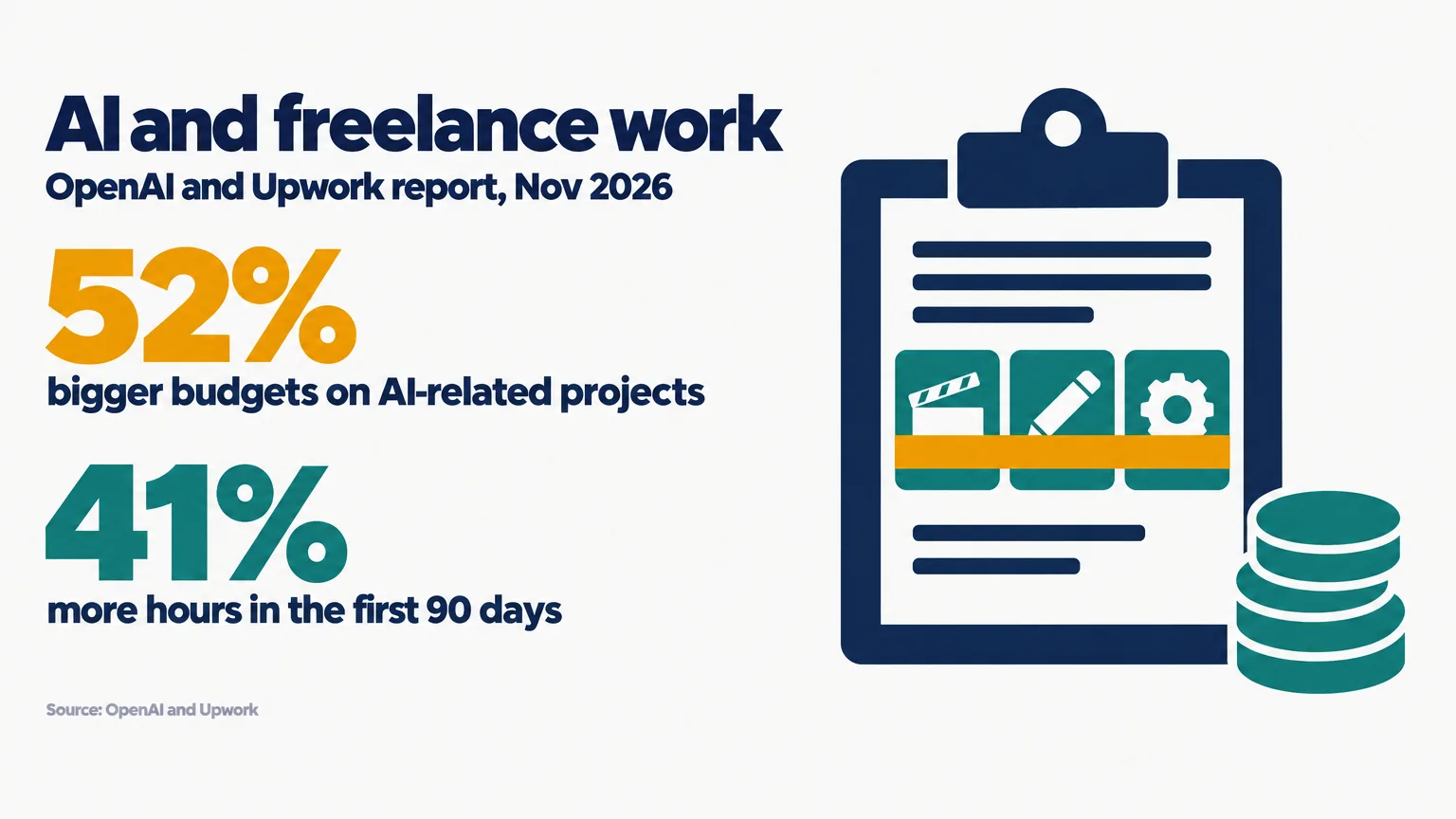
 AI-related projects had fixed-price budgets about 52% higher and about 41% more hours than similar work. Posted hourly rates were 1.5% higher.
 The authors say the two data sets are not directly matched and the estimates do not show cause. OpenAI and Upwork both have a stake in the answer.
§ 01What the report compares

The full report is called The Rebundling of Freelance Work in the AI Age. It runs to 24 pages and has six authors, three from OpenAI and three from Upwork. It sets two data sets side by side: a sample of ChatGPT conversations from January 2025 to June 2026, and Upwork job posts from the first half of 2026.
The two mixes differ. ChatGPT use leans toward writing and advice. Upwork posts lean toward technical and visual work.
| Category | ChatGPT conversations | Upwork job posts |
|---|---|---|
| Content writing | 14.5% | 1.3% |
| Customer service and tech support | 6.5% | 1.2% |
| Graphic, editorial and presentation design | 2.3% | 10.5% |
| Video and animation | 1.0% | 10.0% |
| Mobile development | 0.2% | 7.8% |
The figures come from the key takeaways the two companies published with the report.
§ 02What is losing share, and what is not
- Content writing. Its share of Upwork postings “fell by roughly 31%” from the first half of 2025 to the first half of 2026. The report’s reading: “Firms may be using AI directly for this task instead of hiring remote workers.”
- The wider pattern. The authors matched 63 kinds of work across the two data sets and tracked them from early 2023 to late 2025. In 43 of them, work that is common in ChatGPT lost share on Upwork, or work that is rare in ChatGPT gained share. The other 20 went the opposite way.
- Video and design. AI can help with both, and both remain common on Upwork. On design, the takeaways say “freelance demand for graphic design remains substantial”.
- The gap. Many tasks that AI could do still show up as paid freelance work. The takeaways name it: “OpenAI calls this gap the capability overhang.”
OpenAI’s summary states the limit plainly: “ChatGPT use alone does not explain changes in freelance demand.”
§ 03AI-related projects are bigger
The report counts a job as AI-related when it asks for AI skills, requires AI tools, or involves improving output that AI produced. It then compares those jobs with other jobs in the same category and the same month.
| Measure | Result |
|---|---|
| Posted fixed-price budget | About 52% higher (about 70% before adjusting) |
| Hours logged in the first 90 days, hourly contracts | About 41% more |
| Posted hourly rate | 1.5% higher (about 9% before adjusting) |
| Distinct tasks per posting | 3.35, against 3.19 |
| Task pairs that were rare before | 8.4% of pairs, against 2.4% |
| Spread of tasks in AI-related postings | Equal to 14.6 evenly used tasks in early 2023, and 21.2 in late 2025 |
- Bigger, not pricier per hour. The hourly rate is nearly the same. The budget and the hours are what grow. The takeaways say: “These patterns suggest that clients may commission larger projects when the work involves AI.”
- New combinations. One posting might ask for AI-generated video, editing and motion graphics together. The report counts a pair of tasks as historically uncommon if it appeared in “fewer than 200” earlier postings.
- A wider spread. Task diversity in AI-related postings “rose by about 45%” between early 2023 and late 2025.
§ 04What the report cannot show
The authors list their own limits.
- The two data sets are separate. “The datasets are not directly matched, and neither represents the labor market as a whole.”
- No cause is shown. On the budget and hours comparisons: “These estimates describe conditional associations and do not identify causal effects.”
- Shares, not totals. The chart that links ChatGPT use to Upwork demand “does not measure aggregate Marketplace growth”. A falling share of postings is not the same as fewer jobs.
- A sample. Some results rest on a one-in-20 sample of AI-related jobs.
- Who wrote it. OpenAI makes ChatGPT and Upwork runs the marketplace. Both have a stake in the answer, and the report rests on the two companies’ own data.
The takeaways offer one reading, worded as a possibility: “AI may be changing the composition and scope of work without reducing overall labor demand”.
§ 05Why freelance work
OpenAI’s reasoning is that freelance contracts are short and clients rewrite their postings often, so changes show up there sooner than in employment statistics. It cites Upwork’s own survey, which found that “38% of skilled U.S. knowledge workers freelance”. An earlier Upwork study put freelance knowledge work at “$1.5 trillion in U.S. earnings in 2024”. Both figures are Upwork’s.
§ 06What to watch
- The next half-year of Upwork data. Whether content writing keeps losing share of postings.
- Outside checks. Labor economists testing the same question on other data.
- The rest of the series. OpenAI publishes this under the name Work at the Frontier and lists earlier papers on the same page.
Related on this blog: Skyfall’s Steve: The AI CEO Running 3 Businesses and Human Span of Control for AI Agents: A Workload Model for Safe Supervision.
§ 07Where CellCog sits
CellCog builds AI employees, so read this page with that in mind. The report studies ChatGPT use and freelance job posts. It does not study AI employees, and nothing here is a claim about them. We did not take part in the research.
§ 08Sources
- OpenAI, Work at the Frontier: AI’s effect on freelance work, November 10, 2026
- OpenAI and Upwork, key takeaways (PDF, 5 pages), November 2026
- OpenAI and Upwork, The Rebundling of Freelance Work in the AI Age (PDF, 24 pages), November 2026
- Upwork, Future Workforce Index 2026, cited by OpenAI, not read for this page
Q1What did the OpenAI and Upwork report find?
The report found that the mix of work on Upwork is changing. Content writing lost share of job posts, technical and visual work stayed common, and AI-related projects carried bigger budgets and more hours. The authors say the pattern is not simple substitution.
Q2Is AI reducing demand for freelance writers?
Content writing’s share of Upwork job posts fell by roughly 31% from the first half of 2025 to the first half of 2026. The report says firms may be using AI directly for this task. It measures share of postings, not the total number of jobs, and it does not show cause.
Q3Do AI-related freelance projects pay more?
For similar work posted in the same month, fixed-price budgets were about 52% higher for AI-related jobs, and freelancers logged about 41% more hours in the first 90 days. Posted hourly rates were only 1.5% higher, so the projects are bigger, not pricier per hour.
Q4What is the capability overhang?
It is OpenAI’s term for the gap between what AI systems can do and how people currently use them. The report uses it to explain why tasks AI could help with, such as video production, still appear often in freelance job posts.
Q5What are the limits of the report?
The ChatGPT and Upwork data sets are not directly matched, and neither represents the labor market as a whole. The estimates describe associations, not causes. Both authors’ employers, OpenAI and Upwork, have a stake in the question.
Q6Did CellCog take part in the research?
No. CellCog, which publishes this blog, builds AI employees. It did not take part in the research, and the report does not study AI employees.