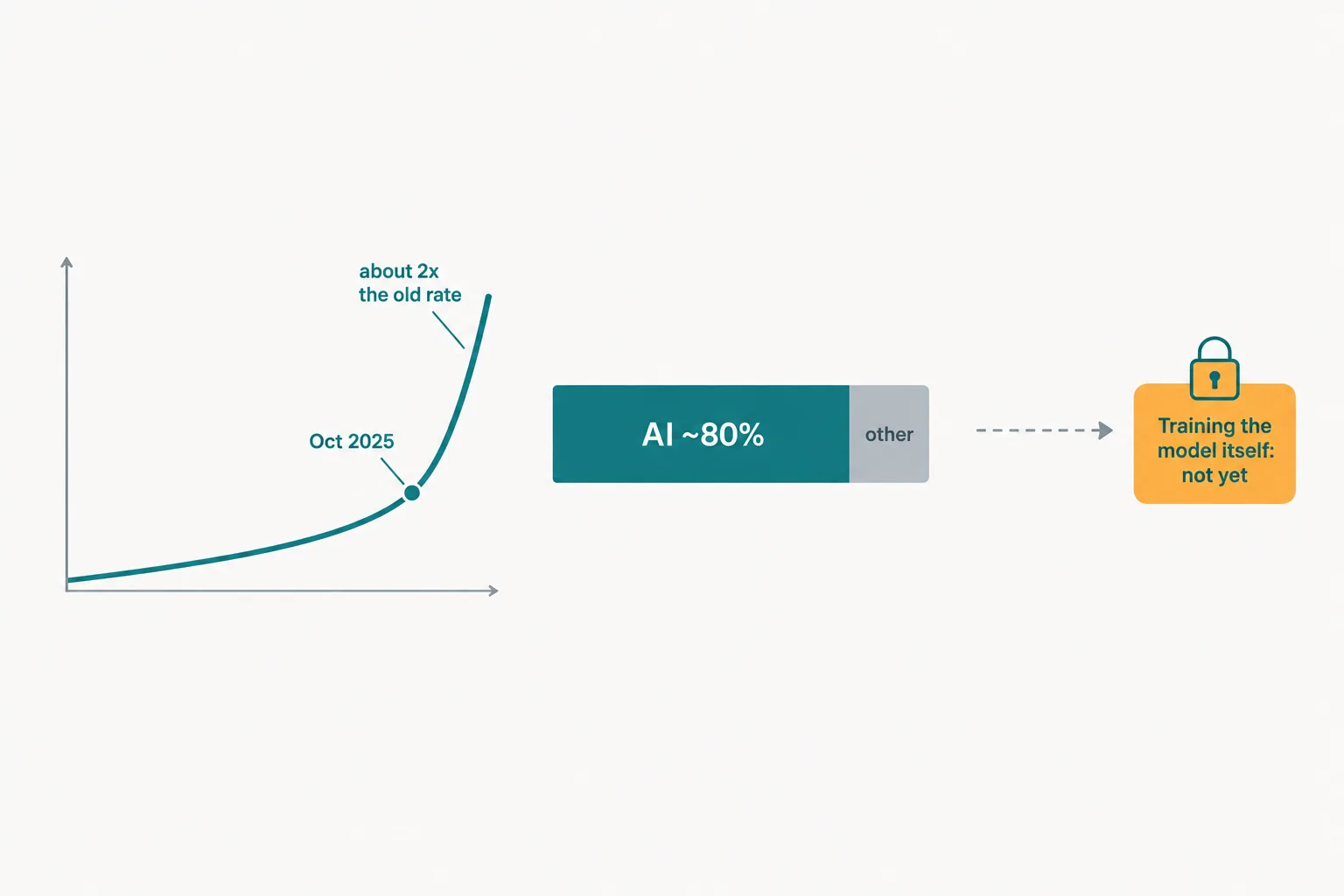
METR, an independent AI-evaluation group, spent eleven weeks inside Anthropic measuring one thing: how much AI is speeding up Anthropic’s own AI research. Its public report, out November 5, 2026, lands on a careful number rather than a dramatic one. Anthropic is now improving its models about twice as fast as it did before, most of that speed-up traces to Anthropic using AI to build AI, and there is no bottleneck in sight that would stop it from compounding.
Read the headline with care, because the viral version of this story, that AI is now building itself, is not what METR found. METR is explicit that AI is not yet doing the most important parts of model training on its own. The real finding is an acceleration, measured under heavy constraints, with the group’s own uncertainty printed on every line.
On this page · 8 sectionsOpen
 METR, an independent AI-evaluation group, spent 11 weeks inside Anthropic measuring how much AI is speeding up Anthropic’s own AI research; the report came out November 5, 2026.
 Anthropic is now improving its models about twice as fast as before October 2025, with a benchmark estimate of 1.9x and a range of 1.1x to 2.9x.
 METR estimates a majority, roughly 80%, of today’s acceleration is due to AI, and is confident it is not explained by faster compute scaling.
 AI is not yet making fully autonomous contributions to the most important parts of model training; researchers describe only signs of life.
 METR found no bottleneck that would stop the acceleration from compounding over the next 12 months, but says its view of bottlenecks changed several times.
 Anthropic redacted a majority of the most informative evidence, so METR says the public has to rely on its judgment more than is ideal.
§ 01What METR actually measured
From August 12 to October 29, 2026, two and a half full-time METR staff ran a high-access evaluation at Anthropic, working on Anthropic devices, taking no payment. Anthropic gave them internal benchmark scores, training-compute figures, interviews with about 15 researchers, and self-reported productivity surveys. METR could request anything; Anthropic could approve or refuse. The three questions were simple: has Anthropic’s rate of progress sped up, how much of that is AI, and is anything about to stop it.

§ 02The three findings
| Question | METR’s finding | Confidence |
|---|---|---|
| Has progress accelerated? | About 2x since October 2025 | High uncertainty (1.3x to 3x plausible) |
| How much is AI? | A majority, roughly 80% today | Substantial uncertainty |
| Any bottleneck in 12 months? | None identified | Changed several times, not confident |
The acceleration rests on a benchmark index Anthropic calls AECI, its version of Epoch’s Capabilities Index. Scores have grown about 1.9x faster since a breakpoint around October 7, 2025, with a 95% confidence interval of 1.5x to 2.8x. Put plainly, Anthropic made as much benchmark progress in the last year as it had in the two years before. METR checked the number against reasonable alternative methods and got a range of 1.1x to 2.9x.
§ 03Why it is probably AI
METR ruled out the obvious alternative first: it is confident the speed-up is not explained by Anthropic scaling up training compute faster. Beyond that, it leans on interviews that centered around a 2x productivity estimate, and on internal surveys where staff self-reported uplift as high as 12x from the latest model in October 2026. METR is careful that a personal “12x faster” does not equal a 12x acceleration in the company’s output; what matters is the sustained change. Its overall guess is that roughly 80% of today’s acceleration is due to AI, with the rest from non-AI factors that mattered more in late 2025.
§ 04The line it will not cross
This is where the honest post diverges from the hype. METR writes that AI “is not yet able to make highly significant and fully autonomous contributions to the most important parts of the model training process.” Researchers described “signs of life” that such contributions could come soon, but they are not here. The acceleration today comes from AI assisting humans, not replacing them in the loop that trains the next model.
The report is also unusually candid about its own limits. Anthropic redacted “a majority of the evidence” METR found most informative, describing the cuts as removing information that could help rival labs. METR says plainly that this means the public has to trust its judgment more than it would like.
§ 05Where CellCog fits
CellCog is our product, an AI employee platform, and a 100-page evaluation with its key evidence redacted is exactly the kind of document that rewards careful reading over a hot take. An AI research assistant can read a report like this end to end, pull out the actual claims and their confidence intervals, and flag where a summary is overreaching, while keeping its own memory of the thread between conversations. The judgment on what it means for you stays yours. For the other side of this story, our record on how Anthropic’s own agents are measuring up against staff.
§ 06What is not established yet
- The real numbers. The most informative evidence, including METR’s detailed attribution and bottleneck analysis, was redacted by Anthropic.
- Benchmarks vs reality. The acceleration is measured on benchmark scores; how it maps to real-world research impact is sparsely evidenced.
- The direction. METR notes the rate could be understated (growth may be curving upward) or overstated (benchmarks may be overfit); it genuinely does not know which.
- Autonomy. Fully autonomous AI contributions to training are “signs of life,” not a fact.
§ 07Where to watch
- Whether a future assessment on a later model shows the acceleration holding, rising or fading.
- Any sign the “signs of life” in autonomous training become real contributions.
- The compute-allocation verification Anthropic canceled midway, if it is ever revived.
§ 08Sources
- METR, Independent Assessment of AI R&D Acceleration at Anthropic in October 2026, November 5, 2026, read 20:06 UTC.
- METR, about the organization, the independent evaluation group behind the assessment.
- Epoch AI, whose Capabilities Index the AECI benchmark is based on.
- Our record on Anthropic’s agents measured against staff.
Q1Who is METR and how did they measure this?
METR is an independent AI-evaluation group. From August 12 to October 29, 2026, its staff ran a high-access evaluation on Anthropic devices, using internal benchmarks, compute data, surveys and about 15 interviews, taking no payment.
Q2Does this mean AI is building itself?
No. The viral framing overstates it. METR found an acceleration driven by AI assisting human researchers, and is explicit that autonomous AI contributions to model training are not here yet.
Q3Why is so much redacted?
Anthropic had unilateral redaction rights over non-public information and cut a majority of the most informative evidence, describing it as removing information that could accelerate rival labs.
Q4What is AECI?
Anthropic’s internal benchmark index, its version of Epoch’s Capabilities Index. Scores grew about 1.9x faster after a breakpoint around October 7, 2025.
Q5Where does CellCog fit?
CellCog is our product, an AI employee platform. An AI research assistant can read a long report like this end to end, extract the real claims and their uncertainty, and leave the judgment to you.