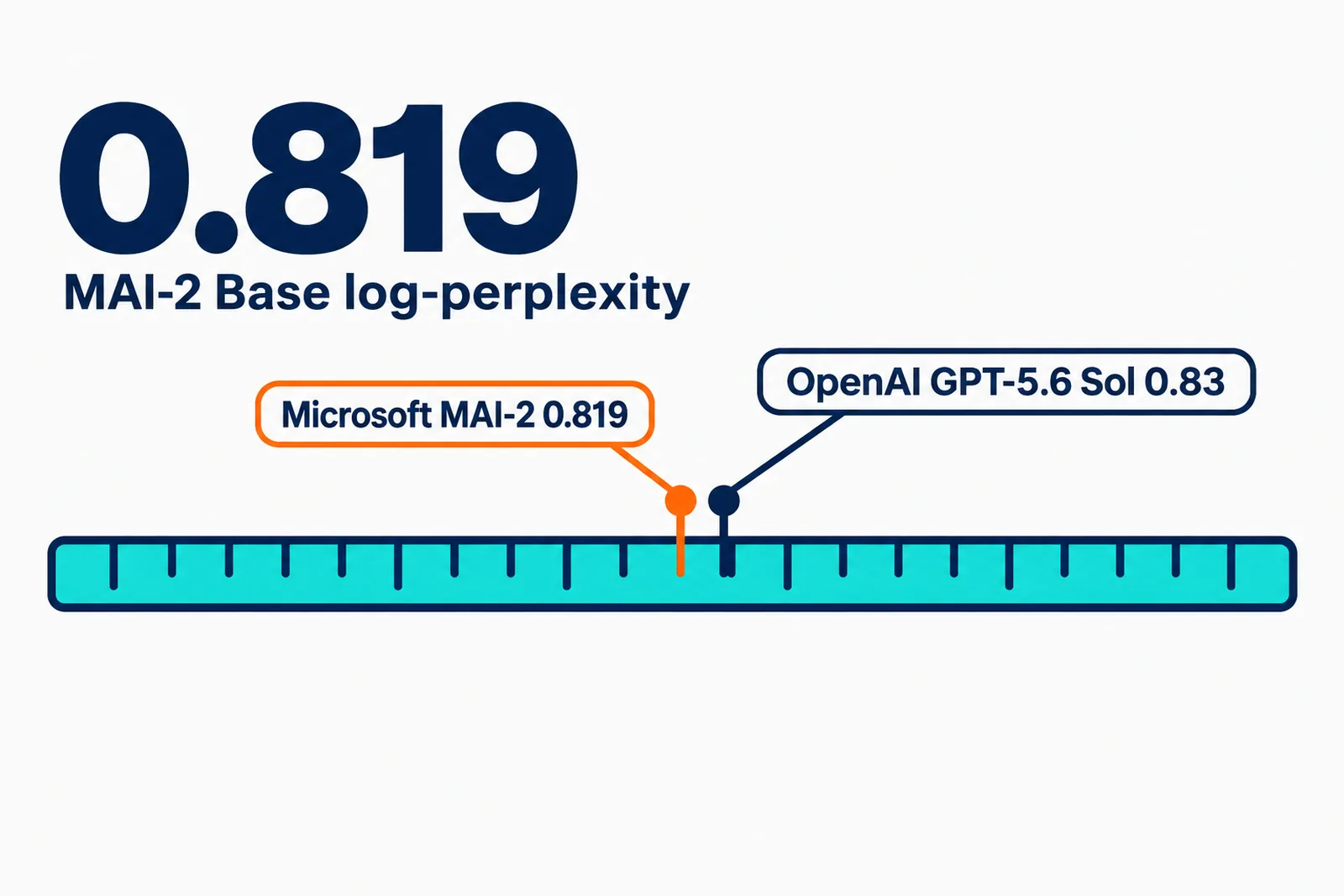
Microsoft is the first lab to put its own model on OpenAI’s perplexity chart. In a post on X at 00:37 UTC on November 23, 2026, Microsoft AI CEO Mustafa Suleyman wrote: “We fully support OpenAI’s transparency initiative.” Then the number: MAI-2 Base, on OpenAI’s own test set. “Its log-perplexity is 0.819, putting it in the same ballpark as the GPT-5.6 Sol base model.”
It answers the proposal OpenAI chief scientist Jakub Pachocki made eight hours earlier: that labs share pretraining progress on a common measure and agree on limits. Here is what Microsoft disclosed, why it could, and why the next lab may not be able to.
On this page · 6 sectionsOpen
 Microsoft AI CEO Mustafa Suleyman said on November 23, 2026 that Microsoft fully supports OpenAI’s push to share pretraining progress.
 He reported MAI-2 Base at 0.819 log-perplexity on OpenAI’s own evaluation set, in the same range as OpenAI’s GPT-5.6 Sol base model.
 Microsoft could do this only because OpenAI let it use its test set, and both labs use the same tokenizer; Suleyman calls that a special case.
 For other labs he suggests reporting bits per byte instead of perplexity, and new shared test sets, because tokenizers differ.
 Microsoft is the first lab to answer OpenAI’s call. Anthropic, Google DeepMind, Meta and xAI had not published a number when we read the posts.
§ 01What Microsoft reported
Suleyman’s chart redraws OpenAI’s and adds two Microsoft points in red, with their values printed on the axis.
| Model | Lab | Log-perplexity |
|---|---|---|
| MAI-1 Base | Microsoft | 0.878 (printed on Microsoft’s chart) |
| GPT-5.5 | OpenAI | about 0.85 (read off the chart) |
| MAI-2 Base | Microsoft | 0.819 (stated in the post) |
| GPT-5.6 Sol | OpenAI | about 0.82 to 0.83 (read off the chart) |
| GPT-6 Astra | OpenAI | about 0.78 (read off the chart) |
| GPT-6.2 Astra | OpenAI | about 0.76 (read off the chart) |
On the chart, MAI-2 Base sits just below GPT-5.6 Sol, near the line OpenAI marks as cybersecurity expert, and above both Astra models. Microsoft did not say whether or when MAI-2 Base ships as a product.
§ 02Why Microsoft could compare, and others can’t yet
Two things made the comparison possible, and Suleyman names both. “Our model uses the same tokenizer as OpenAI, so the numbers are directly comparable.” And OpenAI let Microsoft run its private test set; he calls that “the fact we have access to OpenAI’s evaluation dataset is a special case”.
For everyone else he proposes a different unit: “we might need to report bits-per-byte (BPB) rather than perplexity since different labs use different tokenizers”. Bits per byte counts how well a model predicts raw text, which removes the tokenizer from the comparison. He adds that labs will also need new shared test sets.
An outside researcher, Elie Bakouch, tried it the same night: “here is an attempt to put open models on openai’s base log-perplexity plot”. He placed open models such as DeepSeek and Qwen using Microsoft’s bits-per-byte figures as anchors. Those placements are his estimate, not numbers any lab published.
§ 03The reaction
Suleyman framed it as coordination: “One of the hardest parts of AI safety is coordination, and this is a step in the right direction.” He closed: “Safety and alignment is now the mission.” Sam Altman had called Pachocki’s essay the most important thing OpenAI had published in a while. The same day, Meta’s chief AI officer wrote that superintelligence is arriving, without a number of his own.
§ 04What is shown, and what is not
- Shown. Microsoft’s MAI-1 and MAI-2 base scores on OpenAI’s test set, printed by Microsoft.
- Comparable. Only because of a shared tokenizer and OpenAI’s permission, as Suleyman says.
- Not agreed. No lab has named a limit value. Pachocki proposed limits; Microsoft backed the idea and shared a number.
- Not yet answered. Anthropic, Google DeepMind, Meta and xAI had published no number when we read the posts at 03:19 UTC.

§ 05What we are watching
- A second lab. Whether Anthropic, Google DeepMind, Meta or xAI reports a score, and in which unit.
- A shared test set. Whether labs agree on one that nobody trained on.
- A first limit. Whether anyone puts a number on where to stop, as Pachocki asked in our record of his essay.
§ 06Sources
- Mustafa Suleyman on X, 00:37 UTC, November 23, 2026, with Microsoft’s chart
- Jakub Pachocki on X, 17:03 UTC, November 22, 2026
- Sam Altman on X, November 22, 2026
- Elie Bakouch on X, 00:56 UTC, November 23, 2026
Q1When did Suleyman post this?
At 00:37 UTC on November 23, 2026, quoting Jakub Pachocki’s post. It had 1,512,993 views when we read it at 03:19 UTC.
Q2What is log-perplexity?
A measure of how well a base model predicts text it has not seen. Lower means a stronger model.
Q3Why does the tokenizer matter?
Perplexity is counted per token. Two models split text into the same tokens only if they share a tokenizer, which MAI-2 and OpenAI’s models do.
Q4Did Microsoft agree to a limit?
No. It shared a number and backed the idea; no lab has proposed a value for a limit.
Q5Does this change how CellCog runs?
No. We report it as AI news; CellCog does not route work to Microsoft’s MAI models.