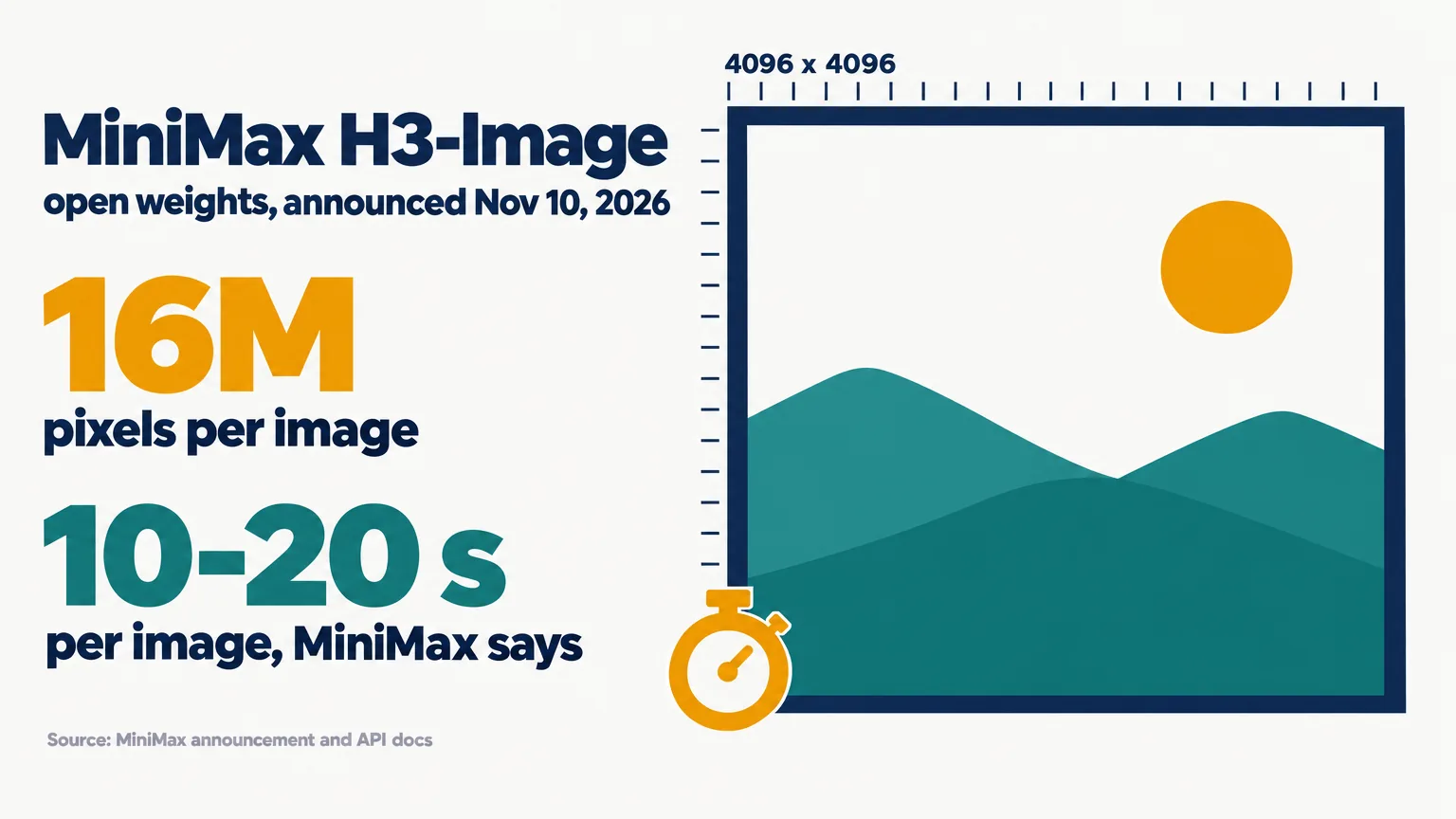
MiniMax announced H3-Image on November 10, 2026, in a post on X at 14:15 UTC. It is an image model built on H3, the company’s video model. The pitch fits in one line of the post: “16 million pixel. 10-20 seconds. Open weights.”
The model makes images from text and edits images from up to 16 references. MiniMax’s API guide and price list were live when we read them. The weights went public on Hugging Face within the hour, under MiniMax’s own license. That license excludes the United States, the European Union, the United Kingdom and South Korea. This page sets out the specs, the prices, the license, and what the announcement leaves out.
On this page · 9 sectionsOpen
 MiniMax announced H3-Image on November 10, 2026: an image model built on its H3 video model, for text-to-image and image editing.
 The headline claim is a 4096 × 4096 image, about 16.8 million pixels, in 10 to 20 seconds. The API accepts any size up to 20 million pixels.
 Editing takes 1 to 16 reference images. The API does not support masked edits, transparent backgrounds or preview images.
 The API bills by token. MiniMax’s example costs are $0.02179 for a 1K image and $0.06879 for a 4K image, with 4K at half price until November 17.
 The weights are public on Hugging Face: 33.1 billion parameters, 68.65 GB. The license excludes the US, the EU, the UK and South Korea, and firms above $1 million in revenue need written permission.
§ 01What MiniMax announced

MiniMax frames the release around three things: speed, quality and control. In its words: “We believe creators shouldn’t have to choose between speed, quality, and control.”
- Speed. “Generate stunning 4K × 4K images in 10-20 seconds.” A 4096 × 4096 image holds 16,777,216 pixels, which is the 16 million in the headline.
- Quality. MiniMax claims detail and photorealism without the look people associate with AI images. It shows no benchmark for this.
- Control. “Strong instruction following, image editing, and support for up to 16 reference images.”
| Item | What MiniMax says |
|---|---|
| Announced | November 10, 2026, 14:15 UTC |
| What it is | An image model built on the H3 video model |
| Modes | Text-to-image, and image editing with 1 to 16 reference images |
| Largest output | Any size up to 20,000,000 pixels |
| Size presets | 1K (1024 × 1024), 2K (2048 × 2048), 4K (4096 × 4096, the default) |
| Aspect ratios | From 1:3 to 3:1 |
| Images per request | 1 to 10 |
| Output formats | JPEG (the default), PNG, WebP |
| Speed claim | 4K × 4K images in 10 to 20 seconds |
| Models in the API | MiniMax-H3-Image and MiniMax-H3-Image-Highspeed |
| Where to use it | MiniMax’s API, MCode and Hailuo AI |
| Weights | Public on Hugging Face: 33.1 billion parameters, 68.65 GB |
| License | MiniMax’s own. It excludes the USA, the EU, the UK and South Korea |
§ 02What the API docs add
The docs are more exact than the post.
- Size. The guide gives an “output area up to 20,000,000 pixels”. A custom size must hold between 655,360 and 20,000,000 pixels. A request outside that range fails, and “the size is never scaled or rounded”.
- Editing. Reference images can be JPG, PNG, WebP, HEIC or HEIF, each between 128 and 8,192 pixels on a side.
- Missing features. The guide lists three things as not supported: “Preview images, masked edits, transparent backgrounds”.
- Prompt rewriting. The model rewrites prompts by default and returns the prompt it used. Text-to-image can turn that off. Edits cannot: “Image edits always apply prompt enhancement.”
- Retries cost money. The guide warns that “Neither endpoint is idempotent”. If a client gives up early, “the server finishes generation and charges for successful images even if the client times out or disconnects”. MiniMax tells developers to turn off automatic retries.
- A long wait is allowed. “The server waits up to 600 seconds”. That ceiling sits well above the 10 to 20 seconds in the announcement.
§ 03What it costs
MiniMax bills by token, not by image. The price list gives two rates.
- MiniMax-H3-Image, the standard model. $2.30 per million input text tokens, $1.50 per million input image tokens and $3.80 per million output image tokens.
- MiniMax-H3-Image-Highspeed. $2.30, $3.00 and $7.60 for the same three.
MiniMax also publishes example costs per image, with a caution attached. The examples “do not represent fixed per-image prices or average costs”. The price list adds: “Actual charges are based on Token usage.”
| Output size | Pixels | Standard | Highspeed | Standard until November 17 |
|---|---|---|---|---|
| 1K (1024 × 1024) | 1,048,576 | $0.02179 | $0.03529 | $0.02179 |
| 2K (2048 × 2048) | 4,194,304 | $0.02333 | $0.03622 | $0.02333 |
| 4K (4096 × 4096) | 16,777,216 | $0.06879 | $0.13001 | $0.03439 |
The 4K image holds 16 times the pixels of the 1K image and costs about 3.2 times as much at the list price.
- The launch discount. Until November 17, 2026, at 16:00 UTC, a request is half price when the delivered image has “at least 16,600,000 pixels”. A 4096 × 4096 image qualifies. A 2K image does not. The post on X words it more loosely, as “50% off 16 million pixel+ generations during launch week”.
- Editing costs more. MiniMax’s example for a 4K edit from one 1K reference image is $0.07312 at the list price. From three references it is $0.07914.
- Read the small print. The price list notes that “Some 1K/2K example amounts have been adjusted for presentation”.
§ 04Are the weights open?
Yes, with limits. The announcement says: “It’s here! Introducing MiniMax H3-Image, and we’re releasing the model weights!” The Hugging Face repository did not load when this page first went up at 14:37 UTC. It was public when we read it at 15:07 UTC.
- Size. The model card describes a diffusion transformer with 33.1 billion parameters. MiniMax says the model is “distilled to 6 sampling steps (6 NFEs) with no classifier-free guidance”.
- Files. The image model is 68.65 GB. It also needs the text encoder from the H3 video model’s repository, which is 66.7 GB. An optional prompt expander, MiniMax-H3-Image-PE, is 17.9 GB and is fine-tuned from Qwen3.8-27B.
- Hardware. The card’s example says “Start the server on one GPU” and shows a four-GPU setup too: “For lower latency, split each request over several GPUs”. It names no GPU model and gives no memory requirement.
The license is the part to read. H3-Image is released under the MiniMax-H3-Image Community License Agreement, dated November 10, 2026. It is MiniMax’s own license and not a standard open-source one.
- Where it applies. The license covers the whole world except four places. It lists them as “the European Union, the United Kingdom, the Republic of Korea and the United States of America”. People there are told to contact MiniMax about a separate license.
- Larger companies need permission. Written authorization from MiniMax is required “if the Annualized Revenue of you and/or your affiliates exceeds 1 Million USD”. The same applies to anyone who offers the model to others as a hosted service.
- The name must show. A commercial product that uses the model must display the name MiniMax-H3-Image in its interface.
- No training other models. “You may not use the MiniMax-H3-Image Works or any of their Outputs or results to improve any other artificial intelligence model”.
- Your images are yours. “MiniMax claims no rights over the Outputs you generate.”
One name to keep apart: Hugging Face already lists repositories called P-H3-Image from other accounts. The oldest in our search, from PrunaAI, was created on October 27. Those are not this release.
§ 05What the announcement does not say
- No benchmark. Neither the post nor the model card gives a test score or a leaderboard rank. The card claims “the strongest instruction following among open-source models” and shows no number for it.
- No hardware for the speed claim. It does not say what the 10 to 20 seconds was measured on, or whether the figure describes the standard model or the Highspeed one. The model card names no GPU model either.
- No independent test. Every claim on this page is MiniMax’s own. We found no outside test at the time of writing.
§ 06What to watch
- Licenses for the excluded places. Whether MiniMax grants licenses in the United States, the EU, the UK and South Korea, and on what terms.
- November 17, 16:00 UTC. The 4K discount ends.
- Outside tests. Leaderboard entries and side-by-side comparisons with other image models.
- Other hosts. Whether inference providers list the model. The license requires MiniMax’s written authorization for hosted services.
Related on this blog: MiniMax H3 Max Renders Video Faster Than It Plays. That Is How AI Employees Get a Face and GPT Image 2.6 vs 2.5: 2x Faster, 4x the Cost.
§ 07Where CellCog sits
CellCog builds AI employees, and its image agent made the illustration at the top of this page with GPT Image 2.5. Read this page knowing that we use a rival model. We have not tested H3-Image, and nothing here rates it. CellCog is based in the United States, which the license lists as an excluded territory.
§ 08Update log
November 10, 2026, 15:23 UTC: the Hugging Face repository opened after this page went live. Added the license, the model size and the files. The first version, published at 14:37 UTC, said the link did not load.
§ 09Sources
- MiniMax, announcement of H3-Image on X, November 10, 2026, 14:15 UTC
- MiniMax, Image Generation Guide, read November 10, 2026
- MiniMax, pricing overview, read November 10, 2026
- Hugging Face, MiniMaxAI/MiniMax-H3-Image, model card, read November 10, 2026, 15:07 UTC
- MiniMax, MiniMax-H3-Image Community License Agreement, dated November 10, 2026
- Hugging Face, MiniMaxAI/MiniMax-H3, model card and license section of the H3 video model
Q1What is MiniMax H3-Image?
MiniMax H3-Image is an image model announced by MiniMax on November 10, 2026. It is built on the company’s H3 video model and supports text-to-image and image editing with 1 to 16 reference images, at sizes up to 20 million pixels.
Q2How fast is MiniMax H3-Image?
MiniMax says it generates 4K × 4K images in 10 to 20 seconds. The announcement does not say what hardware the figure was measured on, or whether it describes the standard model or the Highspeed one.
Q3How much does MiniMax H3-Image cost?
The API bills by token: $3.80 per million output image tokens on the standard model and $7.60 on Highspeed. MiniMax’s example costs are $0.02179 for a 1K image and $0.06879 for a 4K image, with 4K at half price until November 17, 2026.
Q4Is MiniMax H3-Image open source?
The weights are public on Hugging Face, but not under a standard open-source license. MiniMax’s community license excludes the United States, the European Union, the United Kingdom and South Korea, and requires written authorization for companies above $1 million in annual revenue and for hosted services.
Q5What can MiniMax H3-Image not do?
MiniMax’s API guide lists preview images, masked edits and transparent backgrounds as not supported. Image edits always go through prompt rewriting, and a request that times out is still charged.
Q6Does CellCog use MiniMax H3-Image?
No. CellCog, which publishes this blog, runs its image agent on GPT Image 2.5. CellCog has not tested H3-Image, and this page does not rate it.