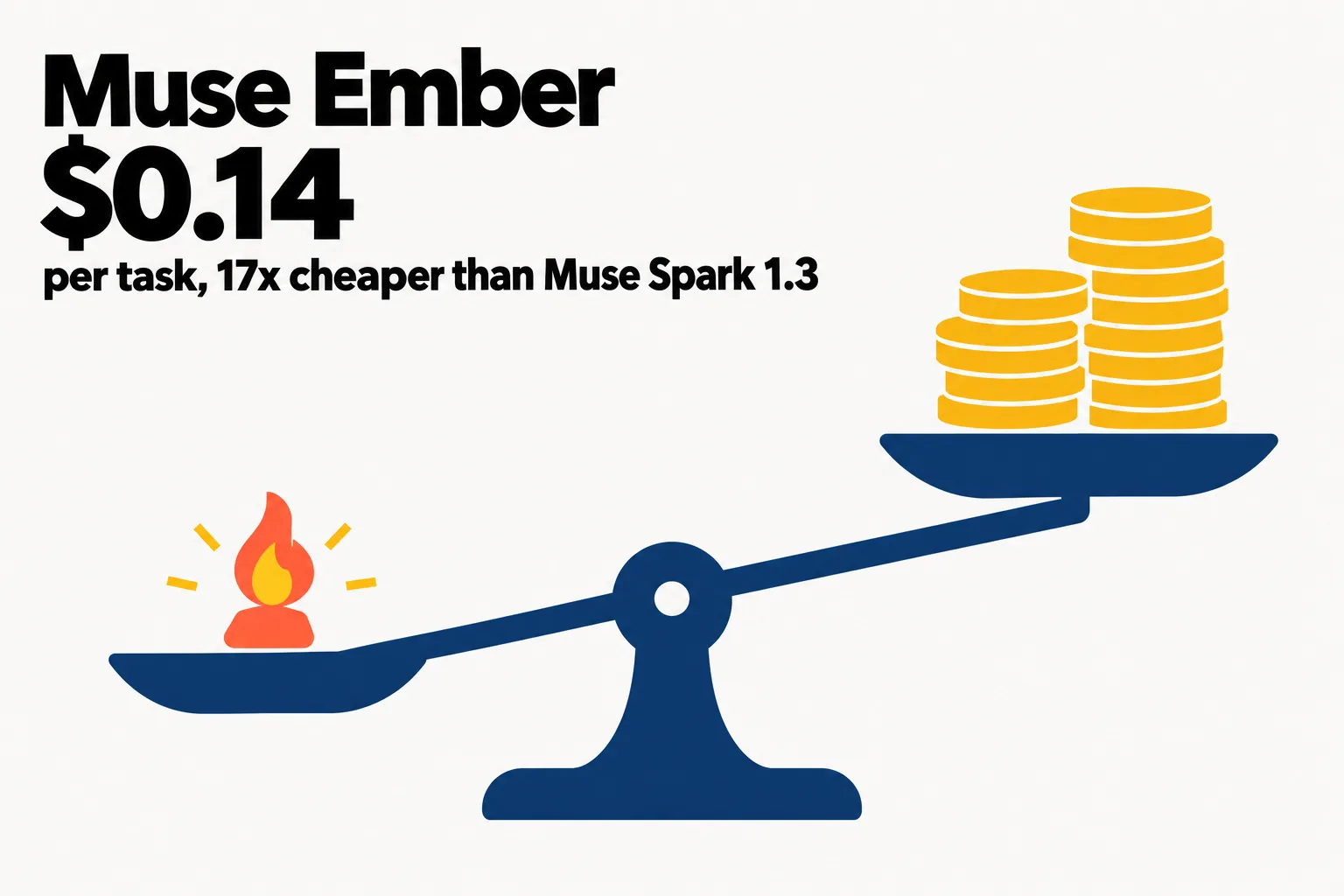
Meta released Muse Ember on November 9, 2026, calling it its “smallest and most efficient model”. It is built for the work agents repeat all day: tool calls, coding subtasks, routing, extraction and long document parsing. It costs $0.10 per million input tokens and $0.50 per million output tokens, and it is live on the Meta Model API and Muse Code as muse-ember-1.0, per Meta’s announcement.
Meta’s headline: Ember scores 36 on the Artificial Analysis Intelligence Index, the same as Claude Haiku 5.5 at max reasoning, for about a third of the cost per task. Artificial Analysis confirmed the score the same hour. Below: the specs, the benchmarks, where Ember loses, and where Meta’s numbers and Artificial Analysis’s do not match.
On this page · 7 sectionsOpen
 Meta released Muse Ember on November 9, 2026: its smallest model, $0.10 per million input tokens and $0.50 per million output, live on the Meta Model API and Muse Code.
 Ember scores 36 on the Artificial Analysis Intelligence Index, level with Claude Haiku 5.5, at $0.14 per task versus Haiku’s $0.41.
 Meta pitches it as the volume worker under Muse Wonder: Wonder plans, Ember runs the tool calls, tests and extraction.
 Ember leads on AutomationBench-AA and Coding Agent Index-AA but trails Haiku 5.5 on FrontierCode 2.0, 27.2% to 34.9%.
 It has a 1M-token context and 512K output, but Artificial Analysis says knowledge is its weak spot: it declines 64% of trivia-style questions.
§ 01What Meta released
Ember takes text, images, audio and video, with a 1M-token context window and up to 512K output tokens. It supports the Responses API. Meta says it is the first model “trained using Muse Wonder Full”, its largest model, and pitches the pair as a team: “Muse Wonder plans, Muse Ember handles the volume.”

Meta does not give a parameter count and did not release weights. Early partners named on the page: Box, Cline, Oracle, Cloudflare and You.com. Cline’s founder, Saoud Rizwan, said Ember “is purpose-built for, and excels at, subagent work like coding and document analysis.”
In one place: model ID muse-ember-1.0; $0.10 per million input tokens, $0.004 cached, $0.50 output; 1M-token context and 512K max output; text, images, audio and video in; on the Meta Model API and Muse Code; parameter count not disclosed.
§ 02The benchmarks
All results are at max reasoning effort. Meta labels some as its own internal evaluations; the rest come from Artificial Analysis.
| Benchmark | Muse Ember | Claude Haiku 5.5 | GPT-6 Luna | Source |
|---|---|---|---|---|
| AA Intelligence Index | 36 | 36 | 28 | Artificial Analysis |
| AutomationBench-AA | 37.8% | 13.9% | 20.2% | Artificial Analysis |
| Agents’ Last Exam | 61.6% | 57.0% | 57.1% | Meta internal |
| Terminal-Bench 4.0 | 40.9% | 39.2% | 16.4% | Best published harness |
| Coding Agent Index-AA | 46 | 37 | 31 | Artificial Analysis |
| FrontierCode 2.0-AA | 27.2% | 34.9% | 25.2% | Artificial Analysis |
| GDP.pdf-AA | 22.8% | 20.8% | 22.8% | Artificial Analysis |
| OSWorld 2.1 (partial credit) | 69.5% | 68.9% | 50.5% | Meta internal |
| PerceptionBench (with tools) | 80.6% | 78.6% | 62.8% | Meta internal |
Ember leads most rows. It loses one clearly: FrontierCode 2.0, real engineering tasks judged on whether the change could merge, where Haiku 5.5 scores 34.9% to Ember’s 27.2%. GDP.pdf is a tie with Luna.
§ 03What it costs per task
Token prices only tell part of the story. Artificial Analysis also measures what each model spends to finish its test set. Ember’s cached input is 60% cheaper than Haiku 5.5’s and it uses roughly a third as many output tokens, per Artificial Analysis.
| Model | Intelligence Index | Cost per task |
|---|---|---|
| Muse Ember | 35.8 | $0.136 |
| Claude Haiku 5.5 | 36.2 | $0.411 |
| GPT-6 Luna | 27.8 | $0.152 |
Against Meta’s own lineup the gap is wider. Muse Spark 1.3 scores 37 at $2.39 per task, so Ember gives up one point for about a seventeenth of the cost. Muse Wonder scores 44 at $6.95 per task, per Artificial Analysis.
§ 04Where Ember is weak
Artificial Analysis names knowledge as the main weakness. Ember’s AA-Omniscience accuracy is 21.1%, the lowest of the similarly intelligent models it compared, against 34.7% for Haiku 5.5. The reason is that it declines to answer 64% of questions, which also keeps its hallucination rate at 17.4%, half of Haiku 5.5’s.
In plain terms: Ember is a worker, not an encyclopedia. It is built to act on the documents and tools you give it, not to answer from memory.
§ 05The numbers do not all line up
Two rows differ between Meta’s page and Artificial Analysis’s thread, both posted November 9:
- AutomationBench-AA: Meta’s table shows Ember at 37.8%. Artificial Analysis’s thread says Ember “scores 68.1% on AutomationBench-AA, level with Muse Wonder (max)”.
- Terminal-Bench 4.0, Haiku 5.5: Meta shows 39.2%, using each model’s best published harness (Claude Code for Haiku). Artificial Analysis shows 32.8% in its own harness. Ember is 40.9% in both.
The harness explains the second gap. The first has no explanation yet; we will update this page if either party corrects it.
§ 06What this means for agent builders
Cheap, capable small models change how agents get built. One strong model plans; many small calls do the volume. That is the split Meta is selling, and it is how Anthropic, OpenAI and now Meta all price their small tiers. Earlier this month we graded clues that OpenRouter’s stealth model Crouton Alpha came from the Muse family; Meta has not said whether Ember is that model.
Every CellCog AI employee runs on Claude Opus 5.5 today, and Muse models are not in our lineup. For the planner half of Meta’s pitch, see our read of Muse Wonder.
§ 07Sources
- Meta: Introducing Our Smallest, Most Efficient Model: Muse Ember (November 9, 2026)
- AI at Meta’s launch post on X
- Artificial Analysis on Muse Ember
- Artificial Analysis on Ember’s cost per task
- Alexandr Wang on Muse Ember
Q1Where can I use Muse Ember?
On the Meta Model API and in Muse Code, as model ID muse-ember-1.0. It supports the Responses API.
Q2Is Muse Ember open weights?
No. Meta did not release weights or a parameter count. Meta’s open-weight model is Muse Spark Open.
Q3What inputs does it take?
Text, images, audio and video, with a 1M-token context window and up to 512K output tokens.
Q4How was it trained?
Meta says Ember is the first model trained using Muse Wonder Full, its largest model.
Q5Does CellCog use Muse Ember?
No. Every CellCog AI employee runs on Claude Opus 5.5 today.