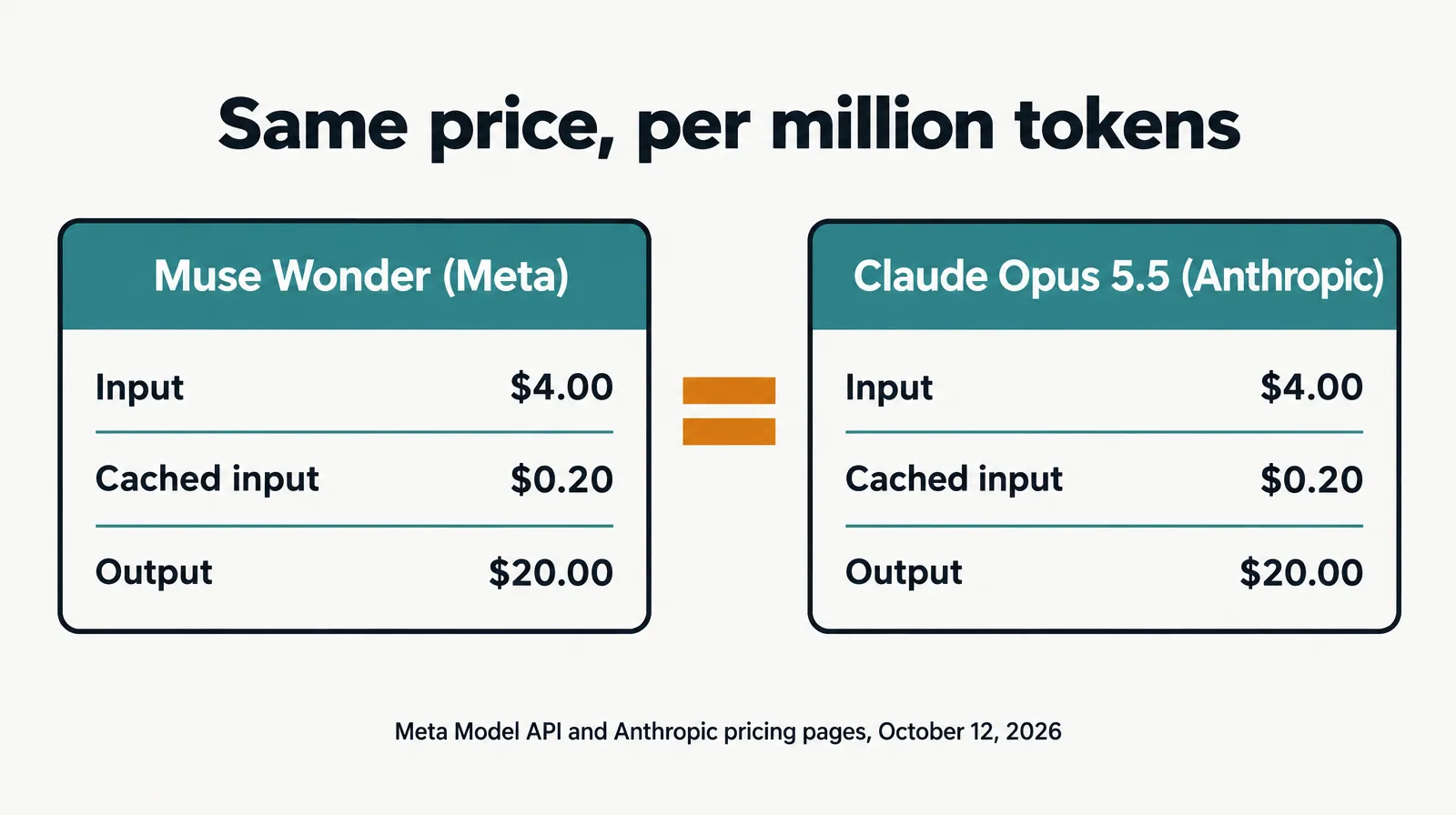
Meta released Muse Wonder on October 12, 2026, its largest model, and priced it at $4 per million input tokens and $20 per million output: exactly what Anthropic charges for Claude Opus 5.5. Alexandr Wang introduced it on X at 16:55 UTC as “our largest and most capable model yet”. Meta’s research post names two models: “Muse Wonder is available today through the Meta Model API and Muse Code, and Muse Wonder Full is available today for Muse Code subscribers.”
We read Meta’s own benchmark table row by row. The race is closer than the launch line suggests, and Meta’s closest rival in it is Claude Opus 5.5, the model every CellCog tier runs on.
On this page · 8 sectionsOpen
 Meta released Muse Wonder and Muse Wonder Full on October 12, 2026, its largest models, built for long-horizon agent work and coding.
 Muse Wonder costs $4 per million input tokens and $20 output on the Meta Model API, the same as Claude Opus 5.5, with a 1M-token context window.
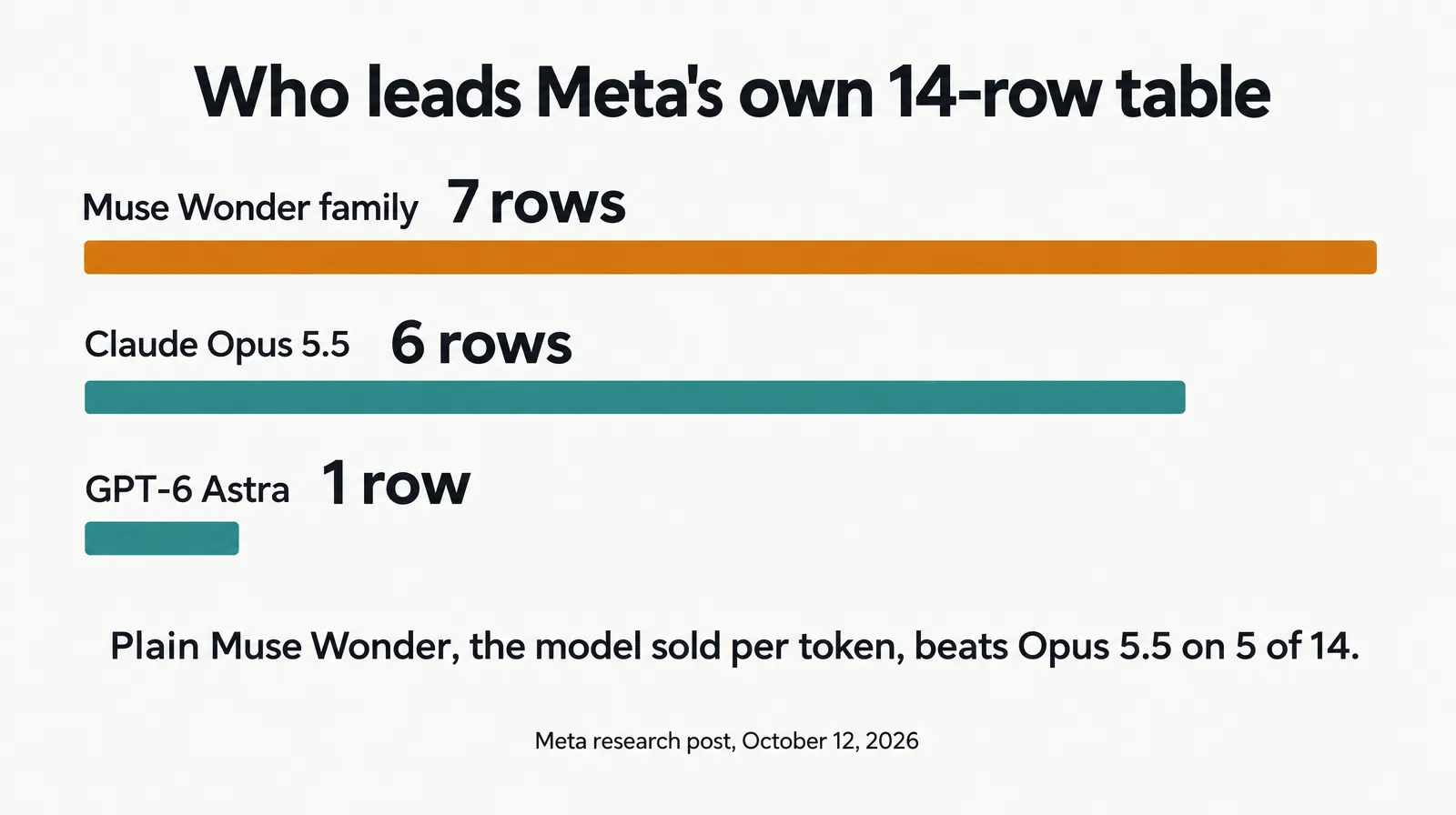
 On Meta’s own 14-row table, the Wonder family leads 7 rows, Claude Opus 5.5 leads 6 and GPT-6 Astra 1.
 Wonder leads on long-running work: SWE-Marathon, DeepSWE, MemoryBench and AutomationBench.
 Opus 5.5 leads on Terminal-Bench, OSWorld and ProgramBench, and tops the Artificial Analysis index in Meta’s own chart, 58 to 56.
 Most of the winning column is Wonder Full, sold only with a Muse Code subscription; plain Muse Wonder beats Opus 5.5 on 5 of 14 rows.
§ 01Price and access
| Muse Wonder | Muse Wonder Full | |
|---|---|---|
| Where | Meta Model API, Muse Code | Muse Code subscription only |
| Input, per million tokens | $4.00 | not sold by the token |
| Cached input, per million tokens | $0.20 | not sold by the token |
| Output, per million tokens | $20.00 | not sold by the token |
| Context window | 1,048,576 tokens | 1M |
| Status | preview | subscription |
| In the Muse app | “soon”, subscribers first | not stated |
For scale: Meta’s previous top model, Muse Spark 1.3, lists at $1.25 in and $4.25 out on the same page. Wonder is more than three times the input price, and Meta set it level with Opus 5.5 rather than under it. The model docs say it is “built for complex software engineering and long-horizon agentic work” and take text, image, video, audio and PDF input.
§ 02How caching works, next to Opus 5.5
Wonder’s cached input costs $0.20 per million tokens, 5% of its input price and the same as Opus 5.5’s cache hits. The mechanics differ more than the price.
| Muse Wonder (Meta) | Claude Opus 5.5 (Anthropic) | |
|---|---|---|
| How it turns on | Automatic on every request; no flag or breakpoint | A cache_control field, top-level or on chosen blocks |
| Default lifetime | Held in memory, no fixed time; evicted under load or after inactivity | 5 minutes, refreshed free on each hit |
| Longer option | prompt_cache_retention “24h” (Responses API), a hint only | 1-hour cache |
| Cache write | No separate charge listed | $5 per million (5 minutes), $8 (1 hour) |
| Cache hit | $0.20 per million | $0.20 per million |
| Routing aid | Optional prompt_cache_key | none needed |
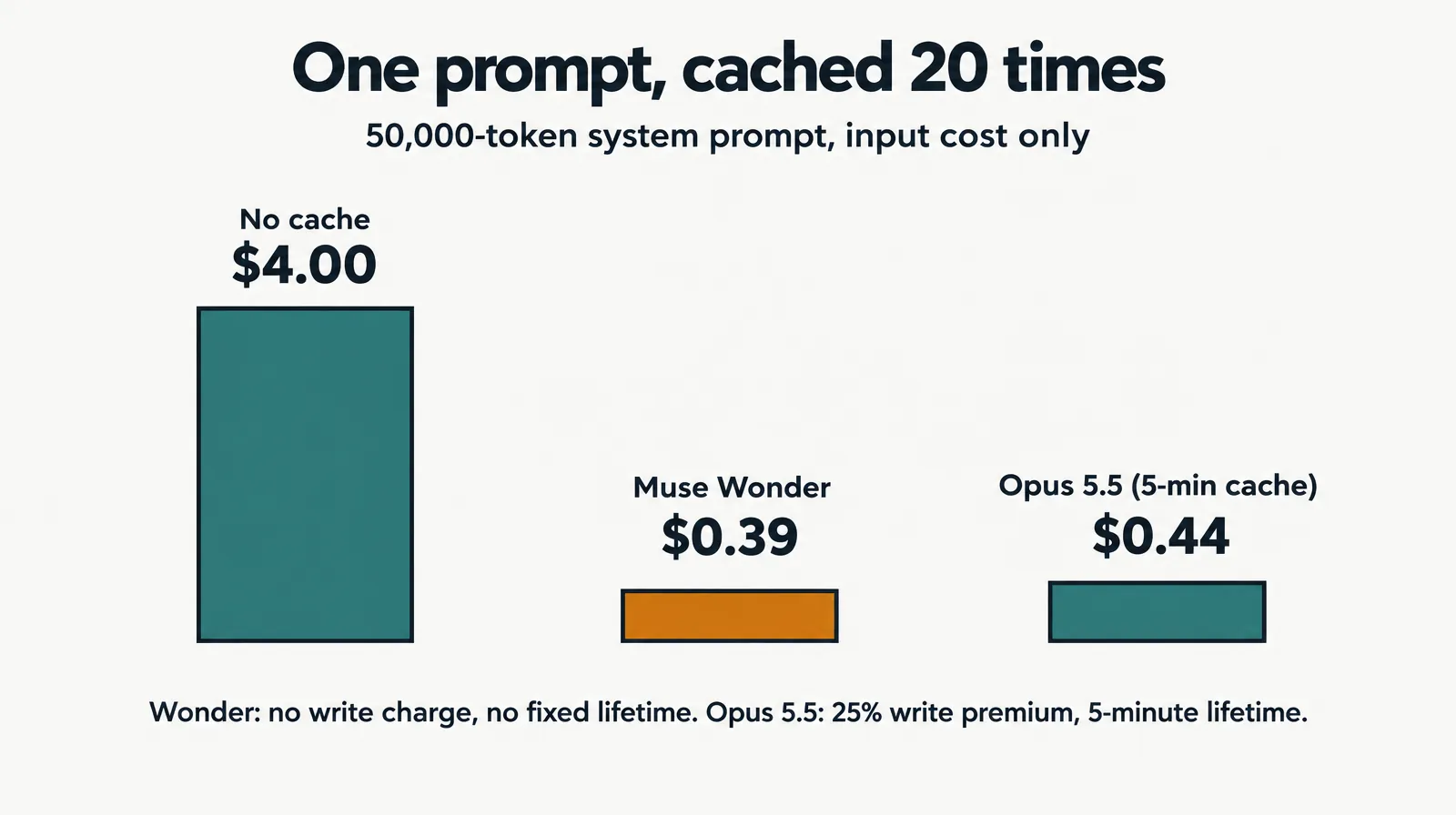
Meta’s prompt-caching doc says the stable prefix is cached “automatically, no flag or key to manage”, and that the 24-hour setting “is a hint, not a guarantee”. Anthropic’s caching doc states: “By default, the cache has a 5-minute lifetime.” The trade: Meta charges nothing to write a cache and asks for no setup, but cannot promise how long it lasts; Anthropic charges 25% over input to write and gives a lifetime you can plan around.
A worked example, input only: a 50,000-token system prompt sent 20 times in a few minutes costs $4.00 with no cache on either model, $0.39 on Wonder if the cache holds, and $0.44 on Opus 5.5 with the 5-minute cache. The gap is the write premium; the risk on Wonder is an eviction you cannot see coming, which shows up as cached_tokens at zero.
§ 03Meta’s own table, row by row
| Benchmark | Wonder Full | Wonder | Opus 5.5 | GPT-6 Astra | Fable 5.1 | Leader |
|---|---|---|---|---|---|---|
| Personal Superintelligence Index (Meta internal) | 59.1 | 54.3 | 55.2 | 54.5 | 49.9 | Wonder Full |
| Harvey LAB-AA | 13.1 | 10.0 | 4.2 | 8.6 | 6.4 | Wonder Full |
| Vals Finance Agent V2 | 59.1 | 56.6 | 58.6 | 53.5 | 58.9 | Wonder Full |
| HealthBench Pro | 62.3 | 60.5 | 65.6 | 65.3 | 62.1 | Opus 5.5 |
| AutomationBench-AA | 45.4 | 39.1 | 41.2 | 41.6 | 32.1 | Wonder Full |
| GDP.pdf | 33.2 | 30.8 | 30.6 | 34.2 | 27.6 | GPT-6 Astra |
| JobBench | 75.3 | 70.5 | 75.4 | 66.1 | 73.1 | Opus 5.5 |
| OSWorld V2.1 (partial) | 78.4 | 72.6 | 81.8 | 75.8 | 80.7 | Opus 5.5 |
| MemoryBench | 85.5 | 85.6 | 81.5 | 81.4 | 79.0 | Wonder |
| Terminal-Bench 4.0-AA | 57.1 | 52.0 | 59.6 | 59.1 | 52.0 | Opus 5.5 |
| DeepSWE 1.1 | 79.0 | 78.8 | 74.2 | 74.1 | 67.4 | Wonder Full |
| SWE-Marathon (Wonder Full at xhigh) | 57.5 | 53.1 | 46.3 | 42.5 | 45.6 | Wonder Full |
| ProgramBench | 59.0 | 50.0 | 70.5 | 52.5 | 55.5 | Opus 5.5 |
| Artificial Analysis Index | 56 | 52 | 58 | 53 | 53 | Opus 5.5 |
Count the leaders and the Wonder family takes 7 of the 14 rows, Opus 5.5 takes 6 and GPT-6 Astra takes 1. The split follows what Meta says it built the model for. Wonder leads the long-running and memory work: SWE-Marathon (57.5 for Wonder Full at xhigh effort, against 46.3 for Opus 5.5), DeepSWE (79.0 against 74.2), MemoryBench (85.6 against 81.5) and AutomationBench (45.4 against 41.2). Opus 5.5 leads the terminal, computer-use and from-scratch coding rows: Terminal-Bench (59.6 against 57.1), OSWorld (81.8 against 78.4) and ProgramBench (70.5 against 59.0).
Three things to hold alongside the count:
- Most of the winning column is Wonder Full, the subscription-only model. The model you can buy at $4 and $20, plain Muse Wonder, beats Opus 5.5 on 5 of the 14 rows and trails it on 9.
- The first row is Meta’s own composite. Meta labels the Personal Superintelligence Index in its table as its own internal composite of personal and knowledge work.
- Safety detail is pending. Meta writes: “A full report with additional safety evaluations will be available soon.”
§ 04The independent index
Meta’s chart, credited to Artificial Analysis and dated October 12, puts Wonder Full second and Wonder level with GPT-6.1 Sol. The live Artificial Analysis leaderboard, read the same afternoon, shows the same 56 and 52, with Claude Opus 5.5 at max effort on 58. On the legal benchmark Meta highlights, Harvey LAB-AA, Wonder Full’s 13.1% would top Artificial Analysis’s leaderboard, where Grok 4.7 led at 9.4% when we read it. On Vals AI’s held-out Harvey LAB leaderboard, Wonder is not listed yet; Muse Spark 1.2 leads there at 25.42%, ahead of GLM-Legal, released the same day.
§ 05Where CellCog sits
Our conflict, declared: we build CellCog, where businesses hire AI employees, and every CellCog tier runs on Claude Opus 5.5, the model Meta’s table measures itself against most closely. At the same price, the choice between them comes down to the work: on Meta’s own numbers, Wonder Full is ahead on long-running coding and memory, and Opus 5.5 on terminal and computer use. We read every frontier launch table against our routing; this one is close enough to keep watching, not a reason to switch on launch day.
§ 06What we are watching
- Independent runs of Muse Wonder on Vals AI and Artificial Analysis beyond Meta’s chart.
- Muse Wonder arriving in the Muse app, and any per-token price for Wonder Full.
- Meta’s full safety report.
§ 07Update log
- October 12, 2026: caching section added (Meta and Anthropic caching docs).
- October 12, 2026: page opened, from Meta’s research post, model docs and API price list, and Alexandr Wang’s announcement.
§ 08Sources
- Meta, Muse Wonder, research post and evaluation table, October 12, 2026.
- Meta, Meta Model API price list and models documentation, read October 12, 2026.
- Meta, Prompt caching and Pricing and rate limits; Anthropic, Prompt caching, read October 12, 2026.
- Alexandr Wang on X, October 12, 2026, 16:55 UTC.
- Artificial Analysis, Harvey LAB-AA v1.1; Vals AI, Harvey’s Legal Agent Benchmark, updated October 12, 2026.
Q1Where can I use Muse Wonder?
Through the Meta Model API and Muse Code, in preview. Meta says it will soon power the Muse app, subscribers first.
Q2What is Muse Wonder Full?
The larger model in the series, available only to Muse Code subscribers, with no per-token price published.
Q3How big is the context window?
1,048,576 tokens, per Meta’s model documentation.
Q4Are there independent benchmark results?
Meta’s chart credits Artificial Analysis for its index; Vals AI had not listed Muse Wonder on its Harvey LAB leaderboard when we read it.
Q5How does prompt caching work on Muse Wonder?
Automatically on every request, at $0.20 per million cached tokens with no write charge; the default lifetime is not fixed, and a 24-hour retention setting is only a hint.
Q6Does CellCog use Muse Wonder?
No. Every CellCog tier runs on Claude Opus 5.5, the model Meta’s table compares itself against most closely.