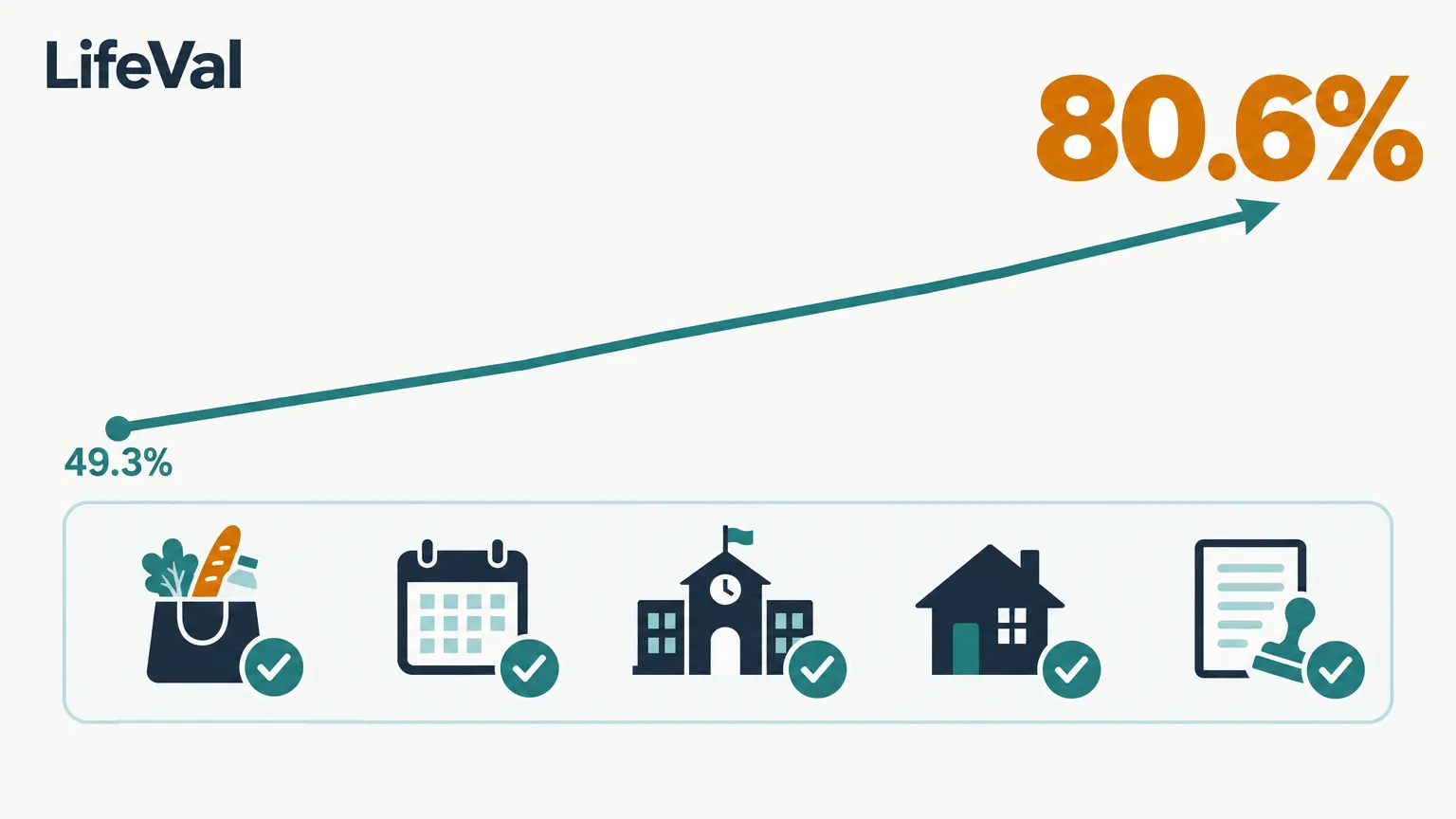
OpenAI published LifeVal on November 2, 2026, a benchmark of the everyday tasks people most want an AI to take off their hands: finding childcare, booking a car inspection, ordering groceries on a budget, getting through government paperwork. Its announcement on X at 17:27 UTC passed 100,000 views in its first half hour.
The headline number is GPT-6 Astra at 80.6% average reward, up from 49.3% for GPT-5.2 in December 2025. The catch is who built it: OpenAI made LifeVal, says it used the evaluation “to track and drive improvement in model performance on everyday tasks over the past year”, and publishes scores for its own models only.
On this page · 7 sectionsOpen
 OpenAI released LifeVal on November 2, 2026, a benchmark of everyday tasks such as finding childcare, booking a car inspection and government paperwork.
 GPT-6 Astra scores 80.6% average reward, up from 49.3% for GPT-5.2 in December 2025; GPT-5.6 sat at 80.0%.
 The task list came from two time-use studies plus a new survey of 3,995 people on where they want an assistant’s help.
 LifeVal tasks ask the AI to finish the job, not give advice; OpenAI shows six tasks where GPT-6 Astra’s best attempt scored 100%.
 OpenAI scores only its own models and gives no task count, grading method or release plan.
§ 01What LifeVal measures

OpenAI states the goal plainly: “To be a truly helpful personal assistant, ChatGPT should be able to take actions that actually get things done.” LifeVal tasks ask for the action, not advice. In OpenAI’s home-search example, the task ends with a property deed added to a county records cart for the user to review.
The task list was built from three sources:
- The American Time Use Survey, which tracks how people in the U.S. spend their days.
- The Multinational Time Use Study, the same kind of record across countries.
- A new survey of 3,995 people that OpenAI calls demographically representative, asking where they would most want a personal assistant’s help.
The resulting tasks cover caregiving, health, education, household administration, personal finances, shopping and government services. OpenAI’s X post describes the benchmark as “shaped by feedback from thousands of ChatGPT users”; the post on its site does not say whether the 3,995 respondents were ChatGPT users.
§ 02The scores
OpenAI charts one number per model, an unweighted average reward across LifeVal tasks, against each model’s release date.
| Model | Date on OpenAI’s chart | Average reward (unweighted) |
|---|---|---|
| GPT-5.2 | Dec 11, 2025 | 49.3% |
| GPT-5.4 | Mar 5, 2026 | 73.0% |
| GPT-5.5 | Apr 23, 2026 | 77.4% |
| GPT-5.6 | Jul 9, 2026 | 80.0% |
| GPT-6 Astra | Sep 3, 2026 | 80.6% |
Most of the gain came early. GPT-5.4 added 23.7 points over GPT-5.2; the three releases since then added 7.6 points together, and GPT-6 Astra sits 0.6 points above GPT-5.6. The curve is flattening near 80%, which is either a ceiling in the models or a ceiling in the tasks; OpenAI’s post does not say which.
OpenAI also shows five worked examples with a score each. The post calls these examples of how “our current models” perform, without naming the model per task.
| Task | Score shown |
|---|---|
| Enroll in the right kindergarten after moving | 93.1% |
| Manage volunteers ahead of a flood | 98.0% |
| Find a new home for my family | 100% |
| Watch a game with grandma from far away | 96.3% |
| Meal prep for a parent adjusting to a new diabetes diagnosis | 90.4% |
A second list names six tasks where GPT-6 Astra’s best recorded score is 100%, among them booking a car inspection before a road trip, ordering halal groceries within a budget and itemizing the order in a spreadsheet, and unsubscribing from email lists. “Best recorded” is the best attempt, not the average, so these show what the model can do, not what it does every time.
§ 03What OpenAI left out
The post is a progress chart, not a paper. It does not give:
- The task count. How many tasks LifeVal holds is not stated.
- The grading. “Average reward” is not defined: no rubric, no grader, no number of attempts behind the average.
- The setting. Whether tasks run on live websites or test copies is not said, though the examples name real places such as Luzerne County.
- Other labs. No Claude, Gemini, Grok or Muse model appears on the chart.
- Release. There is no word on whether the task set will be published for others to run.
Because OpenAI says it used LifeVal to drive improvement for a year, it is a target its own models were tuned toward as well as a measure of them. That makes the 80.6% a useful read of OpenAI’s direction and a weak read of how ChatGPT compares with anything else.
§ 04LifeVal and GDPx, on the same day
SemiAnalysis released GDPx the same morning, and the best model there passes 12%. The two numbers do not conflict. GDPx is third-party, scores 20 models, and puts agents into expert work such as chip design and quant trading for up to eight hours. LifeVal is OpenAI’s own, scores OpenAI’s models, and covers household jobs most people do every week.
They agree on the direction. Both test whether an agent finishes a task, not whether it answers a question, the same move OpenAI made when it let ChatGPT act in your Chrome tabs.
§ 05What this means if you are handing off everyday work
Our position, declared: we build CellCog, and our AI employees run on Claude Opus 5.5, a model LifeVal does not score. Read our take with that in mind.
The useful part of LifeVal is its task list, not its score. Booking, comparing, ordering and filing are the jobs people want done, and OpenAI’s own examples stop before the final step: the deed goes into a cart “so I can review it”, and the kindergarten shortlist leaves “two preferences” for the user. That is the right shape for any agent doing real errands: it does the legwork, and a person approves what leaves the house or the company.
§ 06What we are watching
- A paper or task release. Without one, nobody outside OpenAI can check the 80.6%.
- Other labs. Whether Anthropic, Google or Meta report LifeVal, or answer with an everyday-task benchmark of their own.
- ChatGPT release notes. Whether LifeVal scores start appearing on model cards next to GDPval.
§ 07Sources
- OpenAI: LifeVal, published November 2, 2026, read the same day.
- X: @OpenAI announcement; time from the post id.
- Survey sources named by OpenAI: the American Time Use Survey and the Multinational Time Use Study.
Q1Who made LifeVal?
OpenAI. It says it built the evaluation from time-use studies and a survey of 3,995 people, and used it for a year to improve its models.
Q2What kinds of tasks are in LifeVal?
Caregiving, health, education, household administration, personal finances, shopping and government services, such as enrolling a child in kindergarten or booking a car inspection.
Q3Which model scores highest on LifeVal?
GPT-6 Astra at 80.6% average reward, just above GPT-5.6 at 80.0%. No non-OpenAI model is listed.
Q4How is LifeVal different from GDPx?
GDPx, from SemiAnalysis, scores 20 models on expert work where the best passes 12%; LifeVal is OpenAI’s own test of household tasks and scores only OpenAI models.
Q5Can I run LifeVal myself?
Not today. OpenAI has not published the task set, the task count or how average reward is graded.