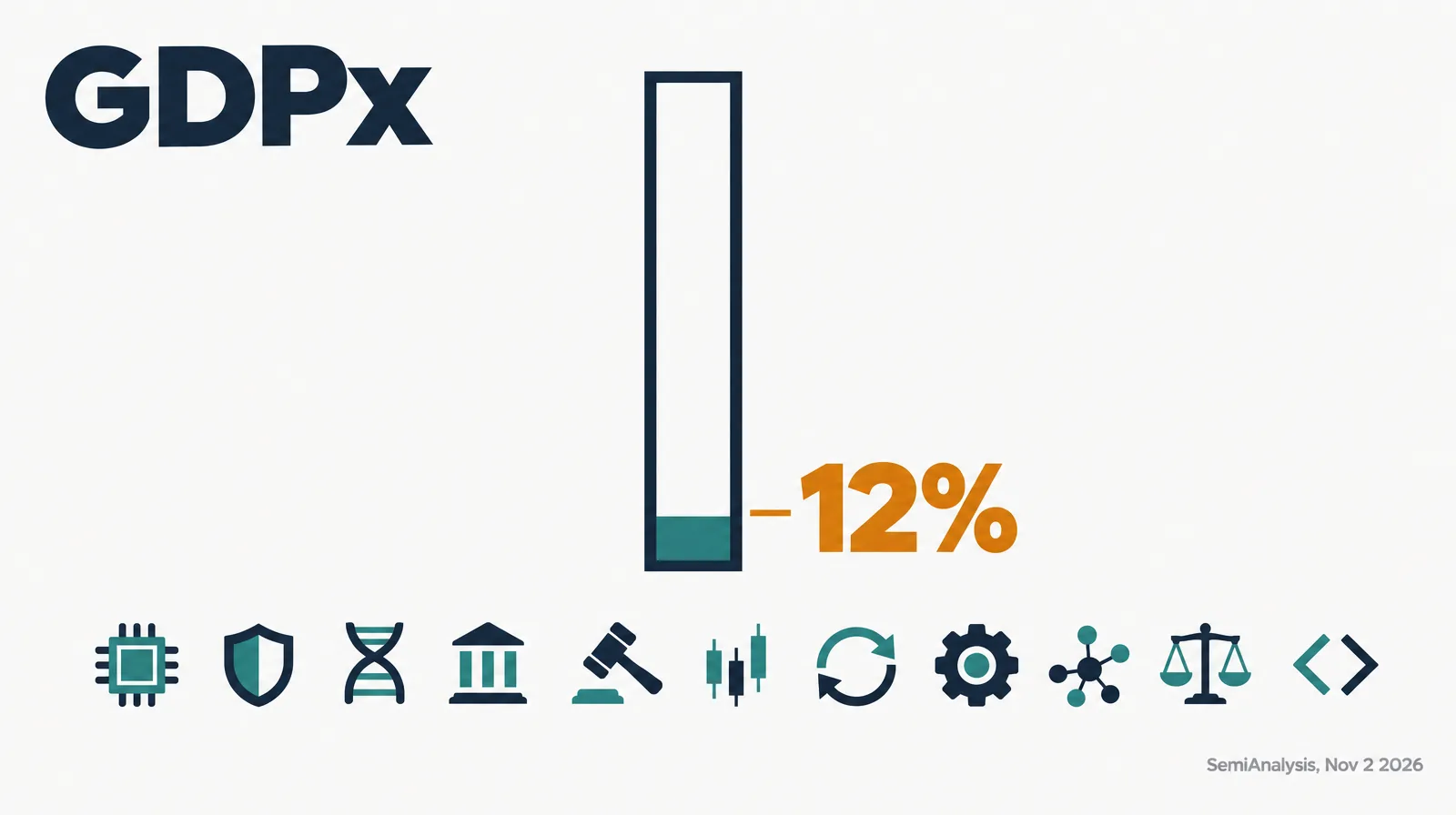
SemiAnalysis released GDPx on November 2, 2026, a benchmark of 206 agent tasks across 11 domains that pay, from chip design to quant trading. Its launch thread at 02:06 UTC put the result in one line: “GDPx is a true frontier-level benchmark: even the best model scores just 12%” and passed a million views within a day.
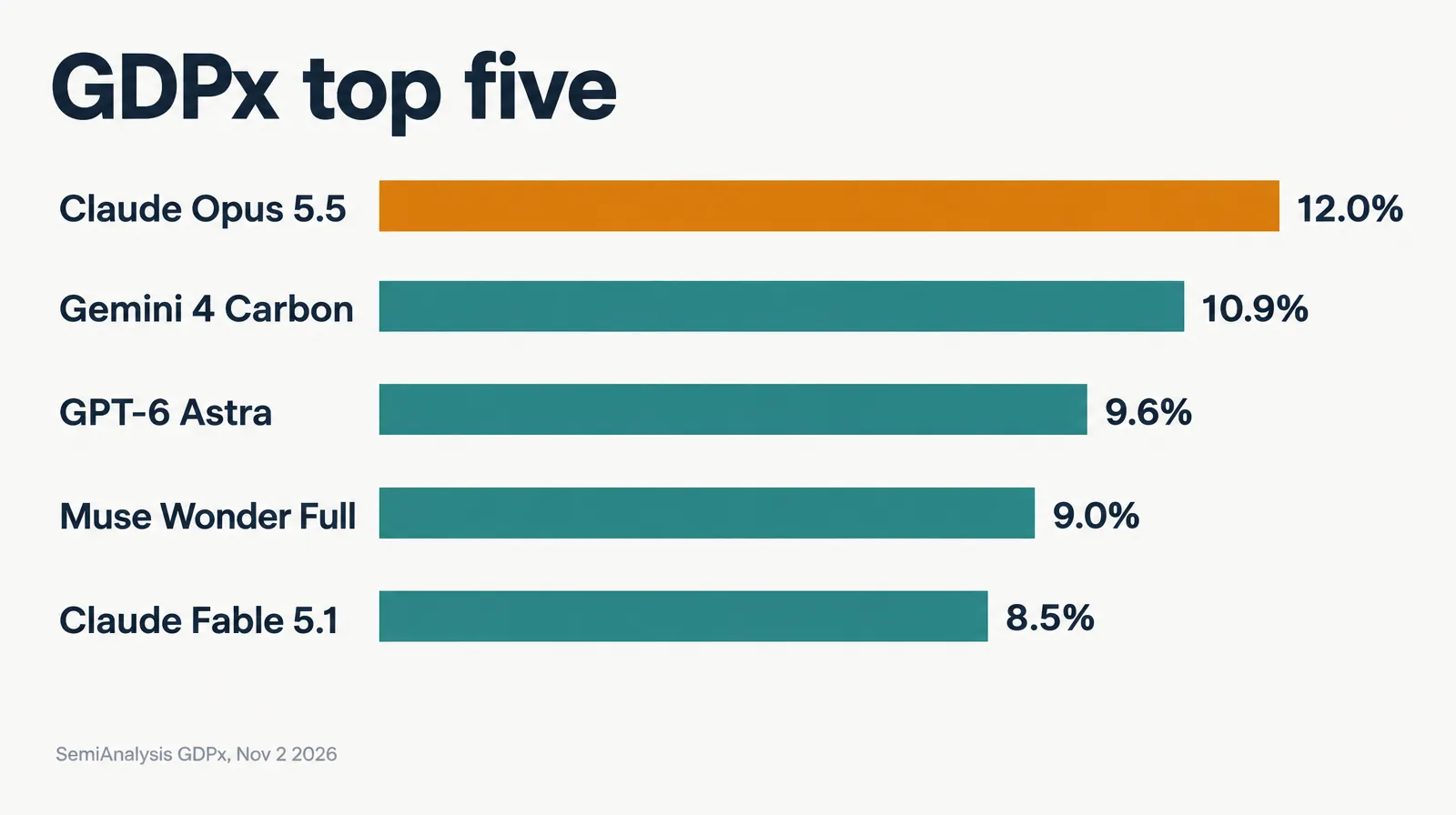
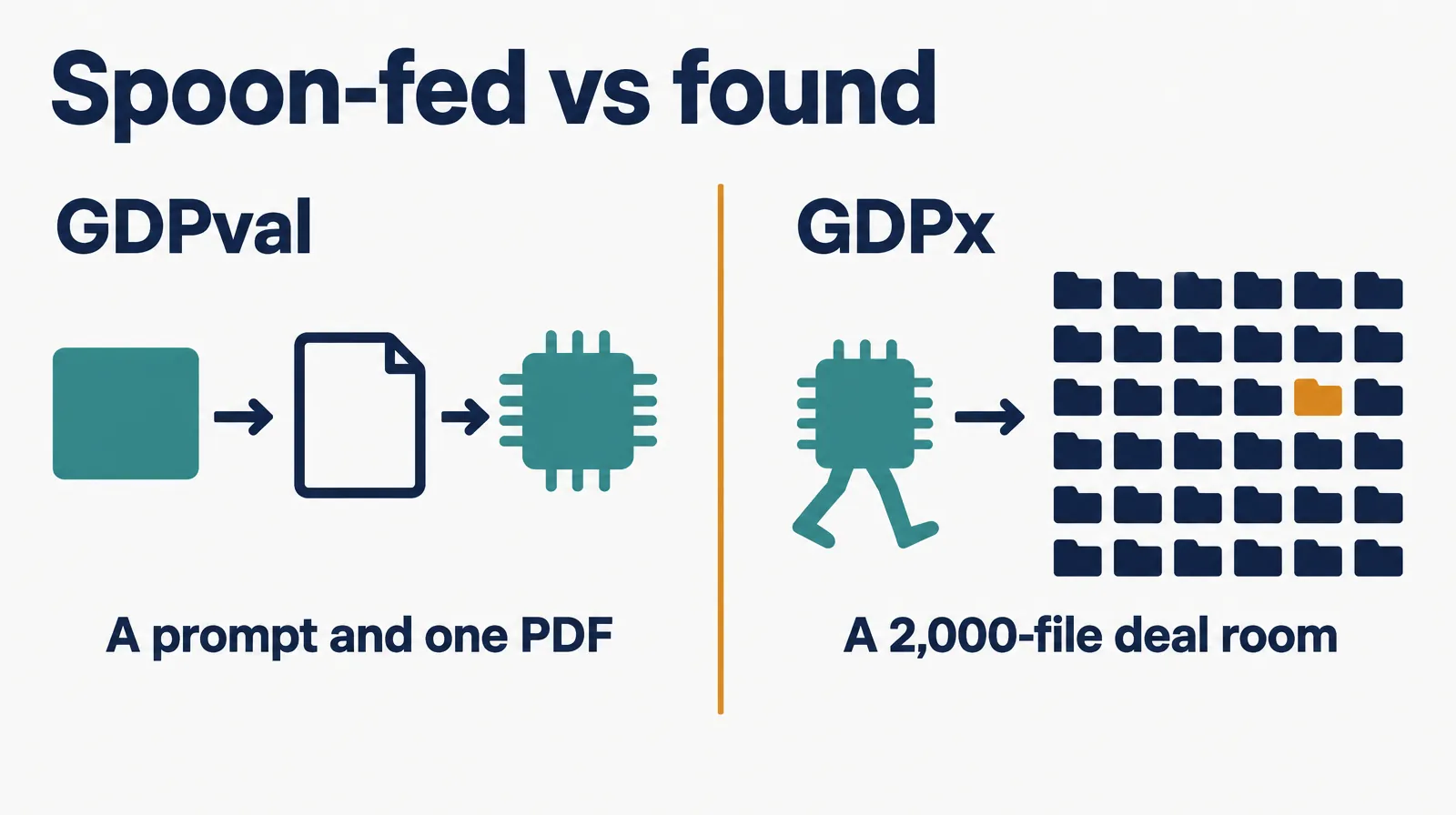
The best model is Claude Opus 5.5 at 12.0%, ahead of Gemini 4 Carbon at 10.9% and GPT-6 Astra at 9.6%. Finance and legal tasks scored zero for almost every model. The difference from older benchmarks is the setting: each task drops the agent into a working environment, such as a deal room of about 2,000 files, and leaves it to find what it needs.
On this page · 7 sectionsOpen
 SemiAnalysis released GDPx on November 2, 2026: 206 agent tasks across 11 high-value domains, built with 14 environment startups.
 Claude Opus 5.5 leads at 12.0%, ahead of Gemini 4 Carbon at 10.9% and GPT-6 Astra at 9.6%.
 Each task drops the agent into a working environment, such as a deal room of about 2,000 files, with up to 8 hours to finish.
 Finance and legal tasks scored zero for nearly every model.
 SemiAnalysis says safety classifiers held back Opus 5.5 and GPT-6 Astra in cybersecurity, biology and alignment.
§ 01What GDPx tests

SemiAnalysis built the tasks with 14 startups that make training environments for AI labs, one or more per domain, and ran each model in its own agent harness. The method, per the SemiAnalysis write-up:
| Item | GDPx v1.0 |
|---|---|
| Tasks | 206 |
| Domains | 11: chip design, cybersecurity, biology, finance, legal, quant trading, recursive self-improvement, hardware design, materials science, alignment, software engineering |
| Data partners | 14 environment startups, at least one per domain |
| Harness | Each model’s own: Claude Code for Opus 5.5, Codex for GPT-6 Astra, Antigravity for Gemini 4 Carbon; OpenCode otherwise |
| Time limit | 8 hours by default |
| Score | pass@1 across three attempts; every domain weighted equally |
The finance example shows what “environment” means. The agent works a private-equity deal from the seat of one adviser, with the target company’s data room and that adviser’s deal folder loaded: about 4,000 anonymized files in all. A human associate did the same task on the real transaction.
§ 02The leaderboard
The public site shows 13 of the 20 models it tested; these are its scores.
| Rank | Model | GDPx score |
|---|---|---|
| 1 | Claude Opus 5.5 | 12.0% |
| 2 | Gemini 4 Carbon | 10.9% |
| 3 | GPT-6 Astra | 9.6% |
| 4 | Muse Wonder Full | 9.0% |
| 5 | Claude Fable 5.1 | 8.5% |
| 6 | GPT 6.1 Sol | 8.4% |
| 7 | Claude Sonnet 5.5 | 8.2% |
| 8 | Gemini 4 Argon | 7.3% |
| 9 | Muse Wonder | 6.8% |
| 10 | DeepSeek 4.1 Flash 1017 | 5.4% |
| 11 | GPT-6 Luna | 5.1% |
| 12 | Grok 4.7 | 3.9% |
| 13 | GLM 5.3 | 2.7% |
On cost, SemiAnalysis reads its own chart this way: “Luna and DeepSeek fight for the low end, Opus wins the high end, and OpenAI claims the middle.” Gemini 4 Carbon, not yet generally available, sits second overall and is the model the authors say to watch.
§ 03Who wins where
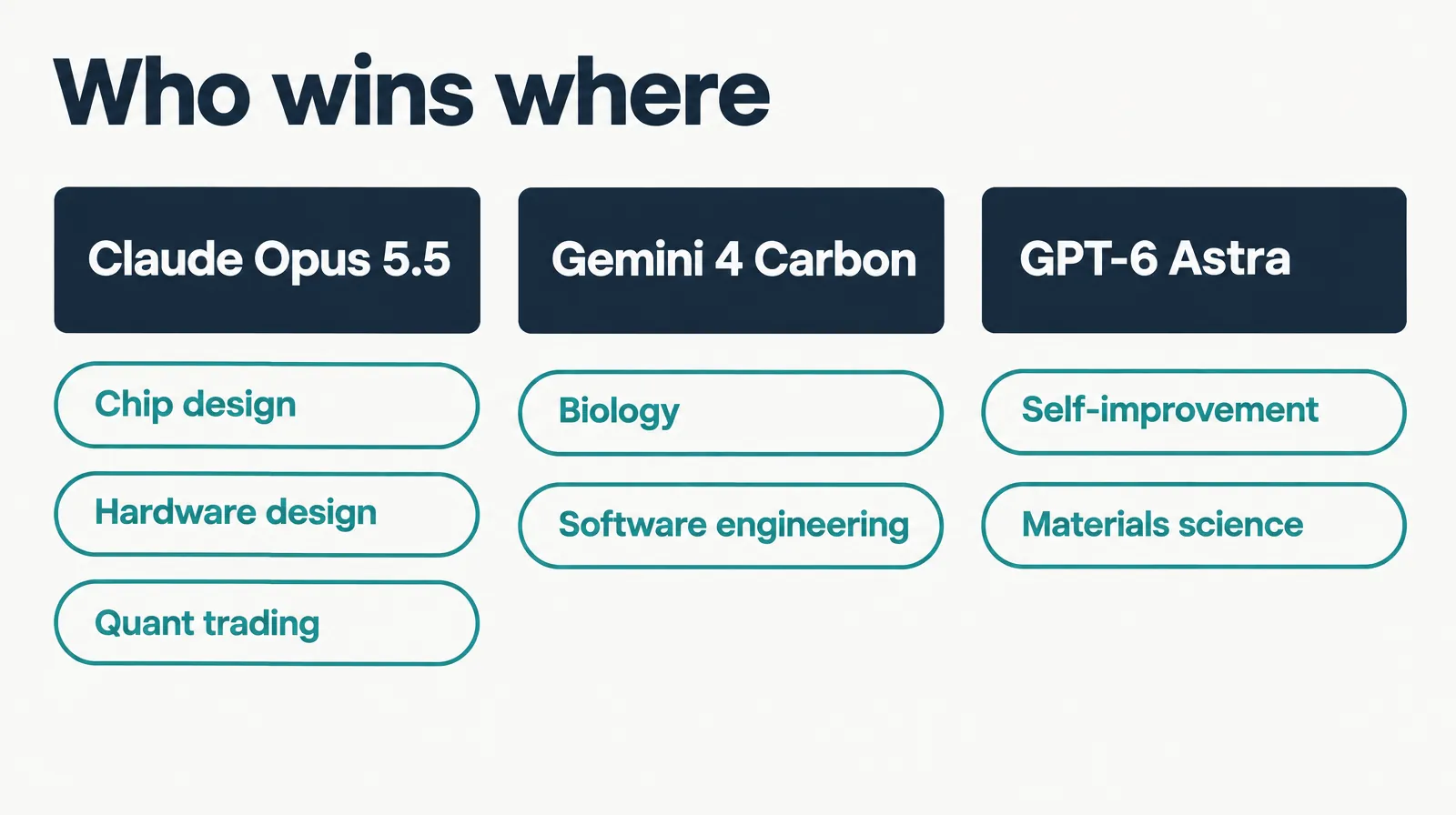
The overall number hides sharp spikes. In SemiAnalysis’s words: “Opus 5.5 is the best all-around model and wins in quant trading, hardware design, and chip design.”
| Domain | Winner |
|---|---|
| Chip design | Claude Opus 5.5 |
| Hardware design | Claude Opus 5.5 |
| Quant trading | Claude Opus 5.5 |
| Biology | Gemini 4 Carbon |
| Software engineering | Gemini 4 Carbon |
| Recursive self-improvement | GPT-6 Astra |
| Materials science | GPT-6 Astra |
| Cybersecurity | Muse Wonder Full |
| Finance and legal | Nearly every model scores 0 |
Domain wins are not uniform inside a domain either. On one chip-design task from the partner Ergodex, timing fixes on a real 20,702-cell design, GPT-6 Astra averaged 0.34 against 0.135 for Claude Opus and 0.07 for Fable.
§ 04Why the scores are so low
Three reasons come out of the write-up. The first is design: SemiAnalysis set out to make tasks the best models solve less than a fifth of the time, and says its review process, run on Terminal Bench 4.0, “flags nearly 50% of tasks as broken.” Partners had to pass that review on the first try.
The second is safety classifiers. The authors write that “certain models like Opus 5.5 and GPT-6 Astra have sandbagged overall scores due to their safety classifiers”, which can refuse work in cybersecurity, biology and alignment. Remove those three domains and the ranking changes; that is also why “Muse Wonder Full is actually the best available cyber model today by a meaningful margin” in their reading.
The third is finance and legal: “Our finance and legal tasks are so challenging that basically every model scores exactly 0.”
GDPx is pitched as the successor to OpenAI’s GDPval, released September 25, 2025. SemiAnalysis’s complaint is that “Every GDPval task is precisely specified and non-interactive”, with the context handed over in the prompt, and that “Human expert inter-rater agreement was just 71% on the gold subset”. Ethan Mollick called it a useful effort and noted that “benchmarks of expert-level work are incredibly hard to pull off.”
§ 05What this means if your AI employees run on Claude
Our conflict, declared: we build CellCog, and every tier of our AI employees runs on Claude Opus 5.5, the model at the top of this board, so a good result for it is good for us. Read our take with that in mind.
The useful part for anyone hiring an agent is the shape of the test, not the rank. GDPx tasks look like real work: hours long, with the context buried in folders the agent has to search. A 12% top score says the hardest expert work still mostly fails. It does not say that routine work fails, because GDPx is built to sit at the frontier on purpose. Our AI employees take on everyday business work with an owner approving anything that leaves the company, and that is a different bar from an eight-hour chip-timing task.
§ 06What we are watching
- Gemini 4 Carbon going generally available. It is second overall and first in biology and software engineering on a model most people cannot use yet.
- The next version. SemiAnalysis says “We plan to release new versions every 3-6 months” and calls GDPx a living benchmark.
- Labs reporting it. Whether GDPx joins GDPval on model release cards.
§ 07Sources
- SemiAnalysis: GDPx write-up by Max Kan, Andrew Megalaa and Dylan Patel, and the GDPx leaderboard, read November 2, 2026.
- X: @SemiAnalysis_ launch thread and @emollick; times from the post ids.
Q1Who made GDPx?
SemiAnalysis, with Max Kan, Andrew Megalaa and Dylan Patel as authors and 14 data partners that build training environments.
Q2How is GDPx scored?
pass@1 across three attempts, with all 11 domains weighted equally and an 8-hour default time limit, each model in its own harness.
Q3How is GDPx different from GDPval?
GDPval gives the model its context in the prompt; GDPx makes the agent find it in a working environment, such as a deal room of thousands of files.
Q4Which model is best at cybersecurity on GDPx?
SemiAnalysis names Muse Wonder Full, and notes that safety classifiers hold back Opus 5.5 and GPT-6 Astra in that domain.
Q5Will GDPx be updated?
Yes. SemiAnalysis plans a new version every three to six months.