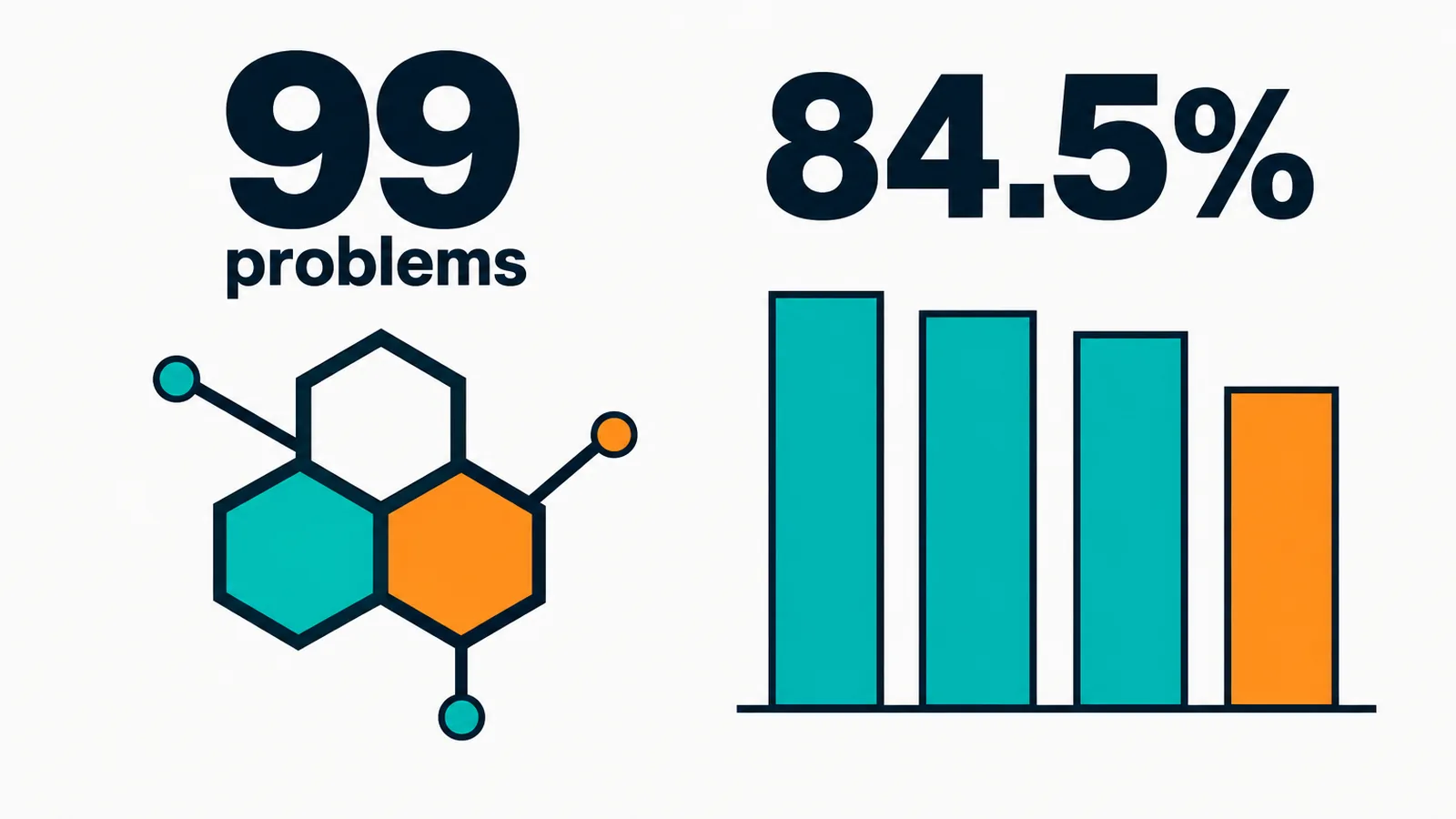
OpenAI has a new test for whether AI can think like a medicinal chemist, and its newest model scores 84.5%. On November 20, 2026, OpenAI announced MedChemBench on X: “MedChemBench is a new benchmark for AI reasoning in medicinal chemistry.” It says the benchmark shows how far its frontier models have come at helping scientists pick promising drug candidates.
The benchmark has 99 problems built from 117 published papers and patents, according to reports from Unite.ai and TokenPost on the announcement and its technical paper. The headline number hides an uneven picture: the models read and draw molecules very well, and still pick between compounds about half as well.
On this page · 6 sectionsOpen
 OpenAI released MedChemBench on November 20, 2026, a benchmark of 99 medicinal chemistry problems drawn from 117 published papers and patents, covering 761 molecular structures.
 Each problem stops at a real decision point in a past drug research program and withholds the results that came next, which become the answer key.
 GPT-6.2 Astra scored 84.5% of available credit at OpenAI’s xhigh reasoning setting, ahead of GPT-6 Astra at 83.3%, GPT-6.1 Sol at 82.0% and GPT-5.6 Sol at 58.2%.
 The parts are uneven. GPT-6 Astra earned about 95% of the credit for drawing molecules correctly but only about half for choosing compounds and predicting numbers.
 By OpenAI’s own account, the scores do not show that a model can find new drugs: every answer was one try with no tools, and the models may have seen the source papers.
§ 01What MedChemBench tests
Drug discovery rarely turns on one measurement. A compound can bind its target strongly and still be absorbed badly or broken down too fast by the liver, so chemists weigh several properties at once before choosing what to make next.
MedChemBench turns that into problems. Each one stops at a decision point in a real, already published research program. The prompt gives the biology, the earlier compounds and some lab findings; the results the researchers got afterwards are held back and become the answer key. The set covers 761 molecular structures, all in preclinical drug discovery.
Unite.ai, which read the technical paper, reports seven task categories. Integrated lead selection is the largest with 48 tasks, then structure-activity forecasting with 26, and smaller groups on absorption and metabolism, molecular design, safety, synthesis routes and assay biology. Eighty-five tasks span more than one of these areas.
§ 02The scores
| Model | Score |
|---|---|
| GPT-6.2 Astra | 84.5% |
| GPT-6 Astra | 83.3% |
| GPT-6.1 Sol | 82.0% |
| GPT-5.6 Sol | 58.2% |
The top three sit within 2.5 points of each other. The jump that matters is from GPT-5.6 Sol to the GPT-6 family, about 25 points. Unite.ai notes that GPT-6.2 Astra was not among the 11 models in the technical paper; its score comes from the announcement alone. The paper itself reports 60,390 graded responses across those 11 models and their effort settings.
§ 03Strong at reading molecules, weaker at choosing them
The grade has four parts, and they tell a sharper story than the total. Unite.ai reports these figures for GPT-6 Astra at the xhigh setting.
| Part of the grade | Share of credit earned |
|---|---|
| Drawing the right molecule | 95.37% |
| Explaining results with evidence | 91.05% |
| Ranking and choosing compounds | 50.42% |
| Predicting numbers | 47.02% |
Drawing and explaining carry most of the credit: 37.49% and 35.78% of the total, against 17.51% for ranking and 8.92% for number predictions. That weighting is why a model can score in the 80s overall while getting about half of the choosing and predicting right. The choosing is the part a chemist is paid for.
The older models fail earlier. In one task described in the paper, models had to build a molecule around an 18-atom ring. GPT-6 Astra got it right in all ten tries; GPT-5.6 Sol and GPT-5.6 Luna got it wrong in all ten, one returning a 15-atom ring and the other two disconnected pieces.

§ 04What OpenAI says the scores do not show
OpenAI lists the limits itself, as both outlets report:
- No discovery claim. The scores do not establish that a model can find new drugs or improve real lab decisions.
- One try, no tools. Every answer was a single attempt, with no search, calculation or feedback, on historical problems.
- The papers are public. The models may have seen the source papers in training. A check that added each paper’s identifier to the prompts moved scores by under one point, which cannot rule it out.
- Close to full. Unite.ai reports the paper calls the benchmark close to saturation in its current form.
- OpenAI models only. The reported results cover GPT models; nothing in what we read tests Claude, Gemini or open models.
The proposed next steps are prospective cases, expert review of alternative answers and an agent track where models can search, calculate and revise over several steps. That last one is the version that would test how AI is actually used in a lab.
§ 05If you work in drug research
The useful reading is narrow. Today’s top models are reliable at reconstructing molecules from papers and explaining published results, and much less reliable at the choice of what to make next. That favors AI for the reading, extracting and summarizing work around a program, with a chemist owning the decision.
§ 06Sources
- OpenAI on X, 19:09 UTC, November 20, 2026
- OpenAI, Introducing MedChemBench, November 20, 2026 (not read by us; figures taken from the two reports below)
- Unite.ai, OpenAI introduces MedChemBench for medicinal chemistry reasoning, November 20, 2026
- TokenPost, OpenAI’s MedChemBench scores GPT-6.2 Astra at 84.5%, November 20, 2026
Q1What does a MedChemBench problem look like?
A prompt gives the biology, the earlier compounds and some lab results from a real research program, then asks the model to draw structures, explain results, rank candidates or predict properties. The later results that the researchers actually got are the answer key.
Q2How is it graded?
Molecules are checked by software against the right structure. Explanations are scored by a GPT-6 Astra judge as zero, half or full credit. Number predictions get partial credit for being close. Unite.ai reports structure and reasoning carry most of the credit, 37.49% and 35.78%.
Q3Does a high score mean AI can discover drugs?
No. OpenAI says the scores do not establish that. Each answer was a single attempt without tools or new experiments, the tasks are historical, and the models may have seen the source papers in training.
Q4Were non-OpenAI models tested?
Not in what we read. The reported results cover OpenAI’s own GPT models only, so the benchmark says nothing yet about Claude, Gemini or open models.
Q5Does CellCog use these models?
No. CellCog’s Core lanes run on Anthropic’s Claude Opus 5.5 and its Agent Max and Creative Max lanes on Fable 5.2; none of its lanes routes to a GPT model.