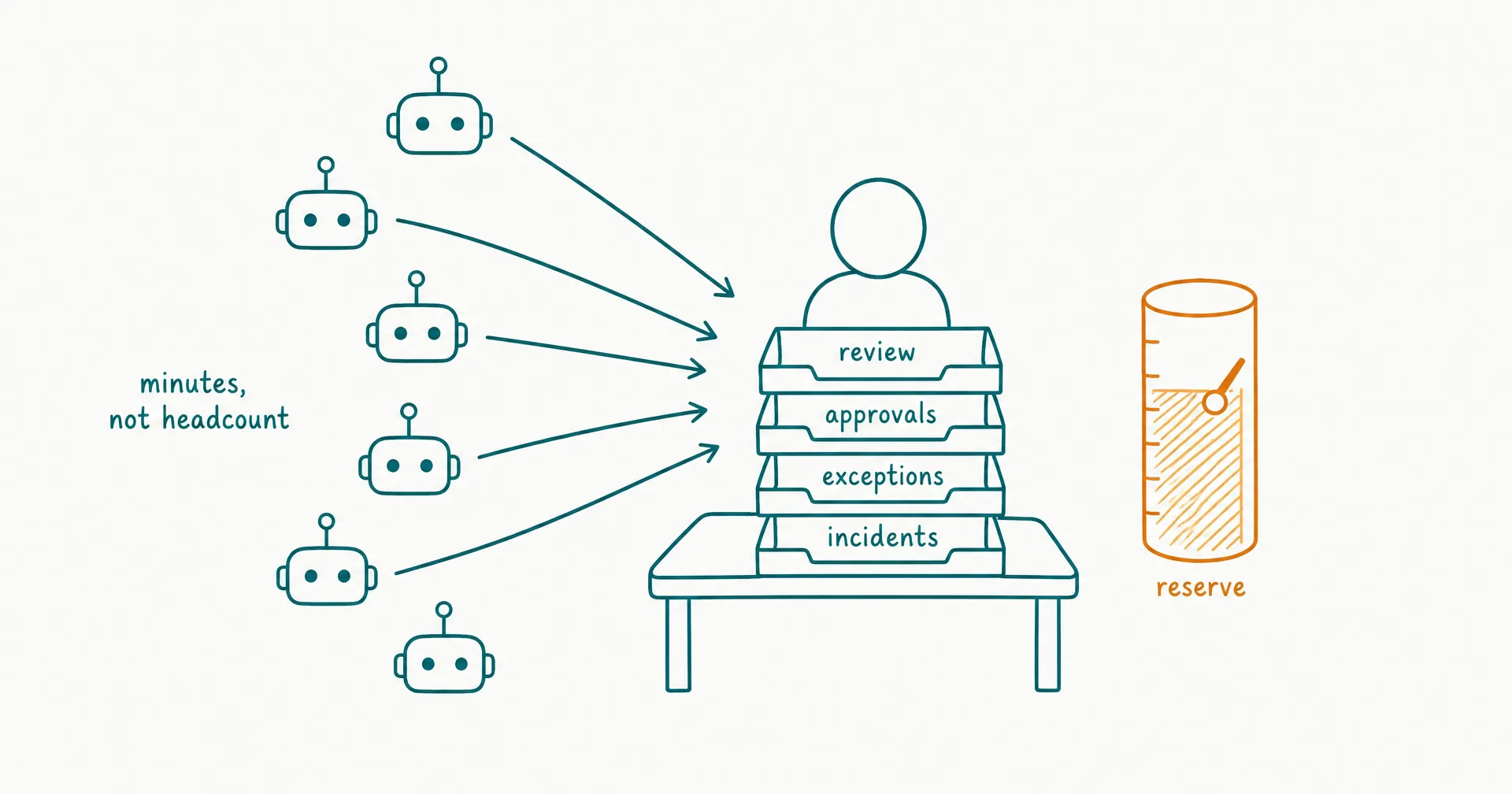
There is no universal number of AI agents one human can responsibly supervise. A safe human span of control is the largest active portfolio for which the accountable person can still review the required work, resolve exceptions, authorize consequential actions, detect drift, stop failures, and meet response deadlines.
Agent count is only an inventory number. Human workload comes from the work each agent sends back: sampled outputs, approval requests, exceptions, corrections, incidents, policy changes, and maintenance.
The practical calculation is:
Human supervision load = routine review + exceptions + approvals + correction + coordination + maintenance + incident readiness
The broader AI organization operating model determines which roles, authority boundaries, and escalation paths should exist. Span of control asks whether the named humans have enough attention and response capacity to make those controls real.
On this page · 19 sectionsOpen
- What Is Human Span of Control for AI Agents?
- Why Is Agent Count the Wrong Denominator?
- Which Factors Increase or Reduce Human Span?
- What Must Remain Human-Owned?
- How Do You Calculate Weekly Supervision Load?
- What Does a Worked Span-of-Control Calculation Look Like?
- How Do Risk Tiers Change the Calculation?
- How Do Concurrency and Response Time Limit Span?
- Does an AI Manager Increase Human Span?
- When Does Human Oversight Become Theater?
- How Does Observability Increase Responsible Capacity?
- How Should the Organization Chart Show Capacity?
- How Do Cascading Failures Change Emergency Span?
- Which KPIs Reveal a Span-of-Control Problem?
- When Should You Add Human Capacity or Reduce Agent Scope?
- How Do You Pilot and Expand the Span?
- What Does CellCog’s Organization Show About Span of Control?
- What Should You Verify Before Adding Another Agent?
- What Is the Final Decision?
- Do not set an agent-to-human ratio from headcount. Calculate supervision minutes for every task class, then test whether weekly workload and peak exception queues fit human capacity.
- Count seven sources of demand: sampled review, exceptions, approvals, corrections, cross-agent coordination, role maintenance, and incident readiness.
- Consequence changes the ratio. Six stable read-only reporting agents may require less attention than two agents that send customer messages or handle sensitive data.
- An AI manager can remove routine routing work, but it also creates manager-audit, false-acceptance, escalation, and failure-concentration work. Measure net human load.
- Oversight becomes theater when approvals arrive without evidence, queues exceed response windows, reviewers silently repair work, or the human cannot pause the complete chain.
- Expand one measured workload at a time. Recalculate after changes to models, prompts, tools, permissions, memory, task mix, volume, risk, or response commitments.
- CellCog’s July 2026 public chart shows one human founder and nine active AI Employees - an operating structure, not a universal or independently validated supervision ratio.
§ 01What Is Human Span of Control for AI Agents?
Human span of control for AI agents is the number and mix of active AI workloads a person can govern while meeting defined quality, risk, approval, escalation, intervention, and recovery obligations.
The unit is not merely an agent. It is an agent-workload-risk combination.
| Same agent, different workload | Human demand |
|---|---|
| Reads public sources and prepares an internal summary | Sample review and occasional correction |
| Updates an internal project record | Postcondition checks and reversible-action review |
| Sends customer email | Claim, recipient, disclosure, and approval controls |
| Changes a campaign budget | Financial limit, authorization, and rapid intervention |
| Handles sensitive customer data | Access, privacy, audit, and incident obligations |
One role can therefore consume very different amounts of supervision capacity as its task mix changes.
Nominal span is not effective span
Nominal span is the number of agents assigned to a person. Effective span is the portfolio that remains controllable during ordinary work, peak exceptions, and a plausible failure.
A nominal span of 10 means little if only 3 agents are active; one agent produces 80% of approval demand; five agents share one failure source; exceptions arrive outside staffed hours; or no person can stop the agents quickly.
Span includes several human roles
One person may act as business sponsor, output reviewer, high-impact approver, exception resolver, policy owner, incident owner, and agent administrator.
Those responsibilities can also be split across several people. Count each person’s queue separately. A chart with one named sponsor and three operational reviewers does not have the same human capacity as a chart where the sponsor performs every control.
Accountability is not constant attention
Responsible supervision does not require a human to watch every tool call.
It requires appropriate deterministic controls; risk-based review; visible state; actionable escalation; available decision capacity; immediate intervention for defined conditions; and evidence that the operating boundary works.
A low-risk, observable role can run mostly independently. A high-impact role may require pre-action approval even after strong performance.
§ 02Why Is Agent Count the Wrong Denominator?
Agent count ignores volume, variation, consequence, and timing.
Volume changes review demand
Two identical agents do not create equal work if one handles 10 tasks per week and the other handles 500.
The review queue depends on eligible tasks, sample rate, minutes per review, exception frequency, correction frequency, and approval frequency.
Task mix changes consequence
A reporting agent and a payment agent may each complete 20 tasks. The payment role can require more human capacity because its actions are financially consequential and harder to reverse.
OpenAI’s practical guidance on building agents identifies two common human-intervention triggers: exceeding failure thresholds and attempting sensitive, irreversible, or high-stakes actions. A capacity model must reserve attention for both.
Reliability changes exception demand
An agent with a 2% exception rate on 200 tasks creates 200 x 2% = 4 exceptions. An agent with a 20% exception rate creates 200 x 20% = 40.
The second role creates ten times as many exception decisions at the same task volume.
Observability changes review time
A structured packet may take 4 minutes to review when it includes the requested decision, current state, source references, an artifact diff, the policy boundary, uncertainty, options, a recommendation, and a deadline.
A vague alert that requires reconstructing the task across chat, logs, memory, and tools may take 25 minutes. Better agent accuracy helps, but better evidence packaging can also expand responsible capacity.
Timing changes queue risk
Ten approvals spread across a week are different from ten approvals due in the same 30-minute window.
Weekly totals can pass while the peak queue fails. Span must satisfy both average load and response-time obligations.
§ 03Which Factors Increase or Reduce Human Span?
Span grows when tasks are standardized, observable, reversible, and low consequence. It shrinks when tasks are novel, coupled, opaque, high impact, or time critical.
| Factor | Wider span when | Narrower span when |
|---|---|---|
| Task repeatability | Stable schema and acceptance rule | Novel or ambiguous objective |
| Output quality | High first-pass acceptance | Frequent silent correction |
| Exception rate | Rare and correctly escalated | Frequent, missed, or noisy |
| Consequence | Internal, low impact | External, financial, regulated, sensitive |
| Reversibility | Draft, preview, rollback | Irreversible or costly to undo |
| Observability | State, evidence, action, and owner visible | Work reconstructed manually |
| Task coupling | Roles work independently | Agents repeatedly depend on one another |
| Failure correlation | Isolated sources and permissions | Shared model, memory, source, or tool |
| Response window | Flexible or scheduled | Immediate approval or incident response |
| Change velocity | Stable role version | Frequent model, prompt, tool, or policy change |
| Work schedule | Staggered and predictable | Concurrent or round-the-clock demand |
| Human expertise | Reviewer understands task and limits | Reviewer cannot evaluate the result |
No single favorable factor compensates for every red flag. A highly observable payment agent still handles consequential actions. A low-risk summarizer can still create a large correction queue if the task is poorly defined.
Standardization widens span
A stable task contract reduces clarification, interpretation differences, variable artifact shape, review time, and correction.
Standardization is more valuable than merely shortening the prompt.
Reversibility widens span
A draft-review-approve-execute-verify path supports a wider span than immediate execution because the human can inspect a bounded proposal before it has an external effect.
Coupling narrows span
When agents depend on one another, one exception can create blocked children, conflicting artifacts, duplicate repair, ownership disputes, and re-planning.
The human may need to understand the chain rather than one output.
Change velocity narrows span
A stable role with 12 weeks of observed behavior is not equivalent to the same named role after its model, prompt, memory, tool, connector, permission, source, or rubric changes.
Treat a material change as a new capacity event. Increase review temporarily until the new version earns a lower supervision level.
§ 04What Must Remain Human-Owned?
AI can coordinate routine work, but the organization needs named humans for decisions that define or exceed the operating boundary.
Keep six decision classes human-owned
- business goals and priority;
- risk tolerance;
- permission and data policy;
- consequential approval;
- novel exception and incident judgment; and
- final accountability and residual-risk acceptance.
The AI manager feasibility and control model separates bounded assignment, monitoring, rubric-based review, repair, and escalation from those human-owned decisions.
Separate review from approval
Review asks: Is the artifact correct? Is the evidence sufficient? Did the role follow the acceptance rule?
Approval asks: May this exact action occur? Against which target and parameters? Under whose authority? Before which expiry?
One person may perform both, but the workload model should count both events.
Separate ordinary exceptions from incidents
An ordinary exception may need missing input, conflict resolution, a source choice, or a policy interpretation.
An incident may need an immediate stop, affected-object identification, access revocation, external-action reconciliation, correction, notification, and recovery.
Average weekly exception minutes do not prove incident readiness.
Give every control an owner and backup
| Control | Primary owner | Backup | Response expectation |
|---|---|---|---|
| Routine artifact review | Domain reviewer | Second trained reviewer | Scheduled queue |
| High-impact approval | Authorized operator | Named delegate | Before action expiry |
| Novel exception | Functional owner | Department lead | Based on task consequence |
| Security or data event | Incident owner | On-call backup | Immediate |
| Role change approval | Product/operations owner | Risk owner | Before release |
| Decommissioning | System owner | Security/IT | Defined shutdown window |
“A human reviews it” is not an operating assignment. The human-in-the-loop oversight model covers where each review belongs.
§ 05How Do You Calculate Weekly Supervision Load?
Calculate each workload separately, then sum the portfolio.
Step 1: Calculate routine sample review
Routine review minutes = task volume x review sample rate x minutes per review
If an internal reporting agent handles 100 tasks, 5% are sampled, and each review takes 3 minutes: 100 x 0.05 x 3 = 15 minutes.
Use risk-weighted sampling, not only random sampling. Include cases near thresholds, changed inputs, unusual tool paths, and apparently successful outputs with weak evidence.
Step 2: Calculate exception handling
Exception minutes = task volume x exception rate x minutes per exception
For 100 tasks at a 2% exception rate and 10 minutes each: 100 x 0.02 x 10 = 20 minutes.
Measure actual exceptions by subtype. A missing field may take 2 minutes; a conflicting policy may take 30.
Step 3: Calculate approval demand
Approval minutes = task volume x approval rate x minutes per approval
For 20 external-action tasks, a 25% approval rate, and 4 minutes per decision: 20 x 0.25 x 4 = 20 minutes.
Count denied, expired, revised, and abandoned approvals. A system that records only approvals granted understates the queue.
Step 4: Calculate correction work
Correction minutes = task volume x correction rate x minutes per correction
For 20 tasks, a 10% correction rate, and 15 minutes per repair: 20 x 0.10 x 15 = 30 minutes.
If the human silently rewrites the output without recording it, the agent appears more scalable than it is.
Step 5: Add fixed operating work
Fixed work includes role and policy review, evaluation maintenance, source and memory governance, permission review, dashboard review, incident drills, vendor or model change review, and coaching or workflow redesign.
Record it by role where possible and as shared portfolio work where it supports several roles.
Step 6: Add cross-agent coordination
Examples: resolving overlap; reconciling conflicting outputs; assigning orphaned work; reviewing manager decomposition; correcting shared sources; and investigating cascade risk.
Do not force shared coordination into one agent’s local metric.
Step 7: Sum the portfolio
For workload i:
L(i) = V(sr + ex + ap + cq) + F
Where V is task volume; s is the review sample rate; r is review minutes; e is the exception rate; x is exception minutes; a is the approval rate; p is approval minutes; c is the correction rate; q is correction minutes; and F is fixed role work.
Then: Portfolio load = sum of all L(i) + shared coordination + planned reserve.
The variables are measured operating inputs, not universal benchmarks.
§ 06What Does a Worked Span-of-Control Calculation Look Like?
Consider one operator with 600 minutes per week allocated to AI supervision.
The organization chooses a 25% reserve for unexpected work: 600 x 25% = 150 reserve minutes. Planned work can therefore use 600 - 150 = 450 minutes.
The 25% reserve is an illustrative internal choice, not a standard.
Workload A: research agent
| Input | Value | Minutes |
|---|---|---|
| Weekly tasks | 40 | - |
| Sample review | 20% x 5 min | 40 |
| Exceptions | 5% x 15 min | 30 |
| Approvals | 0% | 0 |
| Corrections | 5% x 10 min | 20 |
| Fixed maintenance | - | 20 |
| Total | - | 110 |
Workload B: external content agent
| Input | Value | Minutes |
|---|---|---|
| Weekly tasks | 20 | - |
| Sample review | 50% x 8 min | 80 |
| Exceptions | 10% x 20 min | 40 |
| Approvals | 25% x 4 min | 20 |
| Corrections | 10% x 15 min | 30 |
| Fixed maintenance | - | 30 |
| Total | - | 200 |
Workload C: read-only reporting agent
| Input | Value | Minutes |
|---|---|---|
| Weekly tasks | 100 | - |
| Sample review | 5% x 3 min | 15 |
| Exceptions | 2% x 10 min | 20 |
| Approvals | 0% | 0 |
| Corrections | 2% x 8 min | 16 |
| Fixed maintenance | - | 15 |
| Total | - | 66 |
Portfolio result
110 + 200 + 66 = 376 planned minutes. The operator has 450 - 376 = 74 planned minutes remaining.
Another reporting agent at 66 minutes may fit the weekly budget. Another research agent at 110 minutes does not.
The apparent span is 3 agents, yet the workload model shows room for one specific low-demand role and no room for a higher-demand role.
Two high-demand agents can exceed six stable agents
If two high-demand roles each require 260 minutes, they need 2 x 260 = 520 minutes and exceed the 450-minute planned capacity.
Six stable reporting roles at 66 minutes each require 6 x 66 = 396 minutes.
The larger headcount produces less planned supervision work. The correct decision depends on task and risk, not the ratio.
§ 07How Do Risk Tiers Change the Calculation?
Review and approval policy should follow consequence.
| Operating tier | Typical work | Human pattern | Span implication |
|---|---|---|---|
| T0: observe | Read public data, summarize internal signals | Periodic sample | Widest potential span |
| T1: draft | Prepare report, message, analysis, or code | Risk-weighted artifact review | Wide when quality is stable |
| T2: reversible internal action | Update task state or internal record | Postcondition checks + sampling | Moderate |
| T3: bounded external action | Send, publish, change customer record | Action-bound approval or strict policy | Narrower |
| T4: high impact | Financial, destructive, sensitive, regulated | Qualified human decision | Narrowest |
These tiers are an operating template, not a legal or industry standard.
Review rate is not the only difference
Higher tiers may require more evidence per decision, independent authorization, shorter response time, stronger backup coverage, more frequent access review, incident readiness, and lower tolerance for false acceptance.
Sampling cannot replace mandatory approval
A 10% audit sample may be appropriate for a stable low-risk artifact. It does not authorize the other 90% of actions when policy requires every action to be approved.
Consequence can cap span before minutes do
A person may have enough weekly time but insufficient authority, expertise, or availability to supervise a particular risk tier.
Capacity passes only when the supervisor understands the domain, has the required decision rights, can inspect the evidence, can act within the response window, and has a backup.
§ 08How Do Concurrency and Response Time Limit Span?
Average workload hides bursts.
Test the peak queue
Suppose five agents each raise one urgent exception at 9:00 a.m., and each decision takes 15 minutes. One reviewer needs 5 x 15 = 75 minutes.
If every exception must be resolved within 30 minutes, the weekly workload may fit while the service level fails.
Calculate offered load by window
For a response window:
Window load = events arriving in window x minutes per event
Compare it with:
Window capacity = available qualified reviewers x usable minutes in window
If window load exceeds window capacity, use staggered schedules; lower concurrency; deterministic safe defaults; backup reviewers; narrower action scope; longer valid response windows; or fewer active roles.
Define safe waiting behavior
While a human is unavailable, an agent should pause the proposed action; continue only unrelated safe work; route to an authorized backup; preserve state and expiry; or cancel safely.
“Wait” should not mean that the action proceeds after a timeout.
Cover off-hours operation
An agent that works around the clock can create overnight approval queues, expired opportunities, late incident detection, and unsafe automatic fallbacks.
Match agent schedules to human coverage unless the unstaffed path is explicitly safe.
§ 09Does an AI Manager Increase Human Span?
An AI manager can widen human span when it removes more routine coordination than it creates in oversight.
Measure the management layer net
Net human change = direct-worker supervision removed - manager supervision added
Manager supervision added includes audit samples of routing, decomposition review, false-acceptance review, escalation handling, manager correction, policy maintenance, failure investigation, and incident concentration.
If the manager forwards every decision to a human, it adds a routing layer without releasing attention.
AI management can compress normal state
A bounded manager can assign known task types; check required fields; monitor task state; rebalance reversible queues; request missing evidence; enforce retry limits; and summarize a portfolio.
The human can then focus on defined exceptions and sampled manager decisions.
AI management can amplify one error
A wrong decomposition or acceptance can affect several workers.
Anthropic’s account of building a multi-agent research system describes rapid coordination complexity and early behavior such as spawning excessive subagents for simple queries. In the same system, multi-agent runs used about 15x the tokens of chat interactions. Those are architecture-specific observations, not universal ratios; they show why manager fan-out needs budgets, monitoring, and stop conditions.
Audit the manager as its own role
Measure route eligibility, decomposition completeness, duplicate assignments, missed dependencies, false acceptance, correct escalation, closure integrity, cost per accepted parent outcome, and time to intervention.
A strong worker result does not prove that the manager layer is safe.
§ 10When Does Human Oversight Become Theater?
Oversight is theater when the interface contains a human step but the person lacks the time, evidence, authority, or intervention path to change the result.
Approval theater
Signals include one-click approval without action parameters; insufficient time to inspect evidence; approval requested after effect; repeated approval of identical-looking queues; no record of denial or revision; and one approval reused for several actions.
Review theater
Signals include a reviewer silently repairing the artifact; a sample that excludes difficult or high-risk cases; a reviewer who sees only a summary; a rubric changed without revalidation; accepted work later reopened; and a review backlog exceeding the usefulness window.
Escalation theater
Signals include “needs human” without a requested decision; no named owner; no response deadline; no backup; work continuing unsafely while waiting; and escalations disappearing into chat or email.
Intervention theater
Microsoft’s current autonomous agent risk guidance defines meaningful human oversight as the ability to guide, correct, and interrupt behavior, including reliable system-level pause or stop controls.
If a person can see the problem but cannot stop the role, descendants, tools, or queued actions, the span is not controlled.
Accountability theater
NIST’s AI Risk Management Framework calls for clear human-AI oversight roles, risk-prioritized resourcing, operator proficiency, documented oversight processes, and ongoing monitoring.
Naming one executive beside every agent does not satisfy those operating responsibilities unless the people and mechanisms are actually available.
§ 11How Does Observability Increase Responsible Capacity?
Observability reduces the time required to understand state and act.
Show the complete supervision packet
For each item, show the agent and role version; task and parent task; current state; requested human decision; artifact or proposed action; source and evidence; relevant memory; policy and approval requirement; uncertainty; prior attempts; consequence; expiry; safe waiting state; and stop control.
The operator should not reconstruct these fields from several interfaces.
Separate four queues
- scheduled review;
- approval;
- exception;
- incident.
They need different priority, response rules, owners, evidence, and fallback.
One combined inbox hides whether urgent work is displacing ordinary review.
Instrument the controls
OWASP’s AI Agent Security guidance recommends logging agent decisions, tool calls, outcomes, structured high-risk decision metadata, authorization results, approval identifiers, costs, and anomalies.
For capacity management, also log human queue arrival, assignment, first view, decision, handling minutes, correction minutes, timeout, reassignment, and closure.
Observability is not more alerts
More alerts can reduce capacity when duplicates are not grouped; low-risk activity appears urgent; no action is requested; context is missing; or the same incident creates one alert per agent.
The goal is decision-ready state, not maximum notification volume.
§ 12How Should the Organization Chart Show Capacity?
Reporting lines should carry capacity annotations.
The AI organization chart pattern model distinguishes assistant-per-human, functional-pod, manager-specialist, and shared-service structures. Add supervision demand to the chosen structure.
Annotate every human node
Show accountable outcomes; review minutes available; current planned load; approval authority; exception service level; incident responsibility; backup; and operating hours.
Annotate every agent node
Show task volume; risk tier; sample rate; exception rate; approval rate; correction minutes; schedule; and current version.
Annotate every edge
Show whether the edge creates routine review; approval; escalation; handoff acceptance; manager audit; or incident notification.
An agent may report to one person while sending approvals to another and incidents to a third.
Model shared services separately
A shared reviewer, security owner, or data owner may support several teams. Their queue can become the real constraint even when each direct manager appears under capacity.
§ 13How Do Cascading Failures Change Emergency Span?
Ordinary span assumes a distribution of mostly independent work. A shared failure can make many agents require attention at once.
Correlation collapses capacity
Five agents may share one manager plan, model, source, memory object, tool, credential, or policy. One defect can create five simultaneous investigations.
The multi-agent failure-propagation model traces how a local defect gains reach, authority, persistence, repetition, and external effect.
Calculate emergency workload by affected objects
Count active tasks, descendants, artifacts, memory objects, external actions, customer or tenant records, and credentials.
Incident workload follows the affected surface, not the number of agents that first reported the issue.
Test the largest credible shared cause
Run scenarios such as: a manager sends one flawed plan to every child; shared memory contains a false instruction; a common tool returns wrong data; a credential is compromised; the reviewer and producer share one bad source; or cancellation reaches the parent but not descendants.
Verify that the human team can stop new work; freeze or revoke action paths; identify affected objects; reconcile uncertain effects; correct durable state; and restore service.
Keep emergency reserve outside ordinary work
A portfolio at 100% planned utilization has no room for a correlated failure.
Set an internal reserve based on the largest plausible event, response obligations, available backups, time to stop, and recovery complexity.
Do not treat expected-average incident minutes as proof that a peak event fits.
§ 14Which KPIs Reveal a Span-of-Control Problem?
Track human capacity beside agent outcomes.
The AI employee KPI framework defines accepted outcomes, quality, escalation, reliability, cost, and risk. Add the following portfolio measures:
| Metric | Formula or rule | What it reveals |
|---|---|---|
| Planned supervision load | Forecast supervision minutes / available minutes | Capacity design |
| Actual supervision load | Actual supervision minutes / available minutes | Real utilization |
| Queue service-level attainment | Items decided in window / items due | Response capacity |
| Oldest decision age | Current time minus oldest open item | Hidden backlog |
| Review minutes per accepted outcome | Review minutes / accepted outcomes | Oversight efficiency |
| Correction minutes per accepted outcome | Correction minutes / accepted outcomes | Hidden agent weakness |
| Exception minutes per task | Exception minutes / received tasks | Task friction |
| Missed-escalation rate | Required but unraised cases / required cases | Unsafe independence |
| False-escalation rate | Unnecessary escalations / escalations | Human queue noise |
| Approval expiry rate | Expired approvals / approval requests | Capacity or packet failure |
| Human wait share | Time waiting on human / cycle time | Human bottleneck |
| Reserve consumption | Unplanned supervision minutes / reserve minutes | Portfolio volatility |
| Emergency stop time | Stop complete minus detection | Intervention readiness |
| Orphaned-work rate | Active descendants after parent stop / stopped parents | Control integrity |
Preserve raw counts
Show tasks, reviews, exceptions, approvals, corrections, incidents, and human minutes.
A 1% exception rate can still create an impossible queue at large volume.
Segment by workload
Segment metrics by role version, task type, risk tier, tool, source, schedule, customer or tenant, normal versus exception, and human owner.
One aggregate average can hide the role that consumes most attention.
Track trend after changes
Compare at least before and after a model change; a permission expansion; a manager introduction; a volume increase; and a new task subtype.
An unchanged headcount can still exceed capacity after the operating mix changes.
§ 15When Should You Add Human Capacity or Reduce Agent Scope?
Act when a measured constraint persists or a severe gate fails.
Add reviewer capacity when
The review queue age breaches its service level; required sampling cannot be completed; corrections consume the planned reserve; specialist expertise is missing; or ordinary work repeatedly displaces governance.
Add approval capacity when
Valid requests expire; high-impact work waits beyond its business window; one approver is a single point of failure; or off-hours demand lacks coverage.
Reduce agent scope when
False acceptance rises; exceptions remain novel; tasks are too coupled; evidence is insufficient; action consequence exceeds reviewer authority; stop controls fail; or human load removes the business case.
Improve the system before adding people when
Duplicate alerts dominate; escalation packets are incomplete; deterministic checks can handle routine validation; task types need clearer separation; scheduling creates avoidable peaks; or the same correction recurs.
Retire an agent when
Accepted outcomes do not justify total operating cost; the role cannot be evaluated; another role already owns the outcome; incident exposure exceeds value; or maintenance exceeds useful work.
More supervisors should not preserve a badly designed workflow.
§ 16How Do You Pilot and Expand the Span?
Expand through measured increments rather than a fixed ratio.
Phase 1: inventory human obligations
List review, approval, escalation, correction, coordination, maintenance, and incident duties. Assign an owner, backup, evidence packet, and response window to each.
Phase 2: measure one role
For a starter measurement period, capture at least 4 operating weeks; normal and edge tasks; actual handling minutes; queue peaks; correction; missed escalation; and one stop exercise.
Four weeks is only an initial measurement window, not a universal validation standard. Extend the period for infrequent, seasonal, or high-risk work.
Phase 3: set the internal capacity envelope
Define available human minutes; a planned-utilization cap; peak response capacity; risk-tier permissions; an emergency reserve; and stop conditions.
Document the assumptions behind every threshold.
Phase 4: add one workload
Add one agent or task class, then recalculate weekly load, window load, queue age, quality, exceptions, reserve use, and cost per accepted outcome.
Do not add several roles simultaneously if the purpose is to learn which role changed the load.
Phase 5: test a shared failure
Inject one correlated defect and verify detection, pause, descendant stop, affected-object inventory, correction, recovery, and human handling time.
Phase 6: approve, hold, narrow, or reverse
Expand only when accepted outcomes improve; review and approval obligations are met; peak queues pass; severe gates pass; the reserve remains credible; and human cost remains justified.
If a gate fails, reduce scope or concurrency before assuming another management layer will solve it.
§ 17What Does CellCog’s Organization Show About Span of Control?
CellCog publishes a live first-party operating example rather than only an illustrative diagram.
As of July 24, 2026, CellCog’s AI Organization page showed 1 human founder, 9 active AI Employees, 1 AI Sales Lead, and 5 AI sales representatives reporting to that lead, alongside cumulative operating counts for shifts, spend, closed tasks, emails, and dashboard updates.
CellCog also reported 6x outbound throughput and a 1.5% bounce rate after the sales team formed. These are dated, self-reported company metrics - not independently audited customer outcomes or evidence that nine agents are safe for every human.
What the public example demonstrates
The page demonstrates that CellCog publicly operates standing AI roles; an AI manager-to-worker relationship; task-board delegation; internal email coordination; shared strategy memory; handovers; and a human-to-manager communication layer.
That makes human span of control a concrete operating question for the product category.
What the public example does not establish
The page does not publish founder supervision minutes, human review sample rates, exception rates, correction minutes, approval demand, queue response performance, incident workload, false acceptance, or independently validated causal impact.
Do not infer those missing measures from agent count or throughput.
What to verify in CellCog
When evaluating the CellCog AI Organization model, ask to see the active role and task inventory; task volume by agent; human review and approval queues; escalation packets; response deadlines and expiry; agent and manager evaluation; complete task lineage; handling-time records; permission and action boundaries; stop and revocation controls; backup ownership; and reports that separate accepted outcomes from activity.
Users set an AI Employee’s goals, schedule, permissions, and connected accounts, and remain responsible for monitoring its work and the actions it takes on their behalf.
§ 18What Should You Verify Before Adding Another Agent?
Use a capacity release gate.
Workload
- Is weekly supervision load measured from actual events?
- Are review, exception, approval, correction, and maintenance minutes separated?
- Does the new task class fit planned capacity?
- Is a reserve preserved?
Queue
- Does the peak arrival window fit qualified human capacity?
- Are response deadlines explicit?
- Is safe waiting behavior enforced?
- Is backup coverage available?
Quality
- Is first-pass acceptance stable?
- Are silent corrections recorded?
- Are difficult and high-risk cases sampled?
- Are missed escalations measured?
Authority
- Does the supervisor have the expertise and decision rights required?
- Are approvals bound to exact actions?
- Are consequential actions paused until approval?
- Can authority be revoked immediately?
Observability
- Can the person see task, evidence, action, policy, and deadline together?
- Are queues separated by urgency?
- Are human handling minutes logged?
- Can one correlation ID reconstruct the chain?
Failure
- Can the complete role and its descendants be stopped?
- Has a correlated-failure test passed?
- Can affected artifacts, memory, and actions be found?
- Does the human team have recovery capacity?
Economics
- Does the new role increase accepted outcomes?
- Does total cost include human supervision?
- Does an AI manager reduce net human load?
- Would narrowing the workflow create a better result?
If any severe control is unknown, keep the new workload in shadow, draft-only, or otherwise reversible operation.
§ 19What Is the Final Decision?
Calculate human span of control from attention demand, not organizational ambition.
For every active workload, forecast routine sample review; exceptions; approvals; corrections; fixed maintenance; cross-agent coordination; and credible failure demand.
Then test two constraints:
- Does the portfolio fit the available weekly supervision time with an explicit reserve?
- Can qualified humans handle the largest expected queue and stop a plausible shared failure within the required window?
Agent count becomes useful only after those questions are answered. The safe span is the largest portfolio that preserves quality, authority, response, recovery, and accountability when work is ordinary - and when it is not.
Q1How many AI agents can one human supervise?
There is no universal number. Calculate task volume, review sampling, exception rate, approval rate, correction time, fixed maintenance, peak concurrency, risk, and incident reserve for the specific portfolio. The safe count is the largest mix that meets both workload and response gates.
Q2Can one human supervise ten AI agents?
Possibly, if the ten roles are stable, low risk, observable, lightly coupled, and low demand. Two high-impact or exception-heavy agents can consume more attention than ten read-only roles. The count alone cannot answer the question.
Q3Does an AI manager remove the need for human supervision?
No. It can reduce routine assignment, status, and rubric-based review, but humans still own goals, risk tolerance, permissions, consequential approval, novel exceptions, incidents, and accountability. Audit the AI manager’s routing, acceptance, escalation, and closure decisions as a separate role.
Q4What is the best metric for AI supervision load?
Start with total human minutes per accepted outcome, then separate review, exception, approval, correction, coordination, maintenance, and incident work. Add queue service-level attainment and oldest-item age so a reasonable weekly average does not hide late decisions.
Q5How much supervision reserve should a team keep?
There is no universal percentage. Set an internal reserve from the largest plausible shared failure, response obligations, backup availability, stop time, and recovery complexity. Test the reserve through a failure exercise rather than assuming unused calendar time will be available.
Q6When should a team reduce the number of active agents?
Reduce scope or concurrency when required reviews are missed, approval queues expire, false acceptance rises, or exceptions remain novel. The same decision applies when human wait dominates cycle time, stop tests fail, or supervision removes the economic benefit.