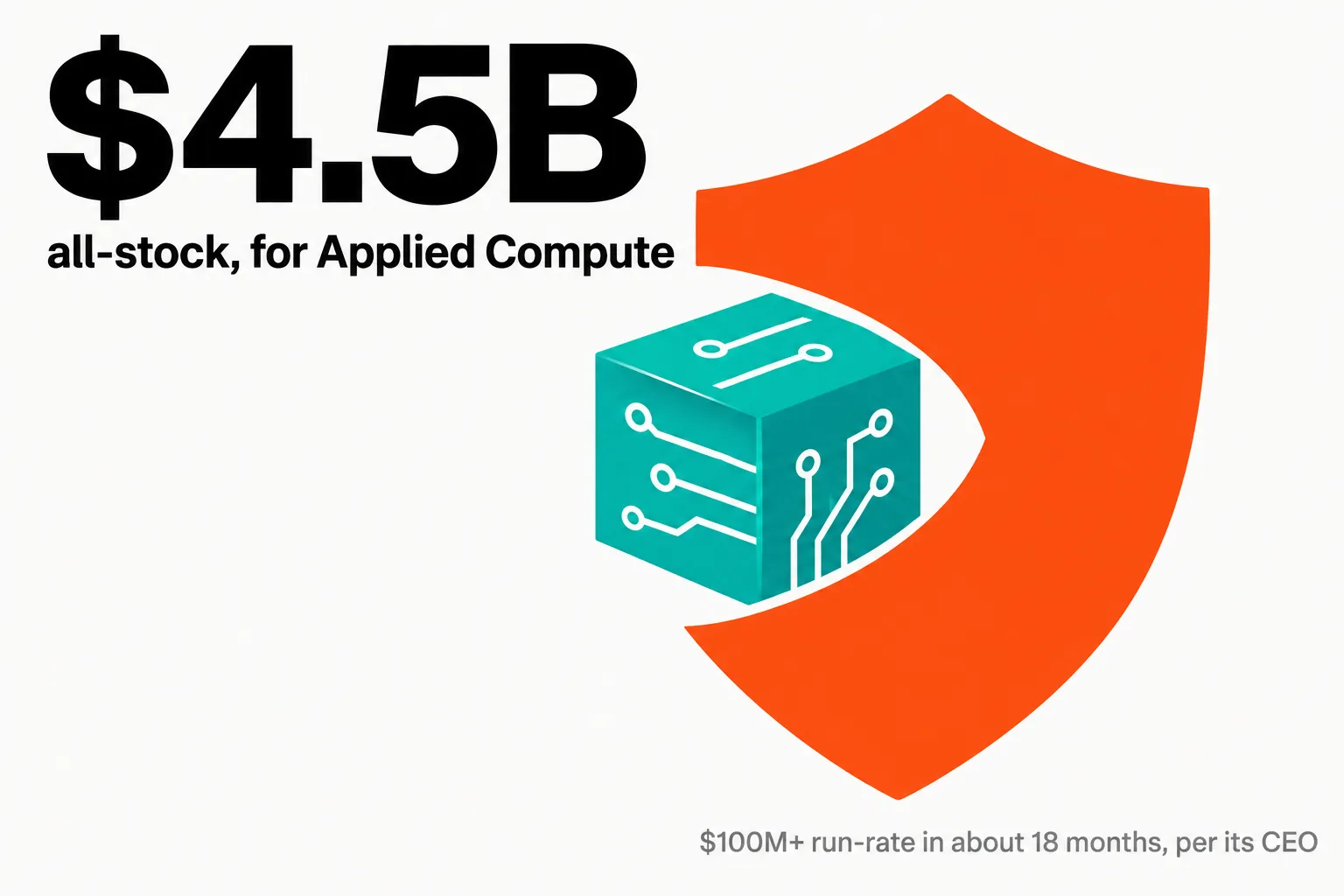
Palo Alto Networks has agreed to buy Applied Compute for $4.5 billion in stock. The Wall Street Journal reported it first at 21:15 UTC on November 18, 2026, and fifty minutes later Applied Compute’s CEO Yash Patil confirmed it: “Applied Compute has signed a definitive agreement to be acquired by Palo Alto Networks for $4.5B!”
Patil’s post passed 590,000 views by the next afternoon. This page is the record: what was agreed, what Applied Compute does, the numbers that came with it, and what we could not check. Every fact here comes from the companies’ and the outlets’ own posts on X.
On this page · 8 sectionsOpen
 Palo Alto Networks agreed to buy Applied Compute, a San Francisco AI startup founded by former OpenAI researchers, in an all-stock deal valued at $4.5 billion, first reported by the Wall Street Journal on November 18, 2026.
 Applied Compute’s CEO Yash Patil says the company went from zero revenue to over $100 million in annualized run-rate in just over 18 months, with a few dozen people.
 The company helps businesses train, serve and improve their own models. Patil’s line: every company should own its intelligence, and customers will keep owning and controlling their models.
 Palo Alto Networks CEO Nikesh Arora says Patil becomes Co-Chief AI Officer, and wants to train a supervisory AI that watches a task AI and flags when it breaks the rules.
 The deal came with a record first quarter: revenue up 39% to $3.44 billion, and shares up 8% on the results, per CNBC.
§ 01What was agreed
| Item | What was said | Source |
|---|---|---|
| Buyer | Palo Alto Networks | WSJ, 21:15 UTC Nov 18 |
| Target | Applied Compute, San Francisco | WSJ |
| Price | $4.5 billion | WSJ, Patil |
| Form | All-stock | WSJ, Bloomberg |
| Founders | Yash Patil, Rhythm Garg, Linden Li | Patil, Arora |
| Patil’s new role | Co-Chief AI Officer | Arora, 02:14 UTC Nov 19 |
The Journal describes Applied Compute as a startup “founded by former OpenAI researchers”, and Bloomberg calls it “the AI model platform Applied Compute”. Palo Alto Networks itself noted the deal in its quarterly results post as its intent to acquire.
§ 02What Applied Compute does
Patil’s post is the clearest description. The founders started with “a belief that was unusual at the time”: that “every company should own its intelligence.” In his words: “We think training, serving, and improving proprietary models will become a normal part of running a company.”
- The product. Tools for a company to train, serve and keep improving models of its own, rather than renting one general model.
- The promise to customers. “Customers will still own and control their models”, Patil says, after the deal as before it.
- The growth. “A few dozen people in just over 18 months grew this company from zero revenue to over $100M in annualized revenue run-rate”, per Patil.
§ 03The quarter that came with it
Palo Alto Networks announced the deal alongside its fiscal first quarter of 2027, which it called a record.
| Measure | Value | Change year over year |
|---|---|---|
| Total revenue | $3.44 billion | +39% |
| Next-Generation Security ARR | $9.73 billion | +66% |
| Remaining performance obligations | $21.0 billion | +35% |
CNBC’s headline: Palo Alto “shares pop 8% on earnings”.
§ 04Arora’s case: a second AI to watch the first
Palo Alto Networks CEO Nikesh Arora explained the deal in a long post at 02:14 UTC on November 19, welcoming Patil “as Co-Chief AI Officer”.
- The risk he names. “The existential risk for enterprise companies is their lack of frontier level talent”, and the chance that someone rebuilds their business with AI first.
- The bet. Enterprise AI, he writes, will be driven by secure, reliable use of open-weight and open-source models, and few players can take a customer from idea through training to secure inference.
- The safety idea. Train a second, supervisory AI to watch the task AI and alert when it breaks the rules. “It is impossible to deliver safety and security without training both models together with different objective functions.”
- His closing line. “In times of technology inflection, if you don’t act on your instinct - you lose.”
§ 05What we could not check
- The press release. Palo Alto Networks’ investor site refused our first request (its robots file answered Access Denied), so we made no other request there and read no press release. Closing timing, conditions and any expected revenue from the deal are not on this page until a post or a named report states them.
- The $100 million. The run-rate figure is Patil’s own; no audited number has been published.
- Earlier funding rounds. Coverage cites earlier Applied Compute rounds and valuations. We have not read them in a primary, so they are left out.
§ 06What it means if you run AI on real work
Two ideas in this deal reach well past security. Patil’s is that a company should own the models it runs on. Arora’s is that one AI doing work needs a second check watching it. Most businesses will never train a model, but both ideas apply to how they hand work to AI: keep ownership of the data and the results, and keep a check on anything the AI does that reaches the outside world.
§ 07The record
As of November 19, 2026, 20:20 UTC: page opened. Sources are posts on X by the Wall Street Journal, CNBC, Bloomberg, Palo Alto Networks, Yash Patil and Nikesh Arora, read through X’s API. View counts were read at 20:11 UTC.
§ 08Sources
- The Wall Street Journal on X, 21:15 UTC, November 18, 2026
- Yash Patil on X, 22:06 UTC, November 18, 2026
- CNBC on X, 22:11 UTC, November 18, 2026
- Palo Alto Networks on X, 23:20 UTC, November 18, 2026
- Bloomberg on X, 00:20 UTC, November 19, 2026
- Nikesh Arora on X, 02:14 UTC, November 19, 2026
Q1How much is Palo Alto Networks paying for Applied Compute?
$4.5 billion, all in stock, per the Wall Street Journal’s report and the deal post by Applied Compute’s CEO.
Q2Who founded Applied Compute?
Yash Patil, Rhythm Garg and Linden Li, per Patil’s post. The Wall Street Journal describes the founders as former OpenAI researchers.
Q3How fast did Applied Compute grow?
From zero revenue to over $100 million in annualized revenue run-rate in just over 18 months, per Patil. That is the company’s own figure; no audited number has been published.
Q4Why does a security company want a model company?
Arora’s answer: enterprise AI will run on open-weight models that need secure training and inference, and safety needs a second model trained to watch the first.
Q5When does the deal close?
We have not read a closing date in a primary source. We will add it when Palo Alto Networks states it on X or a named report carries it.