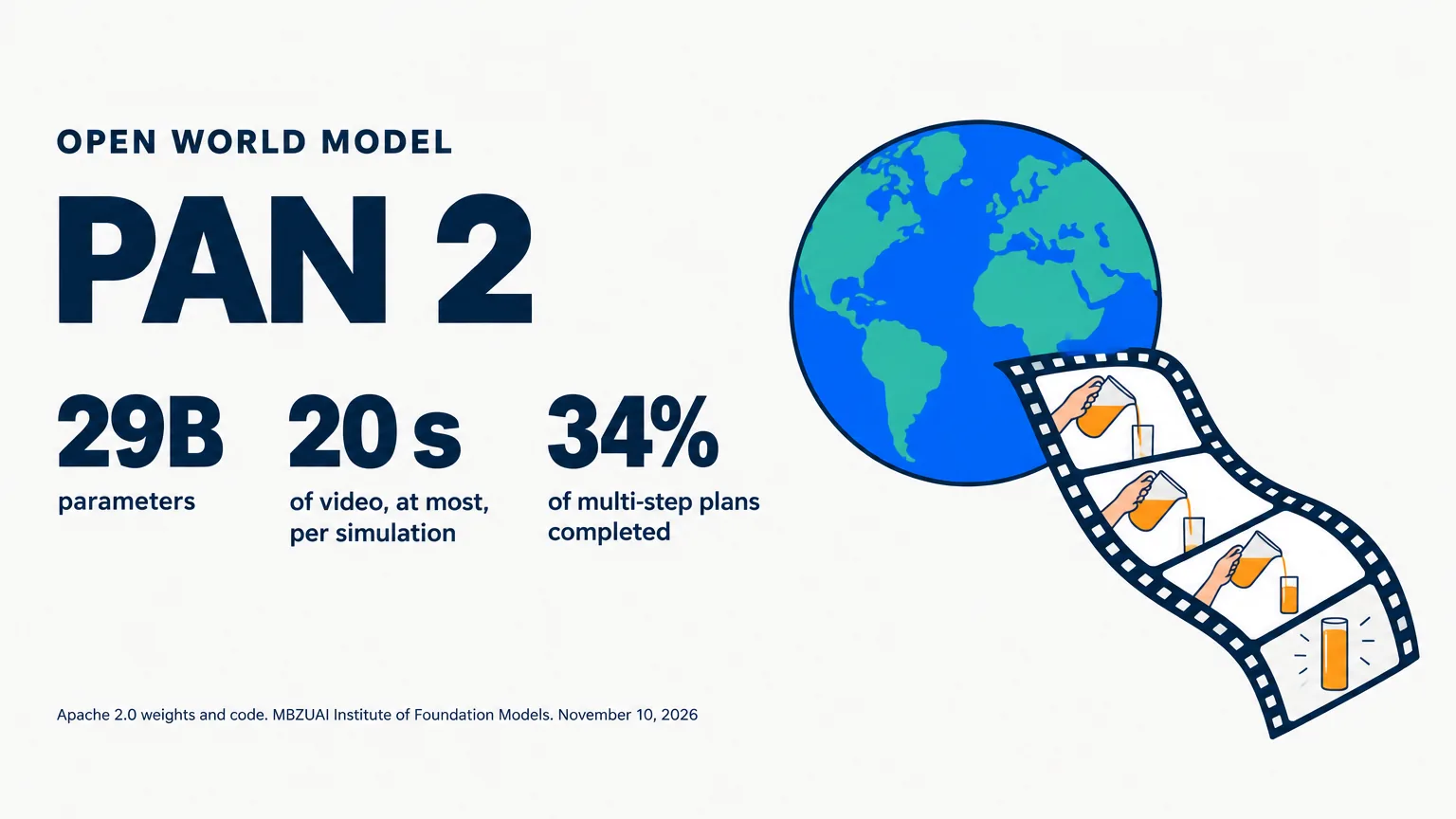
The Institute of Foundation Models at MBZUAI has released PAN 2, an open world model that takes an action written in text and returns a video of what it predicts will happen next. The weights, the training code and the inference code are published under the Apache 2.0 license. IFM announced it on November 10, 2026, and its post on X had about 1.3 million views when we read it at 08:03 UTC on November 11.
We read IFM’s blog post, the model card that ships with the weights, and the code repository against each other. On IFM’s own test, PAN 2 completes three in four single steps and one in three whole plans. An open rival scores higher on single actions and with human reviewers. And IFM’s two documents give different numbers for two of the models PAN 2 is compared with.
On this page · 10 sectionsOpen
 IFM at MBZUAI released PAN 2 on November 10, 2026, with weights, training code and inference code under the Apache 2.0 license.
 PAN 2 takes a text description, an optional image and an action in text, and returns up to 20 seconds of video at 704 by 1248 and 24 frames a second.
 Two models do the work: a language model that writes what happens next, and a 29-billion-parameter diffusion model that renders it. Only the second is in the release.
 On IFM’s own multi-step test PAN 2 completes 75.1% of steps and 34.0% of whole plans. IFM says about two in three simulated plans lose at least one step.
 MiniMax-H3, also open, scores higher on single actions and with human reviewers. IFM’s blog post and model card give different figures for two other models.
§ 01What PAN 2 is
A world model predicts how a scene changes when something acts on it. IFM’s announcement puts it in six words: “PAN 2 predicts the next world”.
You give PAN 2 a starting point, which is a text description and, if you have one, an image. You give it an action in text, such as pouring juice from one glass into another. It returns a video of the outcome. The use IFM has in mind is an AI agent that tries each of its candidate plans in simulation first and then acts on the one that turned out best.
| Item | What IFM publishes |
|---|---|
| Developer | Institute of Foundation Models (IFM) at MBZUAI |
| Announced | November 10, 2026 |
| License | Apache 2.0 for IFM’s own code and weights |
| Input | A text description, an optional starting image, and an action in text |
| Output | Video at 704 x 1248 and 24 frames a second, up to 20 seconds |
| Diffusion model | 29.2 billion parameters in 44 blocks |
| Text encoder | Qwen3.5-9B, used as released |
| Video decoder | Wan 2.2 VAE, used as released |
| Default run | 50 sampling steps and about 10 seconds of video |
| Runs with | IFM’s own scripts, Hugging Face Diffusers, vLLM |
§ 02Two models do the work, and one is in the release
PAN 2 is two models working in sequence.
The first is a language model. It reads the scene and the action and writes down what happens next as a structured list: who acts, at which second, and how the camera moves. The second is a diffusion model that turns that list into video. The model card says the diffusion model was “trained from scratch on hundreds of millions of videos annotated in the same format”.
The release contains the diffusion model. It does not contain a language model. For that part IFM ships a prompt, an agent skill for coding agents, and a script for a local model, and says: “Any instruction-following LLM can be used.”
The model card lists four language models IFM tested in that seat, in order of how many whole plans they completed: Claude Opus 5.5, GPT-6 Astra at medium effort, Kimi K3 and Qwen 3.8 Flash. Its main studies use Kimi K3.
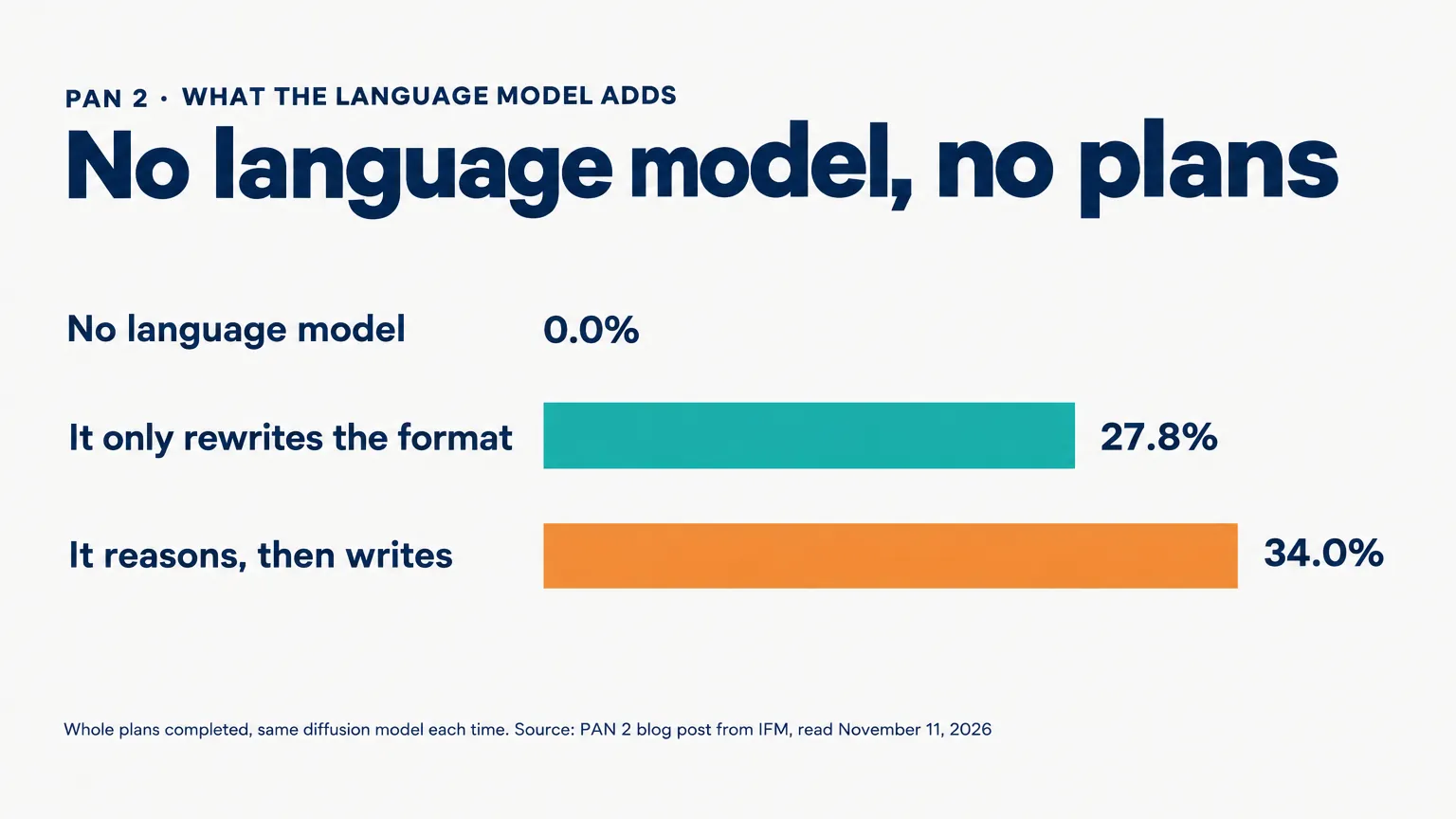
How much the first model matters is the clearest result in IFM’s blog post. IFM kept the diffusion model fixed and changed only how much the language model did.
| Work done by the language model | Single actions | Step completion | Full-plan completion |
|---|---|---|---|
| None, the action goes straight to the diffusion model | 45.1 | 8.7 | 0.0 |
| Rewrites the action into the structured format | 78.2 | 70.7 | 27.8 |
| Reasons about what happens, then writes it | 84.6 | 75.1 | 34.0 |
With no language model in front, not one multi-step plan completed. So the scores below belong to a pair of models, and the pair changes from table to table.
§ 03The headline number: one plan in three
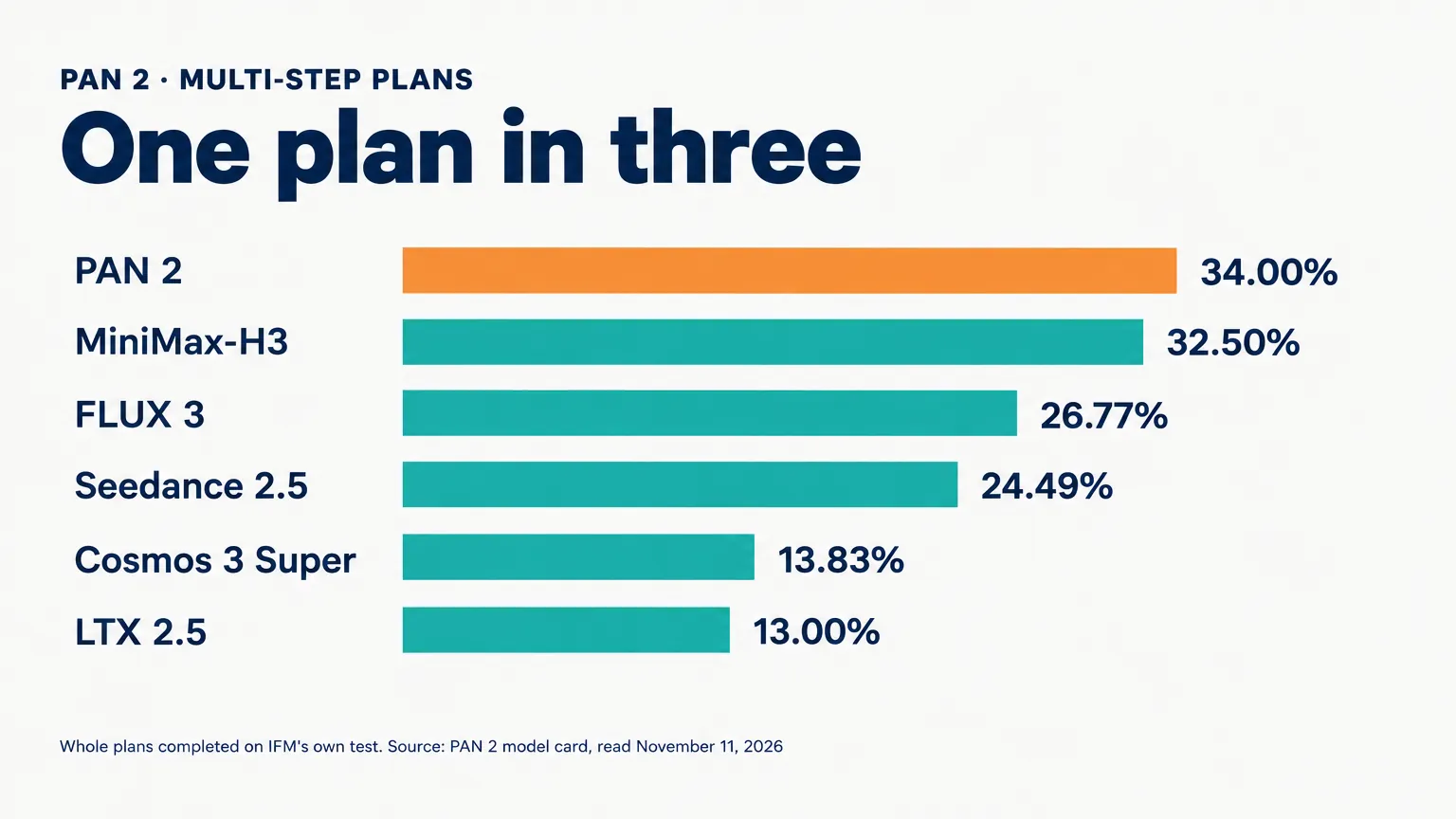
IFM built its own multi-step test. It has 100 everyday tasks seen from the first person, each posed once with a starting image and once without, for 200 prompts and 456 steps. A judge model checks every step. A plan counts as complete only if every step in it is carried out.
| Model | Open weights | Step completion | Full-plan completion |
|---|---|---|---|
| PAN 2 | Yes | 75.10 | 34.00 |
| MiniMax-H3 | Yes | 75.12 | 32.50 |
| FLUX 3 | No | 72.44 | 26.77 |
| Seedance 2.5 | No | 68.95 | 24.49 |
| Cosmos 3 Super | Yes | 57.23 | 13.83 |
| LTX 2.5 | Yes | 55.77 | 13.00 |
IFM’s blog post describes this as “the highest full-plan completion among the models we studied”.
That is what the table shows, with two things to keep in mind. PAN 2 leads MiniMax-H3 by 1.5 points, and across three runs the model card gives a spread of 3.61 points for PAN 2 and 3.04 for MiniMax-H3. On single steps, MiniMax-H3 is ahead by 0.02 points.
The model card states the weakness plainly in its list of limitations: “About two in three simulated plans contain at least one step that is not carried out.”

IFM also fits a curve through the six models and reads a forecast off it: if step completion rose from 75% to 90%, full-plan completion would roughly double, to about two thirds. That is a projection from six data points. It is not a result.
§ 04Where an open rival is ahead
MiniMax-H3 is also an open model. We covered a faster hosted version of it in September. On single actions it beats PAN 2 on every one of IFM’s six capabilities. The test has 300 cases.
| Capability | PAN 2 | MiniMax-H3 |
|---|---|---|
| Overall | 84.48 | 87.20 |
| Physical consistency | 76.92 | 78.86 |
| Causal coherence | 81.61 | 85.96 |
| Entity persistence | 90.40 | 96.83 |
| Constraint satisfaction | 83.13 | 85.86 |
| Viewpoint control | 77.96 | 79.62 |
| External dynamism | 93.25 | 93.65 |
People preferred it too. Thirteen reviewers compared videos side by side without knowing which model made them, across 140 prompts and 1,400 comparisons. Only open models were in this test.
| Model | Elo rating | Win rate (%) |
|---|---|---|
| MiniMax-H3 | 1620 | 68.8 |
| PAN 2, GPT-6 Astra in front | 1595 | 63.7 |
| PAN 2, Claude Opus in front | 1559 | 58.9 |
| Cosmos 3 Super | 1380 | 31.8 |
| LTX 2.5 | 1346 | 25.6 |
IFM says so itself in the blog post: “PAN 2 ranks second among the four evaluated open models.”
On public benchmarks the picture depends on the setting. Physics-IQ scores how closely a generated video matches real footage of a physical event. RBench covers robot tasks.
| Model | Physics-IQ, leaderboard setting | Physics-IQ, each model’s default | RBench |
|---|---|---|---|
| PAN 2 | 49.38 | 37.48 | 57.04 |
| MiniMax-H3 | 39.79 | 42.91 | 56.16 |
| Cosmos 3 Super | 48.62 | 36.11 | 50.64 |
| FLUX 3 | 51.11 | 38.48 | 57.96 |
| Seedance 2.5 | 42.43 | 40.08 | 56.38 |
| Omni Flash 1.1 | 35.34 | 33.86 | 60.79 |
PAN 2’s 49.38 was produced with Claude Opus 5.5 as the language model in front. IFM writes that with this score PAN 2 “would also rank first among open models and third overall” on the public Physics-IQ leaderboard. With each model run in its own default setup, PAN 2 scores 37.48 and MiniMax-H3 scores 42.91.
§ 05Two IFM documents, two sets of numbers
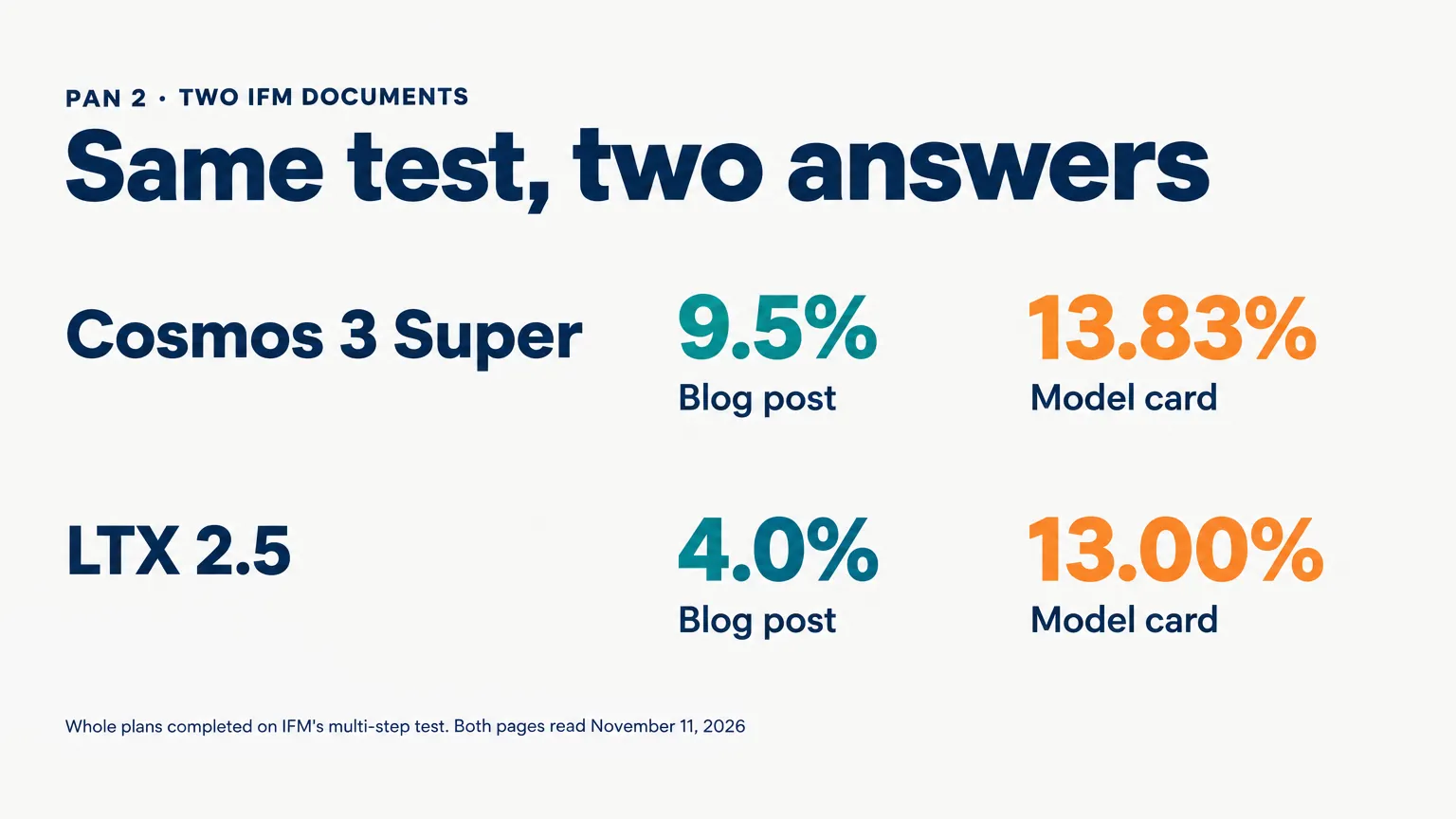
IFM’s blog post and its model card report the same tests. For PAN 2, MiniMax-H3, FLUX 3 and Seedance 2.5 the two agree once the figures are rounded. For the other two models they do not.
| Model and measure | Blog post | Model card |
|---|---|---|
| Cosmos 3 Super, single actions | 68.32 | 71.34 |
| Cosmos 3 Super, step completion | 47.7 | 57.23 |
| Cosmos 3 Super, full-plan completion | 9.5 | 13.83 |
| LTX 2.5, single actions | 61.30 | 72.25 |
| LTX 2.5, step completion | 38.5 | 55.77 |
| LTX 2.5, full-plan completion | 4.0 | 13.00 |
Every one of the six figures is lower in the blog post. Neither page explains the difference. The order of the models is the same in both, and PAN 2’s own figures do not change. The curve IFM fits in the blog post uses the blog’s figures.
One note on how we read this. The model card publishes its result tables as images, and we read the figures from those images.
§ 06What you need to run it
- A license check is short. IFM’s code and weights are Apache 2.0. The text encoder, the video decoder and the Diffusers library come from other teams under their own licenses, which IFM lists in a notice file.
- The download is large. The Hugging Face repository held about 86 GB of files when we read it, about 67 GB of that for the diffusion model.
- It wants a full GPU per copy. The inference guide says each worker holds the full 29B diffusion model, with one worker per GPU. It has a setting that moves parts of the model off the GPU when the model does not fit. We did not find a minimum memory figure or a time per clip in the pages we read.
- Prompts need rewriting. The diffusion model expects the structured format, with a hard limit of 1,536 tokens for each caption. Free text goes through the language model first.
- IFM recommends a separate guardrail. In its own tests the guardrail cut the share of harmful text requests that produced an unsafe video from 33.9% to 1.5%. It also stopped 11.5% of harmless text requests. The model card adds: “The guardrails reduce, but do not eliminate, the risk of harmful outputs”.
§ 07What IFM says it cannot do yet
The limitations section of the model card is specific.
- Prompts. PAN 2 is sensitive to wording. Of its own showcase, IFM writes that “the examples beyond the training data and the agent case studies relied on hand-refined prompts”.
- Long scenes. Each clip starts from one frame and text, so the look of things drifts across clips.
- Fine hand movements. Text describes them only roughly.
- Shortcuts. The model can reach the requested end state while breaking physics on the way. IFM’s example is “pasta appearing in the colander before it is drained”.
- Plans that should fail. The test covers plans designed to succeed. How PAN 2 handles a plan that ought to fail has not been measured.
The blog post shows an agent using PAN 2 to work out which cap on a tube is glued shut. It needed six attempts, and it misread the second simulation as a success.
The model card also draws a line under what the output is: “PAN 2’s simulations are predictions, not records of real events”.
§ 08What is not known
- The paper. The model card refers to a technical report. We did not find it linked from the pages we read. Eric Xing, first author of the paper PAN 2’s design is based on, wrote on X: “A full paper will be posted soon”.
- Independent results. Every figure in this post is IFM’s own.
- Why the two documents differ on Cosmos 3 Super and LTX 2.5.
- Hardware and speed. No minimum GPU memory and no time per clip in the pages we read.
- A hosted version or a price. IFM’s blog post lists weights, training code and inference code. It lists no hosted service.
For another approach to the same idea, Google’s Genie 4 renders worlds a person steers in real time.
§ 09Our conflict, declared
Two systems in IFM’s tables are ones CellCog uses. CellCog’s video generation runs on Seedance 2.5, one of the two closed models PAN 2 is compared with. CellCog’s agents run on Anthropic’s Claude models (Claude Opus 5.5 on most tiers; Claude Fable 5.2 on Agent Max and Creative Max since November 11, 2026), and Claude Opus 5.5 is one of the language models IFM tested in front of PAN 2. We have not run PAN 2, and CellCog routes no work to it. Every figure here is IFM’s, read on November 11, 2026.
§ 10Sources
- IFM, PAN 2: A foundation world model for physical intelligence, blog post dated November 10, 2026
- IFM, PAN 2 model card and weights on Hugging Face, read November 11, 2026
- IFM, PAN 2 code repository, read November 11, 2026
- IFM, inference guide, read November 11, 2026
- IFM, announcement on X, November 10, 2026
- Eric Xing, post on X, November 10, 2026
- Eric Xing, Mingkai Deng and Jinyu Hou, Critique of World Models
Q1What is PAN 2?
PAN 2 is an open world model released on November 10, 2026 by the Institute of Foundation Models at MBZUAI. Given a text description, an optional image and an action in text, it returns a video of up to 20 seconds showing what it predicts will happen.
Q2Is PAN 2 open source?
IFM published the weights, the training code and the inference code under the Apache 2.0 license. The text encoder and the video decoder it uses come from other teams under their own licenses.
Q3How good is PAN 2 at simulating plans?
On IFM’s own test of 200 prompts and 456 steps, PAN 2 completes 75.1% of steps and 34.0% of whole plans. IFM’s model card says about two in three simulated plans contain at least one step that is not carried out.
Q4How does PAN 2 compare with MiniMax-H3?
On IFM’s own tests MiniMax-H3 scores higher on single actions, 87.20% against 84.48%, and with human reviewers. PAN 2 scores higher on whole plans, 34.00% against 32.50%, a gap smaller than the spread between runs.
Q5What do I need to run PAN 2?
The diffusion model has 29.2 billion parameters and the Hugging Face repository holds about 86 GB of files. You also need a language model in front of it to write the structured description it expects. IFM does not state a minimum GPU memory figure in the pages we read.
Q6Does CellCog use PAN 2?
No. CellCog has not run PAN 2 and routes no work to it. CellCog’s video generation runs on Seedance 2.5, one of the closed models in IFM’s comparison tables.