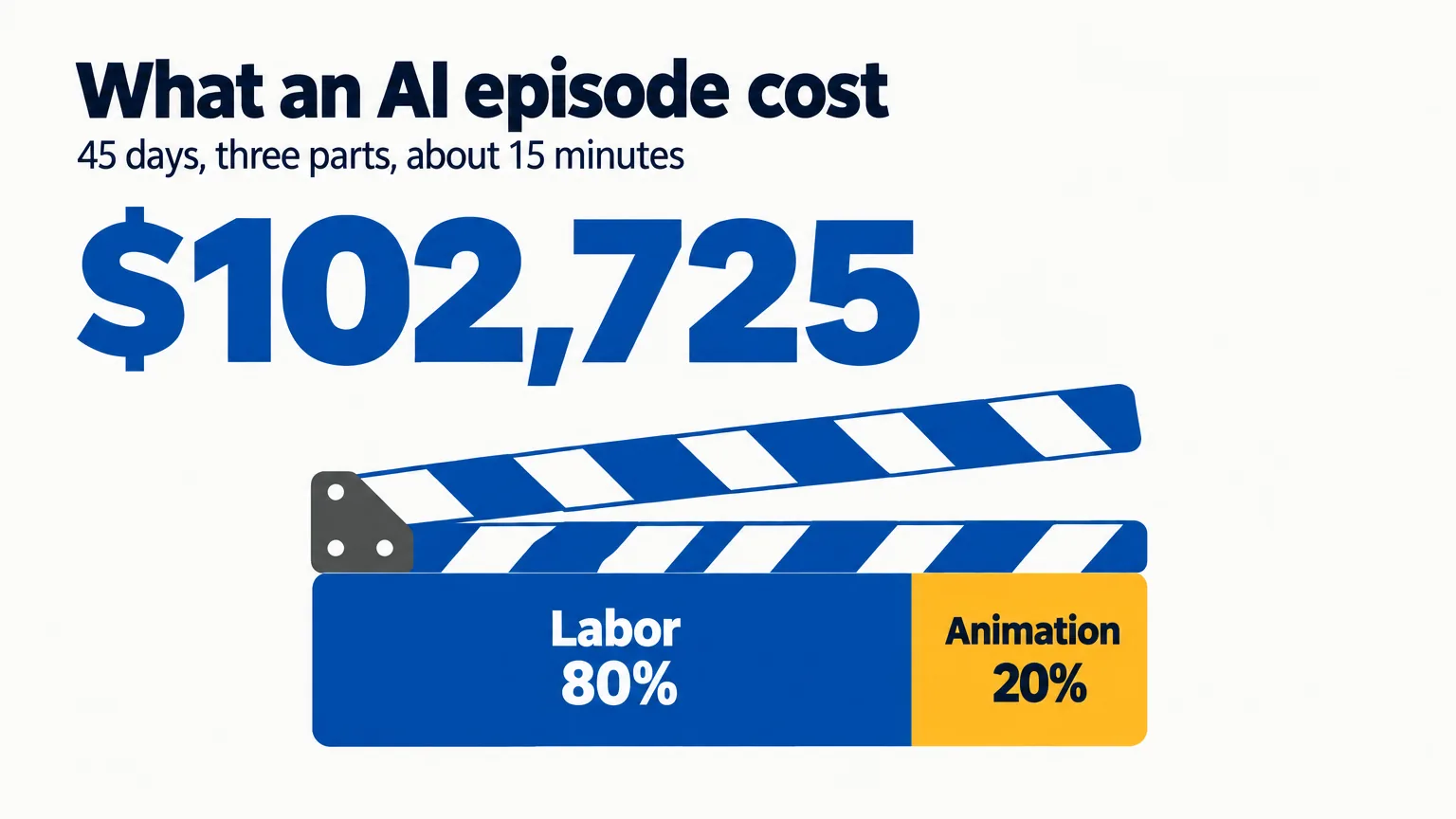
PJ Ace says the eighth episode of his Nexus series cost $102,725 and took 45 days to make. He posted the figure on X on November 13, 2026, and the post passed 2,795,000 views by 14:16 UTC the next day. In replies he said 80% of it was labor and 20% animation costs, and that the figure covers all three parts of the episode.
This page is written from his thread on X and his replies, read through X’s API, and from the episode page on Latent Matinee, a site that catalogues films made with AI.
On this page · 7 sectionsOpen
 PJ Ace posted on November 13, 2026 that Nexus Episode 8 cost $102,725 and took 45 days. The post passed 2,795,000 views.
 In replies he put the split at 80% labor and 20% animation costs, and said the figure covers all three parts, about 15 minutes in total.
 He says each 30-second sequence runs 3 to 7 times at about $15 to $25 a run. By our arithmetic that is $1,350 to $5,250 for 15 minutes.
 His thread names Claude for planning, GPT 2.5 Sunburst and Seedream 5.5 for designs and plates, and Seedance for animation. No 3D.
 He did not say what else sits in the 20%. Dreamina, the series partner, funds the episodes, he says.
§ 01What he posted
- The headline. “This episode cost $102,725 and took 45 days to make.”
- The claim. The next line: “but I think we’ve finally solved AI Filmmaking.”
- The episode. Prison Break, Episode 8 of Nexus. Latent Matinee says the original 4:40 release is Part I, and PJ Ace says Parts II and III follow over the next two weeks.
- The story. He calls it an homage to Nausicaä of the Valley of the Wind.
§ 02Where the money went, in his words
He answered cost questions in the replies, not in the thread itself.
- The split. To one reply he wrote: “80% labor 20% animation costs” (reply).
- What the figure covers. He said “it’ll be a 15 min episode in its entirety” and that the aggregate cost of labor and animation is over $100,000, mostly labor (reply).
- Who pays. “Over part 1, part 2 and part 3 of this episode. And Dreamina funds these” (reply).
- One run. “We run each 30 sec sequence between 3-7 times. Each run is about $15-25 depending on a few factors” (reply).
| Item | Source | Amount |
|---|---|---|
| Whole episode, three parts | His post | $102,725 |
| Labor, 80% | His reply, our arithmetic | $82,180 |
| Animation costs, 20% | His reply, our arithmetic | $20,545 |
| Generation runs for 15 minutes, low end | 30 sequences x 3 runs x $15 | $1,350 |
| Generation runs for 15 minutes, high end | 30 sequences x 7 runs x $25 | $5,250 |
- The gap. By his own per-run numbers, the generation runs for 15 minutes come to $1,350 to $5,250. He puts animation costs at about $20,500. He did not say what else sits inside that 20%, so the difference may be other paid tools, images, sound or retries he did not count as runs.
- The point most replies missed. Most of the money paid people: a director, two writers, a lead animator, two animators and an editor are credited.

§ 03The tools he named
| Step | Tool he names | What he says it did |
|---|---|---|
| Planning | Claude | Lists the characters, props and vehicles, then splits the script into 30-second prompts |
| Design | GPT 2.5 Sunburst | Wide exploration of character and prop variants |
| Design, final | Seedream 5.5 | High-resolution versions of the picks, and 21:9 location plates |
| Animation | Seedance | A wide pass of each scene, then closer coverage anchored on screenshots |
- Two passes. He says the first pass locks where everyone stands, and the second uses screenshots of it to get closer coverage in the same positions.
- No 3D. “We didn’t do any 3D workflows for this film” because, he says, a large team made the ingredients-based approach easier.
- Audio. He says he made big strides in audio but would publish that guide later; the thread does not name the audio tools.
§ 04What he says about longer films
- In one reply he said a feature still costs much more than a short. “It’s way cheaper than traditional but still will be millions”, he wrote, or low tens of millions with A-list talent and a hybrid shoot (reply).
§ 05What we did not check
- We did not watch the episode or count its shots, so the 30-sequence figure is our arithmetic from the 15 minutes he gives.
- He gave no line items, and the 80/20 split is his own. Dreamina, the series partner, funds the episodes, so this is not an independent budget.
- We did not find his audio guide; he said it was still being written.
§ 06Where CellCog sits
CellCog is our product, an AI employee platform. Our video agent runs on Seedance 2.5 and our image agent on GPT Image 2.5, two of the model families named in his thread. We had no part in this film and have no tie to Dreamina. Our own tests of Seedance against other video models are in Seedance 2.5 vs Kling 4.0.
§ 07Sources
- PJ Ace: thread on X, November 13, 2026, 14:30 UTC, and his replies linked above. Read through X’s API at 14:16 UTC on November 14, 2026.
- Latent Matinee: Prison Break, Part I, checked November 13, 2026, read November 14.
Q1Did the AI cost $102,725?
No. PJ Ace says 80% of the $102,725 was labor and 20% animation costs. His own per-run numbers put the generation runs for a 15-minute episode at $1,350 to $5,250 by our arithmetic, well under the roughly $20,500 he gives for animation.
Q2Which AI tools did he use?
His thread names Claude to list characters and split the script into 30-second prompts, what he calls GPT 2.5 Sunburst and Seedream 5.5 for character sheets and location plates, and Seedance for animation. He says this episode used no 3D workflow.
Q3How long is the episode?
Part I runs 4:40. He says the full episode will be about 15 minutes once Parts II and III are out over the following two weeks.
Q4Who made it?
PJ Ace is creator and executive producer and Beau Fipke directs, per the credits in his thread and on Latent Matinee. Dreamina is the series partner.
Q5Does he think AI films are cheap now?
He says a feature would still cost millions, or low tens of millions with A-list talent and a hybrid shoot, while being way cheaper than traditional.