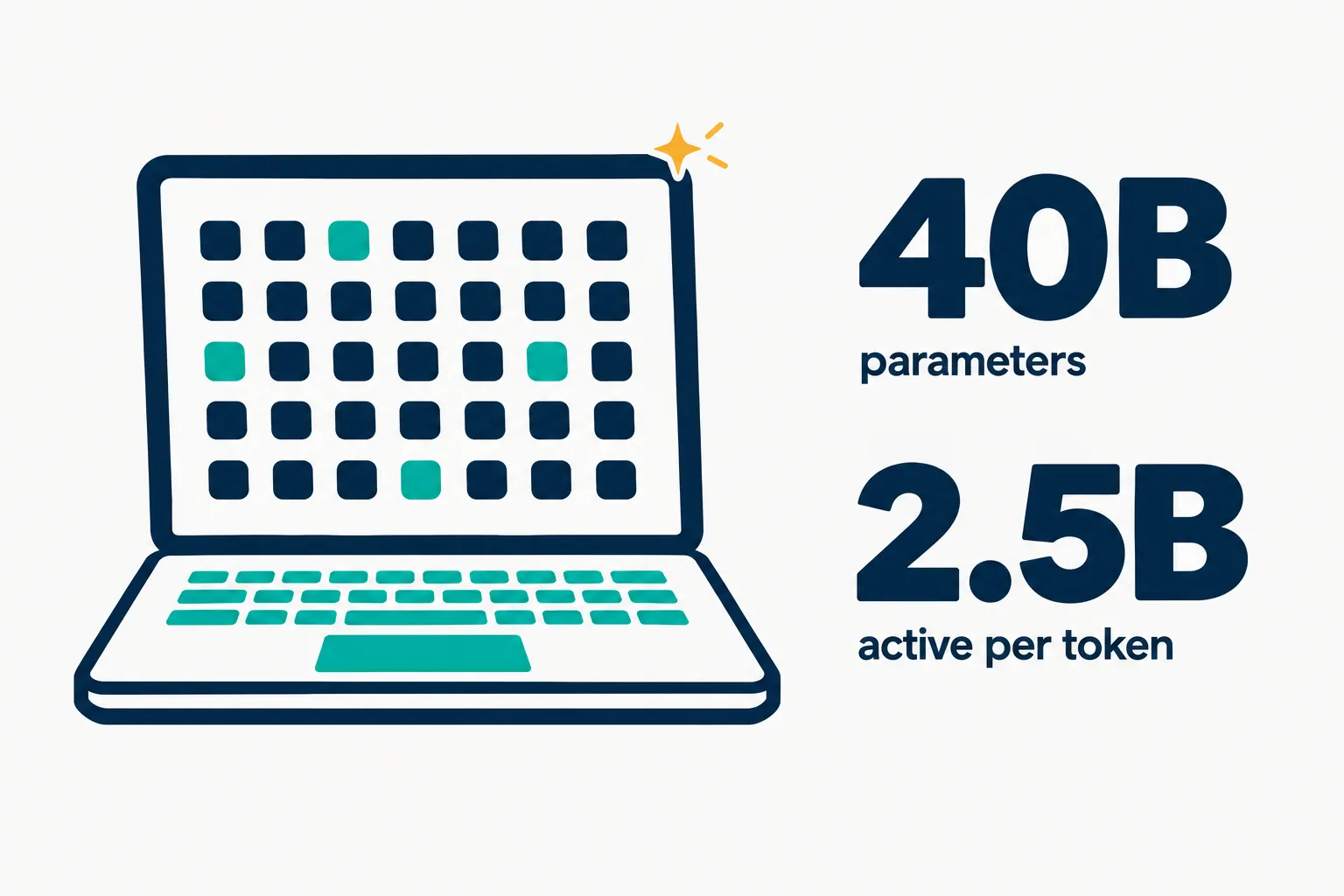
Recursive Superintelligence released Flint on October 21, 2026: an open-weight coding model with 40 billion parameters that activates about 2.5 billion per token, built to run on a laptop. The company says its automated research system, the Eureka Machine, helped design nearly every part of it, and that a small team of people and agents built it in under four months.
Flint is the first model from Recursive, the company led by former Salesforce chief scientist Richard Socher. The weights are on Hugging Face under the Apache 2.0 license. Recursive’s pitch is local coding without API fees: “Our small team of people and agents built it from scratch in under four months.”
On this page · 6 sectionsOpen
 Recursive Superintelligence released Flint on October 21, 2026, an open-weight coding model built to run locally.
 Flint has 39.8 billion total parameters and activates about 2.5 billion per token, using 6 of 256 routed experts plus a shared expert.
 Recursive says its Eureka Machine, an automated research system, helped develop nearly every part of the model in under four months.
 Recursive reports more than 125 tokens a second on an M4 Pro MacBook Pro and more than 150 on a 64GB NVIDIA RTX Spark at short contexts.
 The weights are released under the Apache 2.0 license on Hugging Face.
§ 01What Flint is
| Item | Detail |
|---|---|
| Type | Mixture-of-experts coding model, text in and out |
| Parameters | 39.8 billion total, about 2.5 billion active per token |
| Experts | 256 routed experts, 6 selected per token, plus one shared expert |
| Context | Up to 512k supported; 256k recommended |
| License | Apache 2.0 |
| Knowledge cutoff | June 2026, per the model card |
| Release | BF16 checkpoint with an SGLang serving kit; quantized variants follow |

The low active count is the whole design. Each token touches only a small slice of the weights, which is why a 40B model can run at laptop speed. Recursive says its Eureka Machine searched expert configurations starting from a 35B-total, 3B-active baseline and landed on 40B total with 2.5B active as the best mix of speed and coding performance.
§ 02The benchmark claims
The model card reports these release-evaluation scores. They are Recursive’s own numbers, average pass@1 over at least five attempts; no independent leaderboard has published Flint results yet.
| Benchmark | Score |
|---|---|
| Terminal-Bench 2.1 | 54.9% |
| SWE-bench Pro v2 | 89.7% |
| SWE-bench Verified | 74.2% |
Recursive’s launch post claims Flint leads mixture-of-experts models under 50 billion parameters on these benchmarks and rivals dense models of 25 to 40 billion parameters “while running more than five times faster.” It also tells users to break complex tasks into smaller pieces, because Flint may need more guidance than the large closed coding models.
§ 03How fast, and on what
- Laptop: more than 125 tokens per second on an M4 Pro MacBook Pro, at short contexts, with Recursive’s inference engine.
- Desktop: more than 150 tokens per second on a 64GB NVIDIA RTX Spark.
- Full checkpoint: the card says the BF16 release “runs on one B300 or H200 GPU per replica with the SGLang kit.” Laptop speeds come from quantized versions.
One quantization detail stands out. The Eureka Machine quantized the output layer to 4 bits, “Against common practice”, because with so few active parameters that layer is a large share of what each token reads. Recursive says the NVFP4 model scores within 0.7 points of the 16-bit one.
§ 04The automated-research claim
Recursive describes the Eureka Machine as a system that proposes ideas, implements them, tests them and decides what to try next. It credits it with contributions to data, optimizers, training recipes, infrastructure and inference. That is a claim about assistance, not about a model training itself without people; the launch post says the team was “people and agents.” For the wider debate on self-improving systems, see our record of Google’s Dream-RSI paper.
§ 05What it means if you code with agents
A strong local model changes the privacy math: code never leaves the machine and there is no per-token bill. The tradeoff Recursive names itself is guidance; Flint works best on smaller, well-specified subtasks. CellCog does not run Flint; our agents run on Claude Opus 5.5. Open models like Flint and DeepSeek’s DeepInfer are worth watching as the local option gets closer to the hosted one.
§ 06Sources
- Recursive, Introducing Flint, October 21, 2026.
- Recursive, Flint model card on Hugging Face.
- Recursive on X, launch post; Richard Socher on X, announcement.
- TechCrunch, Recursive launches Flint, October 21, 2026.
Q1Who makes Flint?
Recursive Superintelligence, the company led by Richard Socher, formerly Salesforce’s chief scientist. Flint is its first model.
Q2What license is Flint released under?
Apache 2.0, with weights on Hugging Face.
Q3How many parameters does Flint have?
39.8 billion in total, rounded to 40B, with about 2.5 billion active per token through 6 of 256 routed experts plus one shared expert.
Q4What context window does Flint support?
Recursive says up to 512k tokens, and recommends staying within 256k for the best results.
Q5Was Flint built by AI?
Recursive says its Eureka Machine contributed to data, training recipes, architecture, quantization and inference, and that a small team of people and agents built it.