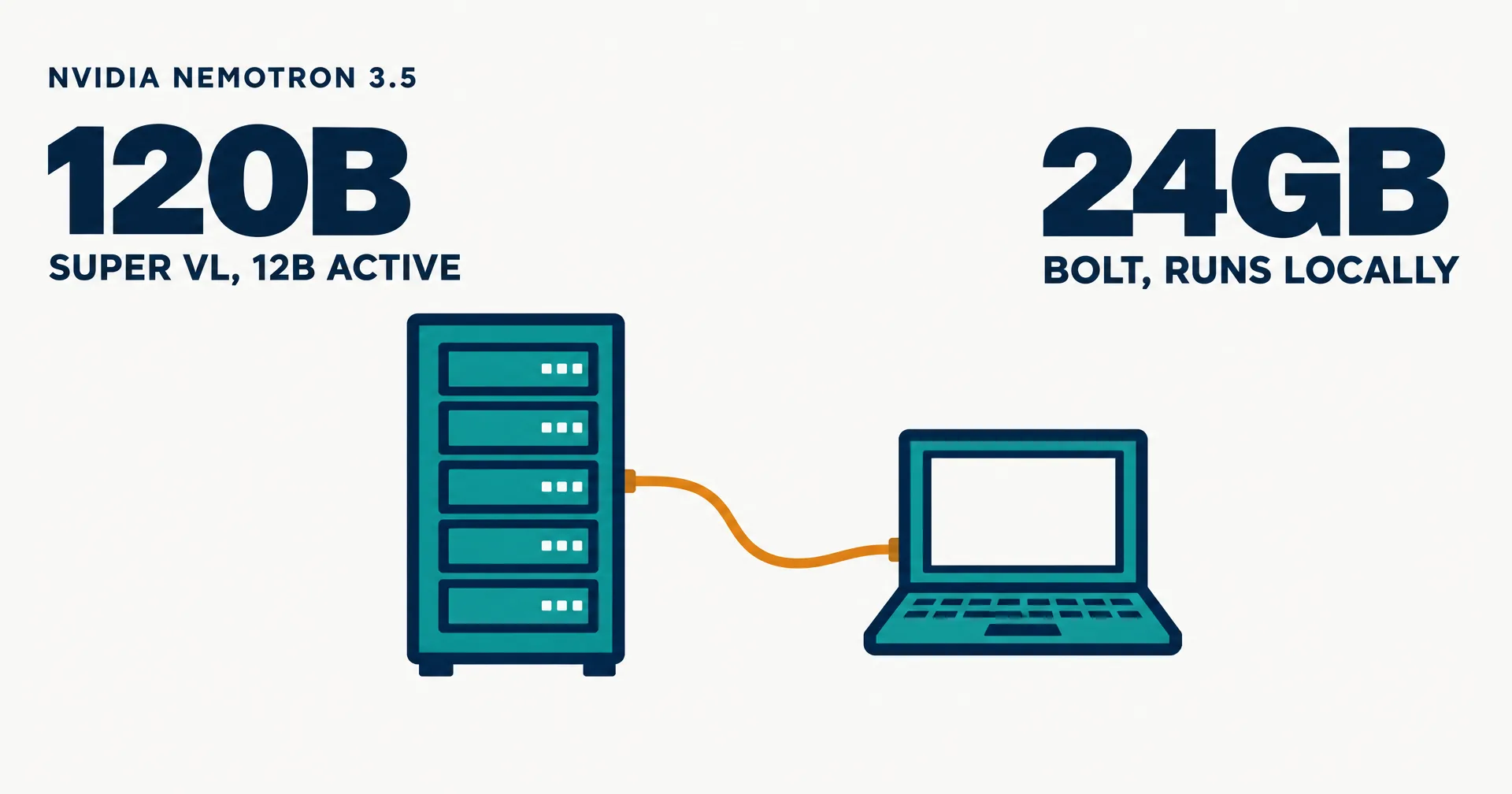
NVIDIA released two open models for AI agents on October 15, 2026: Nemotron 3.5 Super VL, a 120B vision-language model for servers, and Nemotron 3.5 Bolt 74B-A9B, which fits in 24GB of memory to run agents on a laptop. “Super VL and Bolt 74B-A9B are available now, with Bolt E4B coming Oct. 23,” NVIDIA says in its announcement. Both ship with open weights, open datasets and training recipes under a permissive license.
NVIDIA calls Super VL the “fastest open agentic model in its class.” Its own model cards tell a more careful story: Super VL beats Qwen3.5-122B on most agent tests and trails GLM-5.3-Flash and DeepSeek V4 Flash on coding and browsing. Here is what shipped, what the numbers say, and one claim the card does not back.
On this page · 7 sectionsOpen
 NVIDIA released Nemotron 3.5 Super VL and Bolt 74B-A9B on October 15, 2026, with a 4GB Bolt E4B due October 23. All three are open models built for agents.
 Super VL has 120B parameters with 12B active, reads images, charts, PDFs and web pages, and takes up to 1M tokens of context.
 Bolt 74B-A9B uses native 2-bit weights to fit in 24GB of memory and run agents locally, with a 256K context; it is built for the RTX Spark laptops NVIDIA says arrive October 16.
 Both ship under OpenMDW-1.1, a permissive license that asks you to keep the license and notices, with open datasets and training recipes.
 On NVIDIA’s own card, Super VL beats Qwen3.5-122B on most agent tests but trails GLM-5.3-Flash and DeepSeek V4 Flash on coding and browsing.
§ 01What NVIDIA released
- Nemotron 3.5 Super VL: 120B parameters with 12B active, a hybrid of Mamba-2, mixture-of-experts and attention layers plus a vision encoder, up to 1M tokens of context (model card). It reads OCR text, tables, charts, web pages and PDFs, so an agent does not need a separate vision model.
- Nemotron 3.5 Bolt 74B-A9B 24GB: 74B parameters with 9B active, native 2-bit weights to fit in 24GB, and a 256K context (model card). NVIDIA lists llama.cpp, Ollama, LM Studio, Unsloth and vLLM support, and says it is built for RTX Spark laptops arriving October 16.
- Nemotron 3.5 Bolt E4B 4GB: for voice assistants and embedded agents on GeForce RTX and Jetson, due October 23.
They join Nemotron 3.5 Lightning, released in August, and Ultra. NVIDIA names Atlassian, CrowdStrike, Perplexity and Salesforce among the companies building on Super VL.
§ 02Super VL against other open models
These numbers come from NVIDIA’s own Super VL model card, which compares it with open models in the same weight range. They are vendor numbers, not independent replication.
| Benchmark | Super VL | Qwen3.5-122B-A10B | DeepSeek V4 Flash | GLM-5.3-Flash |
|---|---|---|---|---|
| SWE-bench Verified | 71.10 | 71.9 | 75.4 | 79.10 |
| Terminal-Bench 2.1 | 66.70 | 48.70 | 76.80 | 82.70 |
| BrowseComp | 78 | 58.1 | 84.2 | 86.6 |
| GPQA Diamond | 89.52 | 86.7 | 89.6 | 91.2 |
| AA-Omniscience hallucination rate (lower is better) | 30.0 | 84.5 | 95.9 | 30.3 |
The read: Super VL is well ahead of Qwen3.5-122B on terminal and browsing work and level with the field on graduate-level science questions. On coding agents it is behind the two best open Flash models. Its clearest edge is honesty under uncertainty: a 30.0% hallucination rate on AA-Omniscience, against 95.9% for DeepSeek V4 Flash. NVIDIA’s speed claim, up to 5x faster than models in its class, is a throughput measure; it does not appear in the benchmark table above.
§ 03Bolt on a 24GB machine
Bolt’s card compares it with smaller open models you could also run locally, with Bolt measured at its 2-bit (IQ2) setting.
| Benchmark | Bolt 74B-A9B (IQ2) | Qwen3.6-35B-A3B | Gemma 4 26B-A4B |
|---|---|---|---|
| BrowseComp | 66.75 | 48.74 | 26.30 |
| Terminal-Bench 2.1 | 50.98 | 44.38 | 37.22 |
| GPQA Diamond | 86.43 | 83.40 | 79.61 |
| PinchBench | 87.82 | 88.07 | 74.70 |
Bolt leads this group on browsing, terminal tasks and science questions. One claim needs a footnote: the announcement calls Bolt “the #1 open model in its class on PinchBench,” but the same card scores Qwen3.6-35B-A3B at 88.07 and Bolt at 87.82. The gap is a quarter of a point, but the order is the card’s own.
§ 04License, data and where to run it
Both models are under OpenMDW-1.1, which grants use, modification and redistribution “free of charge” and “without restriction,” as long as you keep the license and notices when you redistribute. Your rights end if you sue claiming the model infringes a patent or copyright. That is looser than most custom open-model licenses, including StepFun’s for Step 5 Preview, which adds conditions above set revenue thresholds.
The model cards are unusually open about training data. Super VL’s card lists synthetic data generated with other labs’ models, including Kimi K3, DeepSeek V4 Pro, GLM-5.2 and GPT-5.5. NVIDIA says Super VL saw about 26 trillion tokens before post-training.
You can try Super VL now: weights are on Hugging Face, NVIDIA offers it as a NIM microservice, and OpenRouter lists a free endpoint served by NVIDIA with a 1M context. No paid OpenRouter endpoint existed when we checked on October 15. Bolt is on Hugging Face in GGUF and native formats.
§ 05What it means if you run agents
Open models are now good enough to run real agent work on hardware you own, which matters most when data cannot leave your building. Super VL is a reasonable pick when you need vision and a low hallucination rate more than top coding scores; Bolt is the interesting one for anyone running a local agent harness on a single GPU. Neither has independent benchmark results yet, so test on your own tasks before switching. CellCog does not route to Nemotron 3.5.
§ 06What we are watching
- Independent benchmark results for Super VL and Bolt, starting with Artificial Analysis.
- Bolt E4B on October 23, and paid OpenRouter endpoints with real prices.
- NVIDIA’s GTC Berlin keynote on October 21.
§ 07Sources
- NVIDIA, Nemotron 3.5 Super VL and Bolt announcement, October 15, 2026.
- Hugging Face, Super VL model card and Bolt 74B-A9B model card, read October 15, 2026.
- OpenMDW, OpenMDW-1.1 license, read October 15, 2026.
- OpenRouter, Nemotron 3.5 Super VL (free), read October 15, 2026.
Q1What license are Nemotron 3.5 models under?
OpenMDW-1.1. It grants use, modification and redistribution without fees; you keep the license and notices when you redistribute, and your rights end if you sue claiming the model infringes a patent or copyright.
Q2How big is Nemotron 3.5 Super VL?
120B total parameters with 12B active per token, a hybrid of Mamba-2, mixture-of-experts and attention layers plus a vision encoder, with up to 1M tokens of context per its model card.
Q3Does Bolt really run on a laptop?
NVIDIA says Bolt 74B-A9B fits in 24GB using native 2-bit weights and supports llama.cpp, Ollama, LM Studio, Unsloth and vLLM. We have not run it ourselves.
Q4Is Bolt number one on PinchBench?
NVIDIA’s announcement says so, but its own model card shows Qwen3.6-35B-A3B at 88.07 against Bolt’s 87.82, a 0.25-point gap within the same table.
Q5Does CellCog use Nemotron?
No. CellCog does not route to Nemotron 3.5. This post reads NVIDIA’s announcement and model cards as published.