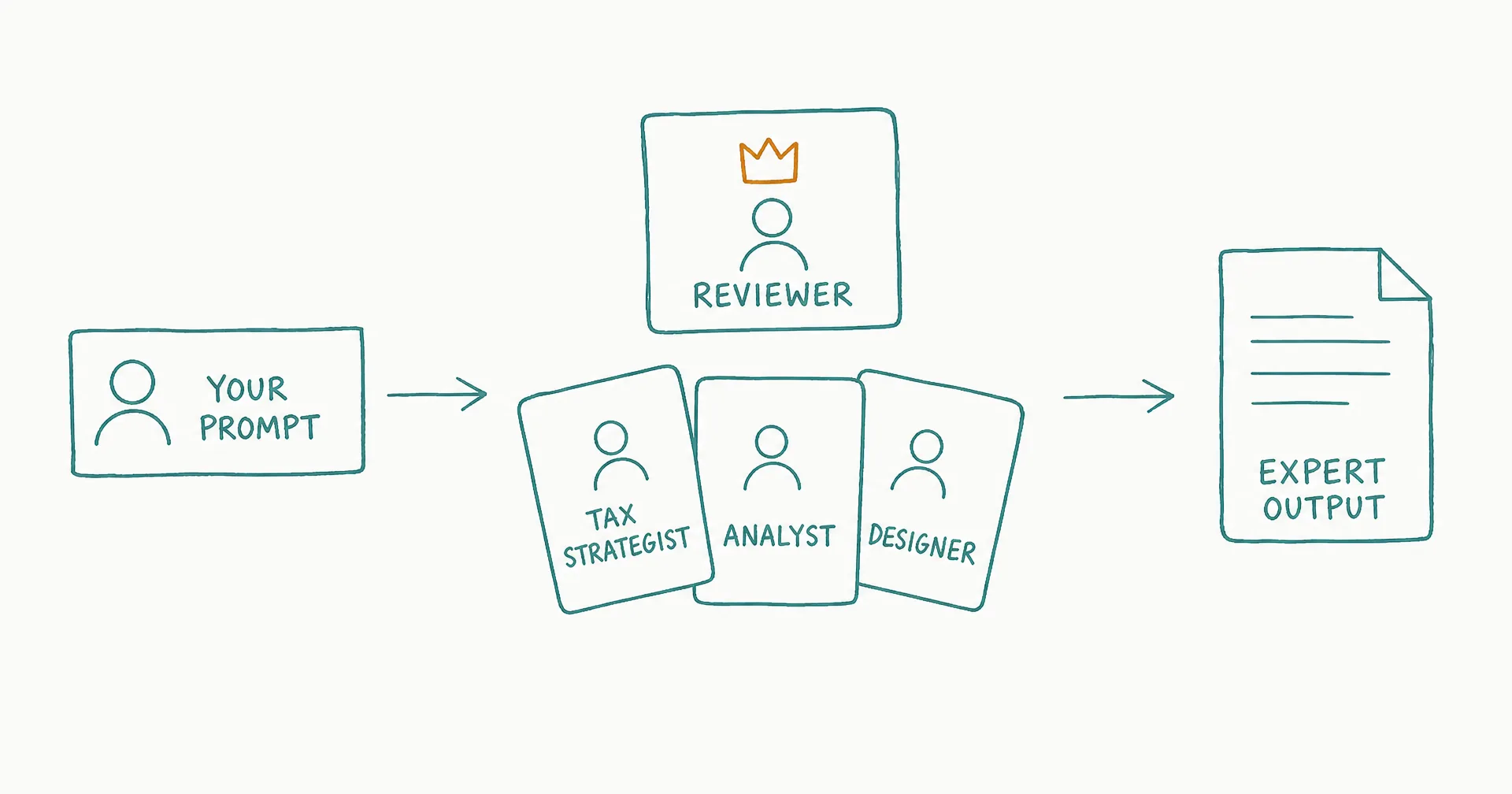
Today we’re rolling out Role Immersion - a new foundational step that runs at the start of every chat across CellCog. Before any other reasoning begins, the agent now figures out who it should be reasoning as.
“This is the biggest reasoning protocol change since CellCog launched. I’ve been personally testing Role Immersion across my own workflows for the past 2-3 months before bringing it in. Now it’s time to test it more broadly. We’re craving honest feedback - has performance gotten better, or worse? We believe each output will feel consistently professional going forward, but we’re committed to learning from real usage. We’ll roll this back if the data tells us to. This is the kind of work no other AI lab is doing right now: pushing reasoning depth across all modalities, not just code.”
Nitish Garg, Founder, CellCog
- Role Immersion is a new foundational step that runs at the start of every chat across CellCog, rolled out May 10, 2026.
- Before any other reasoning begins, the agent assembles the complete set of expert roles the prompt needs, from three stacking sources: your project’s agent definitions, roles you name in the prompt, and gaps the agent fills itself.
- The agent then appoints a reviewer role - the leadership figure those experts report to - and writes itself concrete coaching on what excellence looks like.
- In Agent Team mode the role assembly is a real debate between two agents; in Agent and Agent Core it’s written to a file and committed to.
- The goal is reasoning depth across every modality - research, code, dashboards, spreadsheets, PDFs, video, images - not just code.
- It adds a small fixed overhead per chat: negligible for long research and complex creative work, more noticeable on quick one-shot asks.
§ 01What It Does
The agent assembles the complete set of expert roles needed for your prompt by combining three sources:
- Roles you’ve configured in your project’s agent definitions
- Roles you specify in the prompt itself (“act as a tax strategist”)
- Roles the agent identifies on its own to fill any gaps
These stack into one cumulative set - nothing you configured gets overridden. The agent then appoints a reviewer role: the leadership figure all those experts report to. For a coding task, that’s a product visionary’s eye for elegance. For a financial analysis, a value-investor’s discipline. For a strategic problem, a grandmaster’s depth of thinking.
Finally, the agent writes a directional pep talk to itself - concrete coaching about what to prioritize, what philosophy to maintain, what excellence looks like through the reviewer’s eyes. Not a costume; a quality contract it commits to before the work starts.
In Agent Team mode, this becomes a real debate: one agent proposes the role assembly, the other reviews and challenges it, and they iterate until they agree. In Agent and Agent Core, the agent writes it to a file and commits to it.
§ 02Why This Matters
Most AI labs are racing to make models bigger and pushing reasoning deeper for code. We’re going somewhere different: pushing reasoning depth across every modality - research reports, code, dashboards, spreadsheets, PDFs, slides, images, videos, audio, 3D models. World-class reasoning across every artifact has been our positioning since launch, and Role Immersion is the layer that brings that depth to every output.
The mechanism is simple to state: the role determines the questions the agent asks itself while it works. A super-agent that has just committed to a CFO’s discipline interrogates its own financial model differently than a generalist would. The same applies to general-purpose agents taking on specialized work - the generalist’s flexibility stays, but each task gets a specialist’s lens.
It’s also the same principle our AI employees are built on: an employee is a role held over time, with standards that persist. Role Immersion brings a per-prompt version of that discipline to every ordinary chat.
§ 03What It Costs
Role Immersion adds a small fixed overhead per chat. Negligible for long research and complex creative work. More noticeable on quick image or audio asks. We think it’s worth it; you’ll tell us if we’re wrong.
§ 04The Honest Caveats
This is a reasoning protocol, not magic: a vague prompt with the right experts is still a vague prompt, and the protocol’s value scales with the substance of the ask. It was tested internally for months before this rollout, and the commitment stands - if broad usage shows it makes outputs worse, it gets rolled back.
The protocol is live across Agent, Agent Core, Agent Team, and Agent Team Max starting today. Send us your hardest, most demanding work - and tell us whether the outputs feel sharper, the same, or worse than before. We’ll be reading every reply.
Q1Why does assigning roles improve output?
A research report written through the lens of a domain-expert team reads differently than one written by a generalist. A video script crafted with a creative director’s instincts cuts differently. A financial model built with a CFO’s discipline holds up to scrutiny. The role determines the questions the agent asks itself while it works.
Q2What does the reviewer role do?
It’s the leadership figure the assembled experts report to - a product visionary’s eye for a coding task, a value-investor’s discipline for a financial analysis. The agent adopts that reviewer’s standards as the bar its output has to clear.
Q3What is the pep talk?
Concrete, directive self-coaching the agent writes before starting: what to prioritize, what philosophy to hold, what excellence looks like through the reviewer’s eyes. Not a persona - a quality contract.
Q4How is it different in Agent Team mode?
The role assembly becomes a real debate: one agent proposes the roles, the other reviews and challenges the assembly, and they iterate until they agree. In Agent and Agent Core, the agent writes the assembly to a file and commits to it.
Q5Does this replace roles I set in my project?
No - it builds on them. Project-configured roles, prompt-specified roles, and self-identified roles stack into one cumulative set; nothing you configured is overridden.
Q6Can I tell whether it helped?
That’s the ask: send your hardest work and judge whether outputs feel sharper. The protocol was tested internally for months first, and we watch real usage to validate it - it ships because the data supports it, and it would be rolled back if the data said otherwise.