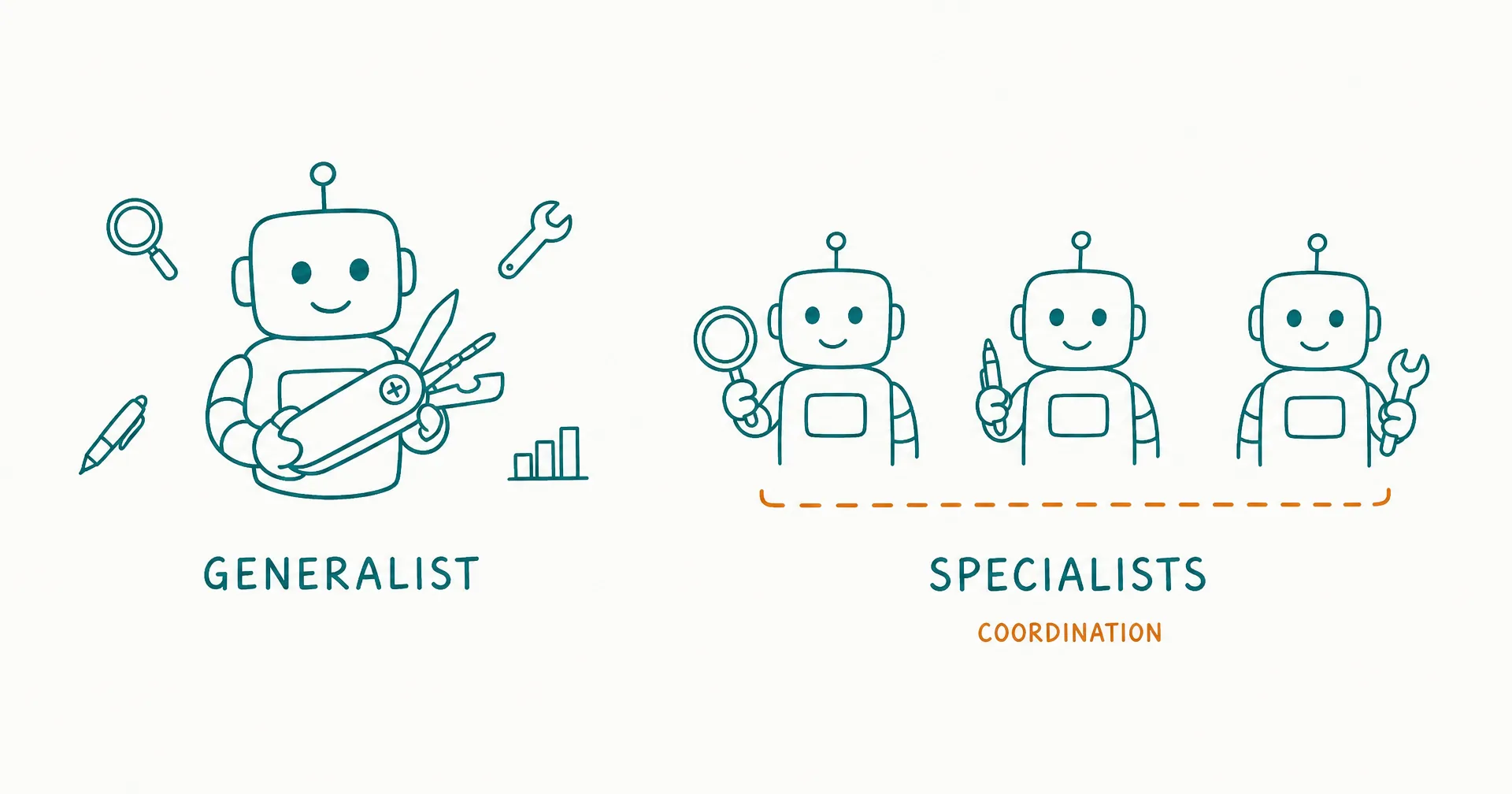
Choose a general-purpose AI agent when one owner needs to complete varied, connected work across research, analysis, documents, code, media, and business tools. Choose specialized AI agents when tasks repeat inside narrow boundaries, require different permissions or evaluation methods, or need independent execution and review.
The wrong comparison is “one smart agent versus many smart agents.” The real comparison is breadth inside one context versus separation across several operating contracts.
A generalist reduces routing and handoff work. A specialist reduces the scope of instructions, tools, data, and tests. Neither is inherently more reliable. Reliability depends on the task, authority boundary, context quality, evaluation design, and coordination overhead.
Use the 12-point AI employee platform framework for the vendor decision. First decide which architecture the platform must support.
On this page · 15 sectionsOpen
- What Is the Difference Between General-Purpose and Specialized AI Agents?
- When Does One General-Purpose Agent Fit Better?
- When Do Specialized AI Agents Fit Better?
- How Do the Architectures Compare Across 10 Operating Criteria?
- Why Does Context Become the Central Architecture Constraint?
- How Do Tools and Permissions Change the Choice?
- What Coordination Tax Do Specialized Agents Add?
- What Are the Four Most Useful Architecture Patterns?
- How Do Generalists and Specialists Affect Evaluation?
- What Does Each Architecture Cost?
- Which Failure Should Trigger an Architecture Change?
- How Would the Choice Change in Three Business Scenarios?
- How Does CellCog Fit the Architecture Choice?
- What Decision Tree Should You Use?
- Match Architecture Breadth to the Work
- Start with one general-purpose agent when the workflow is connected, task volume is moderate, one context improves decisions, and one owner can evaluate the complete outcome.
- Split into specialists when instructions collide, the agent repeatedly chooses the wrong tool, different tasks require different permissions or models, or independent review is valuable.
- More agents add delegation, context packaging, state synchronization, timeout, retry, reconciliation, and cost. Specialization must improve an observed failure enough to pay for those edges.
- Broad capability is not the same as broad authority. A general-purpose agent can use many tools while receiving read-only or approval-gated access to sensitive actions.
- Use a manager-specialist system only when work can be decomposed, capability can be matched, handoffs can be typed, and the manager’s synthesis can be evaluated.
- Match architecture breadth to task variance and evaluation capacity: if you cannot define a pass condition for each role and the combined outcome, do not add the role.
§ 01What Is the Difference Between General-Purpose and Specialized AI Agents?
A general-purpose agent is designed to handle a wide range of tasks, tools, data types, and output formats inside one operating loop. A specialized agent is constrained around a narrower role, workflow, domain, tool set, or success test.
A super-agent makes the stronger claim that broad planning, tools, modalities, state, verification, and recovery work together on one complete outcome. The term describes integrated breadth, while the choice below decides whether that breadth should stay inside one agent or be divided among specialists.
| Dimension | General-purpose agent | Specialized agent |
|---|---|---|
| Task scope | Varied and connected | Narrow and repeatable |
| Instructions | Broad policy with task-specific context | Focused role routine |
| Tools | Larger selectable catalog | Smaller approved set |
| Context | Shared across the complete job | Isolated to the specialty |
| Evaluation | End-to-end plus task slices | Role-specific tests |
| Coordination | Lower inside one run | Higher across roles |
| Failure isolation | Lower by default | Higher when boundaries are real |
| Adaptability | High for changing work | High inside known domain |
| Main risk | Context/tool confusion | Handoff and orchestration failure |
The names describe scope, not intelligence. The same underlying model can power both architectures.
General purpose describes capability breadth
A broad agent may research a market, analyze a spreadsheet, write a memo, create slides, update a task, and draft an email in one assignment.
That continuity can be valuable because the agent sees the original goal, evidence, intermediate decisions, and final artifact together. It does not need every transition translated into a new handoff.
Specialized describes an operating contract
A specialist has a narrower job:
- classify inbound requests;
- reconcile a ledger;
- inspect a contract;
- research an account;
- draft outreach;
- review claims;
- test code; or
- approve a defined quality gate.
The narrowness should affect tools, context, permissions, instructions, metrics, and escalation - not only the role name.
Multi-agent describes coordination
Multiple specialists form a system only when tasks, artifacts, and authority move between them. Three separate agents used independently are a catalog, not a team.
The architecture begins at the edge: who delegates, what state moves, who accepts, what happens on timeout, and who owns final closure.
§ 02When Does One General-Purpose Agent Fit Better?
One broad agent wins when the work benefits from continuity more than separation.
The task changes shape while it runs
Open-ended work often reveals its next step only after evidence arrives. A research task may become spreadsheet analysis, a document, a visual, and a presentation.
A general-purpose agent avoids predicting that entire path in advance. It can choose tools as the state changes.
Good examples include:
- investigate a market and produce a decision memo;
- review a campaign, identify weak segments, and create a revision;
- analyze an operating issue and build a dashboard;
- turn a product brief into copy, assets, and a launch checklist;
- inspect a repository, fix a defect, and verify the result; or
- prepare an executive briefing from email, documents, data, and web sources.
These are cohesive outcomes with heterogeneous steps.
One context improves the result
Context transfer is lossy. A handoff can omit a rejected hypothesis, source caveat, stakeholder preference, failed attempt, or constraint that matters later.
Keep one agent when the same evidence and decisions must remain visible across most steps. Split only if context can be reduced to a stable artifact without weakening the outcome.
Volume does not require parallelism
If one agent can complete the required workload inside the deadline, more agents may add no business value.
For a weekly report with 20 source checks, one broad agent may be easier to supervise than 5 specialists producing partial sections. Parallelism matters only if elapsed time, independent coverage, or capacity is a binding constraint.
One owner evaluates the complete work
A generalist is easier when the business already has one acceptance contract:
- figures reconcile;
- sources are current;
- required sections exist;
- conclusions follow evidence;
- prohibited claims are absent;
- artifact opens correctly; and
- supervisor approves distribution.
If one evaluator can judge the whole result, splitting may create redundant role-level tests.
§ 03When Do Specialized AI Agents Fit Better?
Specialize after the broad architecture exposes a repeatable boundary.
Instructions collide
One agent may be asked to be creative, conservative, concise, exhaustive, persuasive, skeptical, fast, and deeply sourced. Those modes can conflict.
Split when tasks need materially different behavior:
- research agent maximizes coverage and provenance;
- analyst enforces calculation and reconciliation;
- writer optimizes structure and voice;
- verifier challenges claims and citations;
- publisher checks format and permission.
The roles should exchange artifacts, not competing personalities.
Tool selection keeps failing
OpenAI’s current practical guide to building agents recommends maximizing a single agent first, then considering multiple agents when complex instructions or tool selection fail consistently. It also notes that more agents add complexity and overhead.
An observed tool-confusion pattern is a stronger split signal than an impressive architecture diagram.
Permissions need separation
A single broad agent can have many capabilities and still receive narrow authority. Sometimes stronger separation is required:
- researcher reads public sources but cannot access CRM;
- account agent reads approved CRM fields but cannot email;
- outreach agent receives an approved message and recipient;
- finance agent can prepare entries but not post or pay;
- reviewer can approve content but not alter source data.
Specialists can create distinct service identities, credentials, data scopes, and logs. This improves containment only when orchestration cannot bypass the boundary.
The AI employee permissions and approvals model defines the action envelope each specialist still needs.
Independent checks matter
Do not ask the same agent to produce a consequential answer and certify its own correctness using the same context and assumptions.
An independent verifier can use a separate rubric, sources, tool set, or model. Separation does not guarantee independence; copying the producer’s full output and execution record may anchor the reviewer on the same mistake.
Different models fit different work
Classification, extraction, drafting, vision, code, and high-stakes reasoning may have different cost, latency, and quality requirements.
A specialist architecture can route each role to a suitable model while keeping its evaluation stable. The benefit must exceed the orchestration and maintenance cost.
§ 04How Do the Architectures Compare Across 10 Operating Criteria?
Score the architecture against one defined workflow.
| Criterion | General-purpose advantage | Specialist advantage | Decisive test |
|---|---|---|---|
| Task variance | Absorbs changing steps | Optimizes recurring slices | How often does the path change? |
| Context | Preserves full history | Minimizes irrelevant context | What must cross the boundary? |
| Instructions | One policy surface | Fewer collisions per role | Which failures trace to instruction complexity? |
| Tools | Flexible selection | Smaller choice set | Does wrong-tool selection recur? |
| Permissions | One identity to govern | Stronger separation | Do tasks require incompatible authority? |
| Evaluation | End-to-end simplicity | Focused role metrics | Can each output be graded independently? |
| Parallelism | Limited within one loop | Concurrent execution | Is elapsed time a decision constraint? |
| Failure containment | Shared failure domain | Bounded role failure | Can one output contaminate the team? |
| Maintenance | Fewer components | Smaller local changes | How many prompts, tools, and interfaces change? |
| Cost | Less orchestration | Model/tool optimization | What is cost per accepted final outcome? |
The decisive test column turns preference into evidence. If the team cannot answer it, start simpler.
Use a weighted architecture score
For an illustrative 100-point score:
- end-to-end outcome quality: 20;
- evaluation clarity: 15;
- permission separation: 15;
- context integrity: 10;
- tool reliability: 10;
- coordination cost: 10;
- latency/capacity: 5;
- operating cost: 5;
- maintainability: 5;
- recovery: 5.
Change the weights before testing. A regulated workflow may assign 25 points to authority separation; a low-risk creative workflow may assign 5.
Keep knockout gates separate
Possible gates include:
- required credential isolation;
- prohibited data sharing;
- independent approval;
- complete trace correlation;
- deterministic financial calculation;
- maximum end-to-end latency; or
- one accountable final owner.
An architecture that fails a gate is not saved by broad capability.
Compare the same task pack
Run both options on:
- 10-20 ordinary cases;
- 3-5 hard cases;
- 3-5 boundary cases;
- 2-3 tool or source failures;
- at least 2 prohibited-action tests; and
- repeated trials where model variability matters.
These are evaluation-design examples, not universal sample-size rules. Expand the pack with workload diversity and consequence.
§ 05Why Does Context Become the Central Architecture Constraint?
Every architecture competes for a limited, changing context.
Generalists accumulate irrelevant history
A long-running generalist may carry research notes, tool results, intermediate drafts, policy, and feedback that no longer matter. More context can reduce focus and increase cost.
Anthropic’s context engineering guidance describes agent context as a finite resource that must be curated as the loop produces more state.
The generalist needs:
- relevance filtering;
- compact task state;
- source provenance;
- artifact references instead of repeated full content;
- explicit current decision;
- stable instructions outside transient history; and
- memory rules that prevent every observation from becoming durable.
Specialists lose implicit context
A specialist receives a package rather than the producer’s complete experience. The package must include what the role needs without importing noise or hidden authority.
At minimum, define:
- task ID and goal;
- requested output schema;
- relevant source/artifact references;
- decisions already made;
- constraints and prohibited actions;
- uncertainty;
- deadline and budget;
- acceptance tests;
- reply destination; and
- escalation route.
If the next role cannot act from this packet, the boundary is not ready.
Shared memory can spread error
Giving every agent read/write access to one memory store reduces handoff work and increases contamination risk. A false fact or malicious instruction can influence the full team.
Prefer role-specific working memory, approved shared sources, explicit artifact handoffs, provenance, write controls, and correction propagation. Do not treat conversational history as the organization’s source of truth.
§ 06How Do Tools and Permissions Change the Choice?
Capability breadth and authority breadth must be designed separately.
One agent can have a large catalog and narrow active access
A general-purpose platform may expose 50 tools, while a specific role is allowed to use 6 and can execute only 2 without approval.
Design access by:
- role;
- environment;
- system;
- object;
- operation;
- data class;
- recipient;
- value or volume;
- time;
- condition; and
- approval.
Do not place the complete control in natural-language instructions if identity, connector, or policy enforcement can carry it.
Specialists can create real blast-radius boundaries
A specialist improves containment when:
- it uses a separate identity;
- it has fewer tools;
- it receives minimized data;
- it cannot call the orchestrator’s privileged tools;
- its output is treated as untrusted input;
- its budget and recursion are capped; and
- its actions appear in correlated logs.
OWASP’s AI Agent Security Cheat Sheet identifies cascading failure, prompt injection, privilege escalation, memory poisoning, excessive autonomy, and unbounded tool-chain cost as multi-agent risks. More roles can increase rather than reduce the attack surface.
The manager must not become a privilege bridge
A manager agent may need access to specialist capabilities but should not silently inherit every specialist’s credentials.
Separate:
- authority to assign a task;
- authority to provide data;
- authority to approve the returned work;
- authority to execute an external action; and
- authority to change the role itself.
The manager’s broad view is not a reason for universal execution access.
§ 07What Coordination Tax Do Specialized Agents Add?
Coordination is real work with measurable failure modes.
| Coordination edge | Required mechanism | Failure if missing | Metric |
|---|---|---|---|
| Discover capability | Role/capability description | Wrong specialist selected | Misroute rate |
| Delegate | Typed task packet | Ambiguous goal or scope | Clarification rate |
| Accept | Explicit task acknowledgment | Work has no owner | Unaccepted-task age |
| Execute | Bounded tool and budget policy | Runaway action or cost | Cap breach rate |
| Update | Durable state event | Manager guesses progress | Stale-state rate |
| Deliver | Versioned artifact | Result lost in chat | Artifact retrieval rate |
| Review | Independent acceptance rubric | Partial work called complete | False-completion rate |
| Retry | Idempotent retry policy | Duplicate or looping work | Duplicate/retry rate |
| Escalate | Named exception route | Failure waits indefinitely | Escalation response time |
| Close | Final owner and evidence | Task remains logically open | Reopen rate |
A 4-agent linear workflow has at least 3 handoff edges before review and rework. A manager with 5 specialists may have 5 delegation edges plus return, clarification, retry, and review events.
Calculate coordination-adjusted quality
Accepted system outcomes = started outcomes × completion rate × handoff integrity × final acceptance rate
Illustrative example:
- 100 outcomes start;
- 95% complete;
- 92% preserve required context across handoffs;
- 90% pass final acceptance.
100 × 0.95 × 0.92 × 0.90 = 78.66 accepted outcomes
The system can have strong role-level scores and still lose more than 21 outcomes across the chain.
Price the edge
For each handoff, count:
- packaging tokens and compute;
- queue and network latency;
- artifact storage;
- manager review;
- retries;
- duplicate work;
- reconciliation;
- monitoring;
- incident investigation; and
- maintenance of the interface and tests.
Cost per specialist output is not cost per accepted final outcome.
Add specialists only against named failures
Use this split record:
| Field | Required decision |
|---|---|
| Observed failure | Exact repeated failure in the current architecture |
| Proposed boundary | Work that moves to the specialist |
| Expected mechanism | Why smaller context/tools/instructions should help |
| Added edge | New delegation and return path |
| Success threshold | Outcome or risk improvement required |
| Cost ceiling | Maximum added run and operating cost |
| Rollback | How to return to one agent |
If the proposal cannot name the observed failure, specialization is speculative architecture.
§ 08What Are the Four Most Useful Architecture Patterns?
Most business systems fit one of 4 patterns.
Pattern 1: one broad agent
One agent owns the complete outcome and uses tools directly.
Best for:
- connected work;
- moderate volume;
- shared context;
- low-to-medium consequence;
- one evaluation owner; and
- evolving task paths.
Avoid when incompatible permissions or independent verification are mandatory.
Pattern 2: router plus specialists
A router classifies the request and sends it to one specialist. The specialist owns completion.
Best for:
- distinct request categories;
- high repeated volume;
- small, stable classification schema; and
- minimal cross-role synthesis.
The router should return low-confidence or out-of-scope cases instead of forcing a destination.
Pattern 3: manager plus specialists
A manager decomposes work, delegates sub-tasks, tracks state, reviews outputs, and synthesizes the final result.
OpenAI’s guide describes a manager pattern where a central agent controls workflow and uses specialized agents as tools. Anthropic’s multi-agent research system describes an orchestrator-worker architecture in which a lead agent delegates research directions to parallel subagents and combines their findings.
This pattern fits tasks where parallel exploration or specialist depth materially improves results. It adds manager evaluation, delegation, and synthesis risk.
Pattern 4: deterministic workflow with agent steps
Code or workflow state controls the sequence; one or more agents handle only the ambiguous steps.
Best for:
- known process states;
- strict order;
- transactional systems;
- deterministic validation; and
- narrow judgment islands.
Do not use an autonomous manager to rediscover a process the business can specify reliably.
§ 09How Do Generalists and Specialists Affect Evaluation?
Architecture should follow what the team can test.
Evaluate a generalist at two levels
Use:
- component tests for tool selection, extraction, calculation, format, and policy; and
- end-to-end tests for the accepted business artifact or action.
A generalist can pass individual tool tests and fail the overall decision. It can also take an unexpected valid path that static step matching would wrongly reject.
Evaluate specialists at three levels
Use:
- role output tests;
- interface and handoff tests; and
- system outcome tests.
Role scores cannot substitute for system evaluation. A researcher may produce excellent sources that the writer never receives, or a verifier may identify errors that the manager ignores.
Anthropic’s current agent-evaluation guide recommends combining code-based, model-based, and human graders according to what must be measured, and retaining complete execution records for diagnosis.
Preserve failure attribution
Every run should record:
- architecture and role versions;
- task and parent task IDs;
- model and tool versions;
- input and source references;
- delegation packet;
- acceptance or rejection;
- artifact version;
- retries and timeouts;
- policy decisions;
- final outcome; and
- human correction.
Without correlation, adding agents can make root cause less visible.
§ 10What Does Each Architecture Cost?
Generalist and specialist economics differ by both run cost and operating cost.
| Cost layer | General-purpose agent | Specialist system |
|---|---|---|
| Model usage | Larger context; mixed task difficulty | Model can be matched per role |
| Tool usage | Broader catalog and selection | Narrower catalog per role |
| Orchestration | Lower | Delegation, status, and synthesis |
| Evaluation | Broad suite | Role + interface + system suites |
| Operations | Fewer services and alerts | More components and correlated traces |
| Review | One end-to-end output | Partial reviews plus final review |
| Failure | Shared context can contaminate result | Edge failures can compound |
| Maintenance | One broad prompt/policy | Multiple roles and interface contracts |
The monthly invoice may show model and platform consumption. Your TCO must add setup, evaluation, review, correction, monitoring, and expected failure.
Use accepted-system-outcome cost
Architecture cost per accepted outcome = total architecture cost ÷ accepted final outcomes
Do not divide a multi-agent bill by completed sub-tasks. Ten specialist artifacts may produce one accepted customer deliverable.
Include latency
For parallel specialists:
Elapsed time ≈ manager setup + slowest required specialist + synthesis + review
For sequential specialists:
Elapsed time ≈ sum of each role + queues + handoffs + review
Parallelism helps only when the work is genuinely independent and the slowest branch does not dominate.
Use the complete ownership model
The build-versus-buy AI employee guide asks who owns orchestration, tools, memory, evals, security, observability, response, and exit. Apply that question after choosing generalist or specialist shape; architecture and sourcing are separate decisions.
§ 11Which Failure Should Trigger an Architecture Change?
Do not redesign the system after one bad result. Diagnose repeated failure across representative cases and ask whether the cause is actually architectural.
| Observed failure | Likely architectural cause | First repair | Split only if |
|---|---|---|---|
| Wrong tool selected | Catalog or instruction ambiguity | Improve tool names, schemas, examples, and allowed set | Error recurs across the eval pack |
| Important evidence forgotten | Context overload or weak state | Compact state; reference artifacts; improve retrieval | A stable handoff preserves the necessary subset |
| Inconsistent output format | Weak schema or validation | Add structured output and deterministic checks | A specialist owns a genuinely distinct artifact |
| Unauthorized action attempted | Authority not enforced outside prompt | Narrow credentials and enforce policy | Incompatible duties need separate identities |
| Reviewer repeats producer error | Non-independent evaluation | Use separate rubric, sources, or model | Independent verifier materially catches errors |
| Deadline missed | Sequential work or overloaded loop | Remove unnecessary steps; cache; optimize tools | Parallel tasks are independently executable |
| Cost spikes | Long context, retries, or expensive model | Cap loops; route simple steps; reduce context | Stable sub-tasks benefit from cheaper models |
| Final artifact is incoherent | Weak synthesis or too many fragments | Reduce delegation; keep one owner | Specialists improve components without fragmenting voice |
| Errors spread across roles | Shared memory or trust boundary | Isolate state; validate inter-agent input | Separation creates enforceable containment |
| Nobody owns completion | Implicit delegation state | Add accept, status, return, and close states | A manager can be evaluated as the accountable coordinator |
The first repair column matters. Many “we need multiple agents” failures are really poor tool definitions, missing schemas, over-broad permissions, or undefined acceptance.
Wrong-tool errors need a confusion matrix
Record the intended tool and selected tool for every failure. A confusion matrix shows whether errors cluster around 2 overlapping tools or reflect broad reasoning problems.
Before splitting the role:
- rename tools around the business action;
- remove duplicate interfaces;
- write precise schemas and parameter descriptions;
- supply positive and negative examples;
- hide tools irrelevant to the active task;
- validate parameters before execution;
- require approval for risky choices; and
- rerun the same cases.
If the same pair remains confused, one specialist with a smaller catalog may be justified. If failures move randomly, the root cause may be source ambiguity or model capability instead.
Context failures need an ablation test
Run the same task with:
- complete accumulated context;
- compact task state plus artifact references;
- only the proposed specialist handoff packet; and
- handoff packet plus one omitted information category restored.
Compare acceptance, missing facts, contradictions, latency, and cost. This reveals whether specialization improves focus or merely discards necessary information.
The test also defines the minimum viable packet. Do not create an agent interface from intuition when an ablation can show which fields matter.
Permission failures need enforcement, not another persona
Creating “Research Agent” and “Publisher Agent” names does not separate authority if both use the same authenticated browser session or service account.
Require:
- distinct identities where separation matters;
- explicit object and operation scope;
- short-lived credentials where supported;
- approval bound to exact action parameters;
- denial logging;
- central revocation;
- no credential forwarding in messages; and
- a test proving the researcher cannot publish.
Specialization is security only when the system enforces it.
Review failures need independence
A reviewer is not independent merely because it has a different role prompt. It may share the same faulty source, hidden assumption, model bias, or producer framing.
Increase independence by varying:
- source set;
- evaluation rubric;
- model or method;
- context exposure;
- calculation path;
- tool access; and
- order of review.
Measure net error detection and false rejection. A reviewer that rejects 20 correct outputs to catch 1 error may create more operating cost than value.
Coordination failures may require consolidation
Multi-agent teams can become less reliable as roles are added. If clarification, timeout, lost artifact, duplicate work, and inconsistent synthesis rise faster than specialist quality, merge roles.
A consolidation record should name:
- roles being merged;
- interfaces being removed;
- context that will become shared;
- permissions that must remain separated;
- system tests affected;
- expected latency and cost change; and
- rollback path.
Architecture maturity includes removing agents that do not earn their edge.
§ 12How Would the Choice Change in Three Business Scenarios?
Use scenarios to expose the boundary between cohesive work and repeatable specialization.
Scenario 1: weekly growth review
The outcome is a Monday report that reconciles analytics, advertising, CRM, experiments, and campaign artifacts.
| Factor | Evidence | Architecture implication |
|---|---|---|
| Task variance | Questions change with performance | Favors a generalist |
| Shared context | Channel evidence affects conclusions together | Favors a generalist |
| Authority | Read data; draft report; no budget change | One bounded identity can fit |
| Evaluation | Figures reconcile; sources linked; actions trace to evidence | End-to-end rubric is feasible |
| Volume | One report each week | Parallel capacity is unnecessary |
| Specialist opportunity | Deterministic reconciliation | Use code/checks, not necessarily another agent |
Start with one general-purpose analysis employee. Add a separate verifier only if source reconciliation or claim review repeatedly fails and the verifier’s independent method catches the error.
Scenario 2: inbound customer-support queue
The outcome is correct routing, grounded answers, safe account actions, and timely human escalation across thousands of conversations.
| Factor | Evidence | Architecture implication |
|---|---|---|
| Task variance | Stable intent families with exceptions | Router plus specialists may fit |
| Permissions | Billing, account, technical, and refund actions differ | Favors separated authority |
| Volume | Parallel queue capacity matters | Favors specialists |
| Evaluation | Each intent has policy and resolution criteria | Role-specific suites are feasible |
| Handoff | Escalation must preserve transcript and attempted actions | Typed packet required |
| Final owner | Case owner must remain explicit | Router cannot abandon task after classification |
Use deterministic intent rules where confidence is high, specialist agents for bounded resolution categories, and human takeover for policy exceptions or consequential actions. A universal support agent may still handle low-risk knowledge questions.
Scenario 3: board-level acquisition research
The outcome is a cited market, financial, product, customer, risk, and integration assessment under a fixed deadline.
| Factor | Evidence | Architecture implication |
|---|---|---|
| Breadth | Several independent research domains | Favors parallel specialists |
| Deadline | Work can proceed concurrently | Multi-agent speed has value |
| Independence | Cross-checking can reduce blind spots | Separate research directions help |
| Synthesis | Claims must form one investment view | Strong manager required |
| Risk | Sources and uncertainty must survive handoff | Artifact and provenance contract required |
| Evaluation | Section quality plus final thesis coherence | Three-level evaluation required |
A manager-specialist pattern can fit. The manager should not merely concatenate 6 reports. It must resolve conflicts, preserve uncertainty, request follow-up where evidence is thin, and produce one traceable decision artifact.
What the scenarios show
The architecture changes with 5 variables:
- how often the path changes;
- how much context must remain shared;
- whether authority must be separated;
- whether parallelism changes the deadline; and
- whether each boundary has a reliable acceptance test.
Industry label alone is not enough. A marketing workflow can be generalist or specialist; a support workflow can be deterministic, agentic, or human depending on the specific action and consequence.
§ 13How Does CellCog Fit the Architecture Choice?
CellCog publicly supports both broad execution and standing specialist roles.
The Super-Agent is the general-purpose surface
CellCog’s Super-Agent is described as one agent that can research, analyze data, write code, and create documents, presentations, spreadsheets, images, video, audio, dashboards, web applications, diagrams, and 3D artifacts.
This breadth fits heterogeneous deliverables. Buyers should evaluate the exact modes, tools, sources, cost, and acceptance criteria their task uses. A long capability list does not prove every combination.
AI Employees are role-specific operating surfaces
CellCog AI Employees use the same broad base but add standing roles, goals, KPIs, permissions, inboxes, schedules or wake conditions, task state, memory, handovers, approvals, and delegation.
That means “specialist” can be created through an operating contract even when the underlying capability is general. A content writer and a data analyst should not receive the same sources, credentials, instructions, evaluation, or approval boundary merely because they share a base.
Agent modes add another dimension
CellCog publicly describes Agent, Agent Core, Agent Team, and Agent Team Max modes. Higher team modes use multiple agents for research, debate, cross-checking, and synthesis, with different credit minimums.
Treat mode choice separately from role architecture. A single AI Employee may use a multi-agent execution mode for one hard task; an organization may also contain several persistent AI Employees. One is within-task execution, the other is durable role coordination.
The AI organization design guide owns that second layer: accountable roles, reporting and delegation edges, shared sources, task state, escalation, human oversight, incident containment, and organization-level economics.
First-party proof needs correct scope
As of July 2026, CellCog’s DeepResearch benchmark page reported CellCog Max at rank #1 with a 55.78 overall score under a GPT-5.5 judge. That is evidence for one named research benchmark and date, not proof that a team architecture is best for every business role.
Verify the current CellCog benchmark page before publication or purchase, then run your own representative role pack.
§ 14What Decision Tree Should You Use?
Start from the task, not the product label.
Choose one general-purpose agent if all are true
- the outcome is cohesive;
- steps change with evidence;
- context should remain shared;
- one authority envelope is acceptable;
- workload fits the deadline;
- one owner can evaluate the result; and
- observed tool or instruction failures do not justify a split.
Choose specialists if at least one strong signal exists
- tasks have stable, separable interfaces;
- instruction collisions recur;
- wrong-tool selection recurs;
- distinct credentials or data scopes are required;
- independent verification is valuable;
- different models materially improve cost or quality;
- parallel execution changes the business deadline; or
- volume requires separate capacity.
Then prove that the expected improvement exceeds coordination tax.
Choose deterministic orchestration if process order is known
Use code or workflow state when:
- states and transitions are stable;
- validation can be deterministic;
- actions have financial or record consequences;
- retry and idempotency must be explicit; or
- the agent’s only job is judgment inside one step.
Autonomy should handle ambiguity, not replace known controls.
Stay with humans when the evaluation is undefined
Do not automate role ownership when the team cannot define:
- authoritative sources;
- acceptable output;
- prohibited outcome;
- authority boundary;
- escalation;
- evidence;
- consequence; and
- accountable owner.
Architecture cannot repair an undefined job.
§ 15Match Architecture Breadth to the Work
Start with one bounded agent. Keep it while continuity, low coordination, and end-to-end evaluation are more valuable than separation. Add a specialist only when a named failure, permission boundary, evaluation advantage, capacity need, or independent check justifies the edge.
To evaluate breadth, run the same representative task in CellCog’s Super-Agent and a configured CellCog AI Employee role. Compare accepted outcomes, wrong-tool selections, reviewer time, permission behavior, context loss, latency, and total cost. The winning architecture is the smallest one that passes the complete outcome and control contract.
Q1Are specialized AI agents more accurate?
They can be more consistent on narrow tasks because instructions, tools, context, and tests are smaller. They can also reduce total accuracy through routing, handoff, synthesis, or shared-state failures. Measure accepted final outcomes, not only specialist scores.
Q2Is a general-purpose agent the same as an AI employee?
No. General purpose describes capability breadth. An AI employee describes a standing role with recurring responsibility, state, authority, evaluation, and supervision. A general-purpose base can power one specialized AI employee or several distinct roles.
Q3How many specialist agents should a team use?
Use the fewest roles that resolve observed failures or create necessary separation. Start with one agent, add one boundary at a time, and retain the ability to roll back. Agent count is not a maturity metric.
Q4Can one agent manage specialized agents?
Yes, when the manager can decompose tasks, match capability, track state, evaluate returned artifacts, and escalate exceptions. The human remains accountable for the organization’s authority and outcome unless another binding responsibility model exists.
Q5Should specialists share the same memory?
Not by default. Give each role the minimum working context, use approved shared sources, pass versioned artifacts, and control shared-memory writes. Broad shared memory can improve continuity and spread stale, confidential, or malicious content.
Q6Which CellCog option fits a general-purpose workflow?
The CellCog Super-Agent is the broad on-demand surface, while AI Employees add persistent roles and recurring operation. Test the exact workload, mode, tools, permissions, acceptance, and cost before deciding.