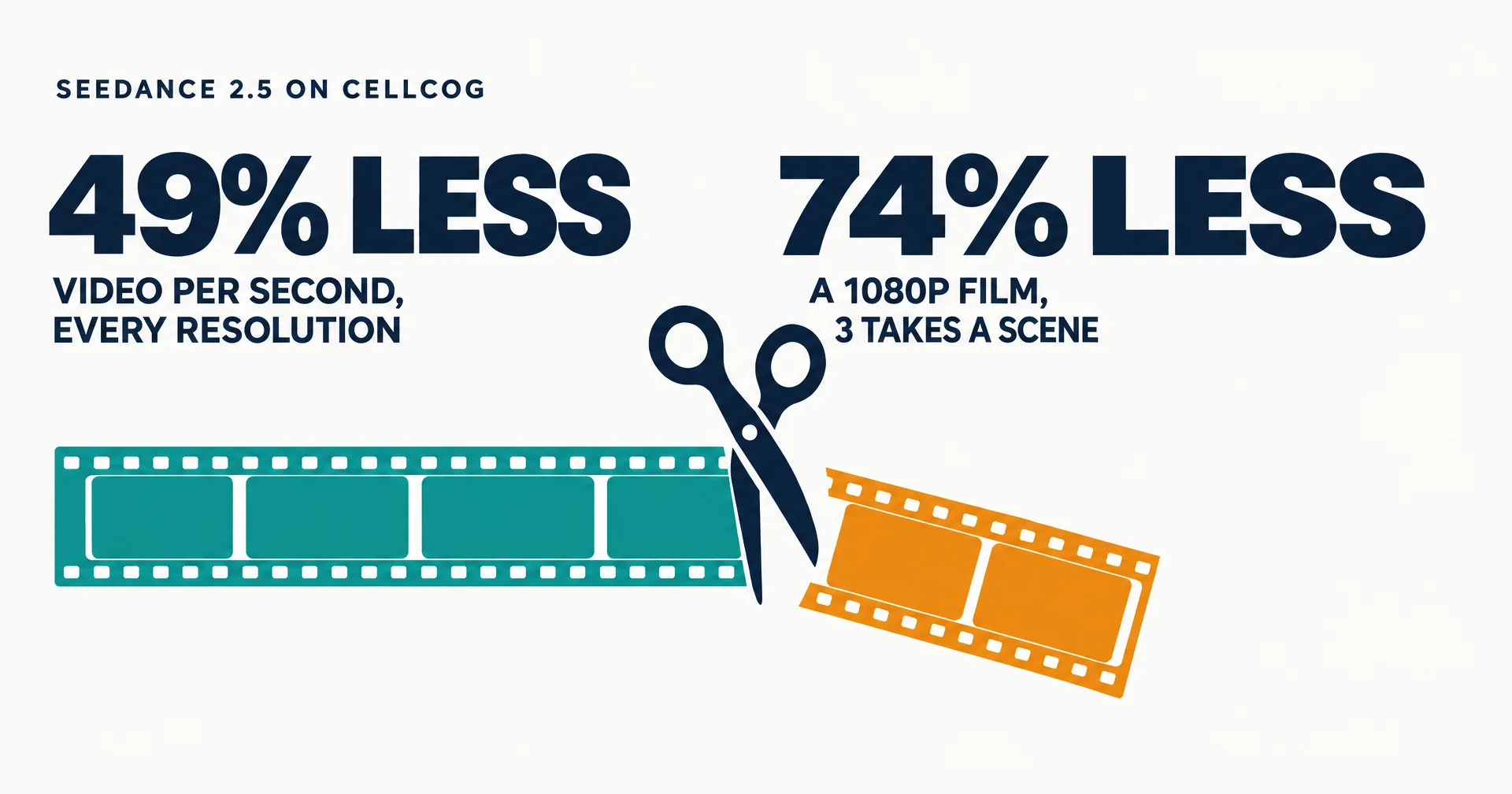
Video generation on CellCog now costs 49% less per second. Since October 15, 2026, every Seedance 2.5 render at 480p, 720p and 1080p costs about half what it did, from the very first shot. It is the same model with the same output: we moved it to a cheaper host, and because CellCog credits follow what the work costs us, the whole saving passes to you.
The second change matters more for anyone making real films: drafts. Your AI employee can now render a 480p draft, let you judge the take, and then finish that exact take at 1080p. Together, the two changes cut the cost of a 1080p film by about three quarters.
On this page · 7 sectionsOpen
 Video generation with Seedance 2.5 on CellCog now costs 49% less per second at 480p, 720p and 1080p, from the very first shot. Same model, same output.
 New drafts: ask for a 480p draft, judge the take, then finish that exact take at 1080p. Same composition, motion and audio, not a new roll of the dice.
 A 1080p final now costs 39% less than before when the first take is the keeper, 65% less on the second take and 74% less on the third.
 A two-minute 1080p film, eight scenes at three takes each, costs about 74% less than the same film did before.
 A draft stays valid for 7 days in the chat that made it. Your AI employee decides when a draft is worth it and quotes the finish before it renders.
 Fictional characters work as references again: photoreal, painted or illustrated faces, so a character stays the same across a long film.
§ 01Half price, from the first shot
If your habit was 720p, you now pay about half. If you rendered 1080p finals directly, those cost about half too. Nothing about the clip changes: Seedance 2.5 still generates 4 to 30 seconds at 24 fps with audio included, from up to 50 reference images, videos and audio clips (BytePlus ModelArk docs). For how every API and platform prices the model, see our market read, Seedance 2.5 pricing compared.
A backup host takes over automatically if the main one is briefly down, so a job does not fail because one provider had a bad minute.
§ 02Drafts: judge the take, then finish that same shot
Video generation is a roll of the dice. Before this change, the only way to a 1080p final was to render at 1080p, and every re-render rolled a new take. A scene that needed three tries meant paying for three full 1080p renders.
A draft breaks that. It renders at 480p and costs what any 480p render costs, a little under a fifth of the 1080p finish. You look at it. If the take is wrong, you draft again cheaply. When a take is right, the finish renders the identical shot at 1080p: same composition, same motion, same audio.
| Draft | Finish | |
|---|---|---|
| Resolution | 480p | 1080p, 24 fps |
| Cost | Same as any 480p render | Same as rendering that shot at 1080p directly |
| What you get | A take you can judge | The same take, at full resolution |
| Locked | Prompt, references, duration, aspect ratio, seed, audio | Inherited from the draft |
| Valid | 7 days, in the chat that made it | Not applicable |
The honest part: if the very first take is the keeper, draft plus finish costs about 18% more than going straight to 1080p at today’s price. Drafts pay off from the second take on, and most scenes in a real film take more than one try.
§ 03What a 1080p final costs now
Here is a 1080p final made with drafts today, compared with rendering every attempt at 1080p before this change.
| The keeper is the | Before: 1080p renders | Now: drafts, then one finish | Saving |
|---|---|---|---|
| 1st take | 1 | 1 draft + 1 finish | 39% |
| 2nd take | 2 | 2 drafts + 1 finish | 65% |
| 3rd take | 3 | 3 drafts + 1 finish | 74% |
| 5th take | 5 | 5 drafts + 1 finish | 80% |
For a longer piece, the numbers compound. A two-minute film at 1080p, built from eight scenes with three takes each, costs about 74% less than the same film did before. That is where long-form video makers feel it most: the more a scene takes to get right, the bigger the saving.
§ 04Your AI employee decides when to draft
You do not have to learn a new step. We ran a blind test on Agent Core with a plain request: a short coffee-shop clip, and “show me something to approve before the 1080p final”. The request never mentioned drafts. The agent made a draft on its own, told us what the finish would cost, and when we said approve, delivered the same take at 1080x1920.
A few rules it follows:
- Drafts are for 1080p finals. For a 720p deliverable it renders 720p directly, now at half the old price.
- A draft is made at the final length, because duration is locked at the draft.
- It quotes the finish before rendering it, and a draft expires after 7 days in the chat that made it.
§ 05Also back: fictional characters as references
Character references of fictional people work again: photoreal, painted or illustrated faces, so a character stays the same from the first scene of a long film to the last. For real people, your own likeness works; anyone else needs their consent; public figures and minors are never allowed.
§ 06Caveats
- The percentages compare our price today with our price before October 15, 2026, for 16:9 clips without a reference video. Jobs with reference video bill differently, and the saving can differ.
- If the main host is down, a job runs on the backup at the old price, and the backup refuses face references; the agent tells you and retries.
- Plans and credit rates live on cellcog.ai/pricing. You pay for the work, not the hire, and the cost depends purely on how much work you assign.
§ 07Sources
- ByteDance Seed, Seedance 2.5 model page, read October 15, 2026.
- BytePlus, ModelArk Seedance 2.5 tutorial, read October 15, 2026.
- Replicate, Seedance 2.5 public API listing, read October 15, 2026 (the model’s public spec, not our host).
- CellCog, Seedance 2.5 pricing: every API and platform compared, updated October 14, 2026.
- CellCog, Seedance 2.5 makes full films from one prompt.
- CellCog price rows for Seedance 2.5 before and after the change, read October 15, 2026, 03:15 UTC.
Q1Is this the same model?
Yes. It is still ByteDance’s Seedance 2.5 with the same output. We moved it to a cheaper host, and because credits follow what the work costs us, the saving goes straight to you.
Q2Do I have to ask for a draft?
No. Your AI employee decides on its own when a draft is worth it. In a blind test, a plain request to see something before the 1080p final got a draft, a quoted finish price, and on approval the same take at 1080p.
Q3What is locked when I make a draft?
The prompt, references, duration, aspect ratio, seed and audio. Change any of them and it is a new draft, so draft at the final length.
Q4Should I use drafts for a 720p video?
No need. Drafts are for 1080p finals. For a 720p deliverable, render at 720p directly; it now costs about half what it did.
Q5Where can I see what a video costs?
Your AI employee quotes the finish before it renders, and plans and credit rates are on cellcog.ai/pricing. You pay for the work, not the hire, and the cost depends on how much work you assign.