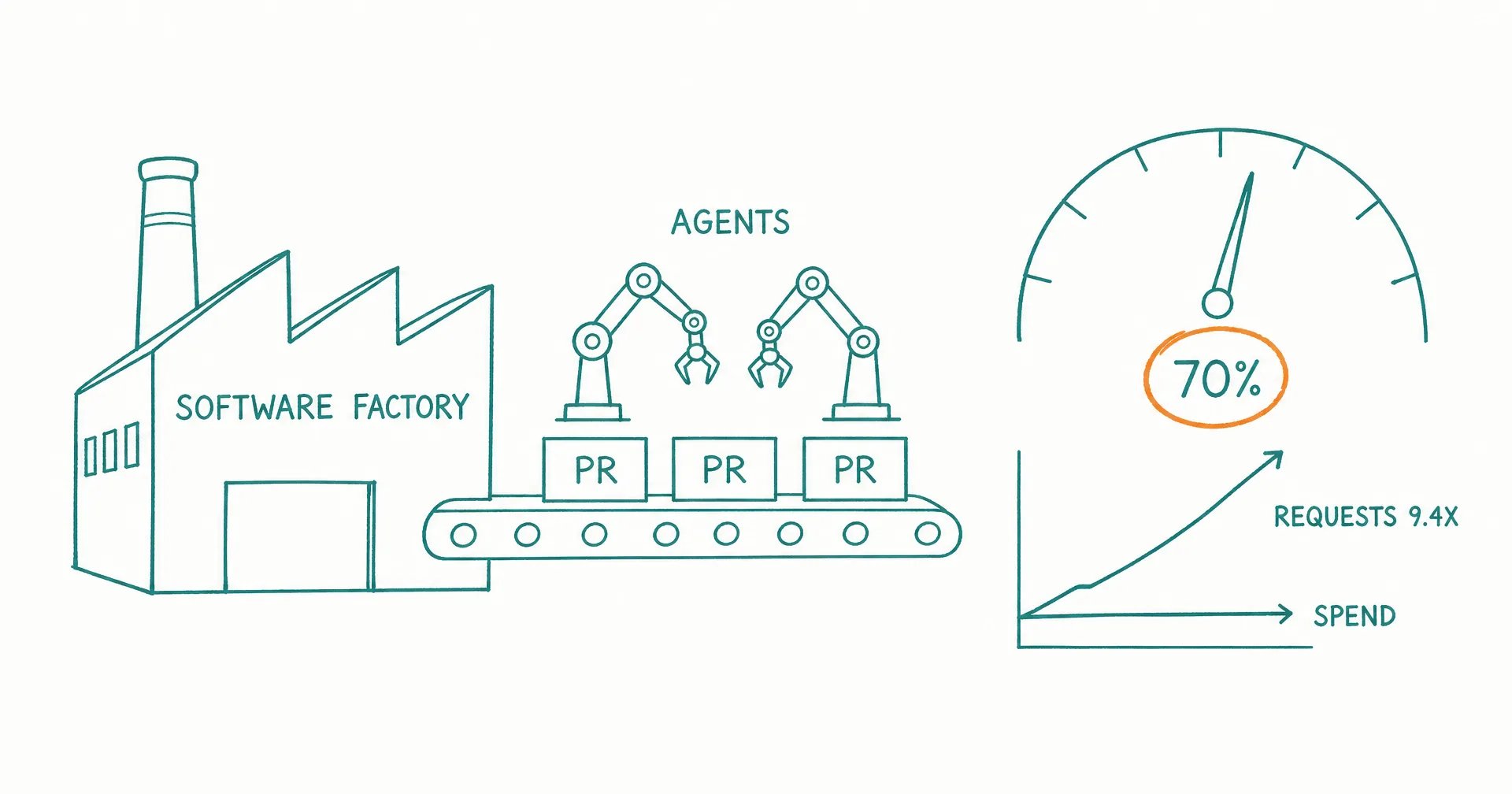
On August 27, 2026, Uber published the most concrete numbers any large enterprise has put on record about AI agents doing production work. In Uber’s own words: more than 70% of pull requests are attributed to local or cloud agents, employees have built over 3,600 agent skills across the software development lifecycle, and those skills execute more than 30,000 times per day.
The headline number will travel alone, so here is the full picture with its context intact: what Uber actually measured, how it kept the bill flat while usage grew nearly 10x, the honest caveats in its own wording, and what the whole thing means if you do not have Uber’s platform team. Everything below is sourced from Uber Engineering’s post, “Running a Software Factory Efficiently at Uber Scale,” by Distinguished Engineer Uday Kiran Medisetty.
- On August 27, 2026, Uber Engineering published its software factory numbers: more than 70% of pull requests are attributed to local or cloud agents, employees have built over 3,600 agent skills, and agents execute 30,000+ skill runs per day.
- From February to mid-August 2026, weekly active users of Uber’s agentic tools grew 7x and weekly agent requests grew 9.4x - while total AI spend has been relatively stable since April.
- Holding one model constant to isolate real optimization gains, cost per 1,000 model requests fell almost 34% from its peak and cost per session fell 52% from its June peak.
- A growing share of sessions are not started by humans: managed agents handle code review, self-healing CI failures, end-to-end PRs with visual validation, on-call alert triage, bug debugging, and code maintenance, with human reviews and escalations.
- The playbook is a cost equation optimized term by term: benchmark-driven model routing, cheaper default models for subagents, prompt caching tuned to real idle gaps, tool schemas kept out of context, code-mode batching that cuts tokens 50-90%, and a 24M-node context graph that stops agents searching.
- The honest caveat is in Uber’s own wording: PRs are ‘attributed to’ agents, with human reviews and escalations - this is agents driving the work, not 70% of code shipping unreviewed.
- The strategic read: the operating model Uber built in-house - skills, managed agents, outcome-denominated cost, human escalation - is exactly the shape of the AI-employee category.
§ 01The numbers
| Metric | Value |
|---|---|
| Pull requests attributed to agents | More than 70% |
| Employee-built agent skills | 3,600+ |
| Agent skill executions | 30,000+ per day |
| Weekly active users growth (Feb to mid-Aug 2026) | 7x |
| Weekly agent requests growth (same window) | 9.4x |
| Total AI spend | Relatively stable since April |
| Cost per 1,000 model requests (model held constant) | Down ~34% from peak |
| Cost per session (model held constant) | Down 52% from June peak |
Two things make these numbers unusually credible as enterprise-AI evidence. First, they are operational, not survey-based: this is Uber counting its own pull requests, not executives estimating adoption. Second, the post is transparent about methodology - the cost reductions are measured with one model held fixed, precisely because model upgrades would otherwise pollute the comparison.
§ 02What a software factory actually is
The phrase is Uber’s, and the interesting part is what runs inside it. A growing share of sessions are not initiated by humans at all. Managed agents - Uber’s term for agents that own a recurring job - handle AI code review on all pull requests, self-heal failing CI jobs, complete end-to-end PRs with visual validation, triage on-call alerts, debug incoming bugs, and do code maintenance. Humans review and take escalations.
That sentence describes a workforce, not a tool. Each managed agent has a job, a benchmark built from its real work, quality metrics (revert rate, F1, time to resolution), and - the most transferable idea in the whole post - outcome-denominated cost: cost per merged PR, cost per review, cost per triaged alert. Uber does not ask what a million tokens costs; it asks whether each agent is getting cheaper per unit of value delivered, and whether quality holds when models change.
§ 03How the bill stayed flat while usage grew 9.4x
The post decomposes agent spend into six multiplying terms and attacks each one. The levers, compressed:
Route models by benchmark, not by habit. Every managed agent gets a benchmark built from its real work, runs on a harness that can serve any model behind one interface, and moves to whatever is Pareto-optimal on cost per completed task, quality, and reliability. Uber’s example: switching the model behind its code-review agent improved F1 while dramatically cutting cost per review. Subagents - which do well-defined subtasks - default to a weaker, cheaper model while the primary model decomposes and evaluates.
Stop paying for idle context. Prompt-cache reads cost a tenth of full-price input, but engineers idle longer than the default 5-minute cache window, so Uber moved interactive sessions to 1-hour cache TTLs and kept subagents at 5 minutes. Compaction triggers at 400K tokens even on million-token models, and reasoning effort defaults to medium.
Keep tool schemas out of the context window. Loading 100+ tool definitions added 50-70K tokens to every session before the user typed anything. Uber routes all 1,000+ MCP servers through one gateway, exposes them as CLI commands resolved at call time, and lets agents search the tool catalog instead of carrying it.
Batch tool calls as code. Under turn-by-turn tool use, one SQL query means a request, several polls, and a retrieval, each landing in context. Code-mode runs the loop in a subprocess and returns only the summary: 50-71% token savings on trivial queries, effectively 100% on wide result sets, compounding past 90% on bulk workflows.
Ground agents so they stop searching. Uber built a context graph - 24 million nodes and 80 million edges across 30+ internal systems - that any agent can query in natural language. Its own comparison: a grounded agent answered a data question in 38 seconds; the ungrounded one spent 20 minutes, spawned two subagents, hit three errors, and concluded wrongly that the data did not exist. An ungrounded agent fails slowly rather than cheaply.
Make cost visible instead of capped. A live cost counter in the status line, shared spend tiers with manager sign-off for upgrades, alerts at 50/80/100% of expected spend, and a session-analysis dashboard - nudges over hard caps.
§ 04The honest read
Three caveats belong next to the headline. First, “attributed to” is doing real work in that 70% figure: it measures agent involvement in pull requests, with human reviews and escalations explicitly in the loop - not 70% of code shipping unreviewed. Second, every number is Uber’s own, from its own telemetry, and the post itself says specific cost reductions are unique to its environment. Third, the playbook rides on infrastructure most companies will never build: internal benchmarks from real PRs, a multi-model harness, an MCP gateway, a 24-million-node graph. The methodology is universal; the magnitudes are not.
None of that shrinks the significance. This is a top-20 engineering organization stating that agents are now the default participants in its production pipeline, and that the constraint was never capability - it was operating discipline: skills, benchmarks, routing, grounding, and cost per outcome.
§ 05What this means if you are not Uber
A disclosure: we build CellCog, an AI employee platform, so we have a stake in this reading. But look at what Uber actually built, because the shape is the story. Reusable skills that hold how-to knowledge. Agents that own recurring jobs and initiate their own sessions. Human review and escalation rails. Cost measured per outcome delivered, not per token burned. That is not a coding-tool configuration - it is an employment model for software agents, built in-house by a company with a platform team to spare.
The rest of the market does not need to build it. That operating model - the skill library, the owned task queue, the memory that persists, the approval rails, the per-outcome economics - is what the AI employee category productizes. For software work specifically, it is the job an AI software engineer is hired to own. We run CellCog itself on an organization of AI employees built exactly this way, so the claim is not hypothetical.
The software factory era has a scoreboard now, and the most important line on it is not the 70%. It is the flat spend curve underneath 9.4x growth - proof that agents doing real work is not just possible at scale, but economical. That argument is no longer being made by vendors. It is being made by the companies running the factories.
Q1What is Uber's software factory?
Uber’s internal system for running AI agents across the software development lifecycle. It organizes AI usage into four layers, gives every engineer and non-engineer access to agentic tools, and runs managed agents that initiate their own sessions for code review, CI repair, end-to-end pull requests, on-call triage, debugging, and maintenance - with human review and escalation paths.
Q2What are agent skills in Uber's setup?
Reusable, employee-authored capabilities agents can execute - Uber reports over 3,600 of them built across the development lifecycle, with more than 30,000 skill executions per day. Skills plus managed agents are what turn a chat assistant into a workforce: the knowledge of how to do a task lives in the skill, and the agent applies it repeatedly.
Q3How does Uber measure whether agents are worth it?
Outcome-denominated cost. For each managed agent, Uber tracks cost per merged PR, cost per review, cost per triaged alert - alongside quality signals like revert rate and F1, and volume. That framing, cost per unit of delivered value rather than cost per token, is the most transferable idea in the post.
Q4What is code-mode and why does it save tokens?
Instead of the model calling tools turn by turn and loading every raw response into its context, code-mode has the model write a small script that runs the whole workflow in a subprocess and returns only the summary. Uber measured 50-71% token savings on simple database queries and effectively 100% on wide result sets, compounding past 90% on bulk workflows.
Q5Can a small company copy this playbook?
The methodology transfers; the infrastructure does not. Uber built benchmarks from its own real work, a model-routing harness, an MCP gateway, and a 24-million-node context graph with a platform team most companies do not have. The alternative is hiring the operating model as a product: AI employees ship with skills, memory, task boards, and per-outcome pricing built in, where you pay for the work, not the hire: the cost depends purely on how much work you assign.