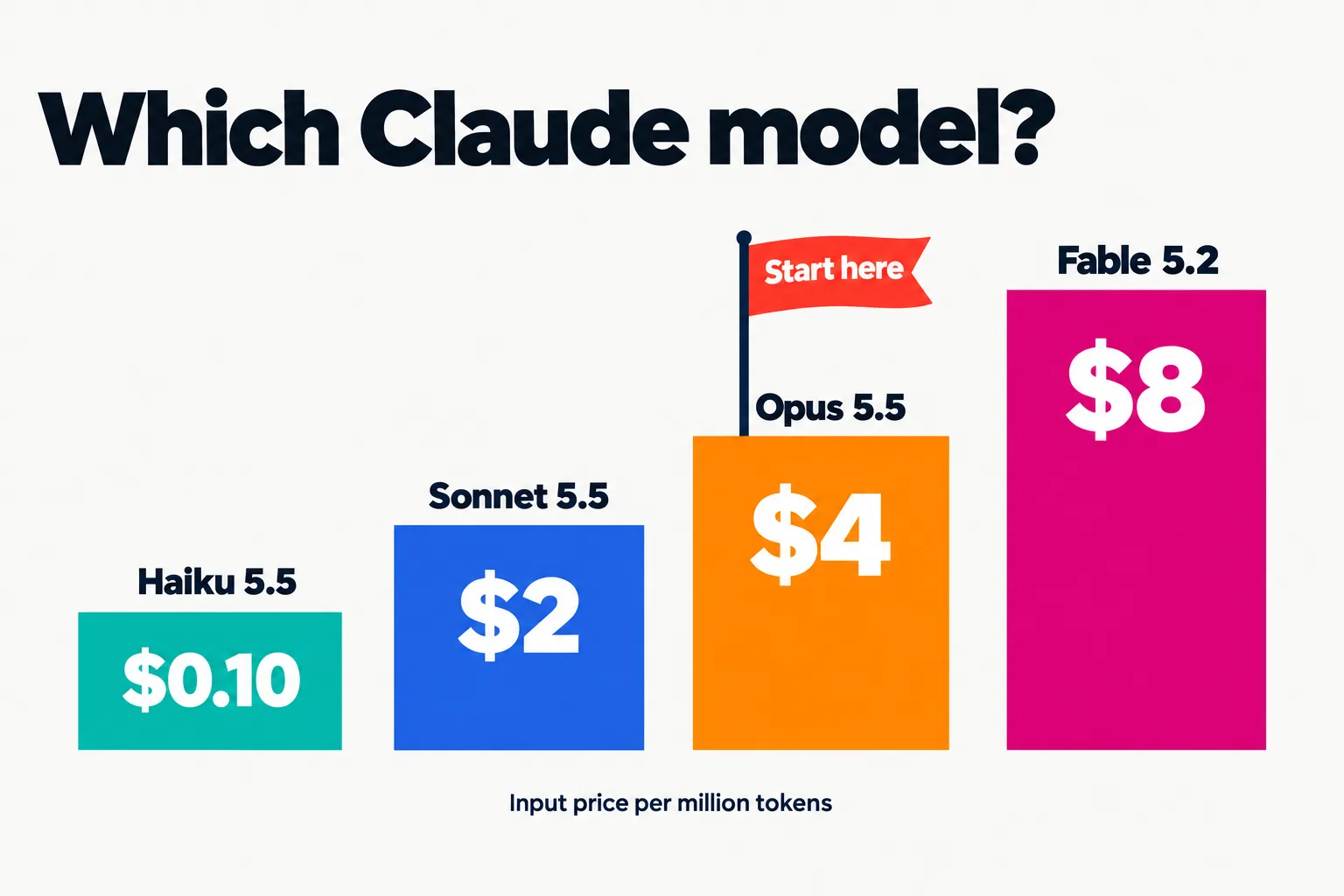
Anthropic has published its own answer to a question developers ask every day: which Claude model to use. The guide, written by Addy Osmani and dated November 9, 2026, says “you should start most work on Opus 5.5 at its default effort level,” which is medium. The post announcing it on X passed 584,000 views in about five hours.
The guide covers the four generally available models: Haiku 5.5, Sonnet 5.5, Opus 5.5 and Fable 5.2, which shipped the same day. This page pulls out the picks, the prices and the numbers behind them.
On this page · 9 sectionsOpen
 Anthropic’s guide says to start most work on Opus 5.5 at its default effort, medium. It is the default model in Claude Code.
 List prices per million tokens run from $0.10 in and $0.50 out on Haiku 5.5 to $8 in and $40 out on Fable 5.2. Opus 5.5 is $4 and $20.
 Change effort before you change models: on SWE-bench Pro, Opus 5.5 at medium scored about 2.5 points below high for about 70% of the cost.
 Put subagents on smaller models: an Opus 5.5 lead with Sonnet 5.5 workers cost about a third less than Opus 5.5 alone and scored about the same.
 Running tasks at low effort and re-running only the failures at high passed about 97% for about $0.17 each, against 95.3% for $0.29 at high.
§ 01The short answer: start on Opus 5.5

Anthropic’s reason is short: “There’s a reason it’s the default model in Claude Code.” Opus 5.5 costs half as much per token as Fable 5.2, and the guide recommends it as the starting point for most coding and knowledge work. From there, it gives three moves:
- Down to Sonnet 5.5 for well-scoped everyday work, such as a bug fix or a feature built against a spec.
- Down again to Haiku 5.5 for simple high-volume work: classification, routing, extraction, and subagents that handle a larger model’s side tasks.
- Up to Fable 5.2 for the hardest technical projects in coding, finance and the sciences, when Opus 5.5 at high effort still falls short, or for long unattended runs.
§ 02Which model for which task
| Task | Starting model | Starting effort |
|---|---|---|
| Everyday engineering, debugging, multi-PR feature work | Opus 5.5 | Medium, then high |
| Classification, routing, tagging, high-volume extraction | Haiku 5.5 | Medium |
| Subagents that search files, read logs or summarize | Haiku 5.5 or Sonnet 5.5 | The model’s default |
| Chat and interactive sessions | Sonnet 5.5 (Haiku 5.5 for simple chat at volume) | Low or medium |
| Well-scoped coding: bug fixes, spec-driven work | Sonnet 5.5 | Medium, then high |
| Everyday documents, slides and spreadsheets | Sonnet 5.5 | High (medium in Claude Code) |
| Repeated agent tasks: investigation, review, drafting | Sonnet 5.5 | Medium |
| Computer use and vision-heavy workflows | Opus 5.5 | Medium |
| Major refactors, migrations, architecture, leading many subagents | Fable 5.2 | Medium, then high |
| Deep research, scientific or quantitative analysis | Fable 5.2 | Medium, then high |
| You aren’t sure yet | Opus 5.5 | Medium |
A clear spec does not always mean Sonnet. The guide notes that a migration or a performance optimization can be well specified and still hard enough to need Opus 5.5, or Fable 5.2 for a major one.
§ 03What each model costs
| Per million tokens | Haiku 5.5 | Sonnet 5.5 | Opus 5.5 | Fable 5.2 |
|---|---|---|---|---|
| Input | $0.10 for prompts up to 100K tokens, $0.50 above | $2 | $4 | $8 |
| Output | $0.50 up to 100K, $2.50 above | $10 | $20 | $40 |
| Cache reads | $0.01 up to 100K, $0.05 above | $0.10 | $0.20 | $0.20 |
| Context window | 1M tokens | 1M tokens | 1M tokens | 1M tokens |
| Max output | 128K tokens | 128K tokens | 128K tokens | 128K tokens |
| Fast mode | No | No | Yes | Yes |
Haiku 5.5 is the only model whose price depends on prompt length. A prompt over 100K tokens bills at five times the lower rate, which is still a quarter of Sonnet 5.5’s per-token price. Every model has the same 1M-token context window, so context size is not a reason to pick one over another.
§ 04Change effort before you change models
The guide’s second rule: “Before you move models, try adjusting your effort level.” Effort controls how long the model thinks, how many tools it calls and how much it checks its own work. It is a finer dial than the model name, and past high effort one more level can cost as much as a bigger model.
Anthropic gives its own numbers for Opus 5.5 on SWE-bench Pro, measured against the high setting:
- Low: about 8 points lower, for about a third of the cost.
- Medium: about 2.5 points lower, for about 70% of the cost.
- xhigh: about 1.4 points higher, for 2.5 times the cost.
When a model is not good enough for a task, the guide says to take three steps in this order:
- Check that the model can verify its own work, with a test, a build or a script.
- Raise effort one level.
- Move to the next model up, starting at a lower effort than you used on the smaller one.
There is also a cheaper pattern for work you can check automatically. Run everything at low effort and re-run only the failures at high. On the same SWE-bench Pro subset, Anthropic says Opus 5.5 run that way passed about 97% of tasks for about $0.17 each, against 95.3% for $0.29 with every task at high.
§ 05When the bigger model is the cheaper one
“A higher price per token doesn’t always mean a higher cost per task, or a better result,” the guide says, and it gives three results from Anthropic’s own runs:
- Terminal-Bench 3.0: the previous Fable, 5.1, at max effort scored 58.0%. Opus 5.5 at high scored 58.9% with half the tokens.
- FrontierCode 2.0: Fable 5.2 at high scored 45.3%, about level with Opus 5.5 at max (45.5%), for roughly half the cost per task. So before you raise Opus 5.5 past high on a hard task, test Fable 5.2.
- A 20-problem search benchmark: two problems carried 43% of the spend. Price your hardest tasks, not only the typical ones.
§ 06Mixing models in one system
The guide spends a third of its length on using several models together. The main points:
- Put subagents on smaller models. “Keep the expensive model’s context for the decisions, and let cheaper subagents do the verbose reading.” Small models suit work where a mistake is cheap to spot, such as finding files, running tests and reading logs. Code edits and judgment calls stay on the main model.
- Delegate bulk work. On an internal defect-search benchmark over about 22 million tokens of source code, an Opus 5.5 lead with up to 25 Sonnet 5.5 workers cost about a third less than Opus 5.5 alone and scored about the same.
- Be careful with the advisor tool. An Opus 5.5 executor at high with a Fable 5.1 advisor scored 90.1% at $2.92 per attempt. That is 1.7 points over Opus 5.5 alone for about 2.1 times the money, a gain Anthropic puts at the edge of run-to-run noise.
- Switch models at a natural break. The prompt cache belongs to the model that wrote it, so the first turn on a new model pays the cache-write price on the whole conversation.
The test Anthropic sets for any multi-model setup: “Keep a multi-model setup only if it beats every single-model point on that chart.” We covered Anthropic’s earlier advice on the same question in one agent or subagents.
§ 07What the guide does not settle
Every number here comes from Anthropic’s own benchmark runs, some of them internal. None has been reproduced by an outside party in what we read. The guide says as much about its limits: published results get you a starting model, and the next step is to test the candidates on a sample of your own tasks.
Claude Mythos 5.2, which Anthropic calls its most capable model for cybersecurity and life sciences research, is not in the comparison. It is available only through Anthropic’s verification programs.
§ 08Where CellCog sits
CellCog routes its agents to Claude Opus 5.5, the model this guide tells developers to start on. You do not pick a model in CellCog. You pick how deep an agent should go on a task (Flash, Core or Max), and the platform handles the rest.
§ 09Sources
- Anthropic, Which Claude model should you build with? Fable, Opus, Sonnet, or Haiku, Addy Osmani, November 9, 2026
- Claude Devs on X (21:03 UTC, November 9, 2026; 584,000 views at 02:06 UTC on November 10)
- Anthropic, Optimizing for cost and intelligence, Claude Platform docs
- Anthropic, Claude Fable 5.2 and Mythos 5.2 launch post, November 9, 2026
Q1Who wrote the guide?
Addy Osmani, a member of technical staff at Anthropic. It was published on claude.dev on November 9, 2026.
Q2Is Sonnet 5.5 enough for coding?
For well-scoped work such as bug fixes and spec-driven features, yes, per the guide. It handles those at half the Opus 5.5 token price.
Q3What is effort?
A setting that controls how long the model thinks, how many tools it calls and how much it checks its work. The guide says to adjust it before switching models.
Q4Are the benchmark numbers independent?
No. They come from Anthropic’s own runs, some on internal benchmarks. The guide tells readers to test on their own tasks.
Q5Which Claude model does CellCog use?
CellCog routes its agents to Claude Opus 5.5. Users choose a depth tier, not a model.