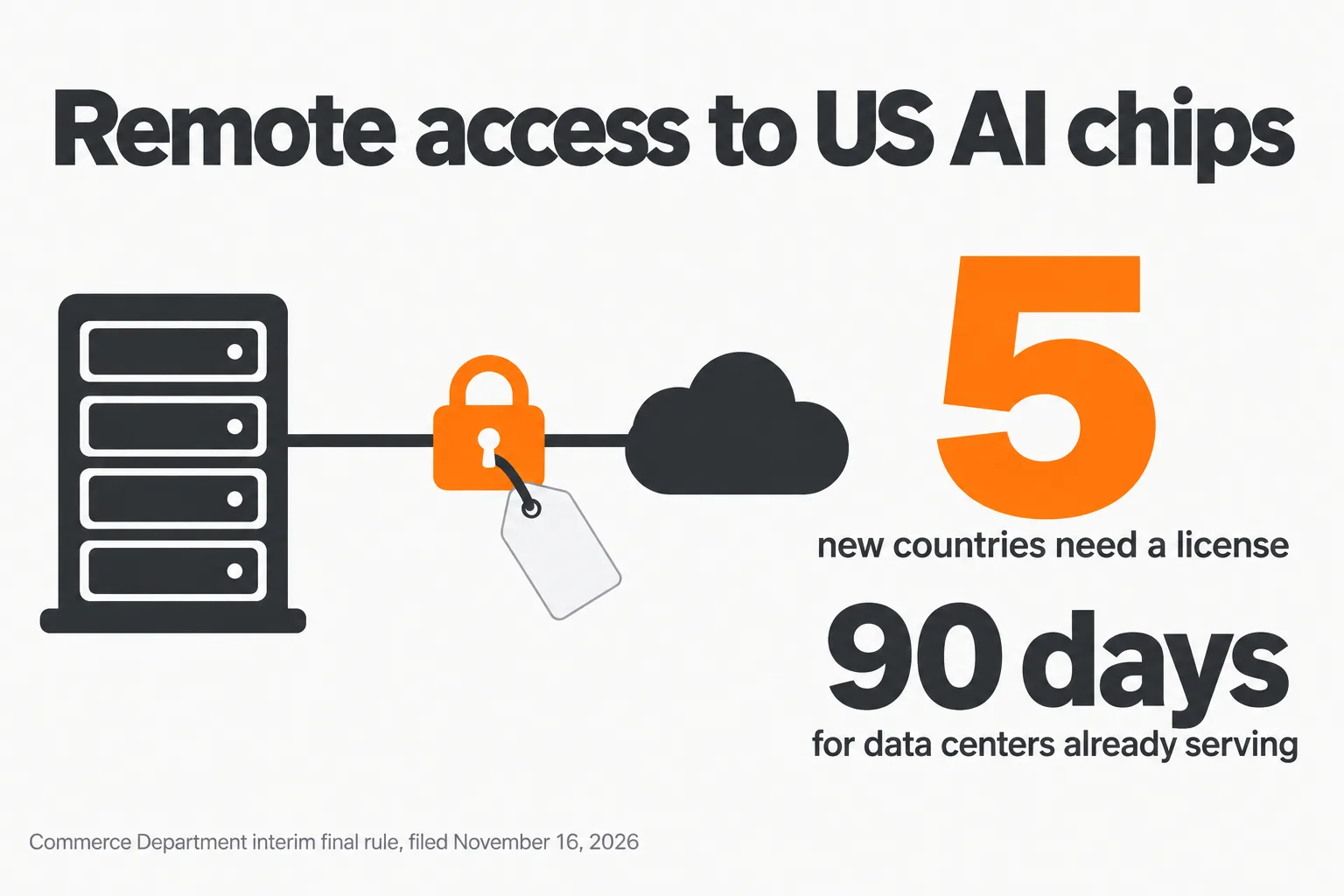
The US Commerce Department filed a rule on November 16, 2026 that requires a license before advanced AI chips go to a data center, anywhere in the world, that sells large amounts of compute to companies headquartered in China, Macau or other Country Group D:5 countries. The same rule adds a license requirement for five countries, tightens the rules for chip foundries and packagers, and formally ends the AI Diffusion Rule.
It is an interim final rule from the Bureau of Industry and Security: it takes effect the day it is published, scheduled for November 19, and comments come after. Throughout its 117 pages, the rule calls advanced AI chips and models Super Intelligence (SI) chips and models. This page records what the filed text says, with the dates it sets.
On this page · 8 sectionsOpen
 A license is now needed for advanced AI chips going to a data center anywhere that gives companies headquartered in China, Macau or other D:5 countries more than 12,000,000 aggregate TPP of compute.
 Five more countries need a license for advanced AI chips: Indonesia, Malaysia, Singapore, Thailand and Brazil, unless the buyer is headquartered in the United States and the exporter reports the sale.
 Commercial recommender systems, the kind online shops and social networks run, are exempt; anything that generates text, images, video or code is not.
 Data centers already serving those companies have 90 days from the effective date to get a license.
 The rule formally rescinds the AI Diffusion Rule of January 2025, with its country tiers, which Commerce says was never enforced.
§ 01What the rule does
| Part | What it does |
|---|---|
| Remote access | A license for advanced AI chips going to a data center anywhere that gives companies headquartered in Macau or Country Group D:5 more than 12,000,000 aggregate TPP of compute |
| Five countries | A license to send advanced AI chips to Indonesia, Malaysia, Singapore, Thailand or Brazil; buyers headquartered in the United States are excluded if the exporter reports |
| Foundries and packagers | Fewer ways to get past the presumptions when advanced-node chips are made for designers that are neither approved nor authorized |
| AI Diffusion Rule | Rescinded, with its country tiers, the Data Center VEU authorization and License Exception AIA |
§ 02The remote access rule
- The reason, in the rule’s words. “These restrictions will undermine the ability of companies headquartered in countries of concern from using U.S. advanced Super Intelligence (SI) semiconductors to train advanced SI models.”
- The line. The license applies when a data center will give companies headquartered in D:5 or Macau access to more than 12,000,000 aggregate TPP, at one site or across linked data centers, a term the rule says includes digitally linked infrastructure. TPP is total processing performance, the measure the export rules already use for chips.
- Who checks. Data centers, foreign foundries and chip exporters must check their customers for direct or indirect ownership or control by persons in D:5 or Macau. The text names the People’s Republic of China among the countries of concern.
- How it is reviewed. Case by case. A data center already serving those companies has 90 days from the effective date to obtain a license, or faces future export restrictions.
- The exception. “The license requirement will not apply to commercial recommender systems, such as those used by online retailers or social media companies, as these functions do not pose the same national security threat.” The definition is narrow: “This term does not include any SI system designed or used to generate novel text, image, audio, video, software, or other content in response to user inputs”
- One passage to read twice. Elsewhere in the preamble, data centers that were serving commercial recommender systems “may continue providing these services for 90 days, but must obtain a license following expiration of this period to continue these services” That sits awkwardly with the exemption above. Until BIS clarifies, read the rule text itself rather than its summary.

§ 03Five new license countries
The rule adds a license requirement for exports of advanced AI chips to Indonesia, Malaysia, Singapore, Thailand and Brazil, and to any country the Secretary of Commerce designates later. Chips going to companies headquartered in the United States, or whose ultimate parent is, are excluded as long as the exporter files a report under a new section, 743.10, with the product, its TPP, the quantity and the date.
On countries that look away: “Commerce will be actively monitoring for countries that tolerate evasion of this IFR” The consequences it lists include import restrictions, new license requirements, a downgrade of the country’s export control status, and Entity List designations.
§ 04Foundries, packagers and the end of AI Diffusion
- Foundries and packagers. A new license requirement covers advanced-node chips that a front end fabricator or an outsourced packager (OSAT) makes for a designer that is neither approved nor authorized, wherever the designer sits.
- AI Diffusion. The rule formally rescinds the Framework for Artificial Intelligence Diffusion of January 15, 2025, which BIS announced it was dropping in May 2025. The rule says: “The AI Diffusion Rule has never been enforced.” Gone with it: the country tiers, the Data Center Validated End User authorization, License Exception AIA and the definition of model weights.
- The paperwork. BIS expects about 100 more license applications a year and about 970 more submissions a year, most of them the new reports.
§ 05The dates
| Date | What happens |
|---|---|
| Nov 16, 2026 | Filed for public inspection, 4:15 p.m. Eastern |
| Nov 19, 2026 | Scheduled publication; the rule takes effect |
| Dec 19, 2026 | Last day for shipments already en route under the old terms |
| Jan 18, 2027 | Comments due (docket BIS-2026-0628) |
| Feb 17, 2027 | Data centers already serving the covered companies need a license |
If publication slips, every later date moves with it.
§ 06What changes for AI companies
Our reading, not legal advice: the control moves from where a chip sits to who uses its compute. A cloud provider in a third country that rents large amounts of compute to a China-headquartered company now needs a US license for the chips, even if the chips never leave its building. The exemption covers ranking and recommending only; a model that writes, draws or codes is not a recommender under the definition. And the build-out of data centers in the five named countries now runs through licenses unless the buyer is headquartered in the United States and the exporter reports.
§ 07Where CellCog sits
CellCog does not export chips or sell data center compute, and its AI employees run on Anthropic’s Claude models, so the rule does not reach us directly as far as we can read it. We cover it because the price and supply of compute shape every AI product, ours included. This page is a reading of the filed text, not legal advice.
§ 08Sources
- Federal Register public inspection, document 2026-23529, filed November 16, 2026 at 4:15 p.m. Eastern, read through the Federal Register API
- The filed rule, 117 pages (PDF), read at 20:33 UTC on November 17, 2026
- Where the rule will appear once published, scheduled for November 19, 2026
Q1What is the AI chip remote access rule?
An interim final rule from the Commerce Department’s Bureau of Industry and Security, filed November 16, 2026. It requires a license before advanced AI chips go to a data center, anywhere in the world, that gives companies headquartered in Country Group D:5 or Macau access to more than 12,000,000 aggregate TPP of compute.
Q2Which countries need a new license?
Indonesia, Malaysia, Singapore, Thailand and Brazil, plus any country the Secretary of Commerce adds. Chips going to companies headquartered in the United States are excluded if the exporter files the required report.
Q3Are recommender systems covered?
The rule says the license requirement does not apply to commercial recommender systems, such as those run by online retailers and social networks. Its definition excludes any system that generates text, images, audio, video or software.
Q4When does the rule take effect?
On the day it is published in the Federal Register, scheduled for November 19, 2026. Comments are due 60 days after publication, and data centers already serving the covered companies have 90 days to obtain a license.
Q5Does the rule affect CellCog?
Not directly, as far as we can read it. CellCog does not export chips or sell data center compute; its AI employees run on Anthropic’s Claude models. This page is a reading of the rule, not legal advice.