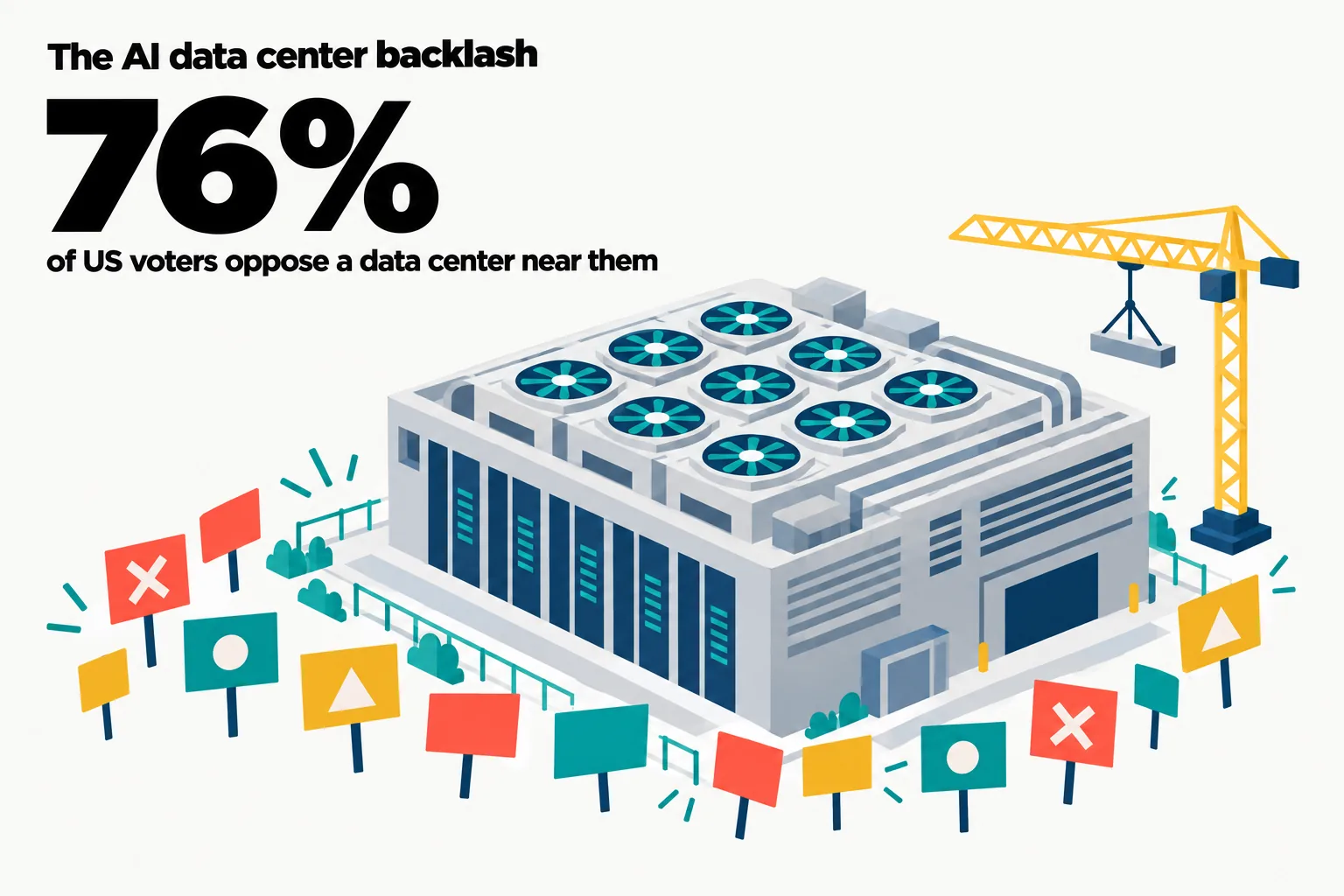
Protesters broke into the construction site of a Microsoft AI data center in Amsterdam on Friday, November 6, 2026, opening two days of coordinated actions against data center construction across Europe. Dutch regional broadcaster NH Nieuws reported that 218 people were detained at the site and all were released. Three days earlier, US voters had opposed a new data center in their own community by 76% to 24% in the NBC News exit poll, and approved dozens of local measures restricting them.
The two stories are the same story: the physical build-out behind AI is now a local political issue on both sides of the Atlantic. Below: what happened in Europe, what the US vote showed, the argument Vitalik Buterin made for slowing the build-out, and what it means for anyone who builds on AI.
Update, November 9, 2026, 12:05 UTC: Ballotpedia’s count has voters favoring limits on data center development in 40 of 41 local ballot measures on November 3. The one exception was Harwood, North Dakota, where InForum reported voters rejected Article X, a charter amendment that would have added review requirements for certain industrial projects, by 325 votes to 105. The measure grew out of local anger over an Applied Digital data center already under construction in the town.
On this page · 7 sectionsOpen
 Protesters entered a Microsoft data center construction site in Amsterdam on November 6, 2026; NH Nieuws reported 218 detained, all released.
 The Stop Dirty Data Centres campaign announced actions in 16 countries, per Reuters, with about 2,000 marching in Dublin and 1,300 in Helsinki.
 In the NBC News exit poll on November 3, 76% of US voters opposed a new data center in their community and 24% favored one.
 Local US votes went the same way: an early count found 33 restrictive measures approved against one allowing data centers.
 Vitalik Buterin argued a slower build-out costs little because algorithms catch up; the EU’s tech chief said Europe needs its own capacity.
§ 01What happened in Amsterdam
According to Reuters, more than 100 activists marched onto the site of a Microsoft data center, climbed cranes and hung balloons while police stood by. “These data centres are destroying our world,” one protester told Reuters.
The site belongs to Pure Data Centres, which plans to invest more than $1 billion and is backed by Brookfield-owned Oaktree. The developer asked protesters to “leave safely and engage with us in dialogue about the development and any concerns they may have.” Microsoft said it respected the right to protest peacefully but did not condone unlawful actions.
The detentions came later in the day. NH Nieuws put the number at 218, all released by the next evening; other reports gave 150 to 200.
§ 02A coordinated week across Europe
Amsterdam was the first of many actions under the Stop Dirty Data Centres banner. Reuters reported actions announced in 16 countries over Friday and Saturday; RTÉ counted 15, and Tom’s Hardware reported a campaign map with 85 planned locations.

| Place | What happened | Reported number | Source |
|---|---|---|---|
| Amsterdam | Activists entered a Microsoft data center site | 100+ activists; 218 detained, all released | Reuters; NH Nieuws |
| Dublin | March | About 2,000 people | RTÉ, via Bloomberg |
| Helsinki | Gathering | About 1,300 people | Yle, via Bloomberg |
| Warsaw | Protest outside parliament | Not reported | Reuters |
| Denmark | Demonstration at a second Microsoft data center | Not reported | Reuters |
The Dublin and Helsinki figures come from Bloomberg’s roundup. The campaign’s demand is narrower than its slogans: it says it is not calling for existing data centers to close, only for major new construction to stop until governments set clearer rules on electricity, water, land and climate.
§ 03The US vote, three days earlier
In the US, the same argument went to the ballot box on November 3. The NBC News exit poll asked voters whether they would favor or oppose a new data center in their community, and 76% said oppose. The opposition crossed party lines; the same poll found 56% of voters called AI data centers a crucial or major factor in their vote for Congress.
The local votes were more direct. The Verge counted 45 local ballot measures on data centers, and Business Insider cited Redbud Consulting’s early count of 33 restrictive measures approved against one allowing development.
| Measure | Result | Source |
|---|---|---|
| Exit poll: a new data center in your community | 76% oppose, 24% favor | NBC News exit poll |
| Exit poll: data centers in your vote for Congress | 56% crucial or major factor | NBC News exit poll |
| Local ballot measures on data centers | 45 nationwide | The Verge |
| Restricting measures approved | 33 vs 1 allowing (early count) | Redbud Consulting, via Business Insider |
| Local measures favoring limits, final count | 40 of 41 | Ballotpedia |
| Harwood, North Dakota | Review requirement rejected, 325 to 105 | InForum |
| El Dorado, Kansas | Ban above 10 MW peak load for 10 years | The Verge |
| Several Ohio cities | Ban on data centers over 25 MW | The Verge |
§ 04Vitalik Buterin’s case for slowing the build-out
The most-read argument of the week came from Ethereum co-founder Vitalik Buterin on November 8, in a post on X with more than 380,000 views by Monday morning. He disagreed with what he called the strong emotional reaction against the protesters.
His reasoning is about software, not ecology: “As I see it, algorithmic progress means that whatever you would be able to do with more and bigger data centers in 2 years, you will be able to do with the data centers we have today in 4 years - probably sooner.” On that view, a slower build-out delays AI by a bounded amount while buying time to harden the world against security and biological risks. He concluded that “a slowdown in compute hyper-scaling seems quite net good?” and noted he made the case without relying on doomer arguments.
The opposite case came from the EU itself. Tech chief Henna Virkkunen told Reuters the day before the protests that Europe needs more data centers, built with care: “AI, of course, is a super important technology and we need to have our own capacity.”
§ 05What this means if you build on AI
For most companies the backlash does not change this quarter’s plans. Model access is sold by the token, and the labs carry the construction risk. It does change the background assumptions:
- Capacity gets local. Siting fights, moratoriums and size caps (10 MW in El Dorado, 25 MW in parts of Ohio) slow where and how fast new capacity comes online, which feeds into availability and price.
- Power becomes the story. The labs are already responding with their own energy deals, from Anthropic’s 1.7 GW of gas generators to OpenAI handing power back to the grid in heat waves.
- Efficiency becomes the hedge. Buterin’s argument cuts both ways: if algorithms keep doing more with the same chips, a slower build-out costs less than it looks. Teams that pick efficient models and tiers for each job are less exposed either way.
§ 06What we are watching
- Amsterdam permits. Any change to the Pure Data Centres project or Dutch rules after the protest.
- US moratoriums. Whether governors and senators elected on data center positions move statewide pauses.
- The labs’ answer. New commitments on power, water or community payments in response.
§ 07Sources
- Reuters, Activists breach Microsoft data centre construction site as protests spread in Europe
- NH Nieuws via Drimble, All 218 detained demonstrators released
- Bloomberg via The Star, AI data centre backlash spreads across Europe
- Tom’s Hardware, Protesters storm Microsoft AI data center construction site
- DatacenterDynamics, NBC exit poll on AI data centers
- The Verge, Data centers lost the midterms
- Business Insider, Data centers got a slap in the face at the ballot box
- Ballotpedia, 40 of 41 local ballot measures
- InForum, Harwood delivers resounding no to home rule charter change
- Vitalik Buterin on X, November 8, 2026
Q1What is Stop Dirty Data Centres?
A coalition of environmental and digital rights groups calling for a pause on major new data center construction until governments set clearer rules. It says it is not asking for existing data centers to close.
Q2Who owns the Amsterdam site?
Pure Data Centres, which plans to invest more than $1 billion and is backed by Brookfield-owned Oaktree, per Reuters. The data center is for Microsoft.
Q3What did the US exit poll ask?
Whether voters would favor or oppose the construction of a new data center in their community. 76% said oppose.
Q4What did Vitalik Buterin say?
That algorithmic progress lets today’s data centers do in about four years what bigger ones would do in two, so slowing the build-out costs little and buys time on security risks.
Q5Is CellCog affected?
CellCog buys model access from the labs, which carry the construction risk. Like every AI user, we depend on that capacity growing.